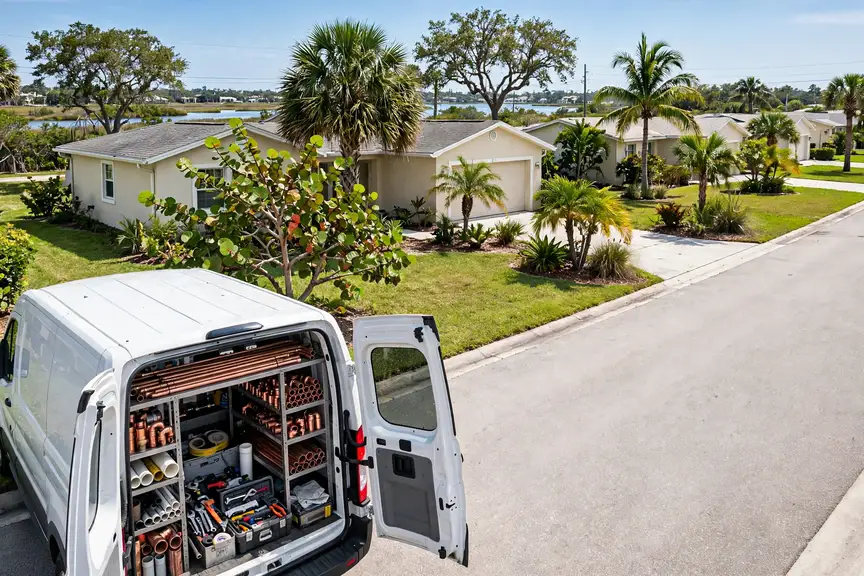


Everything on this page was computed for Palm Bay–Melbourne and nowhere else: the problem ranking from its Census housing profile, the seasonal risks from its NOAA station record, the coverage from its own ZIP codes. PlumbReach USA connects you to an independent local plumber; the page itself is the homework, done in public, so the call you make is an informed one.
Call center hours: Mon-Fri 7:00 AM-10:00 PM ET | Sat 8:00 AM-10:00 PM ET | Sun 7:00 AM-9:00 PM ET
The median Palm Bay–Melbourne home was built in 1987; 33.1% of the stock predates 1980, and the pattern this metro's own data ranks first is slab leaks under concrete foundations. PlumbReach USA is a referral service, not a plumbing company: one call connects you with an independent local plumber serving your ZIP code.
Start with the raw material: 620,533 people, 294,461 housing units, and a housing stock whose middle home was built in 1987. That single date organises everything on this page. On one side of it stand the older districts — 7.7% of homes predate 1960, 33.1% predate 1980 — plumbed in galvanized steel, cast iron and clay, in homes across Brevard that have been repaired piecemeal for decades. On the other side, the 27.9% built since 2000 run plastic lines under slabs, and fail in the newer ways. A Palm Bay–Melbourne plumber reads a home's build year the way a doctor reads a chart: it predicts, before a single wall is opened, which systems deserve suspicion first.
The pre-1980 stock is where most of the metro's plumbing character lives. Homes from those decades in Brevard County and across Brevard were built with galvanized supply lines, cast iron or clay drains and first-generation fixtures, and each of those materials is now at or beyond the age its makers expected of it. Owner-occupiers hold 76.9% of the metro's homes, so most of the people reading this page are reading about a system they own outright — one whose failures arrive as surprises only if nobody has looked at the pattern: pressure fading a little each year, a drain that needs attention a little more often, a heater that recovers a little more slowly.
The growth side of the metro tells the opposite story in the same language. Melbourne, Titusville and the subdivisions still filling in account for much of the 82,155 homes built since 2000 — plastic supply lines, plastic drains, cartridge fixtures, slab foundations. Their plumbing is not old; it is uniform, which creates its own calendar: everything installed in the same boom reaches each wear point in the same years, from the first water-heater replacements to the first slab-leak scares, while 3,446 cooling degree days of annual heat keep demand on the system high.
The climate written over all of it comes from the NOAA station at MELBOURNE INTL AP, FL US: an average year brings 485 heating degree days, 3,446 cooling degree days and 50.79 inches of precipitation. Those are not abstractions to a buried pipe or an exposed line — they set how often soil around a sewer lateral swells and shrinks, how hard a water heater cycles in January and July alike, and whether an uninsulated garage line is a worry or a certainty. The problem sections that follow are selected by exactly these numbers, combined with the housing-age profile above.
The metro's building eras on one side, its weather record on the other — and its plumbing where the two meet.
Break the stock down by building era and the profile sharpens. Before 1960: 7.7% of homes, roughly 22,673 of them. From 1960 to 1979: 25.4%, about 74,793. From 1980 to 1999: 39.1%, about 115,134. Since 2000: 27.9%, about 82,155. Four eras, four material palettes — and the balance among them is this metro's plumbing character in a single paragraph.
The 1980-1999 band runs this metro, and its plumbing has a particular flavour: mature but not ancient. Copper systems old enough to have histories, plastic drains still in their prime, fixtures from the first cartridge generation reaching their wear points in waves, heaters cycling through replacements on a schedule set by whole subdivisions. Palm Bay–Melbourne's is a maintenance-era stock — the decades where attention compounds and neglect starts to invoice.
Behind the leading era, the growth band: 27.9% of homes arrived since 2000. Their plumbing is uniform by construction — one generation of fixtures, one approach to lines under slabs — which writes a shared calendar the whole street keeps. Reading that calendar early is most of what separates a planned replacement from a weekend emergency in Palm Bay–Melbourne's newest districts.
A profile needs its climate column, and Palm Bay–Melbourne's comes from MELBOURNE INTL AP, FL US: an average year of 73.1 degrees, built from extremes at both ends. The heating load (485 degree days) and the cooling load (3,446) together set the water heater's working life; the precipitation total (50.79 inches) sets the soil's behaviour around every buried line; the freeze count (1.8 nights) sets the exposure of every uninsulated run. Four numbers — and most of the metro's plumbing behaviour follows from them.
A profile is only useful if it predicts something, and this one predicts the shape of a plumbing diary in Palm Bay–Melbourne: which streets will call about drains, which about pressure, which about heaters, and in which months. Everything after this section is that prediction written out as services, problems and answers — the numbers first, the narrative second, the way the evidence actually runs.
Ordered by what this metro's data says its homes need most.
Pinpoint first, open second. That order defines leak work: isolate sections, listen along the runs, confirm with pressure, and only then cut — precisely, once. The repair itself is usually ordinary plumbing; the skill being bought is knowing exactly where ordinary plumbing needs to happen.
Every detection job in Palm Bay–Melbourne begins with a subtraction problem: the meter's total, minus everything the household can account for, equals the leak. The arithmetic is simple; the geography is not. That missing water is travelling somewhere inside a stock of 294,461 homes built across a century of methods — through slab concrete in one district, behind plaster in another, under a yard line in a third. The instruments change with the construction, but the logic never does: measure the loss, halve the search area, halve it again, and open the building exactly once, at the marked point. Locally the workload concentrates where the stock is oldest — the districts built around the 1980s first.
Scale the problem by the Census count and it stays concrete: 294,461 housing units, each a small network of pressurised lines, each capable of losing water silently. The meters across Palm Bay–Melbourne register those losses in aggregate; the detection visit exists to assign one of them to one address — in Melbourne this month, somewhere else next.
One leak is an event; three in a year is a verdict. Pipe work weighs that pattern — the metal's age, the water's behaviour, the repair history — and either fixes the section in front of it or proposes the honest larger job: a whole-house repipe that ends the rhythm for good.
A repipe decision in Palm Bay–Melbourne is usually made at a kitchen table, from three exhibits: the water's behaviour at the taps, the count of repairs already paid for, and the material visible wherever the system shows itself. Exhibits like those persuade because they are the household's own. The work itself, when it comes, is less disruptive than its reputation — modern lines route through attics, closets and chases, water stays on for most of the project, and the plaster sacrificed is measured in patches, not rooms. What the household buys back is the thing the old material had been taxing away: pressure, clarity, and the right to forget the pipes exist. The 50.79 inches of rain in an average year here is part of the story too — buried lines feel every wet season.
The repair-or-renew caseload is set by one figure above the rest: 33.1% of Palm Bay–Melbourne homes predate 1980, plumbed in the materials now at the end of their service lives. Around Merritt Island (34,718 residents) as in the old core, that percentage is not an abstraction — it is the street's plumbing, house by house.
A heater rarely dies all at once; it dims. Recovery slows, temperatures wander, the tank starts talking. Repair makes sense while the vessel is sound; once the steel itself is going, replacement is the honest answer, matched in capacity and fuel to how the household actually uses hot water.
Replacement season in Palm Bay–Melbourne is not really a season — it is a wave, set decades ago. The heaters installed across the metro's building booms reach the end of their working lives in the same years, so whole streets of similar-aged homes swap tanks within a few seasons of each other. The 82,155 homes built since 2000 are entering the front of that wave now; the pre-1980 stock, on its second or third unit, is deep in it. Wherever a home sits in the wave, the judgement call is the same: repair the part or retire the tank, made on the tank's condition rather than its birthday alone. In Palm Bay–Melbourne that holds across 30 ZIP codes, from Palm Bay out to Titusville.
Heater work in this metro is a fleet problem: the tanks were installed in waves with the subdivisions, and they reach their verdicts in waves too. West Melbourne (27,643 residents) sits inside one of those waves; the older districts run their own, one tank at a time, inside plumbing a generation older.
Of all a home's pipes, the sewer lateral works under the worst conditions: buried, jointed, rooted at, and loaded by every fixture in the building. Its care begins with seeing it — a camera run that records material, slope and damage — and proceeds by the footage's logic: clear what clearing cures, mend what is locally broken, renew what has failed along its length. No stage of that is guesswork, and the homeowner sees the same footage the plumber does.
Every home in Palm Bay–Melbourne drains to one line, and that line's condition is written in the metro's housing data: a median build year of 1987 means half the metro's laterals have been buried for decades, ageing in step with the houses above them. In the newer areas — 27.9% of homes built since 2000 — the pipe is plastic and the problems are different: bellies where bedding settled, construction debris, a joint shifted by soil movement. The camera inspection is the same either way, and it is what sizes the job: spot repair, partial replacement, or the full run, each with footage to justify it. It is why two Palm Bay–Melbourne homes of the same age, on different streets, so often need the same visit in the same year.
Under Palm Bay–Melbourne lie 294,461 laterals, one per housing unit, and the oldest of them — beneath the 22,673 pre-1960 homes — have been underground since the metro was a fraction of its present size. The camera diary in Cocoa and the old core is written by that buried generation.
One call from anywhere in the Palm Bay–Melbourne metro — from Palm Bay out to Merritt Island — routes to the local professional on cover; the failure patterns they expect first are the ones this page's data ranks.
Across Brevard, drain calls follow the building map: iron and clay near the old core around Palm Bay, plastic at the growth edge — one service, two different crafts, both covered by the routing on this page.
Toilet calls in Palm Bay–Melbourne are the small end of the diary and the most democratic: every era of the 294,461-home stock produces them, and the local fix starts with the mechanism in the tank, not the porcelain.
Drips and disposals across Brevard are small jobs with a standard: repair the mechanism where the fixture deserves it, renew it where it does not, and check the shutoffs and supply lines while the cabinet is open.
If this page's services were ranked by Palm Bay–Melbourne's call patterns rather than listed in catalogue order, they would come out much as they do here — because the ranking behind them is data, not habit. Slab leaks under concrete foundations leads the metro's problem table and galvanized pipes at the end of their life follows, so the services answering them lead the list. The long tail of a metro's plumbing life — fixture failures, toilet calls, the single unexplained leak — fills in the diary around them, here as everywhere.
Ranked for this metro alone, from its Census housing profile and NOAA climate record.
Begin with the design decision: run the water lines under the concrete, where nothing can drip visibly, freeze accessibly or be repaired without breaking ground. It was a sensible decision for the builder and a lifelong riddle for the owner. In Palm Bay–Melbourne's slab districts the riddle presents the same way everywhere — the bill that climbs without a lifestyle change, the meter that moves in an empty house, the one warm square of flooring. Each clue is faint alone. Together they are the leak's signature, written in the only languages a buried pipe can speak: money, motion and heat.
Once a slab leak is located, the repair decision turns on geometry. Opening the floor at the marked point reaches the failed section directly and restores the original run — a good answer when the line is otherwise sound and the spot sits under replaceable flooring. Rerouting abandons the buried run entirely and carries the water through walls and ceiling instead — a better answer when the line has form, when several runs share the slab, or when the floor above is worth more than the pipe below. Plumbers in Palm Bay–Melbourne argue both sides of that choice daily; the honest version depends on the leak's position, the line's history, and what the floor is made of.
One more way to size it: this metro holds 294,461 housing units, and slab construction accounts for a large share of everything built from the post-war decades onward — the tracts first, then the 82,155 homes since 2000. A leak class that hides inside that much concrete, in soil that moves with the seasons, does not need unusual bad luck to lead a ranking; it needs only ordinary time.
Run two taps at once in a galvanized house and the second one apologises. That is the material's signature in old age: rust accreting inside the bore until the pipe delivers a fraction of its designed flow, weakest at the far end of the run. Palm Bay–Melbourne carries 97,467 pre-1980 homes, and the ones still on original galvanized announce themselves the same way — pressure that fades year by year, water that runs tea-coloured after a quiet weekend. Repiping is simply the moment the household stops negotiating with the symptom and replaces the cause.
Galvanized pipe fails politely, which is precisely the problem. No flood, no drama — just a shower that weakens across years, a washing machine that fills slowly, water that blushes rust after holidays. Households adapt without noticing, the way you adapt to a dimming bulb. The 74,793 homes built in this metro between 1960 and 1979 stand in the front of that queue now, their original steel bores narrowed to drinking-straw width in the worst runs. The fix, when it comes, tends to astonish people — not with its scale, but with the pressure they had forgotten they were owed.
In raw numbers, Palm Bay–Melbourne's exposure is 97,467 homes built before 1980 — the galvanized decades. Behind every one of those front doors is the same material on the same clock, which is why pressure complaints and pinhole leaks cluster by neighbourhood here rather than scattering evenly across the metro.
Strain is what a decade of mornings does to a tank. Each cycle heats, expands, cools and settles; sediment from every gallon the household has ever drawn settles a fraction at a time into the bottom, where it insulates the burner, lengthens the cycles and bakes the steel. In Palm Bay–Melbourne, where demand runs high through the long hot season, that accumulation is the difference between a heater that fades quietly at year twelve and one that lets go at year seven. The appliance looks identical from the closet door. Its account of itself, told in rumblings and recovery times, is not.
A water heater's enemies compound quietly. Sediment settling on the tank floor insulates the water from the burner or elements, so the unit fires longer to do the same work; the longer firing expands and contracts the tank steel, working the lining; the anode rod, designed to corrode in the steel's place, spends itself a little faster with every cycle. None of this announces itself until recovery slows — showers running lukewarm in sequence, a rumble from the tank as steam pockets form in the sediment — and by then the arithmetic of age has usually been running for years. Homes in Palm Bay–Melbourne put real hours on these appliances: hot water is not a seasonal luxury here but a year-round daily load, and the fleet of heaters across the metro ages in step with the housing that holds it.
Do the local sums: 251,889 households heating water through 3,446 cooling degree days and 485 heating degree days a year means the metro's heater fleet cycles relentlessly, and sediment settles further with every cycle. Heaters in Palm Bay–Melbourne rarely die young — they die on schedule, and the schedule is written by how hard the climate makes them work and whether anyone ever drained the sediment out of the tank.
A lateral ages in the dark, at the pace of the ground around it. Soil creeps; bedding washes grain by grain toward the street; joints laid generations ago in Palm Bay–Melbourne's older districts step a fraction out of true and stay there, catching what the household sends down. Nothing about this is dramatic from inside the house — until the day the accumulated fractions add up to a line that no longer falls cleanly to the main. That day announces itself downstairs, at the ground-floor fixture, the way it always has: the private sewer reporting, at last, in public.
A lateral gives decades of silence and then a short conversation. The conversation usually starts with the ground-floor drain in the house and escalates through the cleanout to the camera — and the camera's footage settles every argument about whether the line is blocked or broken. Across Palm Bay–Melbourne, the laterals entering that conversation now are the ones buried when the metro's median home went up, in 1987. They were built to outlast their mortgages, and they have; the question the footage answers is how much further the same pipe can honestly be asked to go.
Universality is the point: every housing unit in the metro — 294,461 of them — drains through one lateral apiece, and the older half of that stock is served by lines as old as the homes above them. A component that universal, ageing on that schedule, does not need bad luck to top a problem list; it needs only time.
The season's plumbing story is told in water levels: soil saturated to the surface, groundwater standing high against every lateral joint, drains asked to carry away in hours what they usually carry in weeks. Backups follow the ground-floor fixtures, and the post-storm weeks bring the secondary wave — lines found to have shifted in softened ground, cleanouts buried under debris. Homes prepare the way they can: drains known, shutoffs known, the number for help already saved before the sky makes the decision for them.
For Palm Bay–Melbourne the season is measured at MELBOURNE INTL AP, FL US: 50.79 inches of rain in an average year, much of it capable of arriving in a single system. The homes that feel it first are the ones whose laterals were laid generations ago under the mature streets of Palm Bay and the old core.
Slab leaks map onto Palm Bay–Melbourne's growth pattern with unusual precision. The leaks live where the slabs are: the post-war subdivisions, the boom-era tracts around Palm Bay, and the 82,155 homes built since 2000 on concrete. Pier-and-beam and basement homes in the older districts have their own leak problems, but they announce them visibly — it is the slab stock that hides its failures under flooring. Within a slab neighbourhood the risk is shared: same builder era, same soil, same line materials, which is why one confirmed leak on a street reasonably raises the alertness of every house on it.
Strip the pattern down to its inputs and the ranking stops being mysterious: 251,889 households drawing on systems installed across a median build year of 1987, in a climate that swings between 62.8 days of serious heat and 1.8 freezing nights. Whatever pattern a metro with those inputs manufactures most, it manufactures here — the lead position is less a title than a consequence, recalculated from the same public records any sceptic can check.
Experienced local practice starts with the simple certainties — the observations that take minutes and decide the most:
 PROBLEM
 SOLUTION
Population 125,273
Population 85,718
Population 49,004
Population 34,718
Population 28,279
Population 27,643
Population 24,617
Population 19,330
Population 17,169
Population 13,082
Population 11,341
Population 11,250
Also in the Palm Bay–Melbourne metro: Cape Canaveral (population 9,976), Micco (population 9,053).
The communities in the grid are not suburbs of the page; they are its subject as much as Palm Bay is. Melbourne (85,718 residents) and Titusville (49,004) carry their own building decades, their own pipe materials and their own positions in the problem ranking's logic — a lateral under a Melbourne street answers to the same data as one in the centre, but to a different era of it. Coverage here is defined by the ZIP list below; understanding is defined street by street, and this page's figures are the metro-wide version of a story each community tells in its own numbers.
Beyond the largest communities sit Merritt Island (34,718), Rockledge (28,279), West Melbourne (27,643), Port St. John (24,617), Cocoa (19,330) — smaller places across Brevard, covered on the same terms. Their housing tends to be older on average than the big suburbs', and their calls follow the older patterns on this page. One routing covers them all: find your ZIP code below and the rest is a phone call.
Palm Bay (125,273 residents) anchors the metro, and Melbourne (85,718) is its second centre of gravity. Between them they hold the bulk of the 251,889 households — and, not coincidentally, the bulk of every housing era this page discusses, from the pre-1960 core to the newest subdivisions. Titusville (49,004) and the communities beyond it repeat the same eras at smaller scale.
Administratively the metro is drawn from Brevard — 1 in all — with Brevard County at its centre. County lines do not change pipe physics, but they do shape the paperwork around the work: permits, inspections and code details are county and city business, which is one reason the professional who serves your street is a local one.
This page ends at the metro boundary, but the region does not: Orlando, FL, Sebastian–Vero Beach, FL and Lakeland, FL continue the coverage in their own directions, each with a profile built from its own Census and NOAA figures. If your home sits near the line between metros, go by your ZIP code — it places you in the dataset that describes your housing.
The region around Palm Bay–Melbourne is a set of variations on its theme: Orlando, FL, 41 miles off, runs a median build year of 1994 on a metro population of 2,957,672; Sebastian–Vero Beach, FL (42 miles) medians 1991 on 172,799; Lakeland, FL (65 miles) medians 1991 on 874,790. Nearness is not sameness — a few decades of median build year separate their plumbing as surely as the miles separate their maps.
Divide the stock by the map and the densities appear: roughly 9,815 housing units for every covered ZIP code, 251,889 households to a county, 14 named communities in the grid. The balance between the generations reads 1.2 pre-1980 homes for every home built since 2000 — a single ratio that quietly predicts whether a metro's plumbing week leans toward renewal work in the old districts or first-generation upkeep in the new ones.
Palm Bay–Melbourne by the derived numbers — median home age 39 years · owners in 193,703 homes, renters in 58,186 · each covered ZIP code carrying about 756 pre-1960 homes · a heating-to-cooling degree-day ratio of 0.14 · 1,290 mm average annual rainfall.
Before an emergency, read the guide: How to shut off your home's water main
PlumbReach USA routes your call to an independent local plumbing professional serving Palm Bay–Melbourne — the assessment and the work are theirs.
Call center hours: Mon-Fri 7:00 AM-10:00 PM ET | Sat 8:00 AM-10:00 PM ET | Sun 7:00 AM-9:00 PM ET