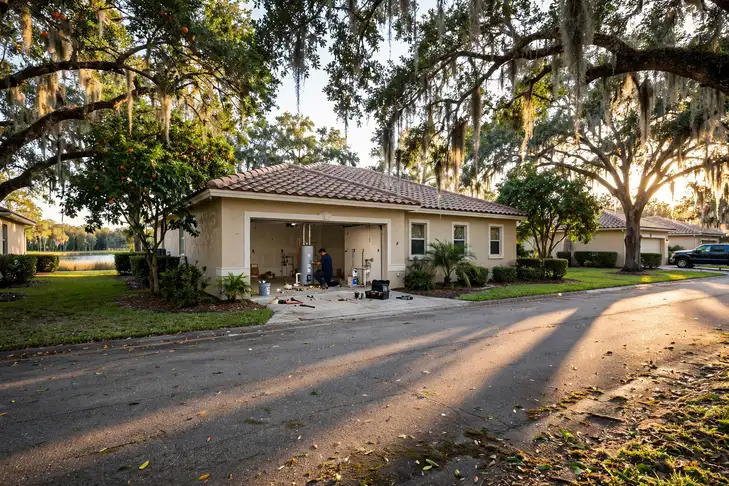


Everything on this page was computed for Lakeland and nowhere else: the problem ranking from its Census housing profile, the seasonal risks from its NOAA station record, the coverage from its own ZIP codes. PlumbReach USA connects you to an independent local plumber; the page itself is the homework, done in public, so the call you make is an informed one.
Call center hours: Mon-Fri 7:00 AM-10:00 PM ET | Sat 8:00 AM-10:00 PM ET | Sun 7:00 AM-9:00 PM ET
The median Lakeland home was built in 1991; 31.9% of the stock predates 1980, and the pattern this metro's own data ranks first is slab leaks under concrete foundations. PlumbReach USA is a referral service, not a plumbing company: one call connects you with an independent local plumber serving your ZIP code.
The stock, in one pass: 760,961 residents, 329,750 housing units, 276,643 households — and a build history that splits the metro into plumbers' generations. 10.6% of homes stand from before 1960; 31.9% from before 1980; the rest divide between the late-century suburbs and the 36.2% built since 2000. Every era is a materials decision still in force: the pipes in a Lakeland wall are the ones its decade specified, ageing on that decade's schedule, whatever the current owner's plans for them.
The pre-1980 districts are not a museum; they are most of the metro's working housing, and their plumbing is a patchwork in the literal sense — original runs beside renewed sections, a heater of one decade feeding fixtures of another. Across 105,190 such homes in Polk, no two systems share exactly the same repair history, which is why the guidance below insists on pattern over incident: in patchwork plumbing, what has already been replaced is as diagnostic as what has failed.
The newer side of Lakeland — the 36.2% of homes built since 2000, concentrated around growing communities like Lakeland — runs on plastic supply and drain lines that age more gracefully but fail in their own ways: slab leaks where lines run under concrete, water heaters worked hard by 3,929 cooling degree days of hot-season demand, and fixture cartridges wearing out in houses that all reach the same age at the same time. One metro, two plumbing generations, and the sections below take them in the order this metro's data ranks them.
One more record sits over the whole metro, and it is the one the pipes themselves keep: the weather's. WINTER HAVEN GILBERT AP, FL US logs 46.12 inches of precipitation in an average year and swings between 121.3 days at 90 degrees or more and 1.3 nights at or below freezing. Buried lines ride that swing in the soil; heaters ride it in their cycle counts; exposed runs ride it at the extremes. Cross the swing with the housing ages above and the selection of problems further down this page stops looking like a list and starts looking like an arithmetic result.
Housing eras and climate, joined — the two datasets every section of this page is built from.
Break the stock down by building era and the profile sharpens. Before 1960: 10.6% of homes, roughly 34,954 of them. From 1960 to 1979: 21.3%, about 70,237. From 1980 to 1999: 31.9%, about 105,190. Since 2000: 36.2%, about 119,370. Four eras, four material palettes — and the balance among them is this metro's plumbing character in a single paragraph.
A metro that mostly built itself after 2000 has plumbing with a distinctive trait: uniformity. The same subdivisions, the same materials, the same installation years — and therefore the same maintenance waves, arriving at the same streets in the same seasons. Lakeland's older pockets still produce the deepest individual jobs, but the volume lives in the new stock: heater fleets cycling together, cartridges wearing together, slab questions surfacing together. Reading those waves early is most of what local knowledge means here.
Second in the table, the 1980-1999 band: 105,190 homes, 31.9% of the metro. Its systems are mature rather than ancient — copper in its pinhole years in places, plastic drains still sound, first-generation cartridges wearing out in waves — and its plumbing is the schedulable kind: work that rewards being booked before it becomes urgent.
Start the climate half where the water starts: underground. Lakeland's laterals rest in soil that takes 46.12 inches of rain in an average year and dries between deluges, swelling and shrinking against their joints through every season. Above ground the same record reads as workload — 3,929 cooling degree days of hot-water demand, 421 heating degree days of cold incoming water at WINTER HAVEN GILBERT AP, FL US. A plumbing system here is never in neutral; the record keeps it working at one end or the other all year.
Hold the two halves together and the rest of this page explains itself: the problems ranked highest here are the ones where Lakeland's dominant housing era and its climate record overlap. Change either dataset and the ranking changes — which is precisely why this profile is rebuilt from the records for every metro instead of carried over from the last one.
Listed in the order this metro's housing and climate data supports.
Every leak has two addresses: where the water appears, and where it escapes. The two are often rooms apart. Detection work exists to close that distance with instruments rather than demolition — acoustic sensors, pressure gauges, tracer methods — until the escape point is known within inches. Only then does the repair begin, sized to the actual failure instead of the size of the search.
The water bill is usually Lakeland's first leak alarm. With 276,643 households on the meter across the metro, a quiet leak inside one home's walls still registers — a climb with no change in habits, a meter that moves at 3 a.m. Detection here is methodical because the housing varies: a slab home near Lakeland, a pier-and-beam older house near the centre and a two-storey newer build each hide water differently, and the plumber chooses listening, isolation or moisture tools to match the construction in front of them. With a median build year of 1991, most of the metro's 329,750 housing units are working through the same ageing curve.
The search territory is the metro's whole stock: 119,370 homes built since 2000, most of them hiding lines under slabs, against 105,190 pre-1980 homes hiding theirs in walls and crawl spaces — detection in Poinciana and detection in the subdivisions are different hunts for the same missing water.
Every pipe material carries a lifespan, and pipe services are how a house changes generations. Sectional repair buys time on a sound system; full repiping retires a tired one, replacing choked or pitting lines wall by wall and leaving the household with pressure and water quality it may not have had in years.
The repiping conversation in Lakeland starts with its housing data: median build year 1991, 31.9% of homes from before 1980, and whole districts plumbed in materials that are now at or past their expected service lives. Galvanized lines in the older neighbourhoods have been narrowing from the inside for decades; the symptom homeowners notice — pressure fading year by year — is the pipe's inner diameter closing. One pinhole in that stock is an event; the third is a pattern, and the plumbers who work Lakeland and the older core will say so plainly rather than sell a fourth repair. Ask in Haines City and the answer rhymes with Lakeland: same eras, same materials, same calendar of failures.
The repair-or-renew caseload is set by one figure above the rest: 31.9% of Lakeland homes predate 1980, plumbed in the materials now at the end of their service lives. Around Haines City (31,156 residents) as in the old core, that percentage is not an abstraction — it is the street's plumbing, house by house.
The water heater is the hardest-working appliance in the house and the least observed. It cycles through every shower, wash and rinse, accumulating sediment with each firing, until its decline announces itself in the household's most intimate routines: the shower that fades, the rumble from the closet, the rust at the tap. Service reads the tank's age, its sediment and its anode, and separates the heaters with years left from the ones living on borrowed time.
The heater fleet in Lakeland was not installed one household at a time; it arrived with the subdivisions, street after street of identical tanks set in the same season. That is why replacement calls arrive in neighbourhood waves, and why an experienced local plumber can guess a tank's age from the street it stands on. The servicing side respects the same pattern: sediment from 3,929 cooling degree days of hard cycling, anodes spent on the metro's water, thermostats drifting — each fixable alone, but together the biography of a unit deciding, this year or next, whether it is a repair or a replacement. From Poinciana to Winter Haven, the pattern repeats wherever the housing era matches.
Heater work in this metro is a fleet problem: the tanks were installed in waves with the subdivisions, and they reach their verdicts in waves too. Auburndale (17,438 residents) sits inside one of those waves; the older districts run their own, one tank at a time, inside plumbing a generation older.
Of all a home's pipes, the sewer lateral works under the worst conditions: buried, jointed, rooted at, and loaded by every fixture in the building. Its care begins with seeing it — a camera run that records material, slope and damage — and proceeds by the footage's logic: clear what clearing cures, mend what is locally broken, renew what has failed along its length. No stage of that is guesswork, and the homeowner sees the same footage the plumber does.
The case for camera-first sewer work is written in this metro's building history. Lakeland's laterals run in clay, iron, early plastic and modern plastic depending on the decade of the street — four materials with four failure styles and four different correct repairs. Treating them as one material invites the classic error: clearing a collapsed clay line as though it were a blocked plastic one, and booking the household for a repeat performance. The survey removes the guesswork at the start, when it is cheapest to remove, and every recommendation that follows can point to footage rather than opinion. Locally the workload concentrates where the stock is oldest — the districts built around the 1990s first.
Sewer demand follows the founding map: the districts built first, around the old centre and out through Highland City, hold the jointed clay and iron; the growth rings hold plastic with decades in hand. 10.6% of the metro's homes stand on the founding side of that line, which is why the footage here so often shows a pipe at the end of its story.
Emergencies in Lakeland are answered by local independents, not a dispatch centre: PlumbReach USA routes the call, and the stock it serves — 329,750 homes across 40 ZIP codes — is the stock this page profiles.
Lakeland's drains are cleared by local independents who work this stock weekly: a median build year of 1991 means most lines they open have decades of history in them, and the clearing approach is chosen for the era, not the postcode.
In Lakeland, a toilet that runs all night is a water bill with a sound; the local service replaces the tired internals and checks the flange and supply while the tank is open.
In Lakeland the faucet call is often the first plumbing visit a newer home ever gets — the professionals routed here treat it as an introduction: the fixture fixed, and the home's shutoffs and heater age noted for the record.
Two patterns generate most of the bookings behind the services above: Slab leaks under concrete foundations and galvanized pipes at the end of their life. That is why the order of this page's service list is what it is — the services answering those patterns come early, and the rest follow in the order the metro's data supports. A homeowner whose home matches the local profile — built in the metro's big decades, in one of its older districts — is, statistically, reading their own shortlist.
Selected and ranked from this metro's housing-age profile and climate record — not copied from another city's page.
A slab leak is quiet in a specific way: no drip to hear, no puddle to see, because the water escapes downward into the ground the house stands on. What surfaces instead are second-order clues — a patch of flooring warm to bare feet, a bill that will not come down, a meter needle moving at 3 a.m. Lakeland's slab neighbourhoods around Lakeland hold thousands of homes plumbed this way, lines entombed in concrete from the day of the pour. Finding the failure is a listening exercise; fixing it is a routing decision; ignoring it is how a pinhole becomes an undermined floor.
Once a slab leak is located, the repair decision turns on geometry. Opening the floor at the marked point reaches the failed section directly and restores the original run — a good answer when the line is otherwise sound and the spot sits under replaceable flooring. Rerouting abandons the buried run entirely and carries the water through walls and ceiling instead — a better answer when the line has form, when several runs share the slab, or when the floor above is worth more than the pipe below. Plumbers in Lakeland argue both sides of that choice daily; the honest version depends on the leak's position, the line's history, and what the floor is made of.
The local denominator matters: 119,370 of the metro's homes went up since 2000, most on slabs, most with lines beneath them. Even a small failure rate across that many buried runs produces a steady stream of leaks — and the stream is young, because those lines are only now reaching the age where soil movement and hot-water cycling start their work.
The galvanized story can be told at a single tap. Open the fixture farthest from the meter in a Lakeland home still on its original steel and watch the stream: respectable for a moment, then thinning as the narrowed runs upstream ration the flow. That rationing is the material's old age made visible — decades of internal rust taxing every gallon. The metro holds 105,190 pre-1980 homes, and in the ones never repiped, the tax rises yearly. Unlike most plumbing failures, this one is perfectly forecastable: the tap has been reporting it, patiently, for years.
Galvanized pipe fails politely, which is precisely the problem. No flood, no drama — just a shower that weakens across years, a washing machine that fills slowly, water that blushes rust after holidays. Households adapt without noticing, the way you adapt to a dimming bulb. The 70,237 homes built in this metro between 1960 and 1979 stand in the front of that queue now, their original steel bores narrowed to drinking-straw width in the worst runs. The fix, when it comes, tends to astonish people — not with its scale, but with the pressure they had forgotten they were owed.
The scale of it in Lakeland: about 105,190 homes predate 1980, the decades when galvanized steel was plumbed into houses as a matter of course. Those lines have been corroding inward ever since, quietly and at different speeds — two houses on the same street in Lakeland can be years apart in symptoms, but they are reading from the same page of the same story.
A water heater keeps its accounts in two currencies: temperature and time. Every shower is a withdrawal; every degree the incoming water must be raised is a tax on the recovery. Lakeland taxes its tanks from both ends — summer demand volume against winter inlet cold — and the fleet pays out accordingly, the oldest units in the oldest homes first. The strain is rarely visible from outside the closet: it is a shower ending cooler than it began, a tank that fires at hours when nobody has drawn water, a household quietly reorganising its mornings around an appliance's fatigue. Those are the entries in the ledger that precede the failure itself.
Two heaters of the same age can live very different lives in this metro, and the difference is usually maintenance rather than luck. The attended tank — sediment drained yearly, anode checked before it is spent, temperature kept sane — routinely outlasts its neglected twin by years. The neglected one's decline announces itself in the water first: a rust blush at the hot tap, a sulphur note after holidays, hot water that arrives carrying the tank's interior with it. By the time the symptoms are that descriptive, the conversation has usually moved from servicing to succession planning.
Scale the workload: 276,643 households, each cycling a tank through chores, showers and laundry, under a climate that loads the system at both temperature extremes across the year. Tank failures distribute across that base like weather — individually unpredictable, collectively as regular as the seasons that drive them.
Ownership is the first surprise with a lateral: the buried stretch between the house and the street main typically belongs to the homeowner, however public it feels. The second surprise is its age. In Lakeland, laterals under the older streets were laid for the homes counted in the 105,190 pre-1980 properties — jointed clay or iron, bedded in soil that has swelled and shrunk through 46.12 inches of rain a year ever since. A pipe can be nobody's thought for fifty years and then become the only thought in the house, usually on the evidence of the ground-floor drain in it.
Slope is the lateral's invisible specification. A sewer line does not need much fall — a quarter inch per foot is the classic figure — but it needs it consistently, and ageing takes consistency away: a section settles, a joint steps down, and the line develops a reach where flow slows and solids settle out. That belly then collects a little more each week, narrowing the line from the bottom up. Many a Lakeland lateral diagnosed as 'blocked' is really 'bellyed' — clearable today, certain to collect again. The camera distinguishes the two, and the distinction decides whether the household is booking a cleaning or planning a repair.
Think of the laterals as a hidden census: 329,750 lines, one per home, the oldest of them — serving the 34,954 pre-1960 homes — now in their seventh decade underground. They age in soil that moves with Lakeland's seasons, and their condition surfaces only as symptoms inside the house, which is why so many are discovered late.
Storm season changes the plumbing risks in Lakeland. Heavy rain pushes groundwater up around buried lines and can flood low-lying drainage, and homes here learn which of their drains sit at the bottom of the system the hard way — a floor drain or a basement fixture is where a surcharged line shows first. Before the season, it is worth knowing how your home behaves: whether the yard drains toward or away from the house, whether the sewer cleanout cap is sound, and where the main water shutoff is if a line is damaged. After a major storm, running every drain and watching the ground-floor ones tells you within minutes whether the line is moving water normally again.
When the storms come, Lakeland's plumbing meets them in the ground: laterals under saturated soil, cleanouts under standing water, ground floors at the level the water is looking for. The season tests the buried half of every system here, and it tests the older districts — where the lines are jointed clay and iron — hardest of all. Preparation is unglamorous and specific: know the cleanout, know the shutoff, know the ground-floor drain in the house.
Slab leaks map onto Lakeland's growth pattern with unusual precision. The leaks live where the slabs are: the post-war subdivisions, the boom-era tracts around Lakeland, and the 119,370 homes built since 2000 on concrete. Pier-and-beam and basement homes in the older districts have their own leak problems, but they announce them visibly — it is the slab stock that hides its failures under flooring. Within a slab neighbourhood the risk is shared: same builder era, same soil, same line materials, which is why one confirmed leak on a street reasonably raises the alertness of every house on it.
Read the ranking backwards and it reads as a data summary: 760,961 residents in 329,750 housing units, 10.6% of the housing from before 1960, 46.12 inches of rain in an average year. The pattern leads because the exposure is broad — counted not in individual unlucky houses but in whole eras of the metro's building, stacked one on another.
The first visit follows a short, diagnostic list — each item ruling a branch of the problem in or out:
 PROBLEM
 SOLUTION
Population 117,030
Population 71,665
Population 52,846
Population 31,156
Population 19,801
Population 17,438
Population 16,365
Population 12,732
Population 11,712
Population 11,669
Population 11,660
Population 10,697
Also in the Lakeland metro: Cypress Gardens (population 10,013), Loughman (population 7,535).
Read the grid as a building programme spread over a century. The oldest communities sit where the metro began; the youngest are still adding streets at its edge; and Poinciana and Winter Haven, with 71,665 and 52,846 residents, stand for the rings in between. Each ring plumbed in its era's materials, and each is now failing, wearing or holding in its era's characteristic order. The ZIP codes below draw the coverage boundary; the eras inside it draw everything else on this page — the problems ranked, the services ordered, the checks advised.
Beyond the largest communities sit Haines City (31,156), Bartow (19,801), Auburndale (17,438), Lake Wales (16,365), Highland City (12,732) — smaller places across Polk, covered on the same terms. Their housing tends to be older on average than the big suburbs', and their calls follow the older patterns on this page. One routing covers them all: find your ZIP code below and the rest is a phone call.
Start with Lakeland itself: 117,030 residents, 15.4% of the metro — the centre the rest of the map orbits. Poinciana (71,665) and Winter Haven (52,846) form the next ring out, housing with its own building decades and its own plumbing generations. Beyond them the metro thins into the smaller communities in the grid above, each a few thousand households deep — small in population, identical in one respect: their pipes answer to the same eras and the same weather as the big city's.
One metro, 1 county lines drawn through it: Polk. The lines are invisible to the water and the weather, but they structure everything administrative around a plumbing job — which office permits it, which inspector signs it, which code edition applies. Polk County, at the centre, carries the oldest housing and the heaviest share of the work this page describes; its neighbours carry the growth. A routed local plumber navigates the patchwork so the homeowner does not have to.
Beyond the metro line, the nearest covered metros are Orlando, FL (44 miles away), Tampa, FL (54 miles) and The Villages, FL (57 miles) — separate pages, separate profiles, because their housing and weather records are their own. Homeowners near the boundary sit between two datasets; the ZIP list above, not the map's edge, decides which page was written about your stock.
The region around Lakeland is a set of variations on its theme: Orlando, FL, 44 miles off, runs a median build year of 1994 on a metro population of 2,957,672; Tampa, FL (54 miles) medians 1985 on 3,418,895; The Villages, FL (57 miles) medians 2005 on 157,772. Nearness is not sameness — a few decades of median build year separate their plumbing as surely as the miles separate their maps.
Count the metro per unit of itself: 8,244 housing units per covered ZIP code; 276,643 households per county; 14 communities sharing 1 county governments. Then weigh the generations against each other — 0.9 older homes for each newer one — and the service pattern on this page stops being a list and becomes a proportion: that much of the diary written by ageing systems, the rest by young ones wearing in.
One line of Lakeland arithmetic — a median home 35 years old · 193,650 owner-occupied homes against 82,993 renter-occupied · 874 pre-1960 homes for every covered ZIP code · a heating-to-cooling degree-day ratio of 0.11 · 1,171 mm of rain in an average year.
Before an emergency, read the guide: How to shut off your home's water main
One call connects you with an independent local plumbing professional serving Lakeland and the surrounding metro.
Call center hours: Mon-Fri 7:00 AM-10:00 PM ET | Sat 8:00 AM-10:00 PM ET | Sun 7:00 AM-9:00 PM ET