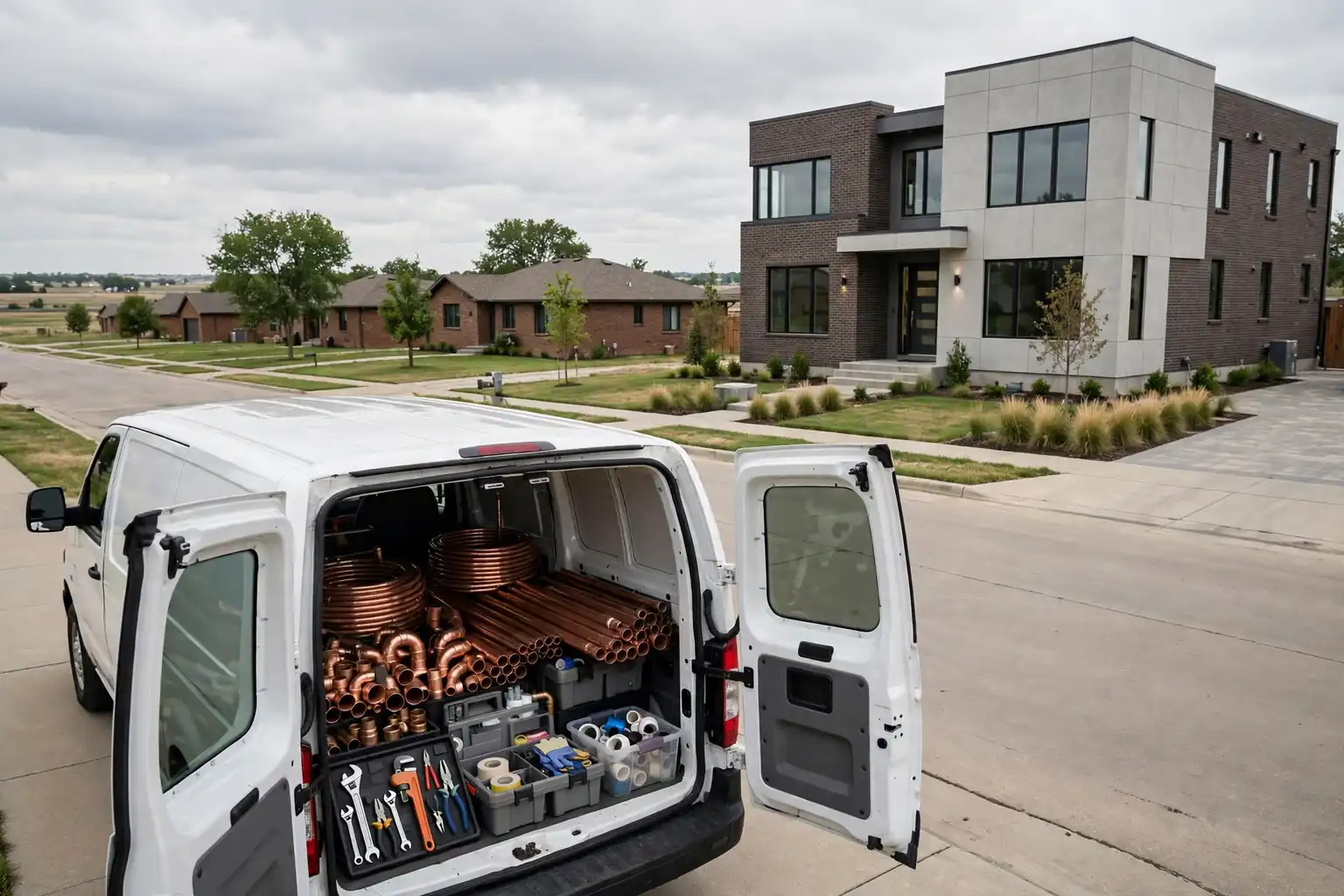


Everything on this page was computed for Wichita and nowhere else: the problem ranking from its Census housing profile, the seasonal risks from its NOAA station record, the coverage from its own ZIP codes. PlumbReach USA connects you to an independent local plumber; the page itself is the homework, done in public, so the call you make is an informed one.
Call center hours: Mon-Fri 7:00 AM-10:00 PM ET | Sat 8:00 AM-10:00 PM ET | Sun 7:00 AM-9:00 PM ET
The median Wichita home was built in 1977; 53.9% of the stock predates 1980, and the pattern this metro's own data ranks first is ageing cast iron sewer lines. PlumbReach USA is a referral service, not a plumbing company: one call connects you with an independent local plumber serving your ZIP code.
Begin where the Census begins, with who lives here and in what: 648,935 people in 252,501 households, owning 64.7% of the homes they live in, in a stock whose median member was built in 1977. Ownership changes the plumbing conversation — owners meet their systems as inheritances, not amenities — and the median date changes its subject: a stock centred on the 1970s is a stock whose original pipework, where it survives, is in its sixth decade and beyond. The sections below are that conversation, organised by the patterns the numbers produce.
There is a materials timeline buried in Wichita's housing figures, and it reads like a plumber's diary. The 91,179 homes from before 1960 were drained in cast iron or clay and supplied, in many cases, in galvanized steel. The 58,655 that followed between 1960 and 1979 mixed those materials with early copper. Then came the 70,330 homes of 1980-1999, plumbed increasingly in copper and early plastics. Each band of that timeline is now a band of characteristic failures, arriving in the order the materials tire — which is why a home's build year, in this metro, is the single most predictive fact about its plumbing.
Growth wrote this metro's newest plumbing chapter in plastic and concrete: supply and drain lines in modern materials, fixtures by the catalogue, foundations poured as slabs across the subdivisions near Derby and Newton. The chapter is young — its systems have decades in hand — but it is not exempt from the metro's arithmetic: 1,622 cooling degree days of demand work its heaters hard, and the soil under its slabs moves with the same seasons as the soil under the oldest farmhouse in Butler County.
Over everything sits the weather, and here it is measured rather than described: NOAA's station at WICHITA JABARA AP, KS US averages 57.0 degrees across the year, with 57.1 days reaching 90 or more and 102.4 nights at freezing or below. A buried lateral feels that record as soil that swells and pulls away; a water heater feels it as an unbroken cycle count; an exposed line feels it on the single coldest night. The problem ranking below is what those numbers, crossed with the housing profile, produce for Wichita specifically.
Housing eras and climate, joined — the two datasets every section of this page is built from.
The distribution, in one breath: of every hundred Wichita homes, 32.8 were standing before 1960, 21.1 went up in the two decades after, 25.3 in the two after that, and 20.8 have arrived since 2000. Percentages flatten the picture, so hold the counts beside them — 91,179 oldest-era homes, 57,821 newest — and the metro's plumbing stops being an abstraction: it is that many systems, of those ages, failing in that order.
Some metros are defined by their growth; this one is defined by its inheritance. The largest share of Wichita's homes was built before 1960, and inheritance in plumbing means materials at the end of their design lives serving households who did not choose them. The work that follows from that fact is the metro's staple: drains renewed, supplies renewed, laterals renewed — the patient, house-by-house replacement of a founding stock. Newer districts exist and matter, but they are not where this metro's plumbing character was decided.
The runner-up era is 1980-1999, with 25.3% of homes. That stock has left its carefree decades and entered its maintenance decades, and it shows in the call pattern around Derby and the other districts of those years: heaters on their second or third cycle, fixtures reaching their wear points together, drains still young enough to reward attention over replacement.
Start the climate half where the water starts: underground. Wichita's laterals rest in soil that takes 32.61 inches of rain in an average year and dries between deluges, swelling and shrinking against their joints through every season. Above ground the same record reads as workload — 1,622 cooling degree days of hot-water demand, 4,492 heating degree days of cold incoming water at WICHITA JABARA AP, KS US. A plumbing system here is never in neutral; the record keeps it working at one end or the other all year.
Hold the two halves together and the rest of this page explains itself: the problems ranked highest here are the ones where Wichita's dominant housing era and its climate record overlap. Change either dataset and the ranking changes — which is precisely why this profile is rebuilt from the records for every metro instead of carried over from the last one.
Selected and ranked from this metro's housing-age profile and climate record — not copied from another city's page.
Ask a cast iron drain how it is doing and it answers at the ground-floor fixture in the house. That is where a failing main shows itself first — the ground-floor bath that gurgles, the basement drain that sighs up odours — because everything above drains through the same tired run. In Wichita, the homes reporting those signals share a profile: built when cast iron was the default, in the streets around Wichita that went up first. The pipe underground is rough now with scale, its bore narrowed, its joints weeping into the soil — and the fixtures upstairs are merely its messengers.
The pipe itself explains the timeline. Cast iron drains by gravity, slowly, and everything a household sends down it — grease films, mineral-heavy water, the occasional corrosive cleaner — works on the iron for decades. The metal does not fail evenly: it thins first at the bottom of horizontal runs, where water and grit sit longest, and at the joints where sections meet. That is why two Wichita homes of the same age can be in different places with the same pipe: usage, water chemistry and soil conditions around the line all vote on how fast it goes. What a camera inspection adds is certainty — the difference between a line that needs cleaning, a line that needs a section replaced, and a line living on borrowed time.
Put a number on it locally: roughly 91,179 homes in the Wichita metro were built before 1960, when cast iron was the default drain material — and cast iron installed then has now been underground for six decades or more. Not every one of those lines has failed, and plenty test sound on a camera, but the population of pipes at risk here is counted in the tens of thousands of homes, which is why this pattern sits where it does on this page.
Water expands as it freezes, and a pipe gives it nowhere to go. The split rarely announces itself in the cold — it waits for the thaw, when pressure returns and the crack opens into a spray inside a wall, a ceiling or a crawl space. The lines that go are predictable: runs through exterior walls, garages, crawl spaces and any stretch the heating never reaches, in homes plumbed before routing pipes through conditioned space became the habit. One hard night is enough; the damage is done by the thaw, and it is usually discovered by the sound of running water in a quiet house or a stain spreading across a ceiling that was dry at breakfast.
A burst pipe is rarely about the coldest night of the year; it is about the one unprotected run of pipe the cold can reach. Water expands as it freezes, and the pressure that splits a line is not the ice itself but the water trapped between the ice blockage and a closed tap. Lines in exterior walls, unheated crawl spaces, garages and hose bibbs are the usual victims — the places where a home's heating never quite arrives. Wichita's older housing carries more of these runs than its newer builds, which route water through conditioned space by design. The thaw is when the damage shows: the split may weep for hours before anyone is home to hear it, which is why the shutoff advice on this page matters more than any repair.
Look at the shape of the risk in Wichita: 102.4 sub-freezing nights a year at WICHITA JABARA AP, KS US means the exposure is a season, not an event. Stack that against the housing side — 149,834 homes built before modern freeze protection was routine — and the pattern explains itself: many lines, many cold nights, and a failure that needs only one bad intersection of the two.
A lateral ages in the dark, and its ageing has a geography. The run beneath the house is sheltered; the run beneath the yard takes the soil's full behaviour — swelling after Wichita's 32.61 inches of yearly rain, shrinking in the dry months, shifting at every joint. Add the trees, whose roots read those joints as invitations, and the lateral's condition at any address is a sum of its material, its soil and its canopy. The camera reads the sum directly, which is why sewer advice here starts with footage: the remedy for a rooted joint and the remedy for a settled belly share no resemblance.
The lateral is the hardest-working pipe a household owns and the only one nobody ever sees. It carries everything, it was buried once and forgotten, and its condition depends on decisions made the year the house was built: the material chosen, the slope it was laid at, the soil it was bedded in. Ageing laterals fail in characteristic ways — joints offset as soil settles, bellies where the bedding washed or sagged, walls thinned by decades of flow. The house above reports these failures indirectly, through its ground-floor fixtures, which is why a sewer problem so often gets mistaken for a simple clog at first. In Wichita, where whole districts were built in the same few decades, laterals are ageing on a shared timetable — the line under one house is a fair guide to the line under its neighbour's.
Think of the laterals as a hidden census: 277,986 lines, one per home, the oldest of them — serving the 91,179 pre-1960 homes — now in their seventh decade underground. They age in soil that moves with Wichita's seasons, and their condition surfaces only as symptoms inside the house, which is why so many are discovered late.
Run two taps at once in a galvanized house and the second one apologises. That is the material's signature in old age: rust accreting inside the bore until the pipe delivers a fraction of its designed flow, weakest at the far end of the run. Wichita carries 149,834 pre-1980 homes, and the ones still on original galvanized announce themselves the same way — pressure that fades year by year, water that runs tea-coloured after a quiet weekend. Repiping is simply the moment the household stops negotiating with the symptom and replaces the cause.
Galvanized pipe fails politely, which is precisely the problem. No flood, no drama — just a shower that weakens across years, a washing machine that fills slowly, water that blushes rust after holidays. Households adapt without noticing, the way you adapt to a dimming bulb. The 58,655 homes built in this metro between 1960 and 1979 stand in the front of that queue now, their original steel bores narrowed to drinking-straw width in the worst runs. The fix, when it comes, tends to astonish people — not with its scale, but with the pressure they had forgotten they were owed.
Count the exposure from the Census side: the metro's 149,834 pre-1980 homes were plumbed in galvanized's long reign, and the material's failure mode — internal rust, narrowing bore — is a matter of chemistry, not workmanship. The variable is speed; the direction, for every one of those systems still original, is settled.
Living with a real winter, as Wichita does, means the season has a rhythm: the first hard freeze finds the unprepared lines, mid-winter tests the insulation, and the late thaws reveal whatever split quietly weeks before. Households that drain exterior lines in autumn and keep a trickle running on the coldest nights get through most winters with nothing to report.
The numbers behind the season here: 102.4 nights a year at or below freezing at WICHITA JABARA AP, KS US, against a housing stock whose median build year is 1977. Every winter writes the same exam for Wichita's older pipes, and every winter some of them — usually in the the 1970s districts first — fail it.
In Wichita the pattern has an address pattern. The cast iron went under the homes built before 1960 — the streets of the old core and the first suburbs around Wichita — and it is failing in the order those streets were built. A camera call in the historic districts is a different appointment from one in Derby or the newer subdivisions: there, the same symptoms usually trace to something younger and simpler. Knowing which side of that line a home sits on is most of the diagnosis before the camera ever leaves the van, and it is why this page ranks the problem by the metro's pre-1960 count rather than by anecdote.
Why here and not everywhere: Wichita pairs 149,834 pre-1980 homes with 57.1 days a year at 90 degrees or more and 102.4 nights below freezing. Every metro pairs its housing with its weather somehow; this particular pairing is what puts the pattern where it sits on this page's list, ahead of problems that dominate metros built in other decades, under other skies.
The first visit follows a short, diagnostic list — each item ruling a branch of the problem in or out:
Listed in the order this metro's housing and climate data supports.
A house can survive a lot of plumbing faults, but not a failed path to the street. Sewer services confront the lateral directly — inspected by camera, cleared where clearing suffices, excavated and renewed where the pipe has structurally given up. The footage, shown to the homeowner, is the basis of every recommendation.
Every home in Wichita drains to one line, and that line's condition is written in the metro's housing data: a median build year of 1977 means half the metro's laterals have been buried for decades, ageing in step with the houses above them. In the newer areas — 20.8% of homes built since 2000 — the pipe is plastic and the problems are different: bellies where bedding settled, construction debris, a joint shifted by soil movement. The camera inspection is the same either way, and it is what sizes the job: spot repair, partial replacement, or the full run, each with footage to justify it. Count it in homes if you prefer: 149,834 built before 1980, 57,821 since 2000, one shared system of soil and seasons.
Under Wichita lie 277,986 laterals, one per housing unit, and the oldest of them — beneath the 91,179 pre-1960 homes — have been underground since the metro was a fraction of its present size. The camera diary in Derby and the old core is written by that buried generation.
Pipes fail in two tenses: suddenly, at a joint or a split, and gradually, as a material narrows, thins or pits across a whole system. The first tense asks for a repair; the second eventually asks the larger question. Pipe services cover both — the sectional fix that restores a sound system, and the planned renewal that replaces a failing material through the whole house, routed to spare the building and staged to keep the household in water.
Repiping reads as a dramatic word for what is, in Wichita's older districts, a routine chapter of homeownership — the point where a material that served two generations hands over to one that will serve the next two. The metro's figures say how routine: 53.9% of homes predate 1980, and every one of them is running supply lines from a shorter-lived era. The households that handle the chapter well treat it as scheduling rather than crisis: evidence gathered, routes planned through the accessible spaces, water staged back on room by room. What they retire is not just pipe but a pattern of small failures. That is the daily reality for the 252,501 households spread across Butler, Harvey, Sedgwick, Sumner.
Pipe work divides by era in this metro with unusual neatness: renewal conversations in the 149,834 pre-1980 homes, sectional repairs in the middle ring, and near-silence from the 57,821 post-2000 homes whose lines are still young. A call from Andover can sit in any of the three bands; the home's build year says which before the door opens.
Heater work in Wichita is workload work: 57.1 hot days and 4,492 heating degree days a year cycle the metro's tanks hard, and the local professionals routed here size, flush and replace against that record.
One call from anywhere in the Wichita metro — from Wichita out to Andover — routes to the local professional on cover; the failure patterns they expect first are the ones this page's data ranks.
Wichita's drains are cleared by local independents who work this stock weekly: a median build year of 1977 means most lines they open have decades of history in them, and the clearing approach is chosen for the era, not the postcode.
Leak detection in Wichita is instrument work over local knowledge: acoustic and thermal tools, aimed first at the districts this page's data flags — the pre-1980 stock and the slab tracts out toward Newton.
In Wichita, a toilet that runs all night is a water bill with a sound; the local service replaces the tired internals and checks the flange and supply while the tank is open.
In Wichita the faucet call is often the first plumbing visit a newer home ever gets — the professionals routed here treat it as an introduction: the fixture fixed, and the home's shutoffs and heater age noted for the record.
Ask where this metro's plumbing diary fills up and the answer is a short story: Ageing cast iron sewer lines first, freeze-burst pipes in cold snaps close behind, and the services that answer them doing the bulk of the booked work. Everything else on the list above is the supporting cast — necessary, frequent enough, but not what Wichita's housing stock, at its age and in its climate, principally demands. Read the service list as a weather report for the metro's pipes and it stops looking like a catalogue.
 PROBLEM
 SOLUTION
Population 396,488
Population 25,801
Population 18,443
Population 15,508
Population 12,882
Population 11,117
Population 9,252
Population 8,937
Population 8,654
Population 7,726
Population 7,643
Population 5,990
Also in the Wichita metro: Mulvane (population 5,829), Goddard (population 5,361).
The communities in the grid are not suburbs of the page; they are its subject as much as Wichita is. Derby (25,801 residents) and Newton (18,443) carry their own building decades, their own pipe materials and their own positions in the problem ranking's logic — a lateral under a Derby street answers to the same data as one in the centre, but to a different era of it. Coverage here is defined by the ZIP list below; understanding is defined street by street, and this page's figures are the metro-wide version of a story each community tells in its own numbers.
Also on the Wichita map: Andover (15,508), El Dorado (12,882), Haysville (11,117), Augusta (9,252), Valley Center (8,937) — communities spread across Butler, Harvey, Sedgwick, Sumner, each with housing from its own growth years. A plumber routed through PlumbReach USA to any of them is working from this same page: the metro data does not change at the city limit, but the housing on your street — its age, its materials, its soil — is what the visit is really about.
Every metro has a first city and a supporting cast, and the census figures draw the billing plainly here: Wichita first, with 396,488 residents; Derby second at 25,801; Newton third at 18,443; then the long tail of smaller communities in the grid above. The billing matters less than the building dates — each of these places was plumbed in its own decade, by its own builders — but between them they account for nearly every housing era, material and failure pattern this page describes.
Administratively the metro is drawn from Butler, Harvey, Sedgwick, Sumner — 4 in all — with Butler County at its centre. County lines do not change pipe physics, but they do shape the paperwork around the work: permits, inspections and code details are county and city business, which is one reason the professional who serves your street is a local one.
Beyond the metro line, the nearest covered metros are Topeka, KS (126 miles away), Tulsa, OK (127 miles) and Oklahoma City, OK (157 miles) — separate pages, separate profiles, because their housing and weather records are their own. Homeowners near the boundary sit between two datasets; the ZIP list above, not the map's edge, decides which page was written about your stock.
The region around Wichita is a set of variations on its theme: Topeka, KS, 126 miles off, runs a median build year of 1972 on a metro population of 233,052; Tulsa, OK (127 miles) medians 1981 on 1,069,273; Oklahoma City, OK (157 miles) medians 1983 on 1,512,813. Nearness is not sameness — a few decades of median build year separate their plumbing as surely as the miles separate their maps.
Ratios tell the metro's story compactly. Renters occupy 35.3% of homes; owners hold the rest. For every home built since 2000 there are 2.6 from before 1980. Spread the stock across the coverage map and each ZIP code carries about 3,519 housing units — the density at which era patterns repeat street after street instead of scattering, and at which a routed round of calls stays inside a few districts.
The Wichita record in one line — median home age: 49 years · owner-occupied homes: 163,368 · renter-occupied homes: 89,133 · pre-1960 homes per covered ZIP code: 1,154 · heating-to-cooling degree-day ratio: 2.77 · average rainfall: 828 mm a year.
Before an emergency, read the guide: How to shut off your home's water main
Describe the problem and the call center routes you to an independent local plumber who works in the Wichita metro.
Call center hours: Mon-Fri 7:00 AM-10:00 PM ET | Sat 8:00 AM-10:00 PM ET | Sun 7:00 AM-9:00 PM ET