

Home / Cities / Kansas / Topeka

Plumbing Services in Topeka, KS

PlumbReach USA connects Topeka homeowners with independent local plumbers. This page is built from the metro's own Census housing data, ZIP codes and climate record — the plumbing problems described here are the ones Topeka homes actually have.

Call center hours: Mon-Fri 7:00 AM-10:00 PM ET | Sat 8:00 AM-10:00 PM ET | Sun 7:00 AM-9:00 PM ET

58
ZIP codes covered
5
Counties in the metro
95,996
Households (Census ACS)
1972
Median year home built
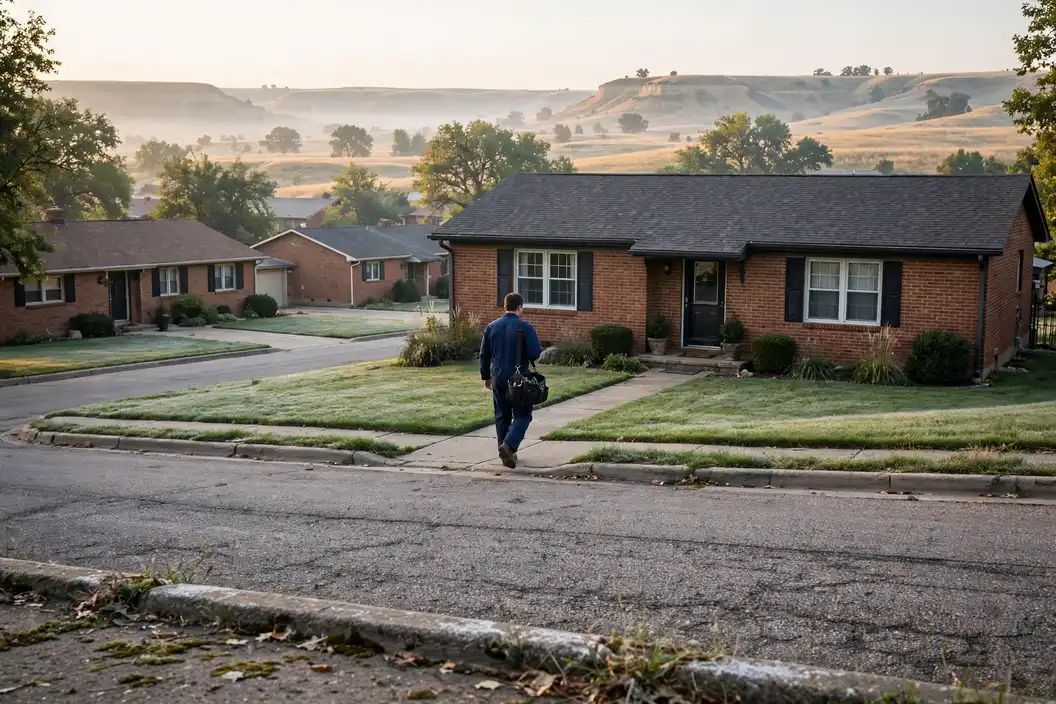
Topeka, KS — the metro skyline and landscape
Topeka, KS — plumbing help across the metro
A local plumber's van on a residential street
Routing local plumbers across the Topeka metro
Water heater installation in a home garage
Water heater work across the metro

Topeka plumbing, in brief

The median Topeka home was built in 1972; 63.0% of the stock predates 1980, and the pattern this metro's own data ranks first is ageing cast iron sewer lines. PlumbReach USA is a referral service, not a plumbing company: one call connects you with an independent local plumber serving your ZIP code.

The Topeka housing stock, and what it means for plumbing

Topeka is a metro of 232,724 people and 95,996 households, and its plumbing is a portrait of its building history. The median home here was built in 1972; 63.0% of homes predate 1980 and 33.3% predate 1960, while 14.6% have arrived since 2000. Every one of those eras plumbed differently — different pipe materials, different drain designs, different fixtures — and they fail differently, which is why this page is organised around the patterns the data actually produces in Topeka rather than plumbing in the abstract.

The pre-1980 districts are not a museum; they are most of the metro's working housing, and their plumbing is a patchwork in the literal sense — original runs beside renewed sections, a heater of one decade feeding fixtures of another. Across 66,107 such homes in Jackson, Jefferson, Osage, Shawnee, Wabaunsee, no two systems share exactly the same repair history, which is why the guidance below insists on pattern over incident: in patchwork plumbing, what has already been replaced is as diagnostic as what has failed.

There is a second way to read the growth figures: as a maintenance wave still approaching. The 15,320 homes built since 2000 were handed over with everything new at once — heaters, cartridges, supply lines, seals — and new things age in convoy. The first replacements in those subdivisions have begun; the wave behind them is arithmetic. Households in Holton and the other growth districts who learn their systems now, while the systems are still young, are the ones who will meet that wave as a schedule rather than a surprise.

The weather's part in this is written at TOPEKA MUNI AP, KS US, where an average year carries 36.53 inches of precipitation, 49.6 days at ninety degrees or more and 113.9 nights at freezing or below. Pipes experience that year as workload and as hazard in roughly equal measure — the workload in the heater's cycle count and the drains' burden, the hazard in the exposed runs and the swelling soil. The problem ranking further down is simply the housing profile above, read under this sky.

The Topeka plumbing profile in numbers

Housing eras and climate, joined — the two datasets every section of this page is built from.

Lay the eras side by side instead: 33.3% pre-1960 (34,942 homes), 29.7% from 1960-1979 (31,165), 22.4% from 1980-1999 (23,505), and 14.6% since 2000 (15,320). No single era tells the story — the proportions among them do, and those proportions are different in every metro this site covers.

This is, by the numbers, an old-system metro. The largest slice of its housing predates 1960, which means the typical serious job here involves materials in their seventh decade or beyond: drains of cast iron or clay, supply runs in galvanized steel, laterals laid when the streets themselves were young. The newer bands exist — the growth since 2000 is real — but they are the supporting cast. Topeka's plumbing identity was fixed by its earliest builders, and its problem list is written in their materials.

Close behind the leader come the 1960-1979 homes, 29.7% of the stock. Their plumbing is mid-change by construction — the decades when materials swapped over mid-stream — so this band is where a Topeka plumber earns the diagnostic fee: pressure tests and camera runs that say which side of the transition a given house was built on.

The climate half of the profile, from TOPEKA MUNI AP, KS US: 4,860 heating degree days against 1,534 cooling degree days, 36.53 inches of precipitation, an average temperature of 55.8 degrees. Read together, those figures describe the loads: how hard heaters cycle, how often the soil around buried lines swells and shrinks, and how much of the year exposed pipework spends anywhere near freezing — 113.9 nights at or below it, against 49.6 days at 90 or above.

Hold the two halves together and the rest of this page explains itself: the problems ranked highest here are the ones where Topeka's dominant housing era and its climate record overlap. Change either dataset and the ranking changes — which is precisely why this profile is rebuilt from the records for every metro instead of carried over from the last one.

Plumbing problems Topeka homes actually get

Selected and ranked from this metro's housing-age profile and climate record — not copied from another city's page.

Ageing cast iron sewer lines

Time is unkind to cast iron below ground. The pipe that carried this metro's post-war growth was laid with a working life in mind, and the calendar has now passed it: the inner wall sheds its lining in flakes, rust blooms narrow the bore, and the rough surface that remains catches everything the household sends down. Flow fades first — a tub that empties slower each year — then the failures arrive: a section that gives way under the yard, a joint that weeps into the soil. Where the metro's housing is oldest, this is not an edge case; it is the standard condition of the stock, arriving street by street as each neighbourhood's pipes reach the same age together. The camera distinguishes rust from roots from collapse, and that distinction sets the job.

There is a temptation to judge an old drain by its kindest day. On its kindest day it still clears, still serves, still seems to argue for another year. Judge it instead by its trend: clearings that come closer together, a tub that drains slower each season, a smell that returns after rain. In the 34,942 pre-1960 homes across this metro, that trend is the pipe's biography being read aloud — corrosion does not pause between visits, and the homes that fare well are the ones whose owners believed the early chapters.

Another way to size the exposure: Topeka's pre-1960 homes — roughly 34,942 of them — were plumbed in an era when cast iron was not a choice but the standard. Their drains have now spent sixty-plus winters and summers expanding, contracting and carrying loads their installers never pictured, which is why this pattern outranks problems that belong to younger housing.

Watch for

  • Floor drains in the basement or ground floor backing up during heavy use
  • A sewer smell near drains that cleaning does not shift
  • Patches of lawn staying green or soggy over the line's path

About sewer line repair & replacement ➔

Galvanized pipes at the end of their life

Galvanized steel announces its age through the water itself. The zinc coating that once protected the pipe is long spent; the steel beneath rusts inward, and the bore narrows to a passage that delivers less water every year. Households adapt without noticing — the shower accepted as weak, the washing machine's fill taken as slow — until a fixture upgrade or a guest's comparison names the decline. In Topeka's pre-1980 districts that decline is the stock's shared condition, written into 66,107 homes, and the repipe conversation begins when the household stops adapting and starts measuring.

The geography of galvanized failure inside one house is uneven, and the unevenness misleads people. The runs nearest the water heater corrode fastest, worked by heat; long horizontal runs narrow differently from vertical risers; the line to a little-used guest bathroom may be nearly closed while the kitchen still flows. This is why a Topeka home can seem fine at most taps while one shower has given up entirely. Repiping answers the whole geography at once, which is its real argument: not that any single run has failed, but that the system's remaining life is scattered unevenly through every wall, and spot repairs keep buying the shortest-lived section.

The replacement side of the ledger is equally local: when a Topeka home of the galvanized era is sold, inspected or renovated, the supply lines are among the first systems examined — because everyone in the local trade knows the material's age here. A pattern the whole market has learned to look for is not an anecdote; it is the metro's housing data wearing a tape measure.

Watch for

  • Fixtures farthest from the meter noticeably weaker than near ones
  • Rust-coloured first water of the day that clears within seconds
  • Shower pressure that drops hard when a second tap opens

About pipe repair & repiping ➔

Freeze-burst pipes in cold snaps

When water freezes inside a pipe it expands, and the pressure it creates has nowhere to go: the pipe splits, often at a joint or an elbow, and the damage is done before anything thaws. Topeka winters make this a standing risk rather than a freak event — the long-term climate record at TOPEKA MUNI AP, KS US shows about 113.9 nights a year at or below freezing and a heating load of 4,860 degree days, which is why pipes in unheated garages, crawl spaces and exterior walls here live dangerously every cold snap. The split itself usually announces at the thaw, when water returns to the line and finds the opening. Homes in Jackson, Jefferson, Osage, Shawnee, Wabaunsee that have frozen once tend to freeze in the same place again, because the exposure that caused it — a vent blowing cold air on a line, insulation that stops short of a corner — is still there. A plumber who repairs a burst pipe here will trace why that run froze and what changes: insulation, rerouting a short section, or sealing the air leak that bathes the pipe in cold air through the coldest nights.

Prevention, for this pattern, is a geography lesson: the burst never happens in the middle of the heated house. It happens at the perimeter — the wall cavity on the windward side, the run beneath the addition, the pipe the builder routed through the garage to spare six feet of copper. In Topeka, where 49.6 summer days tempt everyone to forget what 113.9 freezing nights intend, the autumn ritual is short and specific: find every line that leaves the warmth, and do something about it. The households that keep that ritual read about burst pipes the way other people do — as news.

Two local numbers frame the risk: 113.9 nights a year at or below freezing at TOPEKA MUNI AP, KS US, against a housing stock whose median home dates to 1972 — plumbed, much of it, before routing lines away from cold air was standard practice. Exposure is the product of those two numbers, and in this metro the product is large.

Watch for

  • A tap that runs slower or stops during a cold snap, then returns
  • Frost or condensation on an exposed pipe in the garage or crawl space
  • A sudden drop in pressure, or the sound of water, as temperatures rise after a freeze

About pipe repair & repiping ➔

Winter pipe season in Topeka

Winter in Topeka is pipe season. With about 113.9 nights a year at or below freezing on the long-term record, the houses that get through winter cleanly are the ones whose exposed lines were dealt with in autumn: insulation on garage and crawl-space runs, hoses off the outside taps so those lines can drain, and a household that knows where its main shutoff is before it needs it. During the hardest cold, a slow drip from the tap furthest from the main and open cabinet doors under sinks on outside walls are simple insurance. If a line does freeze, shut the water off before the thaw does its damage and have the run checked — a pipe that froze once has shown you exactly where it is vulnerable.

Put the season in figures: 113.9 freezing nights a year at TOPEKA MUNI AP, KS US, against a median build year of 1972. Half of Topeka's homes are that old or older, and their exposed lines sit the winter's examination every year — the failures the season produces are simply the papers it fails.

A closer look: ageing cast iron sewer lines in Topeka

There is a reason this pattern tops so many old-metro lists, and Topeka holds the reason in bulk: iron was simply what drains were, for the whole first age of indoor plumbing. Every pre-1960 home still on its original line — and the Census counts 34,942 pre-1960 homes here — is running an experiment in how long buried iron can serve. The results arrive unevenly: one street's lines camera clean and sound, the next street's flaked to lace. That unevenness is why the deep-dive ends in a camera rather than a conclusion, and why two neighbours with identical houses can honestly need different work.

The numbers underneath it, for Topeka: 104,931 housing units, a median build year of 1972, and a climate record at TOPEKA MUNI AP, KS US of 4,860 heating degree days against 1,534 cooling degree days. Cross the housing record with the weather record and this pattern is what falls out at the top — rarely the most dramatic problem in plumbing, but the one this metro's stock and climate manufacture most steadily.

The first visit follows a short, diagnostic list — each item ruling a branch of the problem in or out:

  • The ground-floor fixtures first — a main-line problem reports there before anywhere else
  • The age and material of the line, from the home's era and any past camera reports
  • Whether gurgling tracks the washing machine's discharge — a classic main-line signature
  • The cleanout's cap and condition, and whether it has ever been opened

Plumbing services in Topeka

Listed in the order this metro's housing and climate data supports.

Sewer Line Repair & Replacement in Topeka

Of all a home's pipes, the sewer lateral works under the worst conditions: buried, jointed, rooted at, and loaded by every fixture in the building. Its care begins with seeing it — a camera run that records material, slope and damage — and proceeds by the footage's logic: clear what clearing cures, mend what is locally broken, renew what has failed along its length. No stage of that is guesswork, and the homeowner sees the same footage the plumber does.

Consider the lateral as the home's only road out: every drain, every flush, every appliance discharge travels it. In Topeka's older districts that road was built generations ago, in sections, and it has been subsiding, rooting and corroding on its own schedule ever since. The sewer visit surveys the road before recommending anything — its material, its slope, where it is broken versus merely blocked — because the remedies differ by an order of magnitude and the footage, not the symptom, is what separates them. A cleared symptom on a broken road is a postponement, and local plumbers here give their advice accordingly: honestly, from the camera's evidence. Locally the workload concentrates where the stock is oldest — the districts built around the 1970s first.

Under Topeka lie 104,931 laterals, one per housing unit, and the oldest of them — beneath the 34,942 pre-1960 homes — have been underground since the metro was a fraction of its present size. The camera diary in Holton and the old core is written by that buried generation.

More about sewer line repair & replacement ➔

Pipe Repair & Repiping in Topeka

Supply pipe is a house's circulatory system, and its diseases are degenerative: rust narrowing the arteries, corrosion pitting the walls, joints weeping at the seams. Repair treats the acute event. Repiping treats the disease — a planned replacement of the failing material throughout the home, staged so the household keeps water while its circulation is renewed, and verified under pressure before the walls close.

A repipe decision in Topeka is usually made at a kitchen table, from three exhibits: the water's behaviour at the taps, the count of repairs already paid for, and the material visible wherever the system shows itself. Exhibits like those persuade because they are the household's own. The work itself, when it comes, is less disruptive than its reputation — modern lines route through attics, closets and chases, water stays on for most of the project, and the plaster sacrificed is measured in patches, not rooms. What the household buys back is the thing the old material had been taxing away: pressure, clarity, and the right to forget the pipes exist. From Holton to Osage City, the pattern repeats wherever the housing era matches.

Pipe work divides by era in this metro with unusual neatness: renewal conversations in the 66,107 pre-1980 homes, sectional repairs in the middle ring, and near-silence from the 15,320 post-2000 homes whose lines are still young. A call from Silver Lake can sit in any of the three bands; the home's build year says which before the door opens.

More about pipe repair & repiping ➔

Emergency Plumbing in Topeka

In Topeka the emergency call is routed, not queued: one number reaches the independent local plumber covering Jackson, Jefferson, Osage, Shawnee, Wabaunsee at that hour, and the housing record on this page — median build year 1972 — is the homework they arrive already knowing.

More about emergency plumbing ➔

Drain Cleaning in Topeka

Topeka's drains are cleared by local independents who work this stock weekly: a median build year of 1972 means most lines they open have decades of history in them, and the clearing approach is chosen for the era, not the postcode.

More about drain cleaning ➔

Water Heater Repair & Installation in Topeka

In a metro of 104,931 homes with a median build year of 1972, water heaters fail in waves as whole streets age together — the plumbers serving Jackson, Jefferson, Osage, Shawnee, Wabaunsee stock and schedule for exactly that pattern.

More about water heater repair & installation ➔

Leak Detection & Repair in Topeka

Leak detection in Topeka is instrument work over local knowledge: acoustic and thermal tools, aimed first at the districts this page's data flags — the pre-1980 stock and the slab tracts out toward Osage City.

More about leak detection & repair ➔

Toilet Repair & Installation in Topeka

In Topeka, a toilet that runs all night is a water bill with a sound; the local service replaces the tired internals and checks the flange and supply while the tank is open.

More about toilet repair & installation ➔

Faucet, Fixture & Garbage Disposal Repair in Topeka

In Topeka the faucet call is often the first plumbing visit a newer home ever gets — the professionals routed here treat it as an introduction: the fixture fixed, and the home's shutoffs and heater age noted for the record.

More about faucet, fixture & garbage disposal repair ➔

What Topeka books most

There is a plainer way to say what this page's ranking means in practice: most calls in Topeka are two calls. The first answers Ageing cast iron sewer lines; the second answers galvanized pipes at the end of their life. Between them they account for the shape of a local plumber's week here — the districts visited, the parts stocked, the diagnoses made fastest because they are made most often. The remaining services divide the rest of the diary among them, essential but episodic, the supporting work around two leading patterns.

From problem to fixed, in Topeka

A plumbing problem inside a Topeka homePROBLEM
➔
The same system in Topeka after professional repairSOLUTION

Areas covered in the Topeka metro

Topeka

Population 126,103

Holton

Population 3,384

Osage City

Population 2,837

Silver Lake

Population 1,549

Carbondale

Population 1,361

Valley Falls

Population 1,305

Auburn

Population 1,185

Lyndon

Population 1,184

Rossville

Population 1,183

Oskaloosa

Population 1,172

Perry

Population 1,085

Overbrook

Population 1,015

Also in the Topeka metro: Burlingame (population 976), Alma (population 965).

Read the grid as a building programme spread over a century. The oldest communities sit where the metro began; the youngest are still adding streets at its edge; and Holton and Osage City, with 3,384 and 2,837 residents, stand for the rings in between. Each ring plumbed in its era's materials, and each is now failing, wearing or holding in its era's characteristic order. The ZIP codes below draw the coverage boundary; the eras inside it draw everything else on this page — the problems ranked, the services ordered, the checks advised.

The map continues: Silver Lake (1,549), Carbondale (1,361), Valley Falls (1,305), Auburn (1,185), Lyndon (1,184). Different names, different decades — each community in Jackson, Jefferson, Osage, Shawnee, Wabaunsee was plumbed in its own growth years, which is why two streets in the same metro can need entirely different plumbing conversations. The ZIP list below is the working definition of coverage; the housing behind each code is the working definition of the job.

Topeka ZIP codes we cover

66054, 66060, 66066, 66070, 66073, 66088, 66097, 66401, 66402, 66409, 66413, 66414, 66416, 66418, 66419, 66423, 66429, 66431, 66436, 66440, 66451, 66501, 66507, 66509, 66510, 66512, 66516, 66523, 66524, 66526, 66528, 66533, 66537, 66539, 66540, 66542, 66543, 66546, 66552, 66603, 66604, 66605, 66606, 66607, 66608, 66609, 66610, 66611, 66612, 66614, 66615, 66616, 66617, 66618, 66619, 66621, 66622, 66834

The Topeka metro in detail

Every metro has a first city and a supporting cast, and the census figures draw the billing plainly here: Topeka first, with 126,103 residents; Holton second at 3,384; Osage City third at 2,837; then the long tail of smaller communities in the grid above. The billing matters less than the building dates — each of these places was plumbed in its own decade, by its own builders — but between them they account for nearly every housing era, material and failure pattern this page describes.

The metro answers to 5 county governments (Jackson, Jefferson, Osage, Shawnee, Wabaunsee), a patchwork that matters at permit time rather than at the pipe. Jackson County carries the centre; the others carry the growth rings and the older outlying towns. A plumber routed through this page works inside that patchwork daily — the water does not care about the boundaries, but the job's paperwork does.

Beyond the metro line, the nearest covered metros are Wichita, KS (126 miles away), Kansas City, MO (69 miles) and Lincoln, NE (136 miles) — separate pages, separate profiles, because their housing and weather records are their own. Homeowners near the boundary sit between two datasets; the ZIP list above, not the map's edge, decides which page was written about your stock.

Set Topeka among its neighbours and the contrasts sharpen the profile: Wichita, KS — metro population 663,809, median build year 1977 — sits 126 miles away; Kansas City, MO (2,270,682, median 1979) 69 miles; Lincoln, NE (352,081, median 1981) 136 miles. Three different housing stocks under three nearby skies, which is why each keeps its own page and its own problem ranking rather than borrowing this one.

Ratios tell the metro's story compactly. Renters occupy 29.8% of homes; owners hold the rest. For every home built since 2000 there are 4.3 from before 1980. Spread the stock across the coverage map and each ZIP code carries about 1,809 housing units — the density at which era patterns repeat street after street instead of scattering, and at which a routed round of calls stays inside a few districts.

One line of Topeka arithmetic — a median home 54 years old · 67,389 owner-occupied homes against 28,607 renter-occupied · 602 pre-1960 homes for every covered ZIP code · a heating-to-cooling degree-day ratio of 3.17 · 928 mm of rain in an average year.

Topeka plumbing questions

What area does PlumbReach USA cover around Topeka?
Coverage follows the metro's own map: 58 ZIP codes across Jackson, Jefferson, Osage, Shawnee, Wabaunsee, anchored on Topeka and running out through Holton, Osage City and Silver Lake. The list printed on this page is the working boundary — inside it, one call routes you to an independent local plumber who serves your street. The weight of it sits where the metro does: Topeka alone holds 54.2% of the metro's residents, and the coverage follows the housing from there outward, era by era. Coverage questions come back to the same evidence: the housing counted in Jackson, Jefferson, Osage, Shawnee, Wabaunsee, the 15,320 homes built since 2000 at the edge and the older core alike — one footprint, printed in full above. 95,996 households, 232,724 residents, a median build year of 1972: the coverage is drawn around exactly that population, from Topeka out to Silver Lake. Stated as a list of codes: the codes run 66054, 66440, 66552, 66834 and 66607 among the 58 on the list, spread over Jackson, Jefferson, Osage, Shawnee, Wabaunsee.
A Topeka house from about 1972 — which parts of its plumbing deserve a closer look?
Age shows in a predictable order here. Supply lines and shutoff valves from the the 1970s tire first, then drain joints, then the fixtures themselves. Topeka's figures explain the queue: a median build year of 1972 means half the metro's homes are older than yours or the same age, all ageing on the same schedule. The pattern matters more than any single fault — sequential leaks in the same material are the classic signal. In Topeka that plays out across 58 ZIP codes, from Topeka to Holton. Geography of the advice: it holds across 58 ZIP codes and 5 counties, in the 95,996 households the Census counts from Topeka out to Silver Lake — the eras differ by district, the watch-list does not. The metro context is worth holding onto: 33.3% of the stock predates 1960, and the districts around Holton and Osage City hold much of it — your home's neighbours are ageing on the same timetable. The geography repeats the arithmetic: Holton (3,384 residents) and Osage City (2,837) hold the same spread of eras as the core around Topeka, across 58 ZIP codes and Jackson, Jefferson, Osage, Shawnee, Wabaunsee. The watch-list's territory in codes: the codes run 66054, 66440, 66552, 66834 and 66607 among the 58 on the list, spread over Jackson, Jefferson, Osage, Shawnee, Wabaunsee.
If Topeka plumbers could prevent one problem, which would it be?
Count from the housing up and the answer is ageing cast iron sewer lines. Time is unkind to cast iron below ground. The runner-up patterns on this page matter too — a metro rarely specialises in a single fault — but the leader is the leader because Topeka's mix of eras and weather manufactures it at scale. The backdrop is the same metro-wide: 104,931 housing units working against the TOPEKA MUNI AP, KS US climate record. Homeowners near Topeka meet this pattern first; the subdivisions past Osage City meet it later, as their stock reaches the same age — the queue is set by the building map, not by chance. Homeowners comparing notes across the metro — Topeka (126,103 residents), Holton (3,384), Osage City (2,837) — are comparing the same ranked list, because the ranking was run on all 58 ZIP codes at once. The inputs behind the ranking, era by era: the era ledger reads 34,942 homes before 1960, 31,165 from 1960-1979, 23,505 from 1980-1999 and 15,320 since 2000 — 104,931 units, 95,996 households, 70.2% of them owner-occupied.
What does Topeka's climate record mean for the pipes in my home?
Mostly through the ground. Buried lines do not experience weather as temperature; they experience it as soil — soil that swells with Topeka's 36.53 inches of average rainfall, shrinks back in the dry stretches, and shifts the joints of every lateral in the metro a fraction at a time. Above ground, the same record works on exposed pipework and heaters. The climate is not a detail on this page; it is half the evidence. Read the record as the station logs it — TOPEKA MUNI AP, KS US, the NOAA station nearest this metro's centre: 4,860 heating degree days against 1,534 cooling degree days in a normal year. Every pattern ranked on this page was scored against those two numbers and the housing figures beside them. It is the same story from Holton to Osage City — the stock decides, and this stock's median build year is 1972. The record behind it is measured at TOPEKA MUNI AP, KS US and felt from Holton to Silver Lake: one climate for Jackson, Jefferson, Osage, Shawnee, Wabaunsee, 104,931 housing units, and every pipe, heater and lateral inside them. That is why the seasonal advice on this page is dated by TOPEKA MUNI AP, KS US's record rather than by a national calendar: 49.6 hot days and 113.9 freezing nights draw the two working seasons here. That load lands on 95,996 households across Jackson, Jefferson, Osage, Shawnee, Wabaunsee — 33.3% of their homes predate 1960, a median build year of 1972 — which is why the climate section of this page is arithmetic, not atmosphere. The ground it falls on, in codes: the codes run 66054, 66440, 66552, 66834 and 66607 among the 58 on the list, spread over Jackson, Jefferson, Osage, Shawnee, Wabaunsee.
I can hear water running inside a wall at my Topeka home. First move?
Everything after the first minute is cleanup; the first minute is the shutoff. In Topeka homes it lives at the meter by the street or on the wall where the supply enters — if you do not know which, today is the day to learn, because the calm version of this moment is a torchlight errand and the wet version is not. Close it, open the bottom tap in the house to let the lines drain, and only then start moving belongings out of the water's path. Across the metro's 5 counties, Jackson County included, the pattern repeats wherever the housing matches. Where the valve lives in Topeka follows the build decade: the 66,107 pre-1980 homes shut off indoors or at a curb stop, the slab subdivisions toward Silver Lake at the meter box — and TOPEKA MUNI AP, KS US's 113.9 freezing nights a year are why the calm-day search for it matters here more than in milder metros. Local records underline the point: TOPEKA MUNI AP, KS US logs 113.9 freezing nights a year, and the burst calls that follow them come from the same districts each time — the pre-1980 streets around Topeka and Holton — where valves are least often exercised. Afterwards, the details that help the call: your ZIP — anywhere from 66054 to 66834 on this page's list — your district, and your home's era out of a stock where 66,107 homes predate 1980. True in every covered code: the codes run 66054, 66440, 66552, 66834 and 66607 among the 58 on the list, spread over Jackson, Jefferson, Osage, Shawnee, Wabaunsee — the first minute is the same in all of them. For the record of the call: the Topeka metro, 232,724 residents, 70.2% of its homes owner-occupied, a median build year of 1972. The calm-day version of this answer is a walk: the valve behind a 66054 address, the meter box on a 66440 street, the interior shutoff in a 66552 home — three eras, three addresses for the same valve, all inside this metro's 58 codes.
Is a repipe inevitable for Topeka's older housing, or can repairs keep up?
Think of it as a count with a trend. Leak one: repair it and note the material. Leak two, same material, different room: the system has started a pattern. Leak three, with pressure sagging at every tap: repairs are now renting time in a house that needs its lines renewed. The metro's pre-1980 share — 63.0% of homes — means Topeka plumbers hold this conversation weekly, and the honest ones hold it at leak two, not leak five. Homeowners in Holton (3,384) and Osage City (2,837) read this page for the same reason — the stock there is the same stock. It holds in the 23,505 homes built between 1980 and 1999 just as it holds in the older core. Ask where this conversation happens most and the answer is a map: the districts plumbed in the galvanized decades, from the centre out through Holton (3,384 residents) and Osage City (2,837), across Jackson, Jefferson, Osage, Shawnee, Wabaunsee. The newer communities in the grid hear it rarely — their turn is scheduled decades from now. The evidence standard is the same across Jackson, Jefferson, Osage, Shawnee, Wabaunsee: in the 34,942 pre-1960 homes the bore of a cut section settles it; in the 1960-1979 ring — 31,165 homes — the sequence of leaks settles it. The metro's ledger, for the record: 34,942 pre-1960 homes, 31,165 from 1960-1979, 23,505 from 1980-1999, 15,320 since 2000 — the repipe pattern lives in the first two columns. Where the conversations happen: the community ledger reads Topeka (126,103 residents), Holton (3,384), Osage City (2,837), Silver Lake (1,549) and Carbondale (1,361), out of 232,724 residents metro-wide, earliest and oftenest in the founding names on that list.
Is PlumbReach USA the company that will do the work at my Topeka home?
An independent local plumber — not a PlumbReach USA employee. We run the connection service and the call center hours listed on this page; the professional who serves Topeka runs their own business, sets their own schedule with you, and does the work. We think that arrangement works well when it is stated plainly, so we state it on every page. The local figures behind it: 66,107 homes from before 1980 and 15,320 built since 2000, sharing one system of streets and soil. From Holton to Silver Lake, the model does not change: PlumbReach USA publishes the homework — this page, built from Topeka's Census and NOAA records — and routes the call; the independent professional who serves that part of Jackson, Jefferson, Osage, Shawnee, Wabaunsee does everything at the home. The model's footprint on this page is exact: 58 ZIP codes across Jackson, Jefferson, Osage, Shawnee, Wabaunsee, 95,996 households — in every part of it, the professional who arrives is a local business, and PlumbReach USA's part ends at the connection. The footprint the model serves, in figures: 58 ZIP codes — 66054 to 66834 among them — 5 counties, 95,996 households, from Topeka (126,103 residents) outward. The arrangement holds in every covered code: the codes run 66054, 66440, 66552, 66834 and 66607 among the 58 on the list, spread over Jackson, Jefferson, Osage, Shawnee, Wabaunsee.
Is there a yearly plumbing routine that suits Topeka homes?
Build the year around the two stretches that test this metro's plumbing. Ahead of the heat — 49.6 days of it — the heater and the drains. Ahead of the cold — 113.9 freezing nights — the exposed lines and the shutoff. Between stretches, the quiet checks: a meter watched at rest, a cleanout glanced down, valves under sinks turned twice so they remember the motion. In a metro whose median home dates to 1972, that rhythm intercepts most of the emergency diary while it is still a diary of small things. Scale it to this metro: Topeka's stock runs to 104,931 housing units, 66,107 of them built before 1980 — the checks above are written for exactly that population, in a climate that deals the metro 49.6 days of serious heat and 113.9 freezing nights a year. Scale the routine to the map and it stays the same half hour: the checks are written for a stock of 104,931 homes spread over Jackson, Jefferson, Osage, Shawnee, Wabaunsee, from the founding streets near Topeka to the subdivisions past Holton (3,384 residents) — one climate, one ageing pattern, one calendar. Neighbours keeping the same rhythm is the norm here — from Holton (3,384 residents) to Osage City (2,837) the checks are identical because the data behind them, a median build year of 1972, is identical in kind. Kept yearly, the routine compounds across the metro: 95,996 households in Jackson, Jefferson, Osage, Shawnee, Wabaunsee, from Topeka to Silver Lake, each holding one page of notes against the same two seasons. The routine's stock, counted: the era ledger reads 34,942 homes before 1960, 31,165 from 1960-1979, 23,505 from 1980-1999 and 15,320 since 2000 — 104,931 units, 95,996 households, 70.2% of them owner-occupied.
How were the plumbing problems on this page ranked for Topeka?
It starts from the two datasets this page is built on: Census housing figures for the Topeka metro and NOAA's 1991-2020 climate normals for TOPEKA MUNI AP, KS US. Every candidate pattern — ageing laterals, slab leaks, freeze damage and the rest — is weighed against both: how much of the local stock is exposed to it, and how hard the local climate pushes it. The order you are reading is the result, and it is recalculated metro by metro rather than inherited from a bigger city's page. Run the same scoring on any single district and the order bends: Holton's streets would rank their own list, Silver Lake's another. This page ranks the metro as a whole — 95,996 households across Jackson, Jefferson, Osage, Shawnee, Wabaunsee — which is why the evidence paragraphs keep returning to where each pattern actually concentrates. The sort is re-run from the data, not inherited: 33.3% pre-1960 stock, 63.0% pre-1980, 49.6 hot days against 113.9 freezing nights — the weights are this metro's, so the ranking is. The evidence trail is on this page: the problem sections scored pattern by pattern, the housing profile drawn from Jackson, Jefferson, Osage, Shawnee, Wabaunsee, the climate read from TOPEKA MUNI AP, KS US — the ranking is the two records read together, nothing else. The scoring's raw material, community by community: the community ledger reads Topeka (126,103 residents), Holton (3,384), Osage City (2,837), Silver Lake (1,549) and Carbondale (1,361), out of 232,724 residents metro-wide. Run the identical scoring next door and the order shifts: Wichita, KS, 126 miles away, keeps its own list; Kansas City, MO, 69 miles, another; Lincoln, NE, 136 miles, a third — proximity is not sameness. Subset the inputs and the order bends: score Holton's streets alone and their eras lead; score the Silver Lake subdivisions alone and theirs do. The printed order belongs to the full 58-code metro, no smaller unit.
Which Topeka neighbourhoods sit on the metro's oldest pipes?
The oldest homes cluster where the metro began: the historic core around Topeka and the first suburbs out from it, where the 34,942 pre-1960 homes in this metro mostly stand. It matters because era is destiny for plumbing — those streets hold the cast iron, the galvanized steel and the clay laterals this page's problem list is built from. The newer districts around Holton hold younger systems with younger problems: fewer material failures, more wear and installation questions. Put the eras on the same map and the pattern sharpens: the 34,942 oldest homes cluster centrally, the 31,165 homes of 1960-1979 ring them, and the stock thins into new subdivisions past Osage City. A plumber driving outward from Topeka is driving forward through plumbing history, decade by decade. Concentrations, for the record: the oldest systems sit inside the 34,942 pre-1960 homes, and those homes cluster — the founding core, the streetcar-era streets, the first suburbs in Jackson County — rather than scattering evenly across the 58 covered ZIP codes. The layers have counts: 34,942 homes in the oldest ring, 31,165 in the 1960-1979 ring, 15,320 since 2000 at the edge — the drive out from Topeka passes them in order. It is a population map as much as a plumbing map: 232,724 residents, 95,996 households, and the oldest pipework concentrated where the earliest of them settled — the founding districts of Jackson County. The map's own numbers: the era ledger reads 34,942 homes before 1960, 31,165 from 1960-1979, 23,505 from 1980-1999 and 15,320 since 2000 — 104,931 units, 95,996 households, 70.2% of them owner-occupied. The comparison that proves the layering: Wichita, KS, 126 miles off, layers its own eras differently; Kansas City, MO, 69 miles, differently again; Lincoln, NE, 136 miles, differently a third time — each metro's oldest map is its own.
What should a yearly plumbing check in Topeka actually include?
Expect the flags this metro's figures predict. In Topeka the recurring findings are shutoffs seized from disuse, heaters past their anode's protection, supply lines in original the 1970s material, and a meter that creeps when the house is quiet. The check hunts those four in that order, then reads whatever the house adds of its own — in a stock of 104,931 homes, no two inspections are identical, but the shortlist rhymes from street to street. Scale the walk to the metro and its importance grows: 95,996 households, a median build year of 1972, 36.53 inches of rain a year pressing on the buried half of every system. The check is thirty minutes in one home; multiplied across a stock like this, it is the difference between the metro's failures arriving as surprises and arriving as appointments. Across 58 ZIP codes the half hour repeats with the same shortlist and different evidence: a stock of 104,931 homes, 66,107 of them pre-1980, under a record of 4,860 heating degree days — the check reads those numbers home by home. The shortlist is drawn from this metro's evidence: 66,107 pre-1980 homes for the valves and materials, 49.6 hot days for the heater sediment, 36.53 inches of rain for the buried lines the meter reports on. The walk, scaled: 104,931 homes, 66,107 of them pre-1980, a median year of 1972, a climate of 4,860 heating degree days and 36.53 inches of rain at TOPEKA MUNI AP, KS US — the shortlist is those numbers, interviewed one house at a time. The walk's territory, in codes: the codes run 66054, 66440, 66552, 66834 and 66607 among the 58 on the list, spread over Jackson, Jefferson, Osage, Shawnee, Wabaunsee.

Before an emergency, read the guide: How to shut off your home's water main

Nearby metro areas

Need a plumber in Topeka?

One call connects you with an independent local plumbing professional serving Topeka and the surrounding metro.

Call center hours: Mon-Fri 7:00 AM-10:00 PM ET | Sat 8:00 AM-10:00 PM ET | Sun 7:00 AM-9:00 PM ET

Call Now
