

This is Madison's plumbing page, built from Madison's own numbers: Census housing figures, the metro's ZIP codes and its NOAA climate record. PlumbReach USA routes your call to an independent local plumber; the homework below is here so you know your home's likely problems before you ever make it.
Call center hours: Mon-Fri 7:00 AM-10:00 PM ET | Sat 8:00 AM-10:00 PM ET | Sun 7:00 AM-9:00 PM ET
The median Madison home was built in 1983; 46.8% of the stock predates 1980, and the pattern this metro's own data ranks first is freeze-burst pipes in cold snaps. PlumbReach USA is a referral service, not a plumbing company: one call connects you with an independent local plumber serving your ZIP code.
Two numbers frame everything that follows: 60.8% of Madison homes are owner-occupied, and the median one was built in 1983. Ownership matters to plumbing because owners inherit their systems whole — every material decision a builder made in the 1980s or earlier is still in the walls, ageing on its original schedule. With 46.8% of homes predating 1980 and 28.6% arriving since 2000, the metro is really two housing stocks sharing one map, and they are taken separately below before the problems are ranked.
There is a materials timeline buried in Madison's housing figures, and it reads like a plumber's diary. The 74,183 homes from before 1960 were drained in cast iron or clay and supplied, in many cases, in galvanized steel. The 70,474 that followed between 1960 and 1979 mixed those materials with early copper. Then came the 76,037 homes of 1980-1999, plumbed increasingly in copper and early plastics. Each band of that timeline is now a band of characteristic failures, arriving in the order the materials tire — which is why a home's build year, in this metro, is the single most predictive fact about its plumbing.
The growth side of the metro tells the opposite story in the same language. Sun Prairie, Fitchburg and the subdivisions still filling in account for much of the 88,401 homes built since 2000 — plastic supply lines, plastic drains, cartridge fixtures, slab foundations. Their plumbing is not old; it is uniform, which creates its own calendar: everything installed in the same boom reaches each wear point in the same years, from the first water-heater replacements to the first slab-leak scares, while 627 cooling degree days of annual heat keep demand on the system high.
The weather's part in this is written at MADISON DANE RGNL AP, WI US, where an average year carries 37.13 inches of precipitation, 8.6 days at ninety degrees or more and 146.9 nights at freezing or below. Pipes experience that year as workload and as hazard in roughly equal measure — the workload in the heater's cycle count and the drains' burden, the hazard in the exposed runs and the swelling soil. The problem ranking further down is simply the housing profile above, read under this sky.
The metro's building eras on one side, its weather record on the other — and its plumbing where the two meet.
The distribution, in one breath: of every hundred Madison homes, 24.0 were standing before 1960, 22.8 went up in the two decades after, 24.6 in the two after that, and 28.6 have arrived since 2000. Percentages flatten the picture, so hold the counts beside them — 74,183 oldest-era homes, 88,401 newest — and the metro's plumbing stops being an abstraction: it is that many systems, of those ages, failing in that order.
New-stock metros have their own signature, and Madison has it in full: most homes built since 2000, most systems young, most plumbing work a matter of waves — the heater wave, the cartridge wave, the first slab questions — arriving street by street as identical subdivisions age in lockstep. The older pockets still produce the deepest single jobs, but the metro's plumbing centre of mass sits in its newest postcodes, and every year the waves get closer together.
Second in the table, the 1980-1999 band: 76,037 homes, 24.6% of the metro. Its systems are mature rather than ancient — copper in its pinhole years in places, plastic drains still sound, first-generation cartridges wearing out in waves — and its plumbing is the schedulable kind: work that rewards being booked before it becomes urgent.
The climate half of the profile, from MADISON DANE RGNL AP, WI US: 7,138 heating degree days against 627 cooling degree days, 37.13 inches of precipitation, an average temperature of 47.0 degrees. Read together, those figures describe the loads: how hard heaters cycle, how often the soil around buried lines swells and shrinks, and how much of the year exposed pipework spends anywhere near freezing — 146.9 nights at or below it, against 8.6 days at 90 or above.
A profile is only useful if it predicts something, and this one predicts the shape of a plumbing diary in Madison: which streets will call about drains, which about pressure, which about heaters, and in which months. Everything after this section is that prediction written out as services, problems and answers — the numbers first, the narrative second, the way the evidence actually runs.
Ordered by what this metro's data says its homes need most.
One leak is an event; three in a year is a verdict. Pipe work weighs that pattern — the metal's age, the water's behaviour, the repair history — and either fixes the section in front of it or proposes the honest larger job: a whole-house repipe that ends the rhythm for good.
Walk the older streets of Madison with a plumber and you will hear the housing stock dated by its pipework: galvanized behind this wall, copper of a certain vintage there, a repipe already done on the corner house. The metro's median build year of 1983 means that dating game works on half the homes in the metro. What decides any individual home's path is not the street's average but the evidence inside its own walls — pressure at the fixtures, the water's colour after a quiet weekend, the count of repairs already made. The assessment is short; the conclusion follows from it. Locally the workload concentrates where the stock is oldest — the districts built around the 1980s first.
The repair-or-renew caseload is set by one figure above the rest: 46.8% of Madison homes predate 1980, plumbed in the materials now at the end of their service lives. Around Sun Prairie (36,455 residents) as in the old core, that percentage is not an abstraction — it is the street's plumbing, house by house.
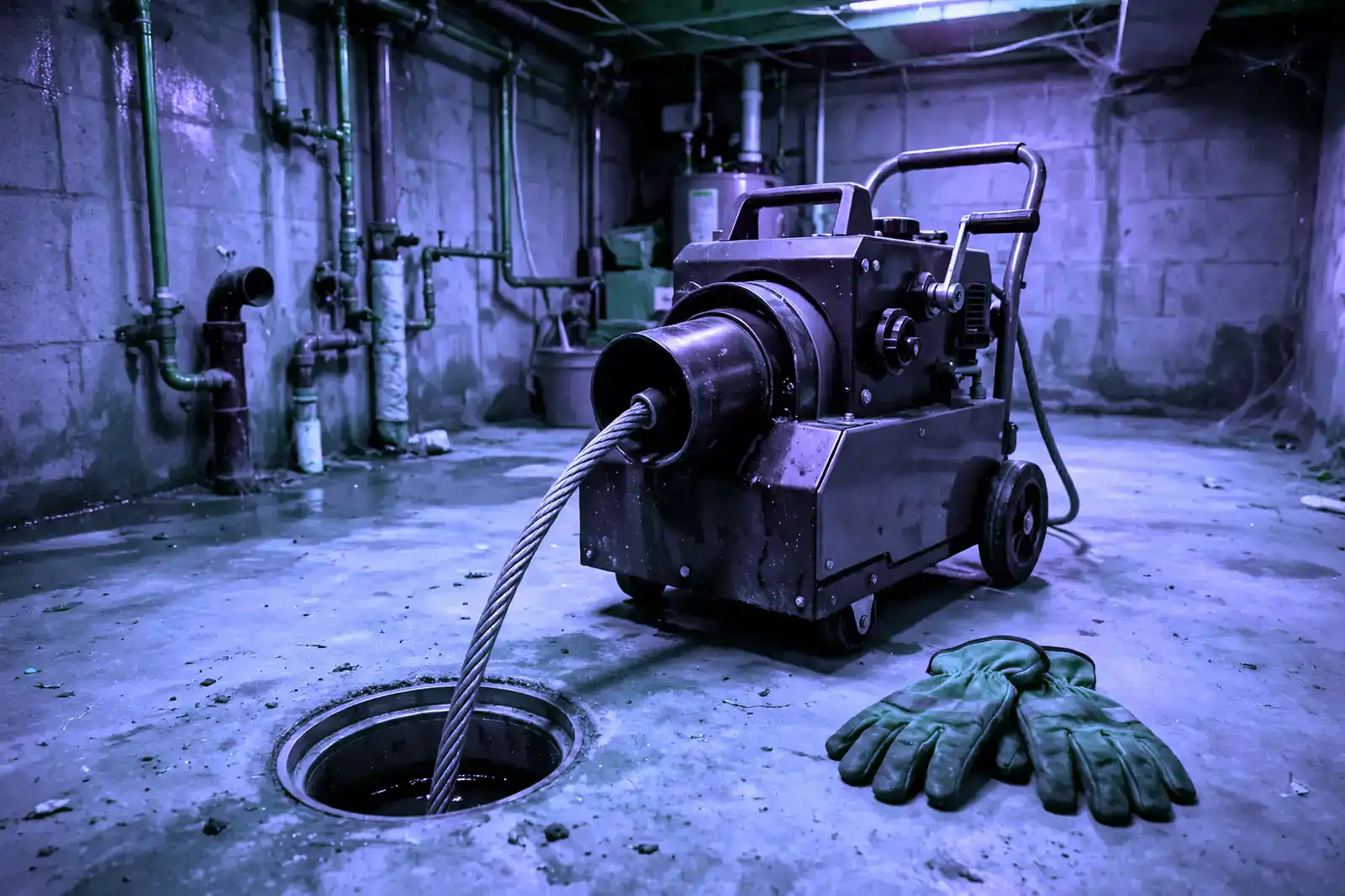
Between the house and the street lies the lateral — privately owned, commonly forgotten, and the source of the worst backups a home can have. Sewer work begins with a camera survey of that run: its material, its fall, its invaders. Spot repairs suit local damage; a line failing along its length gets replaced, not patched into a subscription.
A lateral's enemies in Madison are patient and they are local: roots working the joints under the canopy streets of Columbia County, soil that swells with 37.13 inches of yearly rain and shrinks back in the dry stretches, and plain elapsed time in the districts where the pipe predates the pavement above it. Against enemies that slow, the camera is less a diagnostic luxury than the only honest calendar the line will ever get — footage that says whether the pipe has years left, or has been spending them. The remedy scales to that verdict and to no other. That is the daily reality for the 295,527 households spread across Columbia, Dane, Green, Iowa.
Under Madison lie 309,095 laterals, one per housing unit, and the oldest of them — beneath the 74,183 pre-1960 homes — have been underground since the metro was a fraction of its present size. The camera diary in Middleton and the old core is written by that buried generation.
A heater rarely dies all at once; it dims. Recovery slows, temperatures wander, the tank starts talking. Repair makes sense while the vessel is sound; once the steel itself is going, replacement is the honest answer, matched in capacity and fuel to how the household actually uses hot water.
In Madison, a water heater's biography is written by two authors: the household and the climate. The household writes the demand — showers, laundry, the dishwasher's nightly run — and the climate edits it, raising inlet temperatures through the 8.6 hot days and dropping them through the cold snaps, so the tank's workload swings with the year. Sediment accumulates through both drafts. Servicing reads the manuscript and corrects what can be corrected; replacement starts a new one, sized for the household's actual chapters rather than the previous tank's guess. Count it in homes if you prefer: 144,656 built before 1980, 88,401 since 2000, one shared system of soil and seasons.
Heater work in this metro is a fleet problem: the tanks were installed in waves with the subdivisions, and they reach their verdicts in waves too. Verona (14,499 residents) sits inside one of those waves; the older districts run their own, one tank at a time, inside plumbing a generation older.
One call from anywhere in the Madison metro — from Madison out to Middleton — routes to the local professional on cover; the failure patterns they expect first are the ones this page's data ranks.
Across Columbia, Dane, Green, Iowa, drain calls follow the building map: iron and clay near the old core around Madison, plastic at the growth edge — one service, two different crafts, both covered by the routing on this page.
The meter test starts it in Madison as everywhere; what follows is local — knowing which of Columbia, Dane, Green, Iowa' eras hide lines in slabs, which in crawl spaces, and where the soil movement at MADISON DANE RGNL AP, WI US's record makes joints let go.
Toilet calls in Madison are the small end of the diary and the most democratic: every era of the 309,095-home stock produces them, and the local fix starts with the mechanism in the tank, not the porcelain.
Drips and disposals across Columbia, Dane, Green, Iowa are small jobs with a standard: repair the mechanism where the fixture deserves it, renew it where it does not, and check the shutoffs and supply lines while the cabinet is open.
Bookings in this metro have a centre of gravity, and it sits on the two patterns this page ranks first: Freeze-burst pipes in cold snaps, then ageing cast iron sewer lines. Everything a local service operation does — the vans' stock, the week's scheduling, the order of this very list — bends around that gravity. A homeowner reading the services above is therefore reading something more specific than a menu: a forecast of what a home like theirs, in a metro built like this one, is most likely to need, in the order it is most likely to need it.
Ranked for this metro alone, from its Census housing profile and NOAA climate record.
Water expands as it freezes, and a pipe gives it nowhere to go. The split rarely announces itself in the cold — it waits for the thaw, when pressure returns and the crack opens into a spray inside a wall, a ceiling or a crawl space. The lines that go are predictable: runs through exterior walls, garages, crawl spaces and any stretch the heating never reaches, in homes plumbed before routing pipes through conditioned space became the habit. One hard night is enough; the damage is done by the thaw, and it is usually discovered by the sound of running water in a quiet house or a stain spreading across a ceiling that was dry at breakfast.
The burst itself usually happens quietly, inside a wall or under a floor, during the coldest hours — but the flood waits for the thaw. Ice seals the split it made, and only when temperatures rise and the ice lets go does the water start moving into the house. That delay is why freeze damage so often greets a Madison household in the morning or on return from a trip away. It is also why the checks after a hard freeze matter: pressure oddly low, a meter turning with nothing running, a damp patch at a wall base. Catch the split at the weep stage and the repair is a pipe; catch it after the thaw and it is a room.
Two local numbers frame the risk: 146.9 nights a year at or below freezing at MADISON DANE RGNL AP, WI US, against a housing stock whose median home dates to 1983 — plumbed, much of it, before routing lines away from cold air was standard practice. Exposure is the product of those two numbers, and in this metro the product is large.
Time is unkind to cast iron below ground. The pipe that carried this metro's post-war growth was laid with a working life in mind, and the calendar has now passed it: the inner wall sheds its lining in flakes, rust blooms narrow the bore, and the rough surface that remains catches everything the household sends down. Flow fades first — a tub that empties slower each year — then the failures arrive: a section that gives way under the yard, a joint that weeps into the soil. Where the metro's housing is oldest, this is not an edge case; it is the standard condition of the stock, arriving street by street as each neighbourhood's pipes reach the same age together. The camera distinguishes rust from roots from collapse, and that distinction sets the job.
The pipe itself explains the timeline. Cast iron drains by gravity, slowly, and everything a household sends down it — grease films, mineral-heavy water, the occasional corrosive cleaner — works on the iron for decades. The metal does not fail evenly: it thins first at the bottom of horizontal runs, where water and grit sit longest, and at the joints where sections meet. That is why two Madison homes of the same age can be in different places with the same pipe: usage, water chemistry and soil conditions around the line all vote on how fast it goes. What a camera inspection adds is certainty — the difference between a line that needs cleaning, a line that needs a section replaced, and a line living on borrowed time.
Put a number on it locally: roughly 74,183 homes in the Madison metro were built before 1960, when cast iron was the default drain material — and cast iron installed then has now been underground for six decades or more. Not every one of those lines has failed, and plenty test sound on a camera, but the population of pipes at risk here is counted in the tens of thousands of homes, which is why this pattern sits where it does on this page.
A water heater keeps its accounts in two currencies: temperature and time. Every shower is a withdrawal; every degree the incoming water must be raised is a tax on the recovery. Madison taxes its tanks from both ends — summer demand volume against winter inlet cold — and the fleet pays out accordingly, the oldest units in the oldest homes first. The strain is rarely visible from outside the closet: it is a shower ending cooler than it began, a tank that fires at hours when nobody has drawn water, a household quietly reorganising its mornings around an appliance's fatigue. Those are the entries in the ledger that precede the failure itself.
A water heater's enemies compound quietly. Sediment settling on the tank floor insulates the water from the burner or elements, so the unit fires longer to do the same work; the longer firing expands and contracts the tank steel, working the lining; the anode rod, designed to corrode in the steel's place, spends itself a little faster with every cycle. None of this announces itself until recovery slows — showers running lukewarm in sequence, a rumble from the tank as steam pockets form in the sediment — and by then the arithmetic of age has usually been running for years. Homes in Madison put real hours on these appliances: hot water is not a seasonal luxury here but a year-round daily load, and the fleet of heaters across the metro ages in step with the housing that holds it.
Scale the workload: 295,527 households, each cycling a tank through chores, showers and laundry, under a climate that loads the system at both temperature extremes across the year. Tank failures distribute across that base like weather — individually unpredictable, collectively as regular as the seasons that drive them.
Between the house and the street connection sits the lateral — the home's own stretch of sewer line — and it is the homeowner's responsibility, which surprises many people the first time it fails. In Madison, where 24.0% of homes were built before 1960 and the median home dates to 1983, laterals have been in the ground through decades of soil movement, root growth and material ageing. Clay joints shift and open, older pipe bellies where bedding has washed out, and a line can lose its clean fall to the street, so waste slows, settles and eventually blocks. The signs are house-wide rather than fixture-specific: several drains slow together, the ground-floor fixtures act up first, and cleanings help for shorter and shorter stretches. A camera run down the lateral settles the argument about what is happening — it measures the damage by distance, shows whether it is one bad joint or the whole story of the line, and lets the repair be sized to the actual problem instead of the whole run by default.
The lateral is the hardest-working pipe a household owns and the only one nobody ever sees. It carries everything, it was buried once and forgotten, and its condition depends on decisions made the year the house was built: the material chosen, the slope it was laid at, the soil it was bedded in. Ageing laterals fail in characteristic ways — joints offset as soil settles, bellies where the bedding washed or sagged, walls thinned by decades of flow. The house above reports these failures indirectly, through its ground-floor fixtures, which is why a sewer problem so often gets mistaken for a simple clog at first. In Madison, where whole districts were built in the same few decades, laterals are ageing on a shared timetable — the line under one house is a fair guide to the line under its neighbour's.
Every one of the metro's 309,095 housing units drains through exactly one lateral, and in the older districts those laterals are as old as the streets above them. The pre-1960 share alone — 74,183 homes — represents that many buried lines in their seventh decade of service, under soil that shifts with Madison's wet and dry seasons. Most will never draw attention; the ones that fail announce themselves through the ground-floor fixtures first.
Winter in Madison is pipe season. With about 146.9 nights a year at or below freezing on the long-term record, the houses that get through winter cleanly are the ones whose exposed lines were dealt with in autumn: insulation on garage and crawl-space runs, hoses off the outside taps so those lines can drain, and a household that knows where its main shutoff is before it needs it. During the hardest cold, a slow drip from the tap furthest from the main and open cabinet doors under sinks on outside walls are simple insurance. If a line does freeze, shut the water off before the thaw does its damage and have the run checked — a pipe that froze once has shown you exactly where it is vulnerable.
Put the season in figures: 146.9 freezing nights a year at MADISON DANE RGNL AP, WI US, against a median build year of 1983. Half of Madison's homes are that old or older, and their exposed lines sit the winter's examination every year — the failures the season produces are simply the papers it fails.
A freeze burst is two events wearing one name. The first is the split itself, silent, in the cold hour — ice does its work without an audience. The second is the thaw, hours later, when the split becomes a flood and the household meets the damage all at once. Madison's 146.9 annual freezing nights make that two-act play a standing risk rather than a freak event, and the housing most exposed is the housing plumbed with runs at the building's cold edges. The defence is correspondingly two-part: keep the water warm or keep it absent — insulation and drainage, the whole of the law.
Why here and not everywhere: Madison pairs 144,656 pre-1980 homes with 8.6 days a year at 90 degrees or more and 146.9 nights below freezing. Every metro pairs its housing with its weather somehow; this particular pairing is what puts the pattern where it sits on this page's list, ahead of problems that dominate metros built in other decades, under other skies.
Experienced local practice starts with the simple certainties — the observations that take minutes and decide the most:
 PROBLEM
 SOLUTION
Population 275,568
Population 36,455
Population 31,566
Population 22,235
Population 14,927
Population 14,499
Population 13,063
Population 11,384
Population 10,853
Population 10,568
Population 10,374
Population 9,230
Also in the Madison metro: Windsor (population 8,992), Monona (population 8,604).
The communities in the grid are not suburbs of the page; they are its subject as much as Madison is. Sun Prairie (36,455 residents) and Fitchburg (31,566) carry their own building decades, their own pipe materials and their own positions in the problem ranking's logic — a lateral under a Sun Prairie street answers to the same data as one in the centre, but to a different era of it. Coverage here is defined by the ZIP list below; understanding is defined street by street, and this page's figures are the metro-wide version of a story each community tells in its own numbers.
Also on the Madison map: Middleton (22,235), Waunakee (14,927), Verona (14,499), Stoughton (13,063), Oregon (11,384) — communities spread across Columbia, Dane, Green, Iowa, each with housing from its own growth years. A plumber routed through PlumbReach USA to any of them is working from this same page: the metro data does not change at the city limit, but the housing on your street — its age, its materials, its soil — is what the visit is really about.
Madison (275,568 residents) anchors the metro, and Sun Prairie (36,455) is its second centre of gravity. Between them they hold the bulk of the 295,527 households — and, not coincidentally, the bulk of every housing era this page discusses, from the pre-1960 core to the newest subdivisions. Fitchburg (31,566) and the communities beyond it repeat the same eras at smaller scale.
One metro, 4 county lines drawn through it: Columbia, Dane, Green, Iowa. The lines are invisible to the water and the weather, but they structure everything administrative around a plumbing job — which office permits it, which inspector signs it, which code edition applies. Columbia County, at the centre, carries the oldest housing and the heaviest share of the work this page describes; its neighbours carry the growth. A routed local plumber navigates the patchwork so the homeowner does not have to.
This page ends at the metro boundary, but the region does not: Janesville, WI, Milwaukee, WI and Oshkosh, WI continue the coverage in their own directions, each with a profile built from its own Census and NOAA figures. If your home sits near the line between metros, go by your ZIP code — it places you in the dataset that describes your housing.
The region around Madison is a set of variations on its theme: Janesville, WI, 38 miles off, runs a median build year of 1970 on a metro population of 166,472; Milwaukee, WI (79 miles) medians 1966 on 1,575,010; Oshkosh, WI (86 miles) medians 1975 on 174,218. Nearness is not sameness — a few decades of median build year separate their plumbing as surely as the miles separate their maps.
Count the metro per unit of itself: 4,683 housing units per covered ZIP code; 73,882 households per county; 14 communities sharing 4 county governments. Then weigh the generations against each other — 1.6 older homes for each newer one — and the service pattern on this page stops being a list and becomes a proportion: that much of the diary written by ageing systems, the rest by young ones wearing in.
Madison by the derived numbers — median home age 43 years · owners in 179,680 homes, renters in 115,847 · each covered ZIP code carrying about 1,124 pre-1960 homes · a heating-to-cooling degree-day ratio of 11.38 · 943 mm average annual rainfall.
Before an emergency, read the guide: How to shut off your home's water main
One call connects you with an independent local plumbing professional serving Madison and the surrounding metro.
Call center hours: Mon-Fri 7:00 AM-10:00 PM ET | Sat 8:00 AM-10:00 PM ET | Sun 7:00 AM-9:00 PM ET