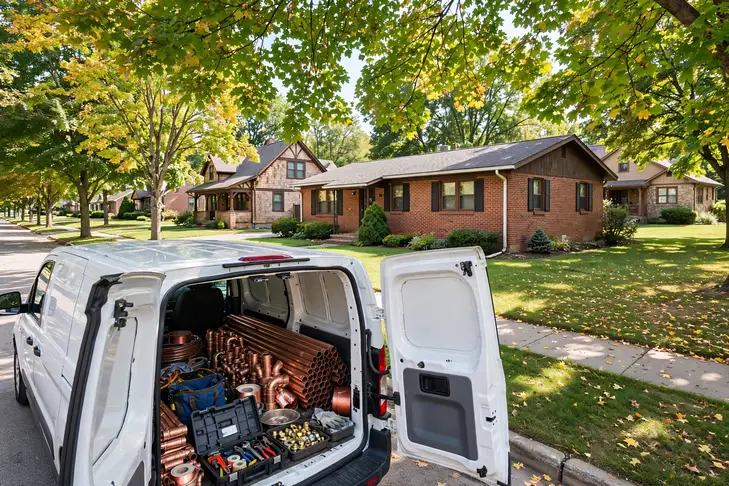


This is La Crosse's plumbing page, built from La Crosse's own numbers: Census housing figures, the metro's ZIP codes and its NOAA climate record. PlumbReach USA routes your call to an independent local plumber; the homework below is here so you know your home's likely problems before you ever make it.
Call center hours: Mon-Fri 7:00 AM-10:00 PM ET | Sat 8:00 AM-10:00 PM ET | Sun 7:00 AM-9:00 PM ET
The median La Crosse home was built in 1976; 55.6% of the stock predates 1980, and the pattern this metro's own data ranks first is ageing cast iron sewer lines. PlumbReach USA is a referral service, not a plumbing company: one call connects you with an independent local plumber serving your ZIP code.
La Crosse is a metro of 169,945 people and 70,803 households, and its plumbing is a portrait of its building history. The median home here was built in 1976; 55.6% of homes predate 1980 and 33.2% predate 1960, while 20.7% have arrived since 2000. Every one of those eras plumbed differently — different pipe materials, different drain designs, different fixtures — and they fail differently, which is why this page is organised around the patterns the data actually produces in La Crosse rather than plumbing in the abstract.
Stand in one of La Crosse's older neighbourhoods and you are standing in its plumbing's back catalogue. The homes there — part of the 42,216 built before 1980 across this metro — went up when galvanized steel was a supply line, cast iron or clay was a drain, and a fixture was expected to serve for half a century. That half-century has now elapsed. What it leaves behind is not universal failure but universal exposure: every joint, valve and lateral in those districts is operating past the horizon its makers planned for, in Houston County and beyond, and the failures arrive in the order the materials tire.
Growth wrote this metro's newest plumbing chapter in plastic and concrete: supply and drain lines in modern materials, fixtures by the catalogue, foundations poured as slabs across the subdivisions near Onalaska and Holmen. The chapter is young — its systems have decades in hand — but it is not exempt from the metro's arithmetic: 942 cooling degree days of demand work its heaters hard, and the soil under its slabs moves with the same seasons as the soil under the oldest farmhouse in Houston County.
The climate written over all of it comes from the NOAA station at LA CROSSE MUNI AP, WI US: an average year brings 6,788 heating degree days, 942 cooling degree days and 35.23 inches of precipitation. Those are not abstractions to a buried pipe or an exposed line — they set how often soil around a sewer lateral swells and shrinks, how hard a water heater cycles in January and July alike, and whether an uninsulated garage line is a worry or a certainty. The problem sections that follow are selected by exactly these numbers, combined with the housing-age profile above.
The metro's building eras on one side, its weather record on the other — and its plumbing where the two meet.
Break the stock down by building era and the profile sharpens. Before 1960: 33.2% of homes, roughly 25,208 of them. From 1960 to 1979: 22.4%, about 17,008. From 1980 to 1999: 23.7%, about 17,995. Since 2000: 20.7%, about 15,717. Four eras, four material palettes — and the balance among them is this metro's plumbing character in a single paragraph.
This is, by the numbers, an old-system metro. The largest slice of its housing predates 1960, which means the typical serious job here involves materials in their seventh decade or beyond: drains of cast iron or clay, supply runs in galvanized steel, laterals laid when the streets themselves were young. The newer bands exist — the growth since 2000 is real — but they are the supporting cast. La Crosse's plumbing identity was fixed by its earliest builders, and its problem list is written in their materials.
The runner-up era is 1980-1999, with 23.7% of homes. That stock has left its carefree decades and entered its maintenance decades, and it shows in the call pattern around Onalaska and the other districts of those years: heaters on their second or third cycle, fixtures reaching their wear points together, drains still young enough to reward attention over replacement.
No profile of this metro is complete without its extremes, because plumbing meets the extremes, not the averages. The average year at LA CROSSE MUNI AP, WI US — 48.9 degrees, 35.23 inches of precipitation — is a statistical resident of a metro nobody lives in. The lived version is the coldest night of January against an uninsulated run, the storm week that saturates the soil over every lateral, the August stretch that works heaters and drains without a pause. The numbers in this section are the averages; the problems ranked below are the extremes, translated.
A profile is only useful if it predicts something, and this one predicts the shape of a plumbing diary in La Crosse: which streets will call about drains, which about pressure, which about heaters, and in which months. Everything after this section is that prediction written out as services, problems and answers — the numbers first, the narrative second, the way the evidence actually runs.
Ranked for this metro alone, from its Census housing profile and NOAA climate record.
Time is unkind to cast iron below ground. The pipe that carried this metro's post-war growth was laid with a working life in mind, and the calendar has now passed it: the inner wall sheds its lining in flakes, rust blooms narrow the bore, and the rough surface that remains catches everything the household sends down. Flow fades first — a tub that empties slower each year — then the failures arrive: a section that gives way under the yard, a joint that weeps into the soil. Where the metro's housing is oldest, this is not an edge case; it is the standard condition of the stock, arriving street by street as each neighbourhood's pipes reach the same age together. The camera distinguishes rust from roots from collapse, and that distinction sets the job.
There is a temptation to judge an old drain by its kindest day. On its kindest day it still clears, still serves, still seems to argue for another year. Judge it instead by its trend: clearings that come closer together, a tub that drains slower each season, a smell that returns after rain. In the 25,208 pre-1960 homes across this metro, that trend is the pipe's biography being read aloud — corrosion does not pause between visits, and the homes that fare well are the ones whose owners believed the early chapters.
Put a number on it locally: roughly 25,208 homes in the La Crosse metro were built before 1960, when cast iron was the default drain material — and cast iron installed then has now been underground for six decades or more. Not every one of those lines has failed, and plenty test sound on a camera, but the population of pipes at risk here is counted in the tens of thousands of homes, which is why this pattern sits where it does on this page.
Galvanized steel pipe was plumbed into millions of homes, and it ages in a particular way: the zinc coating gives out, the steel rusts, and the rust grows inward until the pipe that once carried a full stream is choked to a fraction of its width. With a median build year of 1976 and 55.6% of its homes predating 1980, La Crosse has a large stock of housing in the galvanized era, and its symptoms are the classic ones — pressure that has faded a little more each year, water that runs rusty after the house sits quiet overnight, and leaks that begin appearing at joints. No cleaning reverses this; the corrosion is the pipe itself converting to rust. The judgement call is timing. A galvanized system with one small leak and acceptable pressure can be repaired and watched. A system leaking in several places, with pressure dropping across every fixture, is telling you the material has finished its service life, and each repair buys a shorter quiet interval than the last. Repiping in PEX or copper replaces the whole question with a new system and restores the pressure the home was built with.
Galvanized pipe fails politely, which is precisely the problem. No flood, no drama — just a shower that weakens across years, a washing machine that fills slowly, water that blushes rust after holidays. Households adapt without noticing, the way you adapt to a dimming bulb. The 17,008 homes built in this metro between 1960 and 1979 stand in the front of that queue now, their original steel bores narrowed to drinking-straw width in the worst runs. The fix, when it comes, tends to astonish people — not with its scale, but with the pressure they had forgotten they were owed.
Count it by era rather than by street: the metro's homes built between the war years and 1980 — the heart of the galvanized period — number in the tens of thousands here, and the 42,216 pre-1980 homes overall are the pool this problem draws from. Plumbers working La Crosse and the older districts can often date a home's pipework from the kerb, because the building booms that raised those neighbourhoods plumbed them all the same way.
Water expands as it freezes, and a pipe gives it nowhere to go. The split rarely announces itself in the cold — it waits for the thaw, when pressure returns and the crack opens into a spray inside a wall, a ceiling or a crawl space. The lines that go are predictable: runs through exterior walls, garages, crawl spaces and any stretch the heating never reaches, in homes plumbed before routing pipes through conditioned space became the habit. One hard night is enough; the damage is done by the thaw, and it is usually discovered by the sound of running water in a quiet house or a stain spreading across a ceiling that was dry at breakfast.
The burst itself usually happens quietly, inside a wall or under a floor, during the coldest hours — but the flood waits for the thaw. Ice seals the split it made, and only when temperatures rise and the ice lets go does the water start moving into the house. That delay is why freeze damage so often greets a La Crosse household in the morning or on return from a trip away. It is also why the checks after a hard freeze matter: pressure oddly low, a meter turning with nothing running, a damp patch at a wall base. Catch the split at the weep stage and the repair is a pipe; catch it after the thaw and it is a room.
Look at the shape of the risk in La Crosse: 140.7 sub-freezing nights a year at LA CROSSE MUNI AP, WI US means the exposure is a season, not an event. Stack that against the housing side — 42,216 homes built before modern freeze protection was routine — and the pattern explains itself: many lines, many cold nights, and a failure that needs only one bad intersection of the two.
Living with a real winter, as La Crosse does, means the season has a rhythm: the first hard freeze finds the unprepared lines, mid-winter tests the insulation, and the late thaws reveal whatever split quietly weeks before. Households that drain exterior lines in autumn and keep a trickle running on the coldest nights get through most winters with nothing to report.
The numbers behind the season here: 140.7 nights a year at or below freezing at LA CROSSE MUNI AP, WI US, against a housing stock whose median build year is 1976. Every winter writes the same exam for La Crosse's older pipes, and every winter some of them — usually in the the 1970s districts first — fail it.
The telltale geography here is generational. Cast iron under a La Crosse street means the street predates the metro's plastic era — the blocks around La Crosse first, the early suburbs second, almost nothing built after the material left standard practice. A homeowner in those blocks owns a drain in its eighth or ninth decade, and the diagnostic question is never whether the iron has corroded — it has — but how far the corrosion has travelled: a section, a run, or the whole line to the street. Cameras answer it street by street, house by house, and the answers in the oldest blocks rhyme closely enough that experienced local plumbers can often predict the footage before they see it.
Why here and not everywhere: La Crosse pairs 42,216 pre-1980 homes with 17.5 days a year at 90 degrees or more and 140.7 nights below freezing. Every metro pairs its housing with its weather somehow; this particular pairing is what puts the pattern where it sits on this page's list, ahead of problems that dominate metros built in other decades, under other skies.
Experienced local practice starts with the simple certainties — the observations that take minutes and decide the most:
Ordered by what this metro's data says its homes need most.
A house can survive a lot of plumbing faults, but not a failed path to the street. Sewer services confront the lateral directly — inspected by camera, cleared where clearing suffices, excavated and renewed where the pipe has structurally given up. The footage, shown to the homeowner, is the basis of every recommendation.
Sewer trouble in La Crosse rarely starts with the sewer. It starts with the ground-floor drain in the house misbehaving, and by the time sewage backs into a tub, the line outside has been compromised for a while — roots thickening at a joint, a belly deepening, cast iron scaling shut. The metro's older districts, where the housing predates 1960 by the thousands of homes, produce most of these calls; the established trees over those streets are both the neighbourhood's charm and its sewer lines' oldest enemy. The repair conversation here begins with a camera, not a shovel. That is the daily reality for the 70,803 households spread across Houston, La Crosse, Vernon.
Under La Crosse lie 75,928 laterals, one per housing unit, and the oldest of them — beneath the 25,208 pre-1960 homes — have been underground since the metro was a fraction of its present size. The camera diary in Onalaska and the old core is written by that buried generation.
Supply pipe is a house's circulatory system, and its diseases are degenerative: rust narrowing the arteries, corrosion pitting the walls, joints weeping at the seams. Repair treats the acute event. Repiping treats the disease — a planned replacement of the failing material throughout the home, staged so the household keeps water while its circulation is renewed, and verified under pressure before the walls close.
Every pipe in La Crosse is in one of three conditions: new enough to forget, old enough to watch, or old enough to be living on borrowed time. The stock's distribution across those conditions is the metro's building history restated — the pre-1980 districts deep in the third condition, the growth corridors still in the first — and pipe services are how individual homes move between them. A repair returns a watched system to service; a repipe promotes a borrowed-time system back to the first condition wholesale, at a stroke, for another generation. The assessment that chooses between them is short, physical and evidenced: pressure, water colour, and the repair history in the walls. Count it in homes if you prefer: 42,216 built before 1980, 15,717 since 2000, one shared system of soil and seasons.
Pipe work divides by era in this metro with unusual neatness: renewal conversations in the 42,216 pre-1980 homes, sectional repairs in the middle ring, and near-silence from the 15,717 post-2000 homes whose lines are still young. A call from West Salem can sit in any of the three bands; the home's build year says which before the door opens.
Heater work in La Crosse is workload work: 17.5 hot days and 6,788 heating degree days a year cycle the metro's tanks hard, and the local professionals routed here size, flush and replace against that record.
One call from anywhere in the La Crosse metro — from La Crosse out to West Salem — routes to the local professional on cover; the failure patterns they expect first are the ones this page's data ranks.
Across Houston, La Crosse, Vernon, drain calls follow the building map: iron and clay near the old core around La Crosse, plastic at the growth edge — one service, two different crafts, both covered by the routing on this page.
Leak detection in La Crosse is instrument work over local knowledge: acoustic and thermal tools, aimed first at the districts this page's data flags — the pre-1980 stock and the slab tracts out toward Holmen.
Toilet calls in La Crosse are the small end of the diary and the most democratic: every era of the 75,928-home stock produces them, and the local fix starts with the mechanism in the tank, not the porcelain.
Drips and disposals across Houston, La Crosse, Vernon are small jobs with a standard: repair the mechanism where the fixture deserves it, renew it where it does not, and check the shutoffs and supply lines while the cabinet is open.
Bookings in this metro have a centre of gravity, and it sits on the two patterns this page ranks first: Ageing cast iron sewer lines, then galvanized pipes at the end of their life. Everything a local service operation does — the vans' stock, the week's scheduling, the order of this very list — bends around that gravity. A homeowner reading the services above is therefore reading something more specific than a menu: a forecast of what a home like theirs, in a metro built like this one, is most likely to need, in the order it is most likely to need it.
 PROBLEM
 SOLUTION
Population 51,791
Population 18,909
Population 11,027
Population 5,268
Population 5,266
Population 4,469
Population 4,235
Population 2,825
Population 2,380
Population 1,858
Population 1,409
Population 1,223
Also in the La Crosse metro: Houston (population 883), Stoddard (population 860).
A metro is a federation of building decades wearing one name, and the grid above is La Crosse's federation: La Crosse at the centre, Onalaska (18,909 residents) and Holmen (11,027) in the next ring, and the smaller communities beyond, down to places a few thousand households deep. What unites them is one climate record and one routing; what divides them is the year their streets were plumbed. The ZIP list that follows is the practical definition of that federation — if your code is on it, your home's era is part of the data this page was built from.
The map continues: West Salem (5,268), La Crescent (5,266), Viroqua (4,469), French Island (4,235), Caledonia (2,825). Different names, different decades — each community in Houston, La Crosse, Vernon was plumbed in its own growth years, which is why two streets in the same metro can need entirely different plumbing conversations. The ZIP list below is the working definition of coverage; the housing behind each code is the working definition of the job.
La Crosse (51,791 residents) anchors the metro, and Onalaska (18,909) is its second centre of gravity. Between them they hold the bulk of the 70,803 households — and, not coincidentally, the bulk of every housing era this page discusses, from the pre-1960 core to the newest subdivisions. Holmen (11,027) and the communities beyond it repeat the same eras at smaller scale.
The metro answers to 3 county governments (Houston, La Crosse, Vernon), a patchwork that matters at permit time rather than at the pipe. Houston County carries the centre; the others carry the growth rings and the older outlying towns. A plumber routed through this page works inside that patchwork daily — the water does not care about the boundaries, but the job's paperwork does.
This page ends at the metro boundary, but the region does not: Eau Claire, WI, Madison, WI and Oshkosh, WI continue the coverage in their own directions, each with a profile built from its own Census and NOAA figures. If your home sits near the line between metros, go by your ZIP code — it places you in the dataset that describes your housing.
The region around La Crosse is a set of variations on its theme: Eau Claire, WI, 81 miles off, runs a median build year of 1977 on a metro population of 176,647; Madison, WI (89 miles) medians 1983 on 709,685; Oshkosh, WI (126 miles) medians 1975 on 174,218. Nearness is not sameness — a few decades of median build year separate their plumbing as surely as the miles separate their maps.
Divide the stock by the map and the densities appear: roughly 2,920 housing units for every covered ZIP code, 23,601 households to a county, 14 named communities in the grid. The balance between the generations reads 2.7 pre-1980 homes for every home built since 2000 — a single ratio that quietly predicts whether a metro's plumbing week leans toward renewal work in the old districts or first-generation upkeep in the new ones.
La Crosse by the derived numbers — median home age 50 years · owners in 48,288 homes, renters in 22,515 · each covered ZIP code carrying about 970 pre-1960 homes · a heating-to-cooling degree-day ratio of 7.2 · 895 mm average annual rainfall.
Before an emergency, read the guide: How to shut off your home's water main
One call connects you with an independent local plumbing professional serving La Crosse and the surrounding metro.
Call center hours: Mon-Fri 7:00 AM-10:00 PM ET | Sat 8:00 AM-10:00 PM ET | Sun 7:00 AM-9:00 PM ET