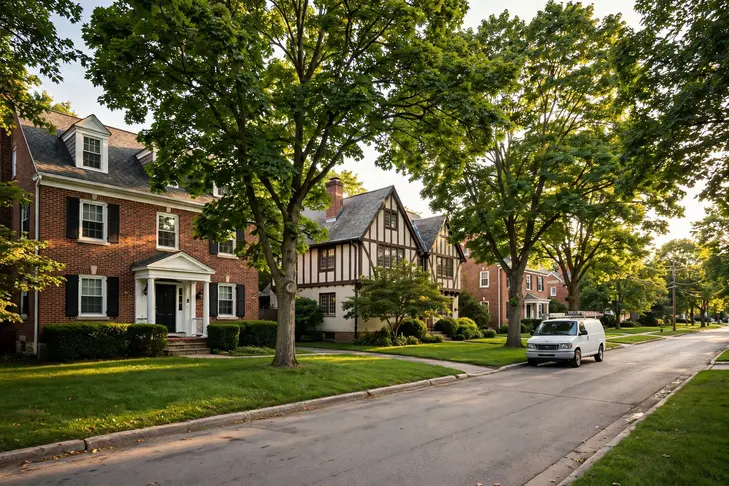


PlumbReach USA connects Detroit homeowners with independent local plumbers. This page is built from the metro's own Census housing data, ZIP codes and climate record — the plumbing problems described here are the ones Detroit homes actually have.
Call center hours: Mon-Fri 7:00 AM-10:00 PM ET | Sat 8:00 AM-10:00 PM ET | Sun 7:00 AM-9:00 PM ET
The median Detroit home was built in 1968; 66.7% of the stock predates 1980, and the pattern this metro's own data ranks first is ageing cast iron sewer lines. PlumbReach USA is a referral service, not a plumbing company: one call connects you with an independent local plumber serving your ZIP code.
Detroit is a metro of 4,367,620 people and 1,755,372 households, and its plumbing is a portrait of its building history. The median home here was built in 1968; 66.7% of homes predate 1980 and 39.9% predate 1960, while 13.2% have arrived since 2000. Every one of those eras plumbed differently — different pipe materials, different drain designs, different fixtures — and they fail differently, which is why this page is organised around the patterns the data actually produces in Detroit rather than plumbing in the abstract.
There is a materials timeline buried in Detroit's housing figures, and it reads like a plumber's diary. The 764,000 homes from before 1960 were drained in cast iron or clay and supplied, in many cases, in galvanized steel. The 513,163 that followed between 1960 and 1979 mixed those materials with early copper. Then came the 384,872 homes of 1980-1999, plumbed increasingly in copper and early plastics. Each band of that timeline is now a band of characteristic failures, arriving in the order the materials tire — which is why a home's build year, in this metro, is the single most predictive fact about its plumbing.
Uniformity is the newer stock's defining trait. A subdivision in Warren or Sterling Heights went up in a handful of years, fitted with one generation of fixtures, one heater model class, one approach to running lines under slabs. That uniformity writes a calendar the whole street shares: the first heater wave, the first cartridge wave, the first questions about lines under concrete arrive together, years before the same streets need anything structural. With 13.2% of the metro built since 2000, that calendar governs a large and growing share of Detroit's plumbing work — predictable work, if a household reads the calendar early.
Over everything sits the weather, and here it is measured rather than described: NOAA's station at PONTIAC OAKLAND CO INTL AP, MI US averages 48.4 degrees across the year, with 9.9 days reaching 90 or more and 135.5 nights at freezing or below. A buried lateral feels that record as soil that swells and pulls away; a water heater feels it as an unbroken cycle count; an exposed line feels it on the single coldest night. The problem ranking below is what those numbers, crossed with the housing profile, produce for Detroit specifically.
Two public records, one metro: what was built here, and what the sky does to it.
The distribution, in one breath: of every hundred Detroit homes, 39.9 were standing before 1960, 26.8 went up in the two decades after, 20.1 in the two after that, and 13.2 have arrived since 2000. Percentages flatten the picture, so hold the counts beside them — 764,000 oldest-era homes, 252,752 newest — and the metro's plumbing stops being an abstraction: it is that many systems, of those ages, failing in that order.
Some metros are defined by their growth; this one is defined by its inheritance. The largest share of Detroit's homes was built before 1960, and inheritance in plumbing means materials at the end of their design lives serving households who did not choose them. The work that follows from that fact is the metro's staple: drains renewed, supplies renewed, laterals renewed — the patient, house-by-house replacement of a founding stock. Newer districts exist and matter, but they are not where this metro's plumbing character was decided.
Close behind the leader come the 1960-1979 homes, 26.8% of the stock. Their plumbing is mid-change by construction — the decades when materials swapped over mid-stream — so this band is where a Detroit plumber earns the diagnostic fee: pressure tests and camera runs that say which side of the transition a given house was built on.
The climate column of this profile is a workload statement. 6,679 heating degree days say how long the cold half of the year keeps inlet water near its chilliest and heaters firing at their hardest; 658 cooling degree days say how relentlessly the hot half loads every drain and tank; 135.5 freezing nights and 9.9 hot days mark the extremes where the failures concentrate. NOAA keeps these figures at PONTIAC OAKLAND CO INTL AP, MI US as thirty-year normals — which is to say, as the closest thing plumbing has to a settled forecast.
That is the whole method of this page in one section: era shares from the Census, loads from NOAA, and a problem list that is simply where the two overlap most in Detroit. The services and guidance that follow are ordered by the same profile — local first, generic last.
Sequenced by this metro's own problem ranking, not by a national catalogue order.
Of all a home's pipes, the sewer lateral works under the worst conditions: buried, jointed, rooted at, and loaded by every fixture in the building. Its care begins with seeing it — a camera run that records material, slope and damage — and proceeds by the footage's logic: clear what clearing cures, mend what is locally broken, renew what has failed along its length. No stage of that is guesswork, and the homeowner sees the same footage the plumber does.
The camera footage is where Detroit's sewer conversations get honest. From the surface, a backup is a backup; on the screen, the metro's whole history is visible — clay joints shouldered apart by decades of soil movement, cast iron scaled to half its width, a plastic line in a newer subdivision bellied where its bedding settled. Lapeer County's older laterals and the growth areas' young ones fail in their own dialects, and the repair that follows the footage — sectional, partial, or the full run to the street — is the one the pipe itself argues for. It is why two Detroit homes of the same age, on different streets, so often need the same visit in the same year.
Under Detroit lie 1,914,787 laterals, one per housing unit, and the oldest of them — beneath the 764,000 pre-1960 homes — have been underground since the metro was a fraction of its present size. The camera diary in Warren and the old core is written by that buried generation.
In Detroit this service is booked most often through the problem patterns at the top of this page — the metro's housing data, not habit, sets the order. If your home is in the 66.7% built before 1980, mention its age on the call: it changes the parts the plumber loads before heading to Detroit and the rest of the metro.
One leak is an event; three in a year is a verdict. Pipe work weighs that pattern — the metal's age, the water's behaviour, the repair history — and either fixes the section in front of it or proposes the honest larger job: a whole-house repipe that ends the rhythm for good.
Not every old pipe in Detroit needs replacing, and the assessment matters: a sound copper system from the 1960s with one failed joint is a repair; a galvanized system with rust at every exposed fitting is a repipe waiting for its date. The metro's newer subdivisions (13.2% built since 2000) sit this conversation out for now — their turn comes decades from now. For the older stock, the job is planned around the household: routes through accessible spaces, water restored in stages, and openings kept to where lines actually have to pass. Count it in homes if you prefer: 1,277,163 built before 1980, 252,752 since 2000, one shared system of soil and seasons.
The repair-or-renew caseload is set by one figure above the rest: 66.7% of Detroit homes predate 1980, plumbed in the materials now at the end of their service lives. Around Dearborn (107,846 residents) as in the old core, that percentage is not an abstraction — it is the street's plumbing, house by house.
One local habit worth copying: Detroit homeowners who mention their street's building era when they book get a better-matched visit, because a plumber heading to a the 1960s home in Lapeer County loads different parts than one heading to a slab-built subdivision in Warren. The service is the same; the preparation is local.
Hot water is a daily expectation so total that its absence reorganises a household within hours. Heater servicing protects that expectation: burners and elements tested, sediment drained, the safety valve exercised, the anode's remaining life judged. When the tank itself is finished, installation replaces it with a unit matched to the home's demand and venting, set up to serve the same expectation for another decade.
Hot water shapes a household's day so completely that the heater is most truly understood as a member of it — one that works silently for years and resigns without notice. In Detroit those resignations bunch predictably: after the first cold snap drives inlet temperatures down, through the peak-demand weeks of high summer, in the subdivisions where every tank was installed in the same season of the same year. The servicing visit interrupts the resignation letter — sediment drained, anode judged, connections checked — and the replacement conversation, when it comes, starts from evidence gathered in the closet rather than steam in the shower. Locally the workload concentrates where the stock is oldest — the districts built around the 1960s first.
The arithmetic behind the diary: 1,755,372 households heating water through 658 cooling degree days and 6,679 heating degree days a year — every one of those households a tank ageing on the same climate's schedule, from the pre-war homes to the newest builds around Troy.
Where this service gets booked in Detroit follows the map on this page: the older districts generate the deep-end work, the post-2000 subdivisions the wear-and-tear work, and the 384,872 homes in between split the difference. Telling the call center your home's build decade — most Detroit owners know it within a few years — puts the right kit on the van the first time.
In Detroit the emergency call is routed, not queued: one number reaches the independent local plumber covering Lapeer, Livingston, Macomb, Oakland, St. Clair, Wayne at that hour, and the housing record on this page — median build year 1968 — is the homework they arrive already knowing.
Drain work in Detroit splits by era: the 1,277,163 pre-1980 homes drain through older materials, the post-2000 subdivisions through plastic — and the local plumber reads the cable's return to tell which world your street drains through.
Leak detection in Detroit is instrument work over local knowledge: acoustic and thermal tools, aimed first at the districts this page's data flags — the pre-1980 stock and the slab tracts out toward Sterling Heights.
Running, rocking or refusing — in Detroit the diagnosis is the same short sequence: fill valve, flapper, supply line, flange. The plumbers routed here carry the internals for the fixtures this metro's eras installed.
Fixture work in Detroit divides by era like everything else on this page: washer-era taps in the older districts, cartridge internals in the post-2000 subdivisions — the local plumber stocks for both.
Two patterns generate most of the bookings behind the services above: Ageing cast iron sewer lines and galvanized pipes at the end of their life. That is why the order of this page's service list is what it is — the services answering those patterns come early, and the rest follow in the order the metro's data supports. A homeowner whose home matches the local profile — built in the metro's big decades, in one of its older districts — is, statistically, reading their own shortlist.
Chosen by this metro's own housing and weather data — the same two records this whole page is built from.
Ask a cast iron drain how it is doing and it answers at the ground-floor fixture in the house. That is where a failing main shows itself first — the ground-floor bath that gurgles, the basement drain that sighs up odours — because everything above drains through the same tired run. In Detroit, the homes reporting those signals share a profile: built when cast iron was the default, in the streets around Detroit that went up first. The pipe underground is rough now with scale, its bore narrowed, its joints weeping into the soil — and the fixtures upstairs are merely its messengers.
There is a temptation to judge an old drain by its kindest day. On its kindest day it still clears, still serves, still seems to argue for another year. Judge it instead by its trend: clearings that come closer together, a tub that drains slower each season, a smell that returns after rain. In the 764,000 pre-1960 homes across this metro, that trend is the pipe's biography being read aloud — corrosion does not pause between visits, and the homes that fare well are the ones whose owners believed the early chapters.
The local weight of it: 764,000 homes in this metro predate 1960, and while some have renewed their drains since, every original line still serving is past the age its installers planned for. That is a population of risk no single street explains — it is the metro's founding stock, failing on a schedule set in the post-war decades.
The galvanized story can be told at a single tap. Open the fixture farthest from the meter in a Detroit home still on its original steel and watch the stream: respectable for a moment, then thinning as the narrowed runs upstream ration the flow. That rationing is the material's old age made visible — decades of internal rust taxing every gallon. The metro holds 1,277,163 pre-1980 homes, and in the ones never repiped, the tax rises yearly. Unlike most plumbing failures, this one is perfectly forecastable: the tap has been reporting it, patiently, for years.
Galvanized pipe fails politely, which is precisely the problem. No flood, no drama — just a shower that weakens across years, a washing machine that fills slowly, water that blushes rust after holidays. Households adapt without noticing, the way you adapt to a dimming bulb. The 513,163 homes built in this metro between 1960 and 1979 stand in the front of that queue now, their original steel bores narrowed to drinking-straw width in the worst runs. The fix, when it comes, tends to astonish people — not with its scale, but with the pressure they had forgotten they were owed.
The replacement side of the ledger is equally local: when a Detroit home of the galvanized era is sold, inspected or renovated, the supply lines are among the first systems examined — because everyone in the local trade knows the material's age here. A pattern the whole market has learned to look for is not an anecdote; it is the metro's housing data wearing a tape measure.
Ice does its damage in silence and announces it in flood. The split forms under pressure while the line is frozen, holds while the ice plug seals it, and opens the moment the thaw restores flow — which is why burst pipes are so often discovered by sound: water running somewhere it should not be, in a house that was intact at breakfast. Detroit's exposure sits where its housing does — in the older districts' unprotected runs and every era's additions and garages — and the repair visit's second job, after the pipe itself, is the insulation and routing that keep the same night from repeating.
Prevention, for this pattern, is a geography lesson: the burst never happens in the middle of the heated house. It happens at the perimeter — the wall cavity on the windward side, the run beneath the addition, the pipe the builder routed through the garage to spare six feet of copper. In Detroit, where 9.9 summer days tempt everyone to forget what 135.5 freezing nights intend, the autumn ritual is short and specific: find every line that leaves the warmth, and do something about it. The households that keep that ritual read about burst pipes the way other people do — as news.
Look at the shape of the risk in Detroit: 135.5 sub-freezing nights a year at PONTIAC OAKLAND CO INTL AP, MI US means the exposure is a season, not an event. Stack that against the housing side — 1,277,163 homes built before modern freeze protection was routine — and the pattern explains itself: many lines, many cold nights, and a failure that needs only one bad intersection of the two.
Every lateral in Detroit is a private road with a public destination, and like a road it wears where the traffic and the ground conspire: at the joints. Sections laid generations ago were joined to the standards of their day, and the decades since have worked each joint individually — a fraction of movement here, a root hair there. The ground-floor fixtures report the cumulative result. Sewer service is the survey of that road, cleanout to street, and its recommendations scale with the survey: a joint renewed, a section replaced, or — where the whole run has given up — a new road laid on the old one's line.
Slope is the lateral's invisible specification. A sewer line does not need much fall — a quarter inch per foot is the classic figure — but it needs it consistently, and ageing takes consistency away: a section settles, a joint steps down, and the line develops a reach where flow slows and solids settle out. That belly then collects a little more each week, narrowing the line from the bottom up. Many a Detroit lateral diagnosed as 'blocked' is really 'bellyed' — clearable today, certain to collect again. The camera distinguishes the two, and the distinction decides whether the household is booking a cleaning or planning a repair.
The depth of the bench matters locally: this is not a pattern confined to a few old streets. Every district built before modern plastic — the core, the post-war rings, the middle suburbs — holds laterals of the same generations, and the metro's own growth means their combined length runs to thousands of miles of buried, jointed, ageing pipe. The ranking reflects that inventory, nothing more exotic.
A tank heater is a vessel that cooks its own lining. Every heating cycle precipitates minerals out of the water, and they settle on the tank floor as sediment — an insulating blanket that makes the burner or element work longer, rumbling as steam pockets form and collapse beneath it. Meanwhile the anode rod, installed to be corroded in the steel's place, quietly spends itself. When it is gone, the tank itself is next. The pattern is universal, but the pace belongs to the local water and the local climate: the harder a metro heats and the more hot water its households draw, the sooner the rumble, the rust-tinged water and the puddle at the base arrive to announce the end of a heater's service.
Two heaters of the same age can live very different lives in this metro, and the difference is usually maintenance rather than luck. The attended tank — sediment drained yearly, anode checked before it is spent, temperature kept sane — routinely outlasts its neglected twin by years. The neglected one's decline announces itself in the water first: a rust blush at the hot tap, a sulphur note after holidays, hot water that arrives carrying the tank's interior with it. By the time the symptoms are that descriptive, the conversation has usually moved from servicing to succession planning.
Scale the problem by the metro's own numbers: 1,755,372 households, each cycling a tank through 658 cooling degree days of heavy summer demand and 6,679 heating degree days of cold incoming water. That is a workload measured in millions of heating cycles a year across Detroit — and sediment, the main product of all that work, never leaves the tank unless someone drains it out.
Winter in Detroit is pipe season. With about 135.5 nights a year at or below freezing on the long-term record, the houses that get through winter cleanly are the ones whose exposed lines were dealt with in autumn: insulation on garage and crawl-space runs, hoses off the outside taps so those lines can drain, and a household that knows where its main shutoff is before it needs it. During the hardest cold, a slow drip from the tap furthest from the main and open cabinet doors under sinks on outside walls are simple insurance. If a line does freeze, shut the water off before the thaw does its damage and have the run checked — a pipe that froze once has shown you exactly where it is vulnerable.
The numbers behind the season here: 135.5 nights a year at or below freezing at PONTIAC OAKLAND CO INTL AP, MI US, against a housing stock whose median build year is 1968. Every winter writes the same exam for Detroit's older pipes, and every winter some of them — usually in the the 1960s districts first — fail it.
The telltale geography here is generational. Cast iron under a Detroit street means the street predates the metro's plastic era — the blocks around Detroit first, the early suburbs second, almost nothing built after the material left standard practice. A homeowner in those blocks owns a drain in its eighth or ninth decade, and the diagnostic question is never whether the iron has corroded — it has — but how far the corrosion has travelled: a section, a run, or the whole line to the street. Cameras answer it street by street, house by house, and the answers in the oldest blocks rhyme closely enough that experienced local plumbers can often predict the footage before they see it.
Why here and not everywhere: Detroit pairs 1,277,163 pre-1980 homes with 9.9 days a year at 90 degrees or more and 135.5 nights below freezing. Every metro pairs its housing with its weather somehow; this particular pairing is what puts the pattern where it sits on this page's list, ahead of problems that dominate metros built in other decades, under other skies.
On a first visit for this pattern, a local plumber's checks run in a practised order:
 PROBLEM
 SOLUTION
Population 636,644
Population 138,128
Population 133,473
Population 107,846
Population 94,058
Population 87,307
Population 84,155
Population 83,316
Population 76,086
Population 76,025
Population 66,224
Population 62,405
Also in the Detroit metro: Dearborn Heights (population 62,099), Pontiac (population 61,914).
Beyond Detroit itself, the metro takes in Warren (138,128 residents), Sterling Heights (133,473) and the rest of the communities in the grid above — each plumbed in its own building era, which is why two streets in the same metro can need entirely different plumbing conversations. The ZIP list below is the full coverage footprint: if your code is on it, this page was written about your housing stock.
The map continues: Dearborn (107,846), Livonia (94,058), Troy (87,307), Westland (84,155), Farmington Hills (83,316). Different names, different decades — each community in Lapeer, Livingston, Macomb, Oakland, St. Clair, Wayne was plumbed in its own growth years, which is why two streets in the same metro can need entirely different plumbing conversations. The ZIP list below is the working definition of coverage; the housing behind each code is the working definition of the job.
Start with Detroit itself: 636,644 residents, 14.6% of the metro — the centre the rest of the map orbits. Warren (138,128) and Sterling Heights (133,473) form the next ring out, housing with its own building decades and its own plumbing generations. Beyond them the metro thins into the smaller communities in the grid above, each a few thousand households deep — small in population, identical in one respect: their pipes answer to the same eras and the same weather as the big city's.
The metro answers to 6 county governments (Lapeer, Livingston, Macomb, Oakland, St. Clair, Wayne), a patchwork that matters at permit time rather than at the pipe. Lapeer County carries the centre; the others carry the growth rings and the older outlying towns. A plumber routed through this page works inside that patchwork daily — the water does not care about the boundaries, but the job's paperwork does.
Three neighbouring coverage areas begin where this one ends: Flint, MI, some 33 miles off; Ann Arbor, MI, 44 miles; and Monroe, MI, 56 miles. Each keeps its own page because each keeps its own numbers — a different median build year, a different climate station, a different problem ranking. Boundary households should trust the ZIP list over the map: the code, not the compass, assigns the dataset.
Set Detroit among its neighbours and the contrasts sharpen the profile: Flint, MI — metro population 401,093, median build year 1969 — sits 33 miles away; Ann Arbor, MI (370,214, median 1978) 44 miles; Monroe, MI (156,004, median 1973) 56 miles. Three different housing stocks under three nearby skies, which is why each keeps its own page and its own problem ranking rather than borrowing this one.
Count the metro per unit of itself: 8,783 housing units per covered ZIP code; 292,562 households per county; 14 communities sharing 6 county governments. Then weigh the generations against each other — 5.1 older homes for each newer one — and the service pattern on this page stops being a list and becomes a proportion: that much of the diary written by ageing systems, the rest by young ones wearing in.
The Detroit record in one line — median home age: 58 years · owner-occupied homes: 1,244,559 · renter-occupied homes: 510,813 · pre-1960 homes per covered ZIP code: 3,505 · heating-to-cooling degree-day ratio: 10.15 · average rainfall: 741 mm a year.
Before an emergency, read the guide: How to shut off your home's water main
PlumbReach USA routes your call to an independent local plumbing professional serving Detroit — the assessment and the work are theirs.
Call center hours: Mon-Fri 7:00 AM-10:00 PM ET | Sat 8:00 AM-10:00 PM ET | Sun 7:00 AM-9:00 PM ET