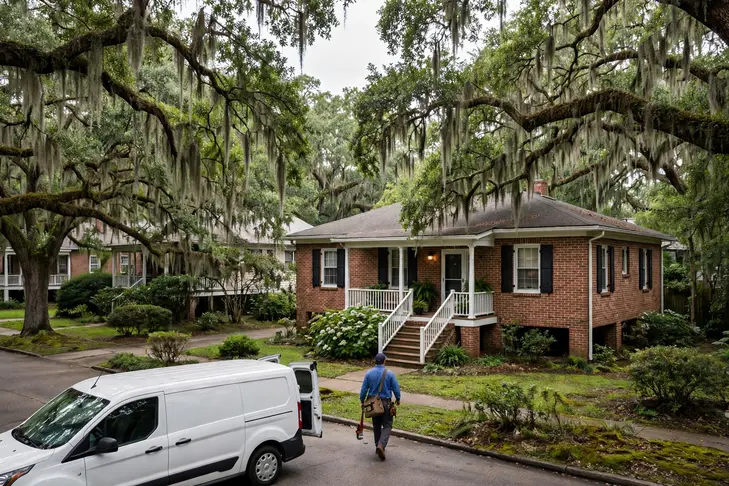


This is Savannah's plumbing page, built from Savannah's own numbers: Census housing figures, the metro's ZIP codes and its NOAA climate record. PlumbReach USA routes your call to an independent local plumber; the homework below is here so you know your home's likely problems before you ever make it.
Call center hours: Mon-Fri 7:00 AM-10:00 PM ET | Sat 8:00 AM-10:00 PM ET | Sun 7:00 AM-9:00 PM ET
The median Savannah home was built in 1990; 36.8% of the stock predates 1980, and the pattern this metro's own data ranks first is slab leaks under concrete foundations. PlumbReach USA is a referral service, not a plumbing company: one call connects you with an independent local plumber serving your ZIP code.
Savannah is a metro of 412,089 people and 158,617 households, and its plumbing is a portrait of its building history. The median home here was built in 1990; 36.8% of homes predate 1980 and 19.1% predate 1960, while 37.4% have arrived since 2000. Every one of those eras plumbed differently — different pipe materials, different drain designs, different fixtures — and they fail differently, which is why this page is organised around the patterns the data actually produces in Savannah rather than plumbing in the abstract.
Stand in one of Savannah's older neighbourhoods and you are standing in its plumbing's back catalogue. The homes there — part of the 65,712 built before 1980 across this metro — went up when galvanized steel was a supply line, cast iron or clay was a drain, and a fixture was expected to serve for half a century. That half-century has now elapsed. What it leaves behind is not universal failure but universal exposure: every joint, valve and lateral in those districts is operating past the horizon its makers planned for, in Bryan County and beyond, and the failures arrive in the order the materials tire.
The growth side of the metro tells the opposite story in the same language. Pooler, Richmond Hill and the subdivisions still filling in account for much of the 66,783 homes built since 2000 — plastic supply lines, plastic drains, cartridge fixtures, slab foundations. Their plumbing is not old; it is uniform, which creates its own calendar: everything installed in the same boom reaches each wear point in the same years, from the first water-heater replacements to the first slab-leak scares, while 2,596 cooling degree days of annual heat keep demand on the system high.
Over the housing sits one more dataset, the sky's: 1,675 heating degree days and 2,596 cooling degree days in the average year at SAVANNAH INTL AP, GA US, an average temperature of 67.4 degrees, extremes at both ends faithfully recorded. A metro's plumbing is designed — to the extent it is designed at all — for the middle of that record, and it fails at the record's edges. What follows is a page about the edges: the cold snaps, the storm weeks, the long hot stretches, and the systems they find first.
Housing eras and climate, joined — the two datasets every section of this page is built from.
The distribution, in one breath: of every hundred Savannah homes, 19.1 were standing before 1960, 17.7 went up in the two decades after, 25.8 in the two after that, and 37.4 have arrived since 2000. Percentages flatten the picture, so hold the counts beside them — 34,106 oldest-era homes, 66,783 newest — and the metro's plumbing stops being an abstraction: it is that many systems, of those ages, failing in that order.
Growth is the headline in Savannah: the post-2000 band is the largest, much of it slab-built subdivisions plumbed in plastic and fitted with cartridge fixtures. The work here is young-stock work — heater replacements arriving in waves as whole streets age together, slab-line questions, fixture internals — carried out on systems whose first owners often never needed a plumber. The metro's older pockets still generate the deep problems, but the volume of its plumbing future is being written in the new subdivisions.
Second in the table, the 1980-1999 band: 46,070 homes, 25.8% of the metro. Its systems are mature rather than ancient — copper in its pinhole years in places, plastic drains still sound, first-generation cartridges wearing out in waves — and its plumbing is the schedulable kind: work that rewards being booked before it becomes urgent.
The climate column of this profile is a workload statement. 1,675 heating degree days say how long the cold half of the year keeps inlet water near its chilliest and heaters firing at their hardest; 2,596 cooling degree days say how relentlessly the hot half loads every drain and tank; 21.4 freezing nights and 80.5 hot days mark the extremes where the failures concentrate. NOAA keeps these figures at SAVANNAH INTL AP, GA US as thirty-year normals — which is to say, as the closest thing plumbing has to a settled forecast.
Hold the two halves together and the rest of this page explains itself: the problems ranked highest here are the ones where Savannah's dominant housing era and its climate record overlap. Change either dataset and the ranking changes — which is precisely why this profile is rebuilt from the records for every metro instead of carried over from the last one.
Selected and ranked from this metro's housing-age profile and climate record — not copied from another city's page.
Begin with the design decision: run the water lines under the concrete, where nothing can drip visibly, freeze accessibly or be repaired without breaking ground. It was a sensible decision for the builder and a lifelong riddle for the owner. In Savannah's slab districts the riddle presents the same way everywhere — the bill that climbs without a lifestyle change, the meter that moves in an empty house, the one warm square of flooring. Each clue is faint alone. Together they are the leak's signature, written in the only languages a buried pipe can speak: money, motion and heat.
The physics under the slab are patient ones. A pressurised copper line resting against aggregate, flexing a fraction with every heating and cooling cycle and every shift of the soil, can wear or corrode at a single point for years before it opens. When it does, the leak is small and constant — which is worse news than a dramatic break, because it can run for months, feeding moisture into the soil the foundation bears on and quietly inflating every water bill. The signs stay indirect precisely because the water never surfaces: it moves down and out, not up. That indirection is why slab leaks are a detection problem first and a repair problem second, and why the listening equipment that locates the leak to a marked square of floor changes the whole shape of the job.
The arithmetic of concealment: 66,783 homes built since 2000, most on slabs, joining the post-war slab tracts — a buried-line population in the tens of thousands of runs, each invisible from inside the house. Even a small annual failure rate across that population produces this metro's steady background count of slab calls.
Ask a cast iron drain how it is doing and it answers at the ground-floor fixture in the house. That is where a failing main shows itself first — the ground-floor bath that gurgles, the basement drain that sighs up odours — because everything above drains through the same tired run. In Savannah, the homes reporting those signals share a profile: built when cast iron was the default, in the streets around Savannah that went up first. The pipe underground is rough now with scale, its bore narrowed, its joints weeping into the soil — and the fixtures upstairs are merely its messengers.
Look inside an old cast iron line with a camera and the failure stops being abstract. The inner wall grows rough with tuberculation — rust nodules that narrow the bore and catch everything passing. The bottom of the run, where water and grit travel, thins fastest; the top can look sound while the channel below it is nearly through. Roots enter at joints and add their own blockage. A Savannah line of this vintage is therefore not one problem but a profile of problems along its length, and the repair that makes sense — cleaning, a section, a full replacement — is the one matched to the worst ten feet the camera finds, not the average of the whole run.
The local weight of it: 34,106 homes in this metro predate 1960, and while some have renewed their drains since, every original line still serving is past the age its installers planned for. That is a population of risk no single street explains — it is the metro's founding stock, failing on a schedule set in the post-war decades.
Between the house and the street connection sits the lateral — the home's own stretch of sewer line — and it is the homeowner's responsibility, which surprises many people the first time it fails. In Savannah, where 19.1% of homes were built before 1960 and the median home dates to 1990, laterals have been in the ground through decades of soil movement, root growth and material ageing. Clay joints shift and open, older pipe bellies where bedding has washed out, and a line can lose its clean fall to the street, so waste slows, settles and eventually blocks. The signs are house-wide rather than fixture-specific: several drains slow together, the ground-floor fixtures act up first, and cleanings help for shorter and shorter stretches. A camera run down the lateral settles the argument about what is happening — it measures the damage by distance, shows whether it is one bad joint or the whole story of the line, and lets the repair be sized to the actual problem instead of the whole run by default.
The lateral is the hardest-working pipe a household owns and the only one nobody ever sees. It carries everything, it was buried once and forgotten, and its condition depends on decisions made the year the house was built: the material chosen, the slope it was laid at, the soil it was bedded in. Ageing laterals fail in characteristic ways — joints offset as soil settles, bellies where the bedding washed or sagged, walls thinned by decades of flow. The house above reports these failures indirectly, through its ground-floor fixtures, which is why a sewer problem so often gets mistaken for a simple clog at first. In Savannah, where whole districts were built in the same few decades, laterals are ageing on a shared timetable — the line under one house is a fair guide to the line under its neighbour's.
Every one of the metro's 178,564 housing units drains through exactly one lateral, and in the older districts those laterals are as old as the streets above them. The pre-1960 share alone — 34,106 homes — represents that many buried lines in their seventh decade of service, under soil that shifts with Savannah's wet and dry seasons. Most will never draw attention; the ones that fail announce themselves through the ground-floor fixtures first.
Galvanized pipe does not fail loudly; it fails by narrowing. Zinc coating gone, the steel rusts from the wet side, and every year the passage water travels through is a little smaller than the year before. The household reads it as personality — the shower that weakens when a tap opens, the washing machine that fills slowly, the rust tinge after a holiday — until the day a pinhole opens in a wall and the personality becomes a flood. In housing built when galvanized was simply how houses were plumbed, the whole system is one age and one material, which is why the faults stop being isolated: the pipe is not breaking in one place, it is finishing in all of them at the same pace, and the repair conversation has to reckon with that arithmetic.
Galvanized pipe fails politely, which is precisely the problem. No flood, no drama — just a shower that weakens across years, a washing machine that fills slowly, water that blushes rust after holidays. Households adapt without noticing, the way you adapt to a dimming bulb. The 31,606 homes built in this metro between 1960 and 1979 stand in the front of that queue now, their original steel bores narrowed to drinking-straw width in the worst runs. The fix, when it comes, tends to astonish people — not with its scale, but with the pressure they had forgotten they were owed.
Count the exposure from the Census side: the metro's 65,712 pre-1980 homes were plumbed in galvanized's long reign, and the material's failure mode — internal rust, narrowing bore — is a matter of chemistry, not workmanship. The variable is speed; the direction, for every one of those systems still original, is settled.
The season's plumbing story is told in water levels: soil saturated to the surface, groundwater standing high against every lateral joint, drains asked to carry away in hours what they usually carry in weeks. Backups follow the ground-floor fixtures, and the post-storm weeks bring the secondary wave — lines found to have shifted in softened ground, cleanouts buried under debris. Homes prepare the way they can: drains known, shutoffs known, the number for help already saved before the sky makes the decision for them.
The season's measure at SAVANNAH INTL AP, GA US is 48.12 inches of rain in an average year, with the storm months capable of delivering a season's worth in days. Savannah's laterals — the generations-old runs under Savannah and the old core most of all — carry the surge, and the backups of storm season are written in that arithmetic.
What makes the slab leak the defining pattern of the growth-era metro is the combination of concealment and consequence. Concealment, because the line is entombed: no crawl space to inspect, no basement ceiling to stain. Consequence, because the escaping water undermines the very ground the slab rests on and feeds the heater a second, phantom household to supply. Savannah's slab stock spans both the post-war tracts and the 66,783 homes built since 2000 — the pattern crosses eras wherever the concrete does — and its detection has become a small science of meters, microphones and thermal cameras precisely because eyes are useless here.
The numbers underneath it, for Savannah: 178,564 housing units, a median build year of 1990, and a climate record at SAVANNAH INTL AP, GA US of 1,675 heating degree days against 2,596 cooling degree days. Cross the housing record with the weather record and this pattern is what falls out at the top — rarely the most dramatic problem in plumbing, but the one this metro's stock and climate manufacture most steadily.
The first visit follows a short, diagnostic list — each item ruling a branch of the problem in or out:
Listed in the order this metro's housing and climate data supports.
The expensive leaks are the quiet ones: a pinhole misting inside a wall, a slab line weeping into the ground for months. Finding them is a measurement exercise — meter behaviour, acoustic listening, pressure isolation — that narrows a whole house down to a square foot before a single board is lifted.
Every detection job in Savannah begins with a subtraction problem: the meter's total, minus everything the household can account for, equals the leak. The arithmetic is simple; the geography is not. That missing water is travelling somewhere inside a stock of 178,564 homes built across a century of methods — through slab concrete in one district, behind plaster in another, under a yard line in a third. The instruments change with the construction, but the logic never does: measure the loss, halve the search area, halve it again, and open the building exactly once, at the marked point. That is the daily reality for the 158,617 households spread across Bryan, Chatham, Effingham.
Scale the problem by the Census count and it stays concrete: 178,564 housing units, each a small network of pressurised lines, each capable of losing water silently. The meters across Savannah register those losses in aggregate; the detection visit exists to assign one of them to one address — in Pooler this month, somewhere else next.
The sewer line is the one pipe every other pipe depends on. When it bellies, cracks or fills with roots, the whole house feels it through its ground-floor fixtures. Repair ranges from sectional fixes through a cleanout to full replacement, chosen from camera footage rather than guesswork.
Consider the lateral as the home's only road out: every drain, every flush, every appliance discharge travels it. In Savannah's older districts that road was built generations ago, in sections, and it has been subsiding, rooting and corroding on its own schedule ever since. The sewer visit surveys the road before recommending anything — its material, its slope, where it is broken versus merely blocked — because the remedies differ by an order of magnitude and the footage, not the symptom, is what separates them. A cleared symptom on a broken road is a postponement, and local plumbers here give their advice accordingly: honestly, from the camera's evidence. Count it in homes if you prefer: 65,712 built before 1980, 66,783 since 2000, one shared system of soil and seasons.
Under Savannah lie 178,564 laterals, one per housing unit, and the oldest of them — beneath the 34,106 pre-1960 homes — have been underground since the metro was a fraction of its present size. The camera diary in Wilmington Island and the old core is written by that buried generation.
Pipes fail in two tenses: suddenly, at a joint or a split, and gradually, as a material narrows, thins or pits across a whole system. The first tense asks for a repair; the second eventually asks the larger question. Pipe services cover both — the sectional fix that restores a sound system, and the planned renewal that replaces a failing material through the whole house, routed to spare the building and staged to keep the household in water.
Pressure is the pipe system's public voice, and in Savannah it speaks with a district accent. In the pre-1980 districts — 65,712 homes — it fades year by year as galvanized bores narrow, a decline so gradual that households adapt to it fixture by fixture and only notice when a visitor's shower puts theirs to shame. In the newer subdivisions it stays loud and even. The repair-or-renew decision is usually just a translation of that voice: a system whose pressure is leaving has delivered its diagnosis already, and the assessment visit exists to confirm it in person. With a median build year of 1990, most of the metro's 178,564 housing units are working through the same ageing curve.
Pipe work divides by era in this metro with unusual neatness: renewal conversations in the 65,712 pre-1980 homes, sectional repairs in the middle ring, and near-silence from the 66,783 post-2000 homes whose lines are still young. A call from Georgetown can sit in any of the three bands; the home's build year says which before the door opens.
From Savannah to Wilmington Island, the heater question is the same — repair the unit or renew it — and the honest answer starts from its age against Savannah's demand record, which this page sets out.
In Savannah the emergency call is routed, not queued: one number reaches the independent local plumber covering Bryan, Chatham, Effingham at that hour, and the housing record on this page — median build year 1990 — is the homework they arrive already knowing.
Savannah's drains are cleared by local independents who work this stock weekly: a median build year of 1990 means most lines they open have decades of history in them, and the clearing approach is chosen for the era, not the postcode.
In Savannah, a toilet that runs all night is a water bill with a sound; the local service replaces the tired internals and checks the flange and supply while the tank is open.
In Savannah the faucet call is often the first plumbing visit a newer home ever gets — the professionals routed here treat it as an introduction: the fixture fixed, and the home's shutoffs and heater age noted for the record.
Ask where this metro's plumbing diary fills up and the answer is a short story: Slab leaks under concrete foundations first, ageing cast iron sewer lines close behind, and the services that answer them doing the bulk of the booked work. Everything else on the list above is the supporting cast — necessary, frequent enough, but not what Savannah's housing stock, at its age and in its climate, principally demands. Read the service list as a weather report for the metro's pipes and it stops looking like a catalogue.
 PROBLEM
 SOLUTION
Population 147,546
Population 27,235
Population 17,408
Population 14,457
Population 11,997
Population 11,606
Population 11,152
Population 10,375
Population 8,907
Population 6,918
Population 4,704
Population 4,640
Also in the Savannah metro: Tybee Island (population 3,121), Bloomingdale (population 2,983).
Read the grid as a building programme spread over a century. The oldest communities sit where the metro began; the youngest are still adding streets at its edge; and Pooler and Richmond Hill, with 27,235 and 17,408 residents, stand for the rings in between. Each ring plumbed in its era's materials, and each is now failing, wearing or holding in its era's characteristic order. The ZIP codes below draw the coverage boundary; the eras inside it draw everything else on this page — the problems ranked, the services ordered, the checks advised.
The map continues: Wilmington Island (14,457), Port Wentworth (11,997), Georgetown (11,606), Rincon (11,152), Garden City (10,375). Different names, different decades — each community in Bryan, Chatham, Effingham was plumbed in its own growth years, which is why two streets in the same metro can need entirely different plumbing conversations. The ZIP list below is the working definition of coverage; the housing behind each code is the working definition of the job.
Start with Savannah itself: 147,546 residents, 35.8% of the metro — the centre the rest of the map orbits. Pooler (27,235) and Richmond Hill (17,408) form the next ring out, housing with its own building decades and its own plumbing generations. Beyond them the metro thins into the smaller communities in the grid above, each a few thousand households deep — small in population, identical in one respect: their pipes answer to the same eras and the same weather as the big city's.
Draw the metro by its paperwork and it resolves into Bryan, Chatham, Effingham — 3 jurisdictions sharing one housing stock and one weather system. Bryan County holds the historic centre and the densest share of the older homes; the surrounding counties hold the rings of growth around it. Permits and inspections follow those boundaries even though water never does, which is part of why the plumber this page connects you to works these streets specifically.
Beyond the metro line, the nearest covered metros are Augusta, GA (108 miles away), Valdosta, GA (143 miles) and Warner Robins, GA (146 miles) — separate pages, separate profiles, because their housing and weather records are their own. Homeowners near the boundary sit between two datasets; the ZIP list above, not the map's edge, decides which page was written about your stock.
The region around Savannah is a set of variations on its theme: Augusta, GA, 108 miles off, runs a median build year of 1987 on a metro population of 641,231; Valdosta, GA (143 miles) medians 1991 on 153,276; Warner Robins, GA (146 miles) medians 1993 on 208,091. Nearness is not sameness — a few decades of median build year separate their plumbing as surely as the miles separate their maps.
Ratios tell the metro's story compactly. Renters occupy 38.5% of homes; owners hold the rest. For every home built since 2000 there are 1.0 from before 1980. Spread the stock across the coverage map and each ZIP code carries about 7,440 housing units — the density at which era patterns repeat street after street instead of scattering, and at which a routed round of calls stays inside a few districts.
One line of Savannah arithmetic — a median home 36 years old · 97,549 owner-occupied homes against 61,068 renter-occupied · 1,421 pre-1960 homes for every covered ZIP code · a heating-to-cooling degree-day ratio of 0.65 · 1,222 mm of rain in an average year.
Before an emergency, read the guide: How to shut off your home's water main
PlumbReach USA routes your call to an independent local plumbing professional serving Savannah — the assessment and the work are theirs.
Call center hours: Mon-Fri 7:00 AM-10:00 PM ET | Sat 8:00 AM-10:00 PM ET | Sun 7:00 AM-9:00 PM ET