

Home / Cities / Georgia / Athens

Plumbing Services in Athens, GA

This is Athens's plumbing page, built from Athens's own numbers: Census housing figures, the metro's ZIP codes and its NOAA climate record. PlumbReach USA routes your call to an independent local plumber; the homework below is here so you know your home's likely problems before you ever make it.

Call center hours: Mon-Fri 7:00 AM-10:00 PM ET | Sat 8:00 AM-10:00 PM ET | Sun 7:00 AM-9:00 PM ET

18
ZIP codes covered
4
Counties in the metro
85,019
Households (Census ACS)
1990
Median year home built
Athens, GA — the metro skyline and landscape
Athens, GA — plumbing help across the metro
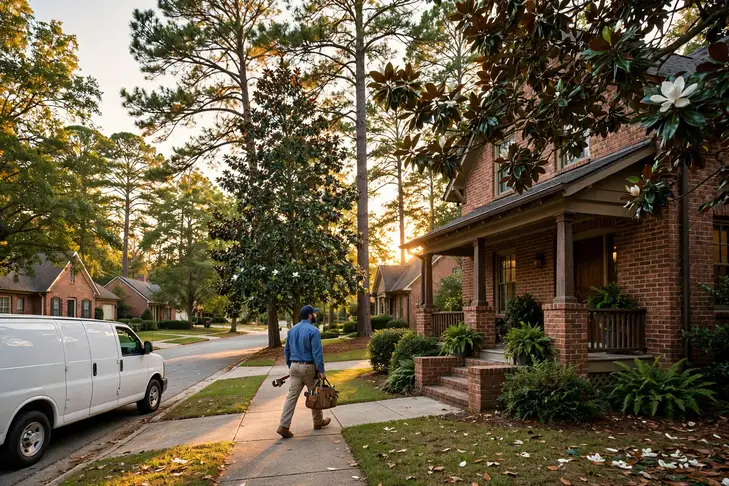
A local plumber's van on a residential street
Local plumbers serving Athens neighbourhoods
Water heater installation in a home garage
Replacing a heater in a Athens home

Athens plumbing, in brief

The median Athens home was built in 1990; 35.5% of the stock predates 1980, and the pattern this metro's own data ranks first is slab leaks under concrete foundations. PlumbReach USA is a referral service, not a plumbing company: one call connects you with an independent local plumber serving your ZIP code.

The Athens housing stock, and what it means for plumbing

Two numbers frame everything that follows: 55.1% of Athens homes are owner-occupied, and the median one was built in 1990. Ownership matters to plumbing because owners inherit their systems whole — every material decision a builder made in the 1990s or earlier is still in the walls, ageing on its original schedule. With 35.5% of homes predating 1980 and 31.3% arriving since 2000, the metro is really two housing stocks sharing one map, and they are taken separately below before the problems are ranked.

There is a materials timeline buried in Athens's housing figures, and it reads like a plumber's diary. The 10,843 homes from before 1960 were drained in cast iron or clay and supplied, in many cases, in galvanized steel. The 21,504 that followed between 1960 and 1979 mixed those materials with early copper. Then came the 30,160 homes of 1980-1999, plumbed increasingly in copper and early plastics. Each band of that timeline is now a band of characteristic failures, arriving in the order the materials tire — which is why a home's build year, in this metro, is the single most predictive fact about its plumbing.

The growth side of the metro tells the opposite story in the same language. Watkinsville, Winterville and the subdivisions still filling in account for much of the 28,520 homes built since 2000 — plastic supply lines, plastic drains, cartridge fixtures, slab foundations. Their plumbing is not old; it is uniform, which creates its own calendar: everything installed in the same boom reaches each wear point in the same years, from the first water-heater replacements to the first slab-leak scares, while 1,955 cooling degree days of annual heat keep demand on the system high.

Over the housing sits one more dataset, the sky's: 2,670 heating degree days and 1,955 cooling degree days in the average year at ATHENS BEN EPPS AP, GA US, an average temperature of 63.0 degrees, extremes at both ends faithfully recorded. A metro's plumbing is designed — to the extent it is designed at all — for the middle of that record, and it fails at the record's edges. What follows is a page about the edges: the cold snaps, the storm weeks, the long hot stretches, and the systems they find first.

The Athens plumbing profile in numbers

Two public records, one metro: what was built here, and what the sky does to it.

The distribution, in one breath: of every hundred Athens homes, 11.9 were standing before 1960, 23.6 went up in the two decades after, 33.1 in the two after that, and 31.3 have arrived since 2000. Percentages flatten the picture, so hold the counts beside them — 10,843 oldest-era homes, 28,520 newest — and the metro's plumbing stops being an abstraction: it is that many systems, of those ages, failing in that order.

The metro's plumbing present was installed between 1980 and 1999, and it is ageing as a cohort. That cohort's traits are consistent: sound bones, wearing surfaces. The systems beneath these homes are not failing from corrosion sagas but from the accumulated cycles of two to four decades — and the work they generate is the steady, schedulable kind, provided it is scheduled. Left alone, cohort ageing has a way of arriving all at once; attended to, it is the most manageable profile a metro can have.

Behind the leading era, the growth band: 31.3% of homes arrived since 2000. Their plumbing is uniform by construction — one generation of fixtures, one approach to lines under slabs — which writes a shared calendar the whole street keeps. Reading that calendar early is most of what separates a planned replacement from a weekend emergency in Athens's newest districts.

The climate half of the profile, from ATHENS BEN EPPS AP, GA US: 2,670 heating degree days against 1,955 cooling degree days, 48.95 inches of precipitation, an average temperature of 63.0 degrees. Read together, those figures describe the loads: how hard heaters cycle, how often the soil around buried lines swells and shrinks, and how much of the year exposed pipework spends anywhere near freezing — 46.4 nights at or below it, against 62.2 days at 90 or above.

That is the whole method of this page in one section: era shares from the Census, loads from NOAA, and a problem list that is simply where the two overlap most in Athens. The services and guidance that follow are ordered by the same profile — local first, generic last.

Plumbing services in Athens

Sequenced by this metro's own problem ranking, not by a national catalogue order.

Leak Detection & Repair in Athens

Pinpoint first, open second. That order defines leak work: isolate sections, listen along the runs, confirm with pressure, and only then cut — precisely, once. The repair itself is usually ordinary plumbing; the skill being bought is knowing exactly where ordinary plumbing needs to happen.

The leaks that hit Athens homeowners hardest share a trait: they were small for a long time. A supply line misting inside a wall cavity through a whole season, a slab run weeping into dry soil that drinks it silently — by the time evidence surfaces, the water has been travelling for months. Detection work exists to shorten that interval, and in this metro it leans on the meter above all: the one instrument that never sleeps, registering the leak's signature in the small hours when an honest system reads zero. A household that knows its meter's quiet behaviour owns an early-warning system already installed. In Athens that holds across 18 ZIP codes, from Athens-Clarke County unified government (balance) out to Winterville.

The search territory is the metro's whole stock: 28,520 homes built since 2000, most of them hiding lines under slabs, against 32,347 pre-1980 homes hiding theirs in walls and crawl spaces — detection in Watkinsville and detection in the subdivisions are different hunts for the same missing water.

More about leak detection & repair ➔

Pipe Repair & Repiping in Athens

Pipes fail in two tenses: suddenly, at a joint or a split, and gradually, as a material narrows, thins or pits across a whole system. The first tense asks for a repair; the second eventually asks the larger question. Pipe services cover both — the sectional fix that restores a sound system, and the planned renewal that replaces a failing material through the whole house, routed to spare the building and staged to keep the household in water.

Every pipe in Athens is in one of three conditions: new enough to forget, old enough to watch, or old enough to be living on borrowed time. The stock's distribution across those conditions is the metro's building history restated — the pre-1980 districts deep in the third condition, the growth corridors still in the first — and pipe services are how individual homes move between them. A repair returns a watched system to service; a repipe promotes a borrowed-time system back to the first condition wholesale, at a stroke, for another generation. The assessment that chooses between them is short, physical and evidenced: pressure, water colour, and the repair history in the walls. Ask in Comer and the answer rhymes with Athens-Clarke County unified government (balance): same eras, same materials, same calendar of failures.

The repair-or-renew caseload is set by one figure above the rest: 35.5% of Athens homes predate 1980, plumbed in the materials now at the end of their service lives. Around Comer (1,928 residents) as in the old core, that percentage is not an abstraction — it is the street's plumbing, house by house.

More about pipe repair & repiping ➔

Sewer Line Repair & Replacement in Athens

Sewer work in Athens begins with the camera: the laterals under the 10,843 pre-1960 homes near the core are a different job from the plastic runs at the edge, and the footage decides which repair the line gets.

More about sewer line repair & replacement ➔

Water Heater Repair & Installation in Athens

Heater work in Athens is workload work: 62.2 hot days and 2,670 heating degree days a year cycle the metro's tanks hard, and the local professionals routed here size, flush and replace against that record.

More about water heater repair & installation ➔

Emergency Plumbing in Athens

In Athens the emergency call is routed, not queued: one number reaches the independent local plumber covering Clarke, Madison, Oconee, Oglethorpe at that hour, and the housing record on this page — median build year 1990 — is the homework they arrive already knowing.

More about emergency plumbing ➔

Drain Cleaning in Athens

Drain work in Athens splits by era: the 32,347 pre-1980 homes drain through older materials, the post-2000 subdivisions through plastic — and the local plumber reads the cable's return to tell which world your street drains through.

More about drain cleaning ➔

Toilet Repair & Installation in Athens

Running, rocking or refusing — in Athens the diagnosis is the same short sequence: fill valve, flapper, supply line, flange. The plumbers routed here carry the internals for the fixtures this metro's eras installed.

More about toilet repair & installation ➔

Faucet, Fixture & Garbage Disposal Repair in Athens

Fixture work in Athens divides by era like everything else on this page: washer-era taps in the older districts, cartridge internals in the post-2000 subdivisions — the local plumber stocks for both.

More about faucet, fixture & garbage disposal repair ➔

What Athens books most

Ask where this metro's plumbing diary fills up and the answer is a short story: Slab leaks under concrete foundations first, freeze-burst pipes in cold snaps close behind, and the services that answer them doing the bulk of the booked work. Everything else on the list above is the supporting cast — necessary, frequent enough, but not what Athens's housing stock, at its age and in its climate, principally demands. Read the service list as a weather report for the metro's pipes and it stops looking like a catalogue.

Plumbing problems Athens homes actually get

Chosen by this metro's own housing and weather data — the same two records this whole page is built from.

Slab leaks under concrete foundations

A slab home keeps its secrets under concrete. The supply lines run beneath the floor, and when one begins to leak — worked by soil movement, chafed where it passes through the slab, thinned by decades of hot water — the evidence surfaces everywhere except at the leak: a meter that turns with every tap closed, a patch of floor warm to bare feet, a water bill that climbs without a change in the household's habits. Left alone, the leak undermines the soil the slab rests on and feeds moisture into flooring from below. Finding it is a listening exercise: acoustic equipment traces the sound of escaping water through the concrete to a single point, so the floor opens once, in the right place.

The cruel arithmetic of a slab leak is that time is water. A pinhole under concrete does not drip into a bucket; it saturates the ground, swells what can swell, and bills the household for every gallon. Weeks of it can pass between the first warm patch on the floor and the diagnosis, which is why the meter test matters so much in Athens's slab districts: ten minutes with every tap closed tells a household whether its concrete is hiding something, long before the floor itself confesses.

The arithmetic of concealment: 28,520 homes built since 2000, most on slabs, joining the post-war slab tracts — a buried-line population in the tens of thousands of runs, each invisible from inside the house. Even a small annual failure rate across that population produces this metro's steady background count of slab calls.

Watch for

  • One room's flooring persistently warmer than the rest
  • The faint sound of running water in a silent house
  • Baseboards pulling away or paint bubbling at floor level

About leak detection & repair ➔

Freeze-burst pipes in cold snaps

Water expands as it freezes, and a pipe gives it nowhere to go. The split rarely announces itself in the cold — it waits for the thaw, when pressure returns and the crack opens into a spray inside a wall, a ceiling or a crawl space. The lines that go are predictable: runs through exterior walls, garages, crawl spaces and any stretch the heating never reaches, in homes plumbed before routing pipes through conditioned space became the habit. One hard night is enough; the damage is done by the thaw, and it is usually discovered by the sound of running water in a quiet house or a stain spreading across a ceiling that was dry at breakfast.

Prevention, for this pattern, is a geography lesson: the burst never happens in the middle of the heated house. It happens at the perimeter — the wall cavity on the windward side, the run beneath the addition, the pipe the builder routed through the garage to spare six feet of copper. In Athens, where 62.2 summer days tempt everyone to forget what 46.4 freezing nights intend, the autumn ritual is short and specific: find every line that leaves the warmth, and do something about it. The households that keep that ritual read about burst pipes the way other people do — as news.

Look at the shape of the risk in Athens: 46.4 sub-freezing nights a year at ATHENS BEN EPPS AP, GA US means the exposure is a season, not an event. Stack that against the housing side — 32,347 homes built before modern freeze protection was routine — and the pattern explains itself: many lines, many cold nights, and a failure that needs only one bad intersection of the two.

Watch for

  • A tap that runs slower or stops during a cold snap, then returns
  • Frost or condensation on an exposed pipe in the garage or crawl space
  • A sudden drop in pressure, or the sound of water, as temperatures rise after a freeze

About pipe repair & repiping ➔

Galvanized pipes at the end of their life

Galvanized pipe does not fail loudly; it fails by narrowing. Zinc coating gone, the steel rusts from the wet side, and every year the passage water travels through is a little smaller than the year before. The household reads it as personality — the shower that weakens when a tap opens, the washing machine that fills slowly, the rust tinge after a holiday — until the day a pinhole opens in a wall and the personality becomes a flood. In housing built when galvanized was simply how houses were plumbed, the whole system is one age and one material, which is why the faults stop being isolated: the pipe is not breaking in one place, it is finishing in all of them at the same pace, and the repair conversation has to reckon with that arithmetic.

The geography of galvanized failure inside one house is uneven, and the unevenness misleads people. The runs nearest the water heater corrode fastest, worked by heat; long horizontal runs narrow differently from vertical risers; the line to a little-used guest bathroom may be nearly closed while the kitchen still flows. This is why a Athens home can seem fine at most taps while one shower has given up entirely. Repiping answers the whole geography at once, which is its real argument: not that any single run has failed, but that the system's remaining life is scattered unevenly through every wall, and spot repairs keep buying the shortest-lived section.

Count it by era rather than by street: the metro's homes built between the war years and 1980 — the heart of the galvanized period — number in the tens of thousands here, and the 32,347 pre-1980 homes overall are the pool this problem draws from. Plumbers working Athens-Clarke County unified government (balance) and the older districts can often date a home's pipework from the kerb, because the building booms that raised those neighbourhoods plumbed them all the same way.

Watch for

  • Pressure fading gradually across the whole house
  • Rusty water after the taps sit unused
  • Repairs needed more often, in more places

About pipe repair & repiping ➔

Getting ready for cold snaps in Athens

Cold snaps in Athens do not need to be record-breaking to cause damage — a few nights well below freezing is enough for an exposed or poorly insulated line. Before the coldest stretch of the year, the checks that matter are simple: know where the main shutoff is and that it turns, insulate the lines in garages and crawl spaces, disconnect garden hoses so the outside taps can drain, and on the coldest nights let a vulnerable tap drip slowly and open cabinet doors so warm room air reaches the pipes beneath sinks on outside walls.

Locally, the risk concentrates in the older housing: the 32,347 pre-1980 homes across the metro carry the exterior-wall runs and crawl-space lines that a snap finds first, and ATHENS BEN EPPS AP, GA US's record says the cold, when it comes to Athens, arrives fast enough to catch them unprepared.

A closer look: slab leaks under concrete foundations in Athens

Slab leaks map onto Athens's growth pattern with unusual precision. The leaks live where the slabs are: the post-war subdivisions, the boom-era tracts around Athens-Clarke County unified government (balance), and the 28,520 homes built since 2000 on concrete. Pier-and-beam and basement homes in the older districts have their own leak problems, but they announce them visibly — it is the slab stock that hides its failures under flooring. Within a slab neighbourhood the risk is shared: same builder era, same soil, same line materials, which is why one confirmed leak on a street reasonably raises the alertness of every house on it.

Strip the pattern down to its inputs and the ranking stops being mysterious: 85,019 households drawing on systems installed across a median build year of 1990, in a climate that swings between 62.2 days of serious heat and 46.4 freezing nights. Whatever pattern a metro with those inputs manufactures most, it manufactures here — the lead position is less a title than a consequence, recalculated from the same public records any sceptic can check.

On a first visit for this pattern, a local plumber's checks run in a practised order:

  • The meter's behaviour with every tap closed — movement is the first fact
  • Warm or damp patches in hard flooring, and flooring beginning to lift
  • The water bill's trend over six months, not just the latest month
  • Whether the home's lines have ever been rerouted before — a previous fix changes the map

From problem to fixed, in Athens

A plumbing problem inside a Athens homePROBLEM
➔
The same system in Athens after professional repairSOLUTION

Areas covered in the Athens metro

Athens-Clarke County unified government (balance)

Population 126,987

Watkinsville

Population 3,151

Winterville

Population 2,245

Comer

Population 1,928

Bogart

Population 1,298

Crawford

Population 996

Danielsville

Population 971

North High Shoals

Population 751

Colbert

Population 667

Ila

Population 490

Bishop

Population 484

Arnoldsville

Population 470

Also in the Athens metro: Lexington (population 470), Maxeys (population 348).

The communities in the grid are not suburbs of the page; they are its subject as much as Athens-Clarke County unified government (balance) is. Watkinsville (3,151 residents) and Winterville (2,245) carry their own building decades, their own pipe materials and their own positions in the problem ranking's logic — a lateral under a Watkinsville street answers to the same data as one in the centre, but to a different era of it. Coverage here is defined by the ZIP list below; understanding is defined street by street, and this page's figures are the metro-wide version of a story each community tells in its own numbers.

Beyond the largest communities sit Comer (1,928), Bogart (1,298), Crawford (996), Danielsville (971), North High Shoals (751) — smaller places across Clarke, Madison, Oconee, Oglethorpe, covered on the same terms. Their housing tends to be older on average than the big suburbs', and their calls follow the older patterns on this page. One routing covers them all: find your ZIP code below and the rest is a phone call.

Athens ZIP codes we cover

30601, 30602, 30605, 30606, 30609, 30619, 30621, 30622, 30627, 30628, 30629, 30630, 30633, 30646, 30648, 30667, 30677, 30683

The Athens metro in detail

The metro's weight is not evenly spread. Athens-Clarke County unified government (balance) holds 126,987 of the 218,190 residents; Watkinsville and Winterville add 3,151 and 2,245; and the remainder scatters across the smaller places above, some no bigger than a few thousand people. Plumbing follows the weight — most calls come from where most homes are — but era matters more than size: a small community of 1960s housing generates older-system work than a large new subdivision does.

Administratively the metro is drawn from Clarke, Madison, Oconee, Oglethorpe — 4 in all — with Clarke County at its centre. County lines do not change pipe physics, but they do shape the paperwork around the work: permits, inspections and code details are county and city business, which is one reason the professional who serves your street is a local one.

Three neighbouring coverage areas begin where this one ends: Gainesville, GA, some 40 miles off; Atlanta, GA, 63 miles; and Augusta, GA, 73 miles. Each keeps its own page because each keeps its own numbers — a different median build year, a different climate station, a different problem ranking. Boundary households should trust the ZIP list over the map: the code, not the compass, assigns the dataset.

Set Athens among its neighbours and the contrasts sharpen the profile: Gainesville, GA — metro population 226,568, median build year 1995 — sits 40 miles away; Atlanta, GA (6,482,182, median 1993) 63 miles; Augusta, GA (641,231, median 1987) 73 miles. Three different housing stocks under three nearby skies, which is why each keeps its own page and its own problem ranking rather than borrowing this one.

Ratios tell the metro's story compactly. Renters occupy 44.9% of homes; owners hold the rest. For every home built since 2000 there are 1.1 from before 1980. Spread the stock across the coverage map and each ZIP code carries about 5,062 housing units — the density at which era patterns repeat street after street instead of scattering, and at which a routed round of calls stays inside a few districts.

The Athens record in one line — median home age: 36 years · owner-occupied homes: 46,845 · renter-occupied homes: 38,174 · pre-1960 homes per covered ZIP code: 602 · heating-to-cooling degree-day ratio: 1.37 · average rainfall: 1,243 mm a year.

Athens plumbing questions

What area does PlumbReach USA cover around Athens?
Coverage follows the metro's own map: 18 ZIP codes across Clarke, Madison, Oconee, Oglethorpe, anchored on Athens-Clarke County unified government (balance) and running out through Watkinsville, Winterville and Comer. The list printed on this page is the working boundary — inside it, one call routes you to an independent local plumber who serves your street. Put the coverage against the Census map and it tracks the population: Athens-Clarke County unified government (balance) first (58.2% of the metro), then the rings of suburbs and smaller communities in their own building decades — all of it inside the same routing. If a street sits between Winterville and Comer, it is in; the list was drawn from the Census map of the metro — 4 counties, 18 codes — rather than from a radius around a shop. The ground inside that boundary holds 91,118 housing units — 10,843 from before 1960, 21,504 from 1960-1979, 28,520 since 2000 — under the climate record kept at ATHENS BEN EPPS AP, GA US. Stated as the communities it covers: the community ledger reads Athens-Clarke County unified government (balance) (126,987 residents), Watkinsville (3,151), Winterville (2,245), Comer (1,928) and Bogart (1,298), out of 218,190 residents metro-wide.
If my Athens house dates to about 1990, where does a plumber look first?
Walk it the way a plumber would. First the visible evidence: staining under sinks, a meter that creeps, drains that have slowed by degrees. Then the era evidence: a home of about 1990 in this metro sits amid 33.1% of housing built between 1980 and 1999 and an older core built earlier still, so mixed pipework — some original, some renewed — is the expectation, and knowing which of yours is which is most of the answer. In Athens that plays out across 18 ZIP codes, from Athens-Clarke County unified government (balance) to Watkinsville. Geography of the advice: it holds across 18 ZIP codes and 4 counties, in the 85,019 households the Census counts from Athens-Clarke County unified government (balance) out to Comer — the eras differ by district, the watch-list does not. The same applies street by street in Clarke County: a median year of 1990 is an average, and the homes on either side of it — older in the core, newer past Comer — read from the same materials list. Set against the climate that works on them — 2,670 heating degree days, 1,955 cooling degree days, 48.95 inches of rain at ATHENS BEN EPPS AP, GA US — the era of a Athens home is the strongest single clue to the condition of its plumbing. Where the watching happens, in figures: the community ledger reads Athens-Clarke County unified government (balance) (126,987 residents), Watkinsville (3,151), Winterville (2,245), Comer (1,928) and Bogart (1,298), out of 218,190 residents metro-wide — one timetable of ageing systems across all of them.
Which plumbing fault shows up most often across Athens?
Count from the housing up and the answer is slab leaks under concrete foundations. A slab home keeps its secrets under concrete. The runner-up patterns on this page matter too — a metro rarely specialises in a single fault — but the leader is the leader because Athens's mix of eras and weather manufactures it at scale. The backdrop is the same metro-wide: 91,118 housing units working against the ATHENS BEN EPPS AP, GA US climate record. For scale, the runner-up is freeze-burst pipes in cold snaps, and the gap between them is the metro's own arithmetic: housing counted across Clarke, Madison, Oconee, Oglethorpe, weather logged at ATHENS BEN EPPS AP, GA US, and an era profile with a median of 1990. Change one input and the order moves: at ATHENS BEN EPPS AP, GA US the record reads 2,670 heating degree days against 1,955 cooling; in the stock, 11.9% predates 1960 and 35.5% predates 1980. The inputs behind the ranking, community by community: the community ledger reads Athens-Clarke County unified government (balance) (126,987 residents), Watkinsville (3,151), Winterville (2,245), Comer (1,928) and Bogart (1,298), out of 218,190 residents metro-wide.
Is Athens's climate hard on pipes, or is that just something plumbers say?
Directly. The long-term normals at ATHENS BEN EPPS AP, GA US — 2,670 heating degree days, 1,955 cooling degree days, 48.95 inches of precipitation in an average year — set the local plumbing calendar: freeze risk for exposed lines in the cold stretch, heavy heater and drain loads through the hot months, and soil that swells and shrinks between seasons, which buried lines feel before anything else does. Read the record as the station logs it — ATHENS BEN EPPS AP, GA US, the NOAA station nearest this metro's centre: 2,670 heating degree days against 1,955 cooling degree days in a normal year. Every pattern ranked on this page was scored against those two numbers and the housing figures beside them. It is the same story from Watkinsville to Winterville — the stock decides, and this stock's median build year is 1990. The record behind it is measured at ATHENS BEN EPPS AP, GA US and felt from Watkinsville to Comer: one climate for Clarke, Madison, Oconee, Oglethorpe, 91,118 housing units, and every pipe, heater and lateral inside them. The figures are worth keeping with the house papers: 63.0 degrees as the yearly average at ATHENS BEN EPPS AP, GA US, 48.95 inches of precipitation, and a housing stock whose median year is 1990 — the three numbers this metro's plumbing lives by. The numbers in one line: 63.0 degrees average, 48.95 inches of precipitation, 2,670 heating degree days, 1,955 cooling degree days, 62.2 days at 90 or above, 46.4 nights at freezing or below. Whose roofs that weather works on: the community ledger reads Athens-Clarke County unified government (balance) (126,987 residents), Watkinsville (3,151), Winterville (2,245), Comer (1,928) and Bogart (1,298), out of 218,190 residents metro-wide.
I can hear water running inside a wall at my Athens home. First move?
Shutoff first, questions later. In most Athens homes the main valve sits by the meter or where the supply line comes through the wall; turn it, open the tap at the bottom of the system to drain the lines down, and move anything water-soluble out of the wet zone. Sewage changes the rules — keep people and pets out of it entirely — and the smell of gas means leave and call from outside. Across the metro's 4 counties, Clarke County included, the pattern repeats wherever the housing matches. The geography is printed on this page: 18 ZIP codes across Clarke, Madison, Oconee, Oglethorpe, and in every one of them the first move is identical even though the valve's address changes — interior wall in the older districts around Athens-Clarke County unified government (balance), meter box at the street in the newer rings past Watkinsville (3,151 residents). The calm-day homework for this metro: walk the 18 covered ZIP codes' worth of housing in your mind to your own valve — in Clarke County the older stock hides it indoors, the slab tracts past Winterville at the meter — and turn it once before you ever need it in anger. The calm-day version, localised: find your valve before ATHENS BEN EPPS AP, GA US's next freeze season — 46.4 freezing nights a year — whether your home sits near Athens-Clarke County unified government (balance), out in Watkinsville (3,151 residents) or past Winterville (2,245). True from the centre to the edge: the community ledger reads Athens-Clarke County unified government (balance) (126,987 residents), Watkinsville (3,151), Winterville (2,245), Comer (1,928) and Bogart (1,298), out of 218,190 residents metro-wide — shutoff first, everywhere on the map. The ranking that frames the damage: Slab leaks under concrete foundations first on this page, freeze-burst pipes in cold snaps second, galvanized pipes at the end of their life third — the burst line in front of you belongs to the same local arithmetic. The calm-day version of this answer is a walk: the valve behind a 30601 address, the meter box on a 30621 street, the interior shutoff in a 30633 home — three eras, three addresses for the same valve, all inside this metro's 18 codes.
When does a Athens house cross the line from repairs to a full repipe?
It is less about age than about evidence. A sound copper system from the 1990s with a single failed joint is a repair, full stop. The repipe case builds when the same material fails in different places — and with 32,347 pre-1980 homes in this metro, local plumbers see that sequence weekly. Pressure declining across every fixture at once is the other half of the verdict. Homeowners in Watkinsville (3,151) and Winterville (2,245) read this page for the same reason — the stock there is the same stock. It holds in the 30,160 homes built between 1980 and 1999 just as it holds in the older core. Ask where this conversation happens most and the answer is a map: the districts plumbed in the galvanized decades, from the centre out through Watkinsville (3,151 residents) and Winterville (2,245), across Clarke, Madison, Oconee, Oglethorpe. The newer communities in the grid hear it rarely — their turn is scheduled decades from now. Streets matter to the timing: the founding districts near Athens-Clarke County unified government (balance) reach the pattern first, the post-war ring through Watkinsville and Winterville a decade behind, the subdivisions past Comer a generation behind that. Streets carry the same ledger at household scale: from Athens-Clarke County unified government (balance) (126,987 residents) through Watkinsville (3,151) to Winterville (2,245), the leak sequence means the same thing wherever the material matches. Where the conversations happen: the community ledger reads Athens-Clarke County unified government (balance) (126,987 residents), Watkinsville (3,151), Winterville (2,245), Comer (1,928) and Bogart (1,298), out of 218,190 residents metro-wide, earliest and oftenest in the founding names on that list.
Is PlumbReach USA the company that will do the work at my Athens home?
Two things, and only two. We publish the homework — city pages like this one, built from Athens's Census and climate records — and we route calls to independent local plumbing professionals. We do not employ those professionals, set their schedules, or carry out the work in your home. If that distinction ever seems blurred on a page of ours, the plainer reading is the right one. The local figures behind it: 32,347 homes from before 1980 and 28,520 built since 2000, sharing one system of streets and soil. The arrangement is the same across the whole footprint: 18 ZIP codes, 4 counties, communities from Athens-Clarke County unified government (balance) through Comer — in each of them the professional is local, independent, and working their own patch of the metro's housing. It is worth being precise about the local end of the arrangement: the professional serving Watkinsville or Comer sets their own terms with you, carries their own responsibility for the work, and answers for it — our routing is the only part this page undertakes. Callers from Watkinsville (3,151 residents), Winterville (2,245) and Comer get the same plain arrangement: our routing, their plumber, their terms — stated here because the metro's 218,190 residents deserve it stated. The arrangement holds in every community: the community ledger reads Athens-Clarke County unified government (balance) (126,987 residents), Watkinsville (3,151), Winterville (2,245), Comer (1,928) and Bogart (1,298), out of 218,190 residents metro-wide.
What plumbing checks are worth doing each year in Athens?
The highest-value checks here are the ones aimed at this page's top patterns. Know and test your shutoff. Keep the meter honest — a reading taken when the house is asleep should not move. Give the water heater its yearly drain-down, and the ground-floor drains a run of water so their traps stay wet and sealed. In a metro where the median home was built in 1990, those four habits intercept most of what eventually becomes an emergency call. None of it is abstract at this scale: 85,019 households across Clarke, Madison, Oconee, Oglethorpe share one climate and one ageing stock, so a yearly rhythm kept by even a fraction of them is the difference between this metro's plumbing failing in private, one house at a time, and failing on a schedule somebody saw coming. Scale the routine to the map and it stays the same half hour: the checks are written for a stock of 91,118 homes spread over Clarke, Madison, Oconee, Oglethorpe, from the founding streets near Athens-Clarke County unified government (balance) to the subdivisions past Watkinsville (3,151 residents) — one climate, one ageing pattern, one calendar. The calendar's local proof is in the stock figures: 32,347 pre-1980 homes to keep valves alive in, 28,520 post-2000 homes reaching first-fixture age together, and 48.95 inches of rain a year testing every cleanout in Clarke, Madison, Oconee, Oglethorpe. The checks are sized to the stock's actual eras — a median build year of 1990, 11.9% of it pre-1960 — not to a generic house that exists nowhere in Athens. The routine's territory, in codes: the codes run 30601, 30621, 30633, 30683 and 30646 among the 18 on the list, spread over Clarke, Madison, Oconee, Oglethorpe.
Why does this page lead with the problems it leads with in Athens?
Nobody picked them by hand. The ranking is the output of this page's two datasets — Census housing figures for the Athens metro and NOAA climate normals for ATHENS BEN EPPS AP, GA US — run through the same scoring every metro gets. That is why the list here leads where it leads, and why a metro built in different decades under a different sky gets a different list: the method is shared, the numbers are not. Run the same scoring on any single district and the order bends: Watkinsville's streets would rank their own list, Comer's another. This page ranks the metro as a whole — 85,019 households across Clarke, Madison, Oconee, Oglethorpe — which is why the evidence paragraphs keep returning to where each pattern actually concentrates. A useful check on the method: run it on Watkinsville alone and the order bends toward that district's eras; run it on the whole metro — 85,019 households — and you get the list printed here. The evidence trail is on this page: the problem sections scored pattern by pattern, the housing profile drawn from Clarke, Madison, Oconee, Oglethorpe, the climate read from ATHENS BEN EPPS AP, GA US — the ranking is the two records read together, nothing else. The scoring's raw material, code by code: the codes run 30601, 30621, 30633, 30683 and 30646 among the 18 on the list, spread over Clarke, Madison, Oconee, Oglethorpe. The dataset's own label for the unit being scored: the Athens-Clarke County metro — 218,190 residents, 55.1% of them owner-occupiers — scored whole, because its housing and its weather arrive whole. Subset the inputs and the order bends: score Watkinsville's streets alone and their eras lead; score the Comer subdivisions alone and theirs do. The printed order belongs to the full 18-code metro, no smaller unit.
Where are Athens's oldest homes, and why does it matter for plumbing?
Ask a plumber who has worked this metro for years and the answer comes as a drive, not a list: start at the old centre of Athens-Clarke County unified government (balance), where the houses went up before modern materials existed, and every street outward is a decade younger in its pipework. The pattern is reliable enough to stock a van by — iron and clay near the middle, steel in the post-war ring, copper and plastic beyond — and it is why the oldest homes are not scattered through Athens but layered, in the order the metro grew. It is also a numbers story: of Athens's 91,118 housing units, the pre-1960 share is 11.9% — the largest single concentration of original-era pipework in the metro, sitting in the districts where Clarke County's streets were laid out first. The drive that proves it runs from the centre of Athens-Clarke County unified government (balance) outward: through Watkinsville (3,151 residents), then Winterville (2,245), then the younger rings toward Comer — a single trip across Clarke, Madison, Oconee, Oglethorpe that travels forward through the metro's plumbing history decade by decade. It is why two homes a mile apart in Athens can need different conversations: one on the 1990s materials near the centre, one on modern lines past Winterville — the map of eras is the first diagnostic. ZIP by ZIP the same gradient: the oldest systems cluster in the codes nearest the centre — the 30601 side of the list — and the youngest toward 30683 at the edge, across Clarke, Madison, Oconee, Oglethorpe. The map's communities in growth order: the community ledger reads Athens-Clarke County unified government (balance) (126,987 residents), Watkinsville (3,151), Winterville (2,245), Comer (1,928) and Bogart (1,298), out of 218,190 residents metro-wide. Counted under its Census name — the Athens-Clarke County metro, 218,190 residents, 55.1% owner-occupied — the oldest layer is a defined population of homes, not a figure of speech.
If a plumber assessed my Athens home tomorrow, what would they look at first?
Read the findings other local homeowners get and a pattern assembles: valves stiff from disuse, anode rods spent in heaters older than their protection, supply lines in the material the the 1990s installed, traps dry in little-used bathrooms. A check in Athens is essentially a census of those four, taken one house at a time — which is why the walk is standardised: the stock keeps returning the same answers, and the value lies in hearing them early. The metro's figures say why the order matters here: 32,347 pre-1980 homes means shutoffs and heaters of a certain age are the statistical norm rather than the exception, and a climate of 2,670 heating degree days works every heater in Clarke County hard enough to justify its place near the front of the walk. Across 18 ZIP codes the half hour repeats with the same shortlist and different evidence: a stock of 91,118 homes, 32,347 of them pre-1980, under a record of 2,670 heating degree days — the check reads those numbers home by home. Keep the findings with the house records: in a metro of 85,019 households, the homes whose owners can date their last check are the ones whose failures arrive as appointments — the entire point of the half hour. District accents, with figures: Watkinsville (3,151 residents) leans to valves and materials, Winterville (2,245) to heaters and drains, Comer to first-generation fixtures — one walk, three readings. The walk's districts, named: the community ledger reads Athens-Clarke County unified government (balance) (126,987 residents), Watkinsville (3,151), Winterville (2,245), Comer (1,928) and Bogart (1,298), out of 218,190 residents metro-wide.

Before an emergency, read the guide: How to shut off your home's water main

Nearby metro areas

Talk to a Athens plumber

PlumbReach USA routes your call to an independent local plumbing professional serving Athens — the assessment and the work are theirs.

Call center hours: Mon-Fri 7:00 AM-10:00 PM ET | Sat 8:00 AM-10:00 PM ET | Sun 7:00 AM-9:00 PM ET

Call Now
