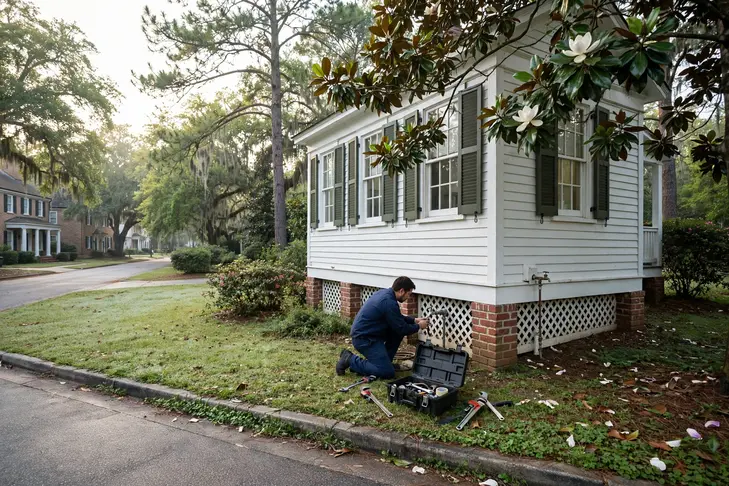


PlumbReach USA connects Montgomery homeowners with independent local plumbers. This page is built from the metro's own Census housing data, ZIP codes and climate record — the plumbing problems described here are the ones Montgomery homes actually have.
Call center hours: Mon-Fri 7:00 AM-10:00 PM ET | Sat 8:00 AM-10:00 PM ET | Sun 7:00 AM-9:00 PM ET
The median Montgomery home was built in 1985; 44.0% of the stock predates 1980, and the pattern this metro's own data ranks first is galvanized pipes at the end of their life. PlumbReach USA is a referral service, not a plumbing company: one call connects you with an independent local plumber serving your ZIP code.
Montgomery is a metro of 385,159 people and 149,998 households, and its plumbing is a portrait of its building history. The median home here was built in 1985; 44.0% of homes predate 1980 and 15.5% predate 1960, while 26.7% have arrived since 2000. Every one of those eras plumbed differently — different pipe materials, different drain designs, different fixtures — and they fail differently, which is why this page is organised around the patterns the data actually produces in Montgomery rather than plumbing in the abstract.
The pre-1980 districts are not a museum; they are most of the metro's working housing, and their plumbing is a patchwork in the literal sense — original runs beside renewed sections, a heater of one decade feeding fixtures of another. Across 75,874 such homes in Autauga, Elmore, Lowndes, Montgomery, no two systems share exactly the same repair history, which is why the guidance below insists on pattern over incident: in patchwork plumbing, what has already been replaced is as diagnostic as what has failed.
The newer homes also house much of the metro's renting population, and rented plumbing lives a harder life: more occupants per system in many cases, faults reported later, and maintenance decided by someone who does not live with the drip. Across Montgomery, 149,998 households depend on systems most of them did not choose, and the post-2000 stock — 46,042 homes — is where the tenancy share runs highest. The failures are the modern ones: cartridges, heater elements, slab-line questions. They arrive on the subdivisions' shared schedule regardless of who holds the lease.
Over everything sits the weather, and here it is measured rather than described: NOAA's station at MONTGOMERY AP, AL US averages 66.4 degrees across the year, with 92.7 days reaching 90 or more and 37.0 nights at freezing or below. A buried lateral feels that record as soil that swells and pulls away; a water heater feels it as an unbroken cycle count; an exposed line feels it on the single coldest night. The problem ranking below is what those numbers, crossed with the housing profile, produce for Montgomery specifically.
Two public records, one metro: what was built here, and what the sky does to it.
Lay the eras side by side instead: 15.5% pre-1960 (26,729 homes), 28.5% from 1960-1979 (49,146), 29.4% from 1980-1999 (50,698), and 26.7% since 2000 (46,042). No single era tells the story — the proportions among them do, and those proportions are different in every metro this site covers.
Homes from 1980 to 1999 form Montgomery's largest band, and they set its plumbing agenda: copper supply lines entering their pinhole years in places, plastic drains still sound, first-generation cartridge fixtures wearing out in waves, water heaters on their second or third cycle. It is a stock past its carefree decades and into its maintenance decades — the era where watched systems keep lasting and unwatched ones start presenting their accounts in the form of leaks.
The second band in the table is the 1960-1979 stock: 49,146 homes, 28.5% of the metro. It is the transition generation — copper arriving, galvanized lingering, drains mixed street by street — and it supplies Montgomery with its most diagnostic plumbing: two homes of the same year needing opposite answers, decided by what the builder happened to specify.
A profile needs its climate column, and Montgomery's comes from MONTGOMERY AP, AL US: an average year of 66.4 degrees, built from extremes at both ends. The heating load (2,000 degree days) and the cooling load (2,540) together set the water heater's working life; the precipitation total (51.16 inches) sets the soil's behaviour around every buried line; the freeze count (37.0 nights) sets the exposure of every uninsulated run. Four numbers — and most of the metro's plumbing behaviour follows from them.
That is the whole method of this page in one section: era shares from the Census, loads from NOAA, and a problem list that is simply where the two overlap most in Montgomery. The services and guidance that follow are ordered by the same profile — local first, generic last.
Sequenced by this metro's own problem ranking, not by a national catalogue order.
The supply system is a single organism, so its failures correlate. Repiping exists for the point where correlation is obvious: pressure fading, water discolouring, leaks touring the house. New runs go in PEX or copper, routed to minimise opening walls, pressure-tested before anything is closed up.
Homes in Montgomery ask the repair-or-repipe question in a particular order. First one leak, repaired. Then another, in the same material, a year later. Pressure meanwhile declines across every fixture, and the water runs discoloured after the house sits quiet. That sequence — which plays out across the metro's pre-1980 housing especially — is the material delivering its verdict, and repiping in PEX or copper is the answer that ends the sequence rather than extending it by one more interval. That is the daily reality for the 149,998 households spread across Autauga, Elmore, Lowndes, Montgomery.
The repair-or-renew caseload is set by one figure above the rest: 44.0% of Montgomery homes predate 1980, plumbed in the materials now at the end of their service lives. Around Prattville (38,850 residents) as in the old core, that percentage is not an abstraction — it is the street's plumbing, house by house.
Between the house and the street lies the lateral — privately owned, commonly forgotten, and the source of the worst backups a home can have. Sewer work begins with a camera survey of that run: its material, its fall, its invaders. Spot repairs suit local damage; a line failing along its length gets replaced, not patched into a subscription.
Every home in Montgomery drains to one line, and that line's condition is written in the metro's housing data: a median build year of 1985 means half the metro's laterals have been buried for decades, ageing in step with the houses above them. In the newer areas — 26.7% of homes built since 2000 — the pipe is plastic and the problems are different: bellies where bedding settled, construction debris, a joint shifted by soil movement. The camera inspection is the same either way, and it is what sizes the job: spot repair, partial replacement, or the full run, each with footage to justify it. Ask in Pike Road and the answer rhymes with Montgomery: same eras, same materials, same calendar of failures.
Sewer demand follows the founding map: the districts built first, around the old centre and out through Pike Road, hold the jointed clay and iron; the growth rings hold plastic with decades in hand. 15.5% of the metro's homes stand on the founding side of that line, which is why the footage here so often shows a pipe at the end of its story.
A leak announces itself indirectly: a bill creeping up, a meter that never rests, paint blistering in a room with no plumbing. The detection visit follows those signs with instruments until the evidence converges, because repairing the wrong spot costs twice — once for the hole, once for the leak still running.
Hidden leaks in Montgomery hide in the places this metro built: under slabs in the post-war and growth subdivisions, inside walls in the older districts where 44.0% of homes predate 1980, and along yard lines crossing soil that shifts with the seasons. The detection approach follows the construction — acoustic listening carries well through slab concrete, while older framed homes give up their leaks to moisture mapping and pressure isolation. Either way, the search starts from the meter: a Montgomery home losing water with every tap closed has a fact to chase, and the instruments chase it to a single marked spot. The MONTGOMERY AP, AL US record — 2,000 heating degree days, 2,540 cooling — is the backdrop Autauga County plumbers plan around.
The search territory is the metro's whole stock: 46,042 homes built since 2000, most of them hiding lines under slabs, against 75,874 pre-1980 homes hiding theirs in walls and crawl spaces — detection in Holtville and detection in the subdivisions are different hunts for the same missing water.
In Montgomery the emergency call is routed, not queued: one number reaches the independent local plumber covering Autauga, Elmore, Lowndes, Montgomery at that hour, and the housing record on this page — median build year 1985 — is the homework they arrive already knowing.
Drain work in Montgomery splits by era: the 75,874 pre-1980 homes drain through older materials, the post-2000 subdivisions through plastic — and the local plumber reads the cable's return to tell which world your street drains through.
In a metro of 172,442 homes with a median build year of 1985, water heaters fail in waves as whole streets age together — the plumbers serving Autauga, Elmore, Lowndes, Montgomery stock and schedule for exactly that pattern.
Running, rocking or refusing — in Montgomery the diagnosis is the same short sequence: fill valve, flapper, supply line, flange. The plumbers routed here carry the internals for the fixtures this metro's eras installed.
Fixture work in Montgomery divides by era like everything else on this page: washer-era taps in the older districts, cartridge internals in the post-2000 subdivisions — the local plumber stocks for both.
Ask where this metro's plumbing diary fills up and the answer is a short story: Galvanized pipes at the end of their life first, ageing sewer laterals close behind, and the services that answer them doing the bulk of the booked work. Everything else on the list above is the supporting cast — necessary, frequent enough, but not what Montgomery's housing stock, at its age and in its climate, principally demands. Read the service list as a weather report for the metro's pipes and it stops looking like a catalogue.
Chosen by this metro's own housing and weather data — the same two records this whole page is built from.
There is a diagnostic shortcut for galvanized systems, and it is a white bucket. Fill it at a tap after the house has sat quiet overnight: the first draw runs tea-coloured with the rust the lines have shed, clearing as fresh water arrives. It is a small experiment with a large meaning — the pipe's interior is dissolving into the water it carries. Across Montgomery, homes plumbed in the galvanized decades run that experiment daily whether they look at the bucket or not. One home's result is a curiosity; the same result with falling pressure and returning leaks is the material's resignation letter.
Galvanized pipe fails politely, which is exactly the problem — it gives a household years of small warnings that are easy to live with. The zinc coating that once protected the steel wears through, rust takes its place, and the rust grows inward like a narrowing artery. Flow to the farthest fixtures drops first. A shower that shares a line with a running tap loses its pressure. By the time the water itself runs discoloured after the house has sat quiet overnight, the narrowing is well advanced. None of this is a single emergency; it is a system reaching the end of its design life on schedule, and in Montgomery's pre-1980 neighbourhoods that schedule is arriving for whole streets at once, because the pipes went in together.
Count it by era rather than by street: the metro's homes built between the war years and 1980 — the heart of the galvanized period — number in the tens of thousands here, and the 75,874 pre-1980 homes overall are the pool this problem draws from. Plumbers working Montgomery and the older districts can often date a home's pipework from the kerb, because the building booms that raised those neighbourhoods plumbed them all the same way.
Every lateral in Montgomery is a private road with a public destination, and like a road it wears where the traffic and the ground conspire: at the joints. Sections laid generations ago were joined to the standards of their day, and the decades since have worked each joint individually — a fraction of movement here, a root hair there. The ground-floor fixtures report the cumulative result. Sewer service is the survey of that road, cleanout to street, and its recommendations scale with the survey: a joint renewed, a section replaced, or — where the whole run has given up — a new road laid on the old one's line.
A lateral gives decades of silence and then a short conversation. The conversation usually starts with the ground-floor drain in the house and escalates through the cleanout to the camera — and the camera's footage settles every argument about whether the line is blocked or broken. Across Montgomery, the laterals entering that conversation now are the ones buried when the metro's median home went up, in 1985. They were built to outlast their mortgages, and they have; the question the footage answers is how much further the same pipe can honestly be asked to go.
The depth of the bench matters locally: this is not a pattern confined to a few old streets. Every district built before modern plastic — the core, the post-war rings, the middle suburbs — holds laterals of the same generations, and the metro's own growth means their combined length runs to thousands of miles of buried, jointed, ageing pipe. The ranking reflects that inventory, nothing more exotic.
Cast iron was the standard sewer material for homes built through the middle of the last century, and Montgomery still has a great deal of it underground: 15.5% of homes here were built before 1960 and 44.0% before 1980. Cast iron does not fail all at once. It corrodes from the inside out, the bottom of the pipe thinning and scaling until waste catches on the rough surface, and a line that drained freely for decades starts slowing, then backing up. By the time roots find the joints of an old cast iron line, the pipe wall around them is often too thin for cleaning alone to be the whole answer. A camera inspection shows exactly how much good pipe is left: scaling near the top of the line may clean up well, while a channel rotted along the bottom means that section is living on borrowed time. Homeowners in Montgomery with a pre-1960 house and drains that misbehave through the whole home — not just one fixture — are usually looking at this story, and the sensible first step is a camera look before another cleaning is booked.
There is a temptation to judge an old drain by its kindest day. On its kindest day it still clears, still serves, still seems to argue for another year. Judge it instead by its trend: clearings that come closer together, a tub that drains slower each season, a smell that returns after rain. In the 26,729 pre-1960 homes across this metro, that trend is the pipe's biography being read aloud — corrosion does not pause between visits, and the homes that fare well are the ones whose owners believed the early chapters.
The historical record is the evidence: iron was the default drain material for the whole era that built this metro's core, and the Census counts that era's survivors home by home — 26,729 of them. Camera surveys in those districts confirm the arithmetic often enough that the pattern's ranking here is the least speculative thing on this page.
The slab leak's cruellest feature is its patience. A pinhole in a pressurised line under concrete does not rest: it runs at night, on holidays, while the house stands empty, moving water into soil that carries it away unseen. Weeks of that patience show up in the aggregates — a bill trending up across three statements, a meter reading that will not reconcile with the household's habits. In Montgomery's slab-built districts the pattern repeats in house after house of the same subdivisions, because the lines were poured in the same seasons and age in convoy. Detection ends the patience at a marked point on the floor.
The cruel arithmetic of a slab leak is that time is water. A pinhole under concrete does not drip into a bucket; it saturates the ground, swells what can swell, and bills the household for every gallon. Weeks of it can pass between the first warm patch on the floor and the diagnosis, which is why the meter test matters so much in Montgomery's slab districts: ten minutes with every tap closed tells a household whether its concrete is hiding something, long before the floor itself confesses.
The growth figures frame the risk: 46,042 homes built in Montgomery since 2000, on top of the slab-built booms before them, mean the metro's buried water lines now number in the hundreds of thousands of individual runs. Each is a small wager against soil movement and time. Most hold. The fraction that do not are what keep this pattern near the top of this page — and the fraction grows as the boom-era lines age together.
Storm season changes the plumbing risks in Montgomery. Heavy rain pushes groundwater up around buried lines and can flood low-lying drainage, and homes here learn which of their drains sit at the bottom of the system the hard way — a floor drain or a basement fixture is where a surcharged line shows first. Before the season, it is worth knowing how your home behaves: whether the yard drains toward or away from the house, whether the sewer cleanout cap is sound, and where the main water shutoff is if a line is damaged. After a major storm, running every drain and watching the ground-floor ones tells you within minutes whether the line is moving water normally again.
When the storms come, Montgomery's plumbing meets them in the ground: laterals under saturated soil, cleanouts under standing water, ground floors at the level the water is looking for. The season tests the buried half of every system here, and it tests the older districts — where the lines are jointed clay and iron — hardest of all. Preparation is unglamorous and specific: know the cleanout, know the shutoff, know the ground-floor drain in the house.
The geography of this problem inside Montgomery is a map of its pre-1980 building. The galvanized went into the post-war districts and the the 1980s growth around Montgomery — whole streets of it, installed by the same builders in the same years. Those streets are now reaching the material's limit together, which is why repiping conversations cluster: one home on a street is an incident, three is the street arriving at its date. The newer side of the metro, around Prattville and the post-2000 subdivisions, simply does not appear in this pattern — its turn is decades away, in different materials.
The numbers underneath it, for Montgomery: 172,442 housing units, a median build year of 1985, and a climate record at MONTGOMERY AP, AL US of 2,000 heating degree days against 2,540 cooling degree days. Cross the housing record with the weather record and this pattern is what falls out at the top — rarely the most dramatic problem in plumbing, but the one this metro's stock and climate manufacture most steadily.
On a first visit for this pattern, a local plumber's checks run in a practised order:
 PROBLEM
 SOLUTION
Population 198,440
Population 38,850
Population 16,923
Population 10,103
Population 7,182
Population 5,700
Population 5,231
Population 5,056
Population 4,228
Population 3,387
Population 2,618
Population 1,609
Also in the Montgomery metro: Fort Deposit (population 1,560), Elmore (population 1,482).
Beyond Montgomery itself, the metro takes in Prattville (38,850 residents), Millbrook (16,923) and the rest of the communities in the grid above — each plumbed in its own building era, which is why two streets in the same metro can need entirely different plumbing conversations. The ZIP list below is the full coverage footprint: if your code is on it, this page was written about your housing stock.
The map continues: Pike Road (10,103), Wetumpka (7,182), Holtville (5,700), Redland (5,231), Tallassee (5,056). Different names, different decades — each community in Autauga, Elmore, Lowndes, Montgomery was plumbed in its own growth years, which is why two streets in the same metro can need entirely different plumbing conversations. The ZIP list below is the working definition of coverage; the housing behind each code is the working definition of the job.
Every metro has a first city and a supporting cast, and the census figures draw the billing plainly here: Montgomery first, with 198,440 residents; Prattville second at 38,850; Millbrook third at 16,923; then the long tail of smaller communities in the grid above. The billing matters less than the building dates — each of these places was plumbed in its own decade, by its own builders — but between them they account for nearly every housing era, material and failure pattern this page describes.
One metro, 4 county lines drawn through it: Autauga, Elmore, Lowndes, Montgomery. The lines are invisible to the water and the weather, but they structure everything administrative around a plumbing job — which office permits it, which inspector signs it, which code edition applies. Autauga County, at the centre, carries the oldest housing and the heaviest share of the work this page describes; its neighbours carry the growth. A routed local plumber navigates the patchwork so the homeowner does not have to.
Three neighbouring coverage areas begin where this one ends: Auburn, AL, some 53 miles off; Birmingham, AL, 78 miles; and Tuscaloosa, AL, 93 miles. Each keeps its own page because each keeps its own numbers — a different median build year, a different climate station, a different problem ranking. Boundary households should trust the ZIP list over the map: the code, not the compass, assigns the dataset.
The region around Montgomery is a set of variations on its theme: Auburn, AL, 53 miles off, runs a median build year of 1995 on a metro population of 208,013; Birmingham, AL (78 miles) medians 1983 on 1,197,766; Tuscaloosa, AL (93 miles) medians 1991 on 281,850. Nearness is not sameness — a few decades of median build year separate their plumbing as surely as the miles separate their maps.
The stock has a shape as well as a size. Owners hold 65.0% of it and renters 35.0%, a split that decides who notices a drip first and who arranges the repair. The generations split 1.6-to-one in favour of the pre-1980 homes. And the map divides into 14 named communities across Autauga, Elmore, Lowndes, Montgomery, each carrying its era's share of the 172,442 housing units the Census counts here.
The Montgomery record in one line — median home age: 41 years · owner-occupied homes: 97,499 · renter-occupied homes: 52,499 · pre-1960 homes per covered ZIP code: 607 · heating-to-cooling degree-day ratio: 0.79 · average rainfall: 1,299 mm a year.
Before an emergency, read the guide: How to shut off your home's water main
One call connects you with an independent local plumbing professional serving Montgomery and the surrounding metro.
Call center hours: Mon-Fri 7:00 AM-10:00 PM ET | Sat 8:00 AM-10:00 PM ET | Sun 7:00 AM-9:00 PM ET