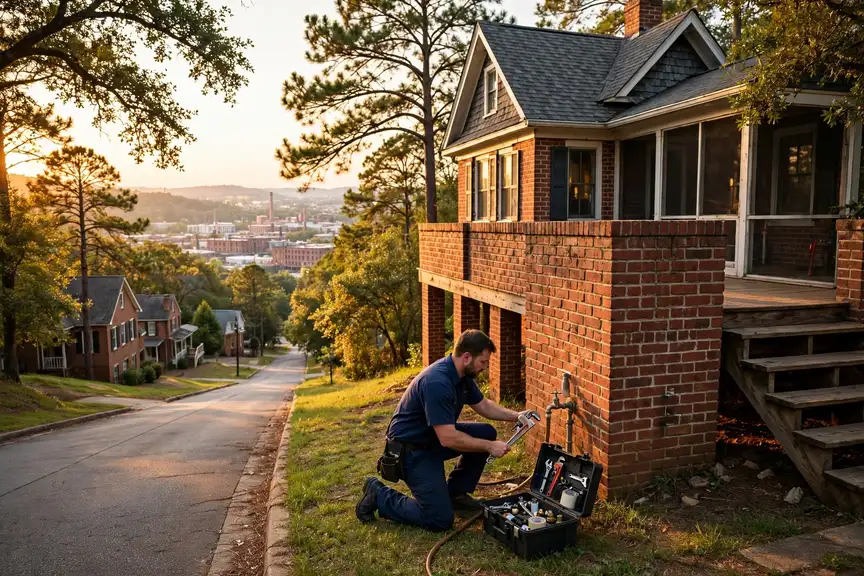


Everything on this page was computed for Birmingham and nowhere else: the problem ranking from its Census housing profile, the seasonal risks from its NOAA station record, the coverage from its own ZIP codes. PlumbReach USA connects you to an independent local plumber; the page itself is the homework, done in public, so the call you make is an informed one.
Call center hours: Mon-Fri 7:00 AM-10:00 PM ET | Sat 8:00 AM-10:00 PM ET | Sun 7:00 AM-9:00 PM ET
The median Birmingham home was built in 1983; 45.9% of the stock predates 1980, and the pattern this metro's own data ranks first is galvanized pipes at the end of their life. PlumbReach USA is a referral service, not a plumbing company: one call connects you with an independent local plumber serving your ZIP code.
Start with the raw material: 1,181,432 people, 522,829 housing units, and a housing stock whose middle home was built in 1983. That single date organises everything on this page. On one side of it stand the older districts — 20.4% of homes predate 1960, 45.9% predate 1980 — plumbed in galvanized steel, cast iron and clay, in homes across Bibb, Blount, Chilton, Jefferson, St. Clair, Shelby, Walker that have been repaired piecemeal for decades. On the other side, the 26.6% built since 2000 run plastic lines under slabs, and fail in the newer ways. A Birmingham plumber reads a home's build year the way a doctor reads a chart: it predicts, before a single wall is opened, which systems deserve suspicion first.
Count the older stock by its materials and the metro's maintenance burden comes into focus: iron and clay drains by the tens of thousands of homes, galvanized and early copper supplies in the same walls, fixtures from the first age of mass production still serving in bathrooms across Bibb County. None of it failed yesterday; all of it is ageing on schedule together. A homeowner in that stock is not unlucky — they are on time, in a district where the systems were always going to need their generation of attention at once.
Growth wrote this metro's newest plumbing chapter in plastic and concrete: supply and drain lines in modern materials, fixtures by the catalogue, foundations poured as slabs across the subdivisions near Hoover and Vestavia Hills. The chapter is young — its systems have decades in hand — but it is not exempt from the metro's arithmetic: 2,177 cooling degree days of demand work its heaters hard, and the soil under its slabs moves with the same seasons as the soil under the oldest farmhouse in Bibb County.
Over everything sits the weather, and here it is measured rather than described: NOAA's station at BIRMINGHAM AP, AL US averages 63.9 degrees across the year, with 65.0 days reaching 90 or more and 47.0 nights at freezing or below. A buried lateral feels that record as soil that swells and pulls away; a water heater feels it as an unbroken cycle count; an exposed line feels it on the single coldest night. The problem ranking below is what those numbers, crossed with the housing profile, produce for Birmingham specifically.
The metro's building eras on one side, its weather record on the other — and its plumbing where the two meet.
Break the stock down by building era and the profile sharpens. Before 1960: 20.4% of homes, roughly 106,657 of them. From 1960 to 1979: 25.5%, about 133,321. From 1980 to 1999: 27.5%, about 143,778. Since 2000: 26.6%, about 139,073. Four eras, four material palettes — and the balance among them is this metro's plumbing character in a single paragraph.
This metro's stock was mostly built in plumbing's transitional decades, 1980 to 1999, and it shows a particular failure calendar: not the corrosion sagas of the old metros, but the wear-out wave of everything installed in those years arriving together — cartridges, heater tanks, fixture finishes, the first of the plastic systems ageing into brittleness. Birmingham's plumbing story for the next decade is largely written: it is the story of that installed base reaching its limits neighbourhood by neighbourhood.
Behind the leading era, the growth band: 26.6% of homes arrived since 2000. Their plumbing is uniform by construction — one generation of fixtures, one approach to lines under slabs — which writes a shared calendar the whole street keeps. Reading that calendar early is most of what separates a planned replacement from a weekend emergency in Birmingham's newest districts.
Translate the climate record into plumbing terms and it comes out as three working conditions. Condition one, the freeze count — 47.0 nights a year when exposed water can solidify and split its container. Condition two, the heat count — 65.0 days that load drains, heaters and tempers simultaneously. Condition three, the water itself: 56.62 inches of it arriving from the sky to move the soil around every lateral in the metro. Birmingham's systems are engineered, installed and aged inside those three conditions, and their failures carry the conditions' fingerprints.
A profile is only useful if it predicts something, and this one predicts the shape of a plumbing diary in Birmingham: which streets will call about drains, which about pressure, which about heaters, and in which months. Everything after this section is that prediction written out as services, problems and answers — the numbers first, the narrative second, the way the evidence actually runs.
Ordered by what this metro's data says its homes need most.
Pipes age by material: galvanized chokes with rust, copper pits into pinholes, early plastic turns brittle. Repair answers the isolated failure; repiping replaces a system whose failures have become a rhythm, rerunning supply lines in modern material while the house stays liveable around the work.
Walk the older streets of Birmingham with a plumber and you will hear the housing stock dated by its pipework: galvanized behind this wall, copper of a certain vintage there, a repipe already done on the corner house. The metro's median build year of 1983 means that dating game works on half the homes in the metro. What decides any individual home's path is not the street's average but the evidence inside its own walls — pressure at the fixtures, the water's colour after a quiet weekend, the count of repairs already made. The assessment is short; the conclusion follows from it. Ask in Alabaster and the answer rhymes with Birmingham: same eras, same materials, same calendar of failures.
The repair-or-renew caseload is set by one figure above the rest: 45.9% of Birmingham homes predate 1980, plumbed in the materials now at the end of their service lives. Around Hoover (92,401 residents) as in the old core, that percentage is not an abstraction — it is the street's plumbing, house by house.
One local habit worth copying: Birmingham homeowners who mention their street's building era when they book get a better-matched visit, because a plumber heading to a the 1980s home in Bibb County loads different parts than one heading to a slab-built subdivision in Hoover. The service is the same; the preparation is local.
A house can survive a lot of plumbing faults, but not a failed path to the street. Sewer services confront the lateral directly — inspected by camera, cleared where clearing suffices, excavated and renewed where the pipe has structurally given up. The footage, shown to the homeowner, is the basis of every recommendation.
The camera footage is where Birmingham's sewer conversations get honest. From the surface, a backup is a backup; on the screen, the metro's whole history is visible — clay joints shouldered apart by decades of soil movement, cast iron scaled to half its width, a plastic line in a newer subdivision bellied where its bedding settled. Bibb County's older laterals and the growth areas' young ones fail in their own dialects, and the repair that follows the footage — sectional, partial, or the full run to the street — is the one the pipe itself argues for. Count it in homes if you prefer: 239,979 built before 1980, 139,073 since 2000, one shared system of soil and seasons.
Sewer demand follows the founding map: the districts built first, around the old centre and out through Alabaster, hold the jointed clay and iron; the growth rings hold plastic with decades in hand. 20.4% of the metro's homes stand on the founding side of that line, which is why the footage here so often shows a pipe at the end of its story.
In Birmingham this service is booked most often through the problem patterns at the top of this page — the metro's housing data, not habit, sets the order. If your home is in the 45.9% built before 1980, mention its age on the call: it changes the parts the plumber loads before heading to Birmingham and the rest of the metro.
One call from anywhere in the Birmingham metro — from Birmingham out to Alabaster — routes to the local professional on cover; the failure patterns they expect first are the ones this page's data ranks.
Across Bibb, Blount, Chilton, Jefferson, St. Clair, Shelby, Walker, drain calls follow the building map: iron and clay near the old core around Birmingham, plastic at the growth edge — one service, two different crafts, both covered by the routing on this page.
Heater work in Birmingham is workload work: 65.0 hot days and 2,533 heating degree days a year cycle the metro's tanks hard, and the local professionals routed here size, flush and replace against that record.
A creeping meter in a Birmingham home is located, not guessed at: the professionals routed here trace the line with instruments and confirm the spot before any floor or wall is opened.
Toilet calls in Birmingham are the small end of the diary and the most democratic: every era of the 522,829-home stock produces them, and the local fix starts with the mechanism in the tank, not the porcelain.
Drips and disposals across Bibb, Blount, Chilton, Jefferson, St. Clair, Shelby, Walker are small jobs with a standard: repair the mechanism where the fixture deserves it, renew it where it does not, and check the shutoffs and supply lines while the cabinet is open.
If this page's services were ranked by Birmingham's call patterns rather than listed in catalogue order, they would come out much as they do here — because the ranking behind them is data, not habit. Galvanized pipes at the end of their life leads the metro's problem table and ageing cast iron sewer lines follows, so the services answering them lead the list. The long tail of a metro's plumbing life — fixture failures, toilet calls, the single unexplained leak — fills in the diary around them, here as everywhere.
Ranked for this metro alone, from its Census housing profile and NOAA climate record.
Galvanized pipe does not fail loudly; it fails by narrowing. Zinc coating gone, the steel rusts from the wet side, and every year the passage water travels through is a little smaller than the year before. The household reads it as personality — the shower that weakens when a tap opens, the washing machine that fills slowly, the rust tinge after a holiday — until the day a pinhole opens in a wall and the personality becomes a flood. In housing built when galvanized was simply how houses were plumbed, the whole system is one age and one material, which is why the faults stop being isolated: the pipe is not breaking in one place, it is finishing in all of them at the same pace, and the repair conversation has to reckon with that arithmetic.
Galvanized pipe fails politely, which is exactly the problem — it gives a household years of small warnings that are easy to live with. The zinc coating that once protected the steel wears through, rust takes its place, and the rust grows inward like a narrowing artery. Flow to the farthest fixtures drops first. A shower that shares a line with a running tap loses its pressure. By the time the water itself runs discoloured after the house has sat quiet overnight, the narrowing is well advanced. None of this is a single emergency; it is a system reaching the end of its design life on schedule, and in Birmingham's pre-1980 neighbourhoods that schedule is arriving for whole streets at once, because the pipes went in together.
The replacement side of the ledger is equally local: when a Birmingham home of the galvanized era is sold, inspected or renovated, the supply lines are among the first systems examined — because everyone in the local trade knows the material's age here. A pattern the whole market has learned to look for is not an anecdote; it is the metro's housing data wearing a tape measure.
Ask a cast iron drain how it is doing and it answers at the ground-floor fixture in the house. That is where a failing main shows itself first — the ground-floor bath that gurgles, the basement drain that sighs up odours — because everything above drains through the same tired run. In Birmingham, the homes reporting those signals share a profile: built when cast iron was the default, in the streets around Birmingham that went up first. The pipe underground is rough now with scale, its bore narrowed, its joints weeping into the soil — and the fixtures upstairs are merely its messengers.
The pipe itself explains the timeline. Cast iron drains by gravity, slowly, and everything a household sends down it — grease films, mineral-heavy water, the occasional corrosive cleaner — works on the iron for decades. The metal does not fail evenly: it thins first at the bottom of horizontal runs, where water and grit sit longest, and at the joints where sections meet. That is why two Birmingham homes of the same age can be in different places with the same pipe: usage, water chemistry and soil conditions around the line all vote on how fast it goes. What a camera inspection adds is certainty — the difference between a line that needs cleaning, a line that needs a section replaced, and a line living on borrowed time.
The local weight of it: 106,657 homes in this metro predate 1960, and while some have renewed their drains since, every original line still serving is past the age its installers planned for. That is a population of risk no single street explains — it is the metro's founding stock, failing on a schedule set in the post-war decades.
Ownership is the first surprise with a lateral: the buried stretch between the house and the street main typically belongs to the homeowner, however public it feels. The second surprise is its age. In Birmingham, laterals under the older streets were laid for the homes counted in the 239,979 pre-1980 properties — jointed clay or iron, bedded in soil that has swelled and shrunk through 56.62 inches of rain a year ever since. A pipe can be nobody's thought for fifty years and then become the only thought in the house, usually on the evidence of the ground-floor drain in it.
Slope is the lateral's invisible specification. A sewer line does not need much fall — a quarter inch per foot is the classic figure — but it needs it consistently, and ageing takes consistency away: a section settles, a joint steps down, and the line develops a reach where flow slows and solids settle out. That belly then collects a little more each week, narrowing the line from the bottom up. Many a Birmingham lateral diagnosed as 'blocked' is really 'bellyed' — clearable today, certain to collect again. The camera distinguishes the two, and the distinction decides whether the household is booking a cleaning or planning a repair.
Every one of the metro's 522,829 housing units drains through exactly one lateral, and in the older districts those laterals are as old as the streets above them. The pre-1960 share alone — 106,657 homes — represents that many buried lines in their seventh decade of service, under soil that shifts with Birmingham's wet and dry seasons. Most will never draw attention; the ones that fail announce themselves through the ground-floor fixtures first.
Water expands when it freezes, and a closed pipe gives that expansion nowhere honourable to go. The split usually forms where the ice plug's pressure peaks — often not where the freeze itself sits — which is why a burst can hide in a warm stretch of wall downstream of the frozen one. Birmingham's exposure concentrates where lines leave the heated envelope: the pre-1980 districts around Birmingham, garages, crawl spaces, additions. On the coldest nights of the year, the metro's plumbing is only as strong as its least-protected run, and the thaw reads out the verdict house by house.
The burst itself usually happens quietly, inside a wall or under a floor, during the coldest hours — but the flood waits for the thaw. Ice seals the split it made, and only when temperatures rise and the ice lets go does the water start moving into the house. That delay is why freeze damage so often greets a Birmingham household in the morning or on return from a trip away. It is also why the checks after a hard freeze matter: pressure oddly low, a meter turning with nothing running, a damp patch at a wall base. Catch the split at the weep stage and the repair is a pipe; catch it after the thaw and it is a room.
Two local numbers frame the risk: 47.0 nights a year at or below freezing at BIRMINGHAM AP, AL US, against a housing stock whose median home dates to 1983 — plumbed, much of it, before routing lines away from cold air was standard practice. Exposure is the product of those two numbers, and in this metro the product is large.
Roots do not break into sewer lines; they are invited. A joint that seeps a thread of moisture into the surrounding soil advertises itself to every root tip in reach, and the tip that finds it thickens season by season inside the pipe, weaving a net that catches the household's solids. In Birmingham the invitation list is written by its canopy: the established streets where trees and laterals have shared the same ground for half a century. Cutting the roots restores the line for a while; the lasting question the camera answers is what the joint that invited them looks like now.
Roots do not break into pipes; they are invited in. A joint in a clay or cast iron line breathes out a trace of moisture vapour, and a nearby tree's root hairs — which exist to find exactly that signal — grow toward it and through any gap the joint presents. Inside the pipe the roots find water and nutrients year-round, so they thicken, branch, and begin to trap everything the household sends down: paper, grease, solids. The first symptom is usually a slow main line that clears and returns on a cycle, because a cable can shred the root mass but cannot remove the joint it entered through. The pattern is seasonal in its own way — roots grow hardest in spring — and it belongs to streets where trees and jointed pipes have shared the same ground for decades, as they have across much of Birmingham.
Time is the ingredient, and Birmingham has supplied it: the metro's older districts pair jointed drain lines from the 1980s and earlier with street trees planted the same decades. A root system has had forty, fifty, sixty years to explore the joints under those streets. Where the housing is newer and the pipe is plastic with fused joints, the invitation never arrives — which is why this problem maps so precisely onto the old-tree, old-pipe neighbourhoods.
When a storm system pushes through Birmingham, the plumbing load arrives as water: saturated ground pressing on laterals, storm runoff testing every joint, and households running everything at once once the weather clears. The homes that ride the season out well are the ones whose drains were clear before it started — a line at half capacity in June is a backup in September.
The season's measure at BIRMINGHAM AP, AL US is 56.62 inches of rain in an average year, with the storm months capable of delivering a season's worth in days. Birmingham's laterals — the generations-old runs under Birmingham and the old core most of all — carry the surge, and the backups of storm season are written in that arithmetic.
The geography of this problem inside Birmingham is a map of its pre-1980 building. The galvanized went into the post-war districts and the the 1980s growth around Birmingham — whole streets of it, installed by the same builders in the same years. Those streets are now reaching the material's limit together, which is why repiping conversations cluster: one home on a street is an incident, three is the street arriving at its date. The newer side of the metro, around Hoover and the post-2000 subdivisions, simply does not appear in this pattern — its turn is decades away, in different materials.
Strip the pattern down to its inputs and the ranking stops being mysterious: 460,747 households drawing on systems installed across a median build year of 1983, in a climate that swings between 65.0 days of serious heat and 47.0 freezing nights. Whatever pattern a metro with those inputs manufactures most, it manufactures here — the lead position is less a title than a consequence, recalculated from the same public records any sceptic can check.
Experienced local practice starts with the simple certainties — the observations that take minutes and decide the most:
 PROBLEM
 SOLUTION
Population 199,322
Population 92,401
Population 38,704
Population 33,633
Population 27,697
Population 26,182
Population 25,655
Population 24,510
Population 22,160
Population 21,452
Population 17,188
Population 16,541
Also in the Birmingham metro: Center Point (population 16,125), Gardendale (population 16,110).
The communities in the grid are not suburbs of the page; they are its subject as much as Birmingham is. Hoover (92,401 residents) and Vestavia Hills (38,704) carry their own building decades, their own pipe materials and their own positions in the problem ranking's logic — a lateral under a Hoover street answers to the same data as one in the centre, but to a different era of it. Coverage here is defined by the ZIP list below; understanding is defined street by street, and this page's figures are the metro-wide version of a story each community tells in its own numbers.
Also on the Birmingham map: Alabaster (33,633), Homewood (27,697), Trussville (26,182), Bessemer (25,655), Pelham (24,510) — communities spread across Bibb, Blount, Chilton, Jefferson, St. Clair, Shelby, Walker, each with housing from its own growth years. A plumber routed through PlumbReach USA to any of them is working from this same page: the metro data does not change at the city limit, but the housing on your street — its age, its materials, its soil — is what the visit is really about.
The metro's weight is not evenly spread. Birmingham holds 199,322 of the 1,181,432 residents; Hoover and Vestavia Hills add 92,401 and 38,704; and the remainder scatters across the smaller places above, some no bigger than a few thousand people. Plumbing follows the weight — most calls come from where most homes are — but era matters more than size: a small community of 1960s housing generates older-system work than a large new subdivision does.
Administratively the metro is drawn from Bibb, Blount, Chilton, Jefferson, St. Clair, Shelby, Walker — 7 in all — with Bibb County at its centre. County lines do not change pipe physics, but they do shape the paperwork around the work: permits, inspections and code details are county and city business, which is one reason the professional who serves your street is a local one.
This page ends at the metro boundary, but the region does not: Tuscaloosa, AL, Decatur, AL and Montgomery, AL continue the coverage in their own directions, each with a profile built from its own Census and NOAA figures. If your home sits near the line between metros, go by your ZIP code — it places you in the dataset that describes your housing.
Set Birmingham among its neighbours and the contrasts sharpen the profile: Tuscaloosa, AL — metro population 281,850, median build year 1991 — sits 64 miles away; Decatur, AL (160,326, median 1984) 74 miles; Montgomery, AL (388,747, median 1985) 78 miles. Three different housing stocks under three nearby skies, which is why each keeps its own page and its own problem ranking rather than borrowing this one.
The stock has a shape as well as a size. Owners hold 70.6% of it and renters 29.4%, a split that decides who notices a drip first and who arranges the repair. The generations split 1.7-to-one in favour of the pre-1980 homes. And the map divides into 14 named communities across Bibb, Blount, Chilton, Jefferson, St. Clair, Shelby, Walker, each carrying its era's share of the 522,829 housing units the Census counts here.
Birmingham by the derived numbers — median home age 43 years · owners in 325,287 homes, renters in 135,460 · each covered ZIP code carrying about 889 pre-1960 homes · a heating-to-cooling degree-day ratio of 1.16 · 1,438 mm average annual rainfall.
Before an emergency, read the guide: How to shut off your home's water main
Describe the problem and the call center routes you to an independent local plumber who works in the Birmingham metro.
Call center hours: Mon-Fri 7:00 AM-10:00 PM ET | Sat 8:00 AM-10:00 PM ET | Sun 7:00 AM-9:00 PM ET