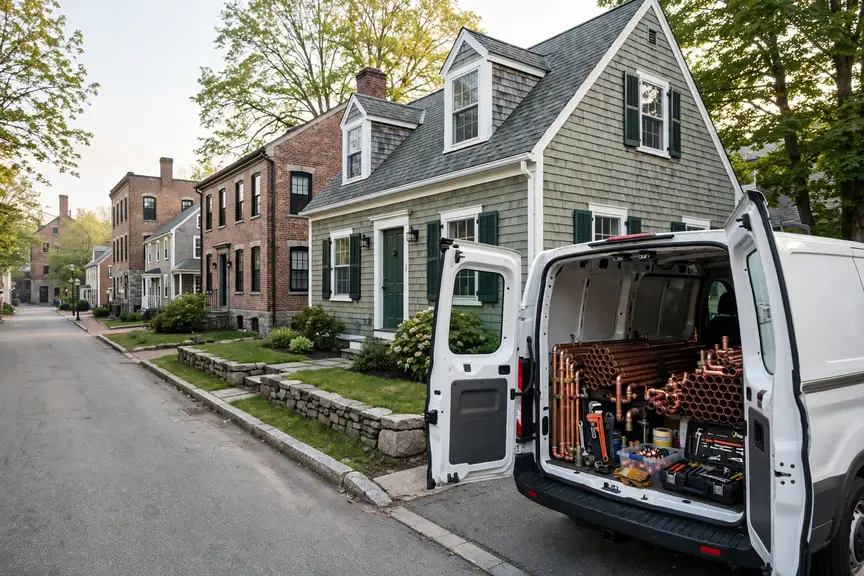


Everything on this page was computed for Manchester and nowhere else: the problem ranking from its Census housing profile, the seasonal risks from its NOAA station record, the coverage from its own ZIP codes. PlumbReach USA connects you to an independent local plumber; the page itself is the homework, done in public, so the call you make is an informed one.
Call center hours: Mon-Fri 7:00 AM-10:00 PM ET | Sat 8:00 AM-10:00 PM ET | Sun 7:00 AM-9:00 PM ET
The median Manchester home was built in 1977; 53.9% of the stock predates 1980, and the pattern this metro's own data ranks first is ageing cast iron sewer lines. PlumbReach USA is a referral service, not a plumbing company: one call connects you with an independent local plumber serving your ZIP code.
Two numbers frame everything that follows: 67.5% of Manchester homes are owner-occupied, and the median one was built in 1977. Ownership matters to plumbing because owners inherit their systems whole — every material decision a builder made in the 1970s or earlier is still in the walls, ageing on its original schedule. With 53.9% of homes predating 1980 and 15.5% arriving since 2000, the metro is really two housing stocks sharing one map, and they are taken separately below before the problems are ranked.
Count the older stock by its materials and the metro's maintenance burden comes into focus: iron and clay drains by the tens of thousands of homes, galvanized and early copper supplies in the same walls, fixtures from the first age of mass production still serving in bathrooms across Hillsborough County. None of it failed yesterday; all of it is ageing on schedule together. A homeowner in that stock is not unlucky — they are on time, in a district where the systems were always going to need their generation of attention at once.
The post-2000 homes have a plumbing trait the older districts never had: uniformity at scale. A subdivision's lines went in within a few seasons of each other, so its first heater failures, its first cartridge failures and its first slab questions arrive within a few seasons of each other too. With 27,397 such homes in the metro, those arrivals are not anecdotes but waves, and the households who read them early — who learn their system's age and keep its number handy — meet them as maintenance rather than emergency.
Over the housing sits one more dataset, the sky's: 6,172 heating degree days and 773 cooling degree days in the average year at MANCHESTER AP, NH US, an average temperature of 50.1 degrees, extremes at both ends faithfully recorded. A metro's plumbing is designed — to the extent it is designed at all — for the middle of that record, and it fails at the record's edges. What follows is a page about the edges: the cold snaps, the storm weeks, the long hot stretches, and the systems they find first.
Housing eras and climate, joined — the two datasets every section of this page is built from.
Break the stock down by building era and the profile sharpens. Before 1960: 29.4% of homes, roughly 51,965 of them. From 1960 to 1979: 24.5%, about 43,304. From 1980 to 1999: 30.6%, about 54,086. Since 2000: 15.5%, about 27,397. Four eras, four material palettes — and the balance among them is this metro's plumbing character in a single paragraph.
The 1980-1999 band runs this metro, and its plumbing has a particular flavour: mature but not ancient. Copper systems old enough to have histories, plastic drains still in their prime, fixtures from the first cartridge generation reaching their wear points in waves, heaters cycling through replacements on a schedule set by whole subdivisions. Manchester's is a maintenance-era stock — the decades where attention compounds and neglect starts to invoice.
Behind the leading era sits the founding stock: 51,965 homes from before 1960, 29.4% of the metro. Second place in the table does not mean second place in the workload — those homes carry the oldest drains and supplies in Manchester, and a disproportionate share of its serious plumbing begins on their streets, in Manchester's first districts and the suburbs that followed them.
Translate the climate record into plumbing terms and it comes out as three working conditions. Condition one, the freeze count — 129.1 nights a year when exposed water can solidify and split its container. Condition two, the heat count — 16.2 days that load drains, heaters and tempers simultaneously. Condition three, the water itself: 40.39 inches of it arriving from the sky to move the soil around every lateral in the metro. Manchester's systems are engineered, installed and aged inside those three conditions, and their failures carry the conditions' fingerprints.
Hold the two halves together and the rest of this page explains itself: the problems ranked highest here are the ones where Manchester's dominant housing era and its climate record overlap. Change either dataset and the ranking changes — which is precisely why this profile is rebuilt from the records for every metro instead of carried over from the last one.
Listed in the order this metro's housing and climate data supports.
Of all a home's pipes, the sewer lateral works under the worst conditions: buried, jointed, rooted at, and loaded by every fixture in the building. Its care begins with seeing it — a camera run that records material, slope and damage — and proceeds by the footage's logic: clear what clearing cures, mend what is locally broken, renew what has failed along its length. No stage of that is guesswork, and the homeowner sees the same footage the plumber does.
The camera footage is where Manchester's sewer conversations get honest. From the surface, a backup is a backup; on the screen, the metro's whole history is visible — clay joints shouldered apart by decades of soil movement, cast iron scaled to half its width, a plastic line in a newer subdivision bellied where its bedding settled. Hillsborough County's older laterals and the growth areas' young ones fail in their own dialects, and the repair that follows the footage — sectional, partial, or the full run to the street — is the one the pipe itself argues for. From Nashua to Milford, the pattern repeats wherever the housing era matches.
Sewer demand follows the founding map: the districts built first, around the old centre and out through Nashua, hold the jointed clay and iron; the growth rings hold plastic with decades in hand. 29.4% of the metro's homes stand on the founding side of that line, which is why the footage here so often shows a pipe at the end of its story.
Pipes age by material: galvanized chokes with rust, copper pits into pinholes, early plastic turns brittle. Repair answers the isolated failure; repiping replaces a system whose failures have become a rhythm, rerunning supply lines in modern material while the house stays liveable around the work.
A repipe decision in Manchester is usually made at a kitchen table, from three exhibits: the water's behaviour at the taps, the count of repairs already paid for, and the material visible wherever the system shows itself. Exhibits like those persuade because they are the household's own. The work itself, when it comes, is less disruptive than its reputation — modern lines route through attics, closets and chases, water stays on for most of the project, and the plaster sacrificed is measured in patches, not rooms. What the household buys back is the thing the old material had been taxing away: pressure, clarity, and the right to forget the pipes exist. The 40.39 inches of rain in an average year here is part of the story too — buried lines feel every wet season.
The repair-or-renew caseload is set by one figure above the rest: 53.9% of Manchester homes predate 1980, plumbed in the materials now at the end of their service lives. Around Hudson (7,105 residents) as in the old core, that percentage is not an abstraction — it is the street's plumbing, house by house.
From Manchester to Hudson, the heater question is the same — repair the unit or renew it — and the honest answer starts from its age against Manchester's demand record, which this page sets out.
Emergencies in Manchester are answered by local independents, not a dispatch centre: PlumbReach USA routes the call, and the stock it serves — 176,753 homes across 34 ZIP codes — is the stock this page profiles.
Manchester's drains are cleared by local independents who work this stock weekly: a median build year of 1977 means most lines they open have decades of history in them, and the clearing approach is chosen for the era, not the postcode.
A creeping meter in a Manchester home is located, not guessed at: the professionals routed here trace the line with instruments and confirm the spot before any floor or wall is opened.
In Manchester, a toilet that runs all night is a water bill with a sound; the local service replaces the tired internals and checks the flange and supply while the tank is open.
In Manchester the faucet call is often the first plumbing visit a newer home ever gets — the professionals routed here treat it as an introduction: the fixture fixed, and the home's shutoffs and heater age noted for the record.
If this page's services were ranked by Manchester's call patterns rather than listed in catalogue order, they would come out much as they do here — because the ranking behind them is data, not habit. Ageing cast iron sewer lines leads the metro's problem table and freeze-burst pipes in cold snaps follows, so the services answering them lead the list. The long tail of a metro's plumbing life — fixture failures, toilet calls, the single unexplained leak — fills in the diary around them, here as everywhere.
Selected and ranked from this metro's housing-age profile and climate record — not copied from another city's page.
Ask a cast iron drain how it is doing and it answers at the ground-floor fixture in the house. That is where a failing main shows itself first — the ground-floor bath that gurgles, the basement drain that sighs up odours — because everything above drains through the same tired run. In Manchester, the homes reporting those signals share a profile: built when cast iron was the default, in the streets around Manchester that went up first. The pipe underground is rough now with scale, its bore narrowed, its joints weeping into the soil — and the fixtures upstairs are merely its messengers.
Look inside an old cast iron line with a camera and the failure stops being abstract. The inner wall grows rough with tuberculation — rust nodules that narrow the bore and catch everything passing. The bottom of the run, where water and grit travel, thins fastest; the top can look sound while the channel below it is nearly through. Roots enter at joints and add their own blockage. A Manchester line of this vintage is therefore not one problem but a profile of problems along its length, and the repair that makes sense — cleaning, a section, a full replacement — is the one matched to the worst ten feet the camera finds, not the average of the whole run.
The historical record is the evidence: iron was the default drain material for the whole era that built this metro's core, and the Census counts that era's survivors home by home — 51,965 of them. Camera surveys in those districts confirm the arithmetic often enough that the pattern's ranking here is the least speculative thing on this page.
Ice does its damage in silence and announces it in flood. The split forms under pressure while the line is frozen, holds while the ice plug seals it, and opens the moment the thaw restores flow — which is why burst pipes are so often discovered by sound: water running somewhere it should not be, in a house that was intact at breakfast. Manchester's exposure sits where its housing does — in the older districts' unprotected runs and every era's additions and garages — and the repair visit's second job, after the pipe itself, is the insulation and routing that keep the same night from repeating.
Prevention, for this pattern, is a geography lesson: the burst never happens in the middle of the heated house. It happens at the perimeter — the wall cavity on the windward side, the run beneath the addition, the pipe the builder routed through the garage to spare six feet of copper. In Manchester, where 16.2 summer days tempt everyone to forget what 129.1 freezing nights intend, the autumn ritual is short and specific: find every line that leaves the warmth, and do something about it. The households that keep that ritual read about burst pipes the way other people do — as news.
Manchester's freeze maths is unforgiving: 129.1 sub-freezing nights in an average year at MANCHESTER AP, NH US, multiplied by every uninsulated run in every older home, gives the season hundreds of chances to find one weak line. The splits favour the same addresses winter after winter — the the 1970s stock with pipes in the cold zones of the house.
Ownership is the first surprise with a lateral: the buried stretch between the house and the street main typically belongs to the homeowner, however public it feels. The second surprise is its age. In Manchester, laterals under the older streets were laid for the homes counted in the 95,270 pre-1980 properties — jointed clay or iron, bedded in soil that has swelled and shrunk through 40.39 inches of rain a year ever since. A pipe can be nobody's thought for fifty years and then become the only thought in the house, usually on the evidence of the ground-floor drain in it.
Slope is the lateral's invisible specification. A sewer line does not need much fall — a quarter inch per foot is the classic figure — but it needs it consistently, and ageing takes consistency away: a section settles, a joint steps down, and the line develops a reach where flow slows and solids settle out. That belly then collects a little more each week, narrowing the line from the bottom up. Many a Manchester lateral diagnosed as 'blocked' is really 'bellyed' — clearable today, certain to collect again. The camera distinguishes the two, and the distinction decides whether the household is booking a cleaning or planning a repair.
The depth of the bench matters locally: this is not a pattern confined to a few old streets. Every district built before modern plastic — the core, the post-war rings, the middle suburbs — holds laterals of the same generations, and the metro's own growth means their combined length runs to thousands of miles of buried, jointed, ageing pipe. The ranking reflects that inventory, nothing more exotic.
Galvanized steel announces its age through the water itself. The zinc coating that once protected the pipe is long spent; the steel beneath rusts inward, and the bore narrows to a passage that delivers less water every year. Households adapt without noticing — the shower accepted as weak, the washing machine's fill taken as slow — until a fixture upgrade or a guest's comparison names the decline. In Manchester's pre-1980 districts that decline is the stock's shared condition, written into 95,270 homes, and the repipe conversation begins when the household stops adapting and starts measuring.
Galvanized pipe fails politely, which is exactly the problem — it gives a household years of small warnings that are easy to live with. The zinc coating that once protected the steel wears through, rust takes its place, and the rust grows inward like a narrowing artery. Flow to the farthest fixtures drops first. A shower that shares a line with a running tap loses its pressure. By the time the water itself runs discoloured after the house has sat quiet overnight, the narrowing is well advanced. None of this is a single emergency; it is a system reaching the end of its design life on schedule, and in Manchester's pre-1980 neighbourhoods that schedule is arriving for whole streets at once, because the pipes went in together.
Count it by era rather than by street: the metro's homes built between the war years and 1980 — the heart of the galvanized period — number in the tens of thousands here, and the 95,270 pre-1980 homes overall are the pool this problem draws from. Plumbers working Manchester and the older districts can often date a home's pipework from the kerb, because the building booms that raised those neighbourhoods plumbed them all the same way.
Winter in Manchester is pipe season. With about 129.1 nights a year at or below freezing on the long-term record, the houses that get through winter cleanly are the ones whose exposed lines were dealt with in autumn: insulation on garage and crawl-space runs, hoses off the outside taps so those lines can drain, and a household that knows where its main shutoff is before it needs it. During the hardest cold, a slow drip from the tap furthest from the main and open cabinet doors under sinks on outside walls are simple insurance. If a line does freeze, shut the water off before the thaw does its damage and have the run checked — a pipe that froze once has shown you exactly where it is vulnerable.
The numbers behind the season here: 129.1 nights a year at or below freezing at MANCHESTER AP, NH US, against a housing stock whose median build year is 1977. Every winter writes the same exam for Manchester's older pipes, and every winter some of them — usually in the the 1970s districts first — fail it.
In Manchester the pattern has an address pattern. The cast iron went under the homes built before 1960 — the streets of the old core and the first suburbs around Manchester — and it is failing in the order those streets were built. A camera call in the historic districts is a different appointment from one in Nashua or the newer subdivisions: there, the same symptoms usually trace to something younger and simpler. Knowing which side of that line a home sits on is most of the diagnosis before the camera ever leaves the van, and it is why this page ranks the problem by the metro's pre-1960 count rather than by anecdote.
The numbers underneath it, for Manchester: 176,753 housing units, a median build year of 1977, and a climate record at MANCHESTER AP, NH US of 6,172 heating degree days against 773 cooling degree days. Cross the housing record with the weather record and this pattern is what falls out at the top — rarely the most dramatic problem in plumbing, but the one this metro's stock and climate manufacture most steadily.
The first visit follows a short, diagnostic list — each item ruling a branch of the problem in or out:
 PROBLEM
 SOLUTION
Population 115,415
Population 91,131
Population 8,857
Population 7,105
Population 5,806
Population 4,872
Population 4,586
Population 3,127
Population 2,343
Population 1,582
Population 1,444
Population 1,293
Also in the Manchester metro: Greenville (population 1,102), Klondike Corner (population 800).
Read the grid as a building programme spread over a century. The oldest communities sit where the metro began; the youngest are still adding streets at its edge; and Nashua and Milford, with 91,131 and 8,857 residents, stand for the rings in between. Each ring plumbed in its era's materials, and each is now failing, wearing or holding in its era's characteristic order. The ZIP codes below draw the coverage boundary; the eras inside it draw everything else on this page — the problems ranked, the services ordered, the checks advised.
The map continues: Hudson (7,105), South Hooksett (5,806), East Merrimack (4,872), Pinardville (4,586), Goffstown (3,127). Different names, different decades — each community in Hillsborough was plumbed in its own growth years, which is why two streets in the same metro can need entirely different plumbing conversations. The ZIP list below is the working definition of coverage; the housing behind each code is the working definition of the job.
Every metro has a first city and a supporting cast, and the census figures draw the billing plainly here: Manchester first, with 115,415 residents; Nashua second at 91,131; Milford third at 8,857; then the long tail of smaller communities in the grid above. The billing matters less than the building dates — each of these places was plumbed in its own decade, by its own builders — but between them they account for nearly every housing era, material and failure pattern this page describes.
The metro answers to 1 county governments (Hillsborough), a patchwork that matters at permit time rather than at the pipe. Hillsborough County carries the centre; the others carry the growth rings and the older outlying towns. A plumber routed through this page works inside that patchwork daily — the water does not care about the boundaries, but the job's paperwork does.
Beyond the metro line, the nearest covered metros are Boston, MA (42 miles away), Worcester, MA (43 miles) and Amherst, MA (62 miles) — separate pages, separate profiles, because their housing and weather records are their own. Homeowners near the boundary sit between two datasets; the ZIP list above, not the map's edge, decides which page was written about your stock.
Set Manchester among its neighbours and the contrasts sharpen the profile: Boston, MA — metro population 5,034,221, median build year 1963 — sits 42 miles away; Worcester, MA (888,502, median 1966) 43 miles; Amherst, MA (164,065, median 1970) 62 miles. Three different housing stocks under three nearby skies, which is why each keeps its own page and its own problem ranking rather than borrowing this one.
The stock has a shape as well as a size. Owners hold 67.5% of it and renters 32.5%, a split that decides who notices a drip first and who arranges the repair. The generations split 3.5-to-one in favour of the pre-1980 homes. And the map divides into 14 named communities across Hillsborough, each carrying its era's share of the 176,753 housing units the Census counts here.
One line of Manchester arithmetic — a median home 49 years old · 113,219 owner-occupied homes against 54,513 renter-occupied · 1,528 pre-1960 homes for every covered ZIP code · a heating-to-cooling degree-day ratio of 7.99 · 1,026 mm of rain in an average year.
Before an emergency, read the guide: How to shut off your home's water main
PlumbReach USA routes your call to an independent local plumbing professional serving Manchester — the assessment and the work are theirs.
Call center hours: Mon-Fri 7:00 AM-10:00 PM ET | Sat 8:00 AM-10:00 PM ET | Sun 7:00 AM-9:00 PM ET