Everything on this page was computed for Kingsport and nowhere else: the problem ranking from its Census housing profile, the seasonal risks from its NOAA station record, the coverage from its own ZIP codes. PlumbReach USA connects you to an independent local plumber; the page itself is the homework, done in public, so the call you make is an informed one.
Call center hours: Mon-Fri 7:00 AM-10:00 PM ET | Sat 8:00 AM-10:00 PM ET | Sun 7:00 AM-9:00 PM ET
31
ZIP codes covered
5
Counties in the metro
129,894
Households (Census ACS)
1978
Median year home built
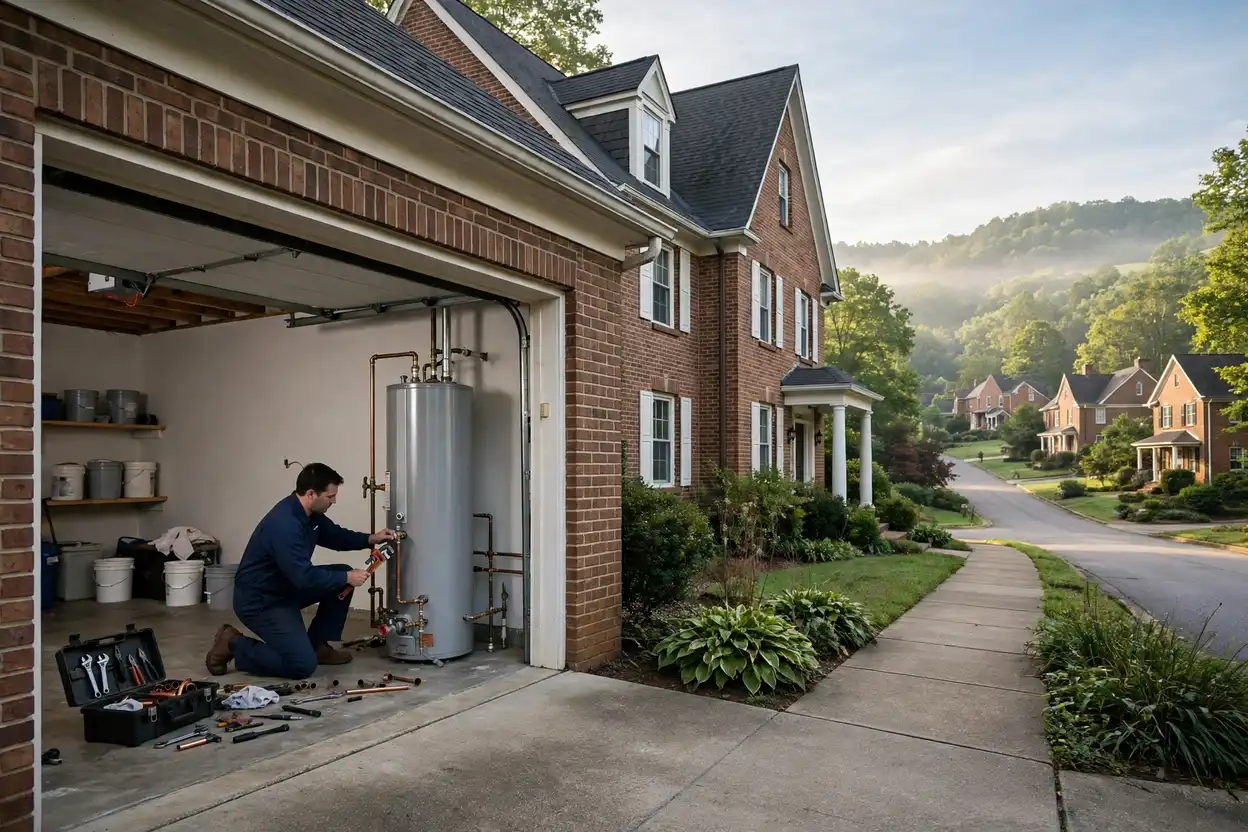
Kingsport, TN — plumbing help across the metroLocal plumbers serving Kingsport neighbourhoodsReplacing a heater in a Kingsport home
Kingsport plumbing, in brief
The median Kingsport home was built in 1978; 53.2% of the stock predates 1980, and the pattern this metro's own data ranks first is ageing cast iron sewer lines. PlumbReach USA is a referral service, not a plumbing company: one call connects you with an independent local plumber serving your ZIP code.
The Kingsport housing stock, and what it means for plumbing
Read Kingsport through its counties and the picture sharpens. Hawkins, Sullivan, Scott, Washington, Bristol city were not built in the same decades or for the same households, and their plumbing carries those differences: an older core where 25.9% of the metro's homes predate 1960, growth corridors where the subdivisions arrived in waves, and edges still being built out. The metro-wide medians — a middle home built in 1978, 149,151 housing units in all — are the average of those local stories, and the sections below are organised by the patterns the combined record produces, from the oldest pipe materials to the newest failure modes.
The pre-1980 districts are not a museum; they are most of the metro's working housing, and their plumbing is a patchwork in the literal sense — original runs beside renewed sections, a heater of one decade feeding fixtures of another. Across 79,348 such homes in Hawkins, Sullivan, Scott, Washington, Bristol city, no two systems share exactly the same repair history, which is why the guidance below insists on pattern over incident: in patchwork plumbing, what has already been replaced is as diagnostic as what has failed.
The newer side of Kingsport — the 17.9% of homes built since 2000, concentrated around growing communities like Kingsport — runs on plastic supply and drain lines that age more gracefully but fail in their own ways: slab leaks where lines run under concrete, water heaters worked hard by 1,104 cooling degree days of hot-season demand, and fixture cartridges wearing out in houses that all reach the same age at the same time. One metro, two plumbing generations, and the sections below take them in the order this metro's data ranks them.
Over everything sits the weather, and here it is measured rather than described: NOAA's station at BRISTOL TRI CITY AP, TN US averages 56.6 degrees across the year, with 23.0 days reaching 90 or more and 94.2 nights at freezing or below. A buried lateral feels that record as soil that swells and pulls away; a water heater feels it as an unbroken cycle count; an exposed line feels it on the single coldest night. The problem ranking below is what those numbers, crossed with the housing profile, produce for Kingsport specifically.
The Kingsport plumbing profile in numbers
Two public records, one metro: what was built here, and what the sky does to it.
Break the stock down by building era and the profile sharpens. Before 1960: 25.9% of homes, roughly 38,630 of them. From 1960 to 1979: 27.3%, about 40,718. From 1980 to 1999: 28.9%, about 43,105. Since 2000: 17.9%, about 26,698. Four eras, four material palettes — and the balance among them is this metro's plumbing character in a single paragraph.
The 1980-1999 band runs this metro, and its plumbing has a particular flavour: mature but not ancient. Copper systems old enough to have histories, plastic drains still in their prime, fixtures from the first cartridge generation reaching their wear points in waves, heaters cycling through replacements on a schedule set by whole subdivisions. Kingsport's is a maintenance-era stock — the decades where attention compounds and neglect starts to invoice.
Close behind the leader come the 1960-1979 homes, 27.3% of the stock. Their plumbing is mid-change by construction — the decades when materials swapped over mid-stream — so this band is where a Kingsport plumber earns the diagnostic fee: pressure tests and camera runs that say which side of the transition a given house was built on.
A profile needs its climate column, and Kingsport's comes from BRISTOL TRI CITY AP, TN US: an average year of 56.6 degrees, built from extremes at both ends. The heating load (4,150 degree days) and the cooling load (1,104) together set the water heater's working life; the precipitation total (43.97 inches) sets the soil's behaviour around every buried line; the freeze count (94.2 nights) sets the exposure of every uninsulated run. Four numbers — and most of the metro's plumbing behaviour follows from them.
That is the whole method of this page in one section: era shares from the Census, loads from NOAA, and a problem list that is simply where the two overlap most in Kingsport. The services and guidance that follow are ordered by the same profile — local first, generic last.
Plumbing problems Kingsport homes actually get
Chosen by this metro's own housing and weather data — the same two records this whole page is built from.
Ageing cast iron sewer lines
Iron drains do not fail the way modern pipes fail. Plastic cracks; iron thins, roughens and narrows from within, wall by wall, until the smooth bore the installer left is a reef of corrosion products that catches everything the household sends down. In Kingsport, that reef is growing under the oldest streets in the metro — the homes around Kingsport plumbed when iron was the only serious choice. A line in this condition can serve for years in a diminished way, draining slowly, complaining occasionally, which is exactly how it escapes attention until the day it stops entirely.
There is a temptation to judge an old drain by its kindest day. On its kindest day it still clears, still serves, still seems to argue for another year. Judge it instead by its trend: clearings that come closer together, a tub that drains slower each season, a smell that returns after rain. In the 38,630 pre-1960 homes across this metro, that trend is the pipe's biography being read aloud — corrosion does not pause between visits, and the homes that fare well are the ones whose owners believed the early chapters.
The local weight of it: 38,630 homes in this metro predate 1960, and while some have renewed their drains since, every original line still serving is past the age its installers planned for. That is a population of risk no single street explains — it is the metro's founding stock, failing on a schedule set in the post-war decades.
Watch for
Floor drains in the basement or ground floor backing up during heavy use
A sewer smell near drains that cleaning does not shift
Patches of lawn staying green or soggy over the line's path
There is a particular silence after a hard freeze in Kingsport: the pause while households open taps one by one, auditing the night. Most winters, most homes pass. The failures cluster where they always cluster — the addition plumbed in a hurry across a crawl space, the garage wall line, the hose bibb nobody drained — because cold air is a systematic inspector and it works from a list. The record at BRISTOL TRI CITY AP, TN US guarantees the inspection recurs: this is not a freak-weather problem but a standing appointment between the climate and the metro's least-protected pipework, kept every year whether the household remembers it or not.
Prevention, for this pattern, is a geography lesson: the burst never happens in the middle of the heated house. It happens at the perimeter — the wall cavity on the windward side, the run beneath the addition, the pipe the builder routed through the garage to spare six feet of copper. In Kingsport, where 23.0 summer days tempt everyone to forget what 94.2 freezing nights intend, the autumn ritual is short and specific: find every line that leaves the warmth, and do something about it. The households that keep that ritual read about burst pipes the way other people do — as news.
Two local numbers frame the risk: 94.2 nights a year at or below freezing at BRISTOL TRI CITY AP, TN US, against a housing stock whose median home dates to 1978 — plumbed, much of it, before routing lines away from cold air was standard practice. Exposure is the product of those two numbers, and in this metro the product is large.
Watch for
A tap that runs slower after a cold night than it did the evening before
Frost visible on an exposed section of pipe in the garage or crawl space
A water bill spike in the month after a hard freeze
One pipe carries everything a house produces, and in the older half of this metro that pipe has been buried since the street was young. Clay sections shift as soil settles; cast iron scales inward; joints open by degrees. The lateral rarely fails all at once — it degrades into symptoms the household learns to live with: the slow drain blamed on the fixture, the gurgle blamed on venting, the cleanings that help for shorter and shorter stretches. Each of those is the lateral reporting its condition. When sewage finally backs up into the ground-floor tub, the line has usually been compromised for a long while, and the question the camera answers is how much of it: a section, or the whole run from house to main.
The lateral is the hardest-working pipe a household owns and the only one nobody ever sees. It carries everything, it was buried once and forgotten, and its condition depends on decisions made the year the house was built: the material chosen, the slope it was laid at, the soil it was bedded in. Ageing laterals fail in characteristic ways — joints offset as soil settles, bellies where the bedding washed or sagged, walls thinned by decades of flow. The house above reports these failures indirectly, through its ground-floor fixtures, which is why a sewer problem so often gets mistaken for a simple clog at first. In Kingsport, where whole districts were built in the same few decades, laterals are ageing on a shared timetable — the line under one house is a fair guide to the line under its neighbour's.
The depth of the bench matters locally: this is not a pattern confined to a few old streets. Every district built before modern plastic — the core, the post-war rings, the middle suburbs — holds laterals of the same generations, and the metro's own growth means their combined length runs to thousands of miles of buried, jointed, ageing pipe. The ranking reflects that inventory, nothing more exotic.
Watch for
The ground-floor bath draining slower than every fixture above it
Winter in Kingsport is pipe season. With about 94.2 nights a year at or below freezing on the long-term record, the houses that get through winter cleanly are the ones whose exposed lines were dealt with in autumn: insulation on garage and crawl-space runs, hoses off the outside taps so those lines can drain, and a household that knows where its main shutoff is before it needs it. During the hardest cold, a slow drip from the tap furthest from the main and open cabinet doors under sinks on outside walls are simple insurance. If a line does freeze, shut the water off before the thaw does its damage and have the run checked — a pipe that froze once has shown you exactly where it is vulnerable.
Put the season in figures: 94.2 freezing nights a year at BRISTOL TRI CITY AP, TN US, against a median build year of 1978. Half of Kingsport's homes are that old or older, and their exposed lines sit the winter's examination every year — the failures the season produces are simply the papers it fails.
A closer look: ageing cast iron sewer lines in Kingsport
There is a reason this pattern tops so many old-metro lists, and Kingsport holds the reason in bulk: iron was simply what drains were, for the whole first age of indoor plumbing. Every pre-1960 home still on its original line — and the Census counts 38,630 pre-1960 homes here — is running an experiment in how long buried iron can serve. The results arrive unevenly: one street's lines camera clean and sound, the next street's flaked to lace. That unevenness is why the deep-dive ends in a camera rather than a conclusion, and why two neighbours with identical houses can honestly need different work.
The numbers underneath it, for Kingsport: 149,151 housing units, a median build year of 1978, and a climate record at BRISTOL TRI CITY AP, TN US of 4,150 heating degree days against 1,104 cooling degree days. Cross the housing record with the weather record and this pattern is what falls out at the top — rarely the most dramatic problem in plumbing, but the one this metro's stock and climate manufacture most steadily.
On a first visit for this pattern, a local plumber's checks run in a practised order:
The ground-floor fixtures first — a main-line problem reports there before anywhere else
The age and material of the line, from the home's era and any past camera reports
Whether gurgling tracks the washing machine's discharge — a classic main-line signature
The cleanout's cap and condition, and whether it has ever been opened
Plumbing services in Kingsport
Sequenced by this metro's own problem ranking, not by a national catalogue order.
Sewer Line Repair & Replacement in Kingsport
Roots, offsets, bellies, corrosion — the camera distinguishes them, and each has a different remedy at a different scale. That is the whole logic of sewer work: see the line first, then decide whether it needs a clearing, a section, or a new run entirely.
A lateral's enemies in Kingsport are patient and they are local: roots working the joints under the canopy streets of Hawkins County, soil that swells with 43.97 inches of yearly rain and shrinks back in the dry stretches, and plain elapsed time in the districts where the pipe predates the pavement above it. Against enemies that slow, the camera is less a diagnostic luxury than the only honest calendar the line will ever get — footage that says whether the pipe has years left, or has been spending them. The remedy scales to that verdict and to no other. Count it in homes if you prefer: 79,348 built before 1980, 26,698 since 2000, one shared system of soil and seasons.
Sewer demand follows the founding map: the districts built first, around the old centre and out through Bristol, hold the jointed clay and iron; the growth rings hold plastic with decades in hand. 25.9% of the metro's homes stand on the founding side of that line, which is why the footage here so often shows a pipe at the end of its story.
One leak is an event; three in a year is a verdict. Pipe work weighs that pattern — the metal's age, the water's behaviour, the repair history — and either fixes the section in front of it or proposes the honest larger job: a whole-house repipe that ends the rhythm for good.
Repiping reads as a dramatic word for what is, in Kingsport's older districts, a routine chapter of homeownership — the point where a material that served two generations hands over to one that will serve the next two. The metro's figures say how routine: 53.2% of homes predate 1980, and every one of them is running supply lines from a shorter-lived era. The households that handle the chapter well treat it as scheduling rather than crisis: evidence gathered, routes planned through the accessible spaces, water staged back on room by room. What they retire is not just pipe but a pattern of small failures. Locally the workload concentrates where the stock is oldest — the districts built around the 1970s first.
Pipe work divides by era in this metro with unusual neatness: renewal conversations in the 79,348 pre-1980 homes, sectional repairs in the middle ring, and near-silence from the 26,698 post-2000 homes whose lines are still young. A call from Abingdon can sit in any of the three bands; the home's build year says which before the door opens.
In Kingsport the emergency call is routed, not queued: one number reaches the independent local plumber covering Hawkins, Sullivan, Scott, Washington, Bristol city at that hour, and the housing record on this page — median build year 1978 — is the homework they arrive already knowing.
Drain work in Kingsport splits by era: the 79,348 pre-1980 homes drain through older materials, the post-2000 subdivisions through plastic — and the local plumber reads the cable's return to tell which world your street drains through.
Heater work in Kingsport is workload work: 23.0 hot days and 4,150 heating degree days a year cycle the metro's tanks hard, and the local professionals routed here size, flush and replace against that record.
Leak detection in Kingsport is instrument work over local knowledge: acoustic and thermal tools, aimed first at the districts this page's data flags — the pre-1980 stock and the slab tracts out toward Bloomingdale.
Running, rocking or refusing — in Kingsport the diagnosis is the same short sequence: fill valve, flapper, supply line, flange. The plumbers routed here carry the internals for the fixtures this metro's eras installed.
Faucet, Fixture & Garbage Disposal Repair in Kingsport
Fixture work in Kingsport divides by era like everything else on this page: washer-era taps in the older districts, cartridge internals in the post-2000 subdivisions — the local plumber stocks for both.
If this page's services were ranked by Kingsport's call patterns rather than listed in catalogue order, they would come out much as they do here — because the ranking behind them is data, not habit. Ageing cast iron sewer lines leads the metro's problem table and freeze-burst pipes in cold snaps follows, so the services answering them lead the list. The long tail of a metro's plumbing life — fixture failures, toilet calls, the single unexplained leak — fills in the diary around them, here as everywhere.
From problem to fixed, in Kingsport
PROBLEMA plumbing problem inside a Kingsport home
➔
SOLUTIONThe same system in Kingsport after professional repair
Areas covered in the Kingsport metro
Kingsport
Population 55,807
Bristol
Population 27,490
Bloomingdale
Population 8,840
Abingdon
Population 8,332
Church Hill
Population 7,057
Mount Carmel
Population 5,504
Rogersville
Population 4,638
Spurgeon
Population 3,749
Blountville
Population 3,301
Colonial Heights
Population 2,783
Walnut Hill
Population 2,480
Bluff City
Population 2,268
Also in the Kingsport metro: Surgoinsville (population 2,246), Glade Spring (population 2,224).
A metro is a federation of building decades wearing one name, and the grid above is Kingsport's federation: Kingsport at the centre, Bristol (27,490 residents) and Bloomingdale (8,840) in the next ring, and the smaller communities beyond, down to places a few thousand households deep. What unites them is one climate record and one routing; what divides them is the year their streets were plumbed. The ZIP list that follows is the practical definition of that federation — if your code is on it, your home's era is part of the data this page was built from.
Beyond the largest communities sit Abingdon (8,332), Church Hill (7,057), Mount Carmel (5,504), Rogersville (4,638), Spurgeon (3,749) — smaller places across Hawkins, Sullivan, Scott, Washington, Bristol city, covered on the same terms. Their housing tends to be older on average than the big suburbs', and their calls follow the older patterns on this page. One routing covers them all: find your ZIP code below and the rest is a phone call.
Kingsport (55,807 residents) anchors the metro, and Bristol (27,490) is its second centre of gravity. Between them they hold the bulk of the 129,894 households — and, not coincidentally, the bulk of every housing era this page discusses, from the pre-1960 core to the newest subdivisions. Bloomingdale (8,840) and the communities beyond it repeat the same eras at smaller scale.
Administratively the metro is drawn from Hawkins, Sullivan, Scott, Washington, Bristol city — 5 in all — with Hawkins County at its centre. County lines do not change pipe physics, but they do shape the paperwork around the work: permits, inspections and code details are county and city business, which is one reason the professional who serves your street is a local one.
Three neighbouring coverage areas begin where this one ends: Johnson City, TN, some 26 miles off; Knoxville, TN, 103 miles; and Chattanooga, TN, 199 miles. Each keeps its own page because each keeps its own numbers — a different median build year, a different climate station, a different problem ranking. Boundary households should trust the ZIP list over the map: the code, not the compass, assigns the dataset.
The region around Kingsport is a set of variations on its theme: Johnson City, TN, 26 miles off, runs a median build year of 1982 on a metro population of 216,416; Knoxville, TN (103 miles) medians 1985 on 968,137; Chattanooga, TN (199 miles) medians 1982 on 594,530. Nearness is not sameness — a few decades of median build year separate their plumbing as surely as the miles separate their maps.
The stock has a shape as well as a size. Owners hold 74.4% of it and renters 25.6%, a split that decides who notices a drip first and who arranges the repair. The generations split 3.0-to-one in favour of the pre-1980 homes. And the map divides into 14 named communities across Hawkins, Sullivan, Scott, Washington, Bristol city, each carrying its era's share of the 149,151 housing units the Census counts here.
The Kingsport record in one line — median home age: 48 years · owner-occupied homes: 96,641 · renter-occupied homes: 33,253 · pre-1960 homes per covered ZIP code: 1,246 · heating-to-cooling degree-day ratio: 3.76 · average rainfall: 1,117 mm a year.
Kingsport plumbing questions
What area does PlumbReach USA cover around Kingsport?
Start with the list on this page: 31 ZIP codes, running from the centre of Kingsport out through Bristol, Bloomingdale and the metro's edge communities, across Hawkins, Sullivan, Scott, Washington, Bristol city. That list is the coverage. A home inside it sits inside the dataset this page was built from — its housing era, its climate station, its problem ranking — and inside the routing area of the independent local plumbers PlumbReach USA connects callers to. Put the coverage against the Census map and it tracks the population: Kingsport first (18.0% of the metro), then the rings of suburbs and smaller communities in their own building decades — all of it inside the same routing. If a street sits between Bloomingdale and Abingdon, it is in; the list was drawn from the Census map of the metro — 5 counties, 31 codes — rather than from a radius around a shop. The ground inside that boundary holds 149,151 housing units — 38,630 from before 1960, 40,718 from 1960-1979, 26,698 since 2000 — under the climate record kept at BRISTOL TRI CITY AP, TN US. Stated as the communities it covers: the community ledger reads Kingsport (55,807 residents), Bristol (27,490), Bloomingdale (8,840), Abingdon (8,332) and Church Hill (7,057), out of 309,580 residents metro-wide.
If my Kingsport house dates to about 1978, where does a plumber look first?
Start with whatever is original. A the 1970s build in Hawkins County has likely kept some of its first plumbing — and with 79,348 pre-1980 homes across the metro, plumbers here open walls on that stock every week. The tells are gradual: pressure a little weaker than last year, a drain cleared a little more often, a heater recovering a little more slowly. None of them is an emergency; together they are a timetable. In Kingsport that plays out across 31 ZIP codes, from Kingsport to Bristol. The same watch-list runs metro-wide: from Bristol (27,490 residents) to Bloomingdale (8,840) and Abingdon, across Hawkins, Sullivan, Scott, Washington, Bristol city, the 79,348 pre-1980 homes share the materials this answer describes — which is why a neighbour's leak two streets away is worth a homeowner's attention here. The same applies street by street in Hawkins County: a median year of 1978 is an average, and the homes on either side of it — older in the core, newer past Abingdon — read from the same materials list. Set against the climate that works on them — 4,150 heating degree days, 1,104 cooling degree days, 43.97 inches of rain at BRISTOL TRI CITY AP, TN US — the era of a Kingsport home is the strongest single clue to the condition of its plumbing. Where the watching happens, in figures: the community ledger reads Kingsport (55,807 residents), Bristol (27,490), Bloomingdale (8,840), Abingdon (8,332) and Church Hill (7,057), out of 309,580 residents metro-wide — one timetable of ageing systems across all of them.
What fills a Kingsport plumber's diary more than anything else?
The honest answer comes from the stock, not from anecdotes: Kingsport's leading pattern is ageing cast iron sewer lines. Iron drains do not fail the way modern pipes fail. Homes around Kingsport and the older districts supply most of these calls, because that is where the relevant housing concentrates. The backdrop is the same metro-wide: 149,151 housing units working against the BRISTOL TRI CITY AP, TN US climate record. For scale, the runner-up is freeze-burst pipes in cold snaps, and the gap between them is the metro's own arithmetic: housing counted across Hawkins, Sullivan, Scott, Washington, Bristol city, weather logged at BRISTOL TRI CITY AP, TN US, and an era profile with a median of 1978. Change one input and the order moves: at BRISTOL TRI CITY AP, TN US the record reads 4,150 heating degree days against 1,104 cooling; in the stock, 25.9% predates 1960 and 53.2% predates 1980. The inputs behind the ranking, community by community: the community ledger reads Kingsport (55,807 residents), Bristol (27,490), Bloomingdale (8,840), Abingdon (8,332) and Church Hill (7,057), out of 309,580 residents metro-wide.
Does Kingsport's weather affect my plumbing?
Directly. The long-term normals at BRISTOL TRI CITY AP, TN US — 4,150 heating degree days, 1,104 cooling degree days, 43.97 inches of precipitation in an average year — set the local plumbing calendar: freeze risk for exposed lines in the cold stretch, heavy heater and drain loads through the hot months, and soil that swells and shrinks between seasons, which buried lines feel before anything else does. The figures behind that answer, from the station record: a yearly average of 56.6 degrees, 43.97 inches of precipitation, 23.0 days at 90 or above and 94.2 nights at freezing or below — the four numbers this page's seasonal section is built from. It is the same story from Bristol to Bloomingdale — the stock decides, and this stock's median build year is 1978. That is the metro-wide version; the household version differs by exposure — a shaded lot in Bristol, an open slab in Bloomingdale (8,840 residents), a crawl space in Abingdon — but the loads themselves, 4,150 heating degree days against 1,104 cooling, are the same sky over every roof in Kingsport. The figures are worth keeping with the house papers: 56.6 degrees as the yearly average at BRISTOL TRI CITY AP, TN US, 43.97 inches of precipitation, and a housing stock whose median year is 1978 — the three numbers this metro's plumbing lives by. The numbers in one line: 56.6 degrees average, 43.97 inches of precipitation, 4,150 heating degree days, 1,104 cooling degree days, 23.0 days at 90 or above, 94.2 nights at freezing or below. Whose roofs that weather works on: the community ledger reads Kingsport (55,807 residents), Bristol (27,490), Bloomingdale (8,840), Abingdon (8,332) and Church Hill (7,057), out of 309,580 residents metro-wide.
I can hear water running inside a wall at my Kingsport home. First move?
The first five minutes belong to one valve. Find the main shutoff (meter box at the street for many Kingsport homes, an interior valve for others), close it, then open a low faucet so the broken line empties into a drain instead of a wall. Photograph the damage for your records once the water stops, keep clear of any electrics the water has reached, and then call — in that order. Across the metro's 5 counties, Hawkins County included, the pattern repeats wherever the housing matches. The geography is printed on this page: 31 ZIP codes across Hawkins, Sullivan, Scott, Washington, Bristol city, and in every one of them the first move is identical even though the valve's address changes — interior wall in the older districts around Kingsport, meter box at the street in the newer rings past Bristol (27,490 residents). The calm-day homework for this metro: walk the 31 covered ZIP codes' worth of housing in your mind to your own valve — in Hawkins County the older stock hides it indoors, the slab tracts past Bloomingdale at the meter — and turn it once before you ever need it in anger. The calm-day version, localised: find your valve before BRISTOL TRI CITY AP, TN US's next freeze season — 94.2 freezing nights a year — whether your home sits near Kingsport, out in Bristol (27,490 residents) or past Bloomingdale (8,840). True from the centre to the edge: the community ledger reads Kingsport (55,807 residents), Bristol (27,490), Bloomingdale (8,840), Abingdon (8,332) and Church Hill (7,057), out of 309,580 residents metro-wide — shutoff first, everywhere on the map. The ranking that frames the damage: Ageing cast iron sewer lines first on this page, freeze-burst pipes in cold snaps second, ageing sewer laterals third — the burst line in front of you belongs to the same local arithmetic. Learn it street by street if you must: the 37873 subdivisions shut off at the meter, the 37664 districts at the wall, the oldest homes out toward 24210 at a curb stop — the map of valves is the map of build decades.
When does a Kingsport house cross the line from repairs to a full repipe?
It is less about age than about evidence. A sound copper system from the 1970s with a single failed joint is a repair, full stop. The repipe case builds when the same material fails in different places — and with 79,348 pre-1980 homes in this metro, local plumbers see that sequence weekly. Pressure declining across every fixture at once is the other half of the verdict. Homeowners in Bristol (27,490) and Bloomingdale (8,840) read this page for the same reason — the stock there is the same stock. Drive it in any direction — out to Abingdon, back through Bristol — and the eras change but the materials story does not. The pattern is not evenly spread: it concentrates in the 79,348 pre-1980 homes, thickest in the founding districts and the first suburbs — the streets around Bristol and the old core — and thins toward Abingdon and the growth edge, where the stock is a generation younger. Streets matter to the timing: the founding districts near Kingsport reach the pattern first, the post-war ring through Bristol and Bloomingdale a decade behind, the subdivisions past Abingdon a generation behind that. Streets carry the same ledger at household scale: from Kingsport (55,807 residents) through Bristol (27,490) to Bloomingdale (8,840), the leak sequence means the same thing wherever the material matches. Where the conversations happen: the community ledger reads Kingsport (55,807 residents), Bristol (27,490), Bloomingdale (8,840), Abingdon (8,332) and Church Hill (7,057), out of 309,580 residents metro-wide, earliest and oftenest in the founding names on that list.
Who actually turns up at my door if I call PlumbReach USA from Kingsport?
You are hiring the local plumber; PlumbReach USA is the switchboard and the library. The switchboard part routes your call to an independent professional serving Kingsport. The library part is this page — the metro's housing and climate homework, published so the call you make is an informed one. The wrench work, the scheduling and the responsibility for the job itself all belong to the professional who takes it on. The local figures behind it: 79,348 homes from before 1980 and 26,698 built since 2000, sharing one system of streets and soil. From Bristol to Abingdon, the model does not change: PlumbReach USA publishes the homework — this page, built from Kingsport's Census and NOAA records — and routes the call; the independent professional who serves that part of Hawkins, Sullivan, Scott, Washington, Bristol city does everything at the home. It is worth being precise about the local end of the arrangement: the professional serving Bristol or Abingdon sets their own terms with you, carries their own responsibility for the work, and answers for it — our routing is the only part this page undertakes. Callers from Bristol (27,490 residents), Bloomingdale (8,840) and Abingdon get the same plain arrangement: our routing, their plumber, their terms — stated here because the metro's 309,580 residents deserve it stated. The arrangement holds in every community: the community ledger reads Kingsport (55,807 residents), Bristol (27,490), Bloomingdale (8,840), Abingdon (8,332) and Church Hill (7,057), out of 309,580 residents metro-wide.
What plumbing checks are worth doing each year in Kingsport?
Treat it as a calendar rather than a list. Before the hot stretch: the heater, flushed and checked, because 23.0 days a year at 90 degrees or more will work it hard. Before the cold stretch: exposed lines insulated and the shutoff tested, against 94.2 freezing nights. Between seasons: a slow walk past every drain, trap and cleanout in the house. Kingsport's climate writes the schedule; the checks themselves are deliberately ordinary. None of it is abstract at this scale: 129,894 households across Hawkins, Sullivan, Scott, Washington, Bristol city share one climate and one ageing stock, so a yearly rhythm kept by even a fraction of them is the difference between this metro's plumbing failing in private, one house at a time, and failing on a schedule somebody saw coming. The checks travel well because the conditions do: BRISTOL TRI CITY AP, TN US's record covers Bristol, Bloomingdale and Abingdon alike, and the housing eras repeat across all 31 ZIP codes. A neighbour in another district keeping the same calendar is not copying you; they are reading the same data. The calendar's local proof is in the stock figures: 79,348 pre-1980 homes to keep valves alive in, 26,698 post-2000 homes reaching first-fixture age together, and 43.97 inches of rain a year testing every cleanout in Hawkins, Sullivan, Scott, Washington, Bristol city. The checks are sized to the stock's actual eras — a median build year of 1978, 25.9% of it pre-1960 — not to a generic house that exists nowhere in Kingsport. The routine's territory, in codes: the codes run 24201, 24270, 37645, 37873 and 37664 among the 31 on the list, spread over Hawkins, Sullivan, Scott, Washington, Bristol city.
Why does this page lead with the problems it leads with in Kingsport?
The ranking is computed, not copied. Each pattern is scored against this metro's own figures — the housing-age profile from the Census Bureau's American Community Survey (a median build year of 1978 here, 25.9% of homes before 1960) and the climate normals NOAA keeps at BRISTOL TRI CITY AP, TN US. A pattern rises when the local stock and the local weather both manufacture it. Another metro's page is ranked by that metro's numbers, which is why the lists differ from city to city. The ranking's geography is visible in the coverage grid: the patterns at the top of the list concentrate where the old stock does — the core around Kingsport, the first suburbs toward Bristol — while the growth communities past Bloomingdale (8,840 residents) pull the ranking's lower half upward year by year. A useful check on the method: run it on Bristol alone and the order bends toward that district's eras; run it on the whole metro — 129,894 households — and you get the list printed here. The evidence trail is on this page: the problem sections scored pattern by pattern, the housing profile drawn from Hawkins, Sullivan, Scott, Washington, Bristol city, the climate read from BRISTOL TRI CITY AP, TN US — the ranking is the two records read together, nothing else. The scoring's raw material, code by code: the codes run 24201, 24270, 37645, 37873 and 37664 among the 31 on the list, spread over Hawkins, Sullivan, Scott, Washington, Bristol city. The dataset's own label for the unit being scored: the Kingsport–Bristol metro — 309,580 residents, 74.4% of them owner-occupiers — scored whole, because its housing and its weather arrive whole. The sort ran over the whole list — from 24201 and 24270 through 37645, 37873 and 37664 to 24210 — and returned one order for all of it, because the inputs were the metro's totals, not any single district's.
Where are Kingsport's oldest homes, and why does it matter for plumbing?
Read the metro as a materials map and the oldest plumbing draws itself. Where the building is pre-war and immediate post-war — the centre, the streetcar-era districts, the first ring past them — the drains are iron or clay and the supplies are steel, all of it installed when Kingsport was a fraction of its present size. Move outward through Bristol toward the newest subdivisions and the materials modernise decade by decade. Oldest pipes, oldest map: in this metro they are the same picture. It is also a numbers story: of Kingsport's 149,151 housing units, the pre-1960 share is 25.9% — the largest single concentration of original-era pipework in the metro, sitting in the districts where Hawkins County's streets were laid out first. Concentrations, for the record: the oldest systems sit inside the 38,630 pre-1960 homes, and those homes cluster — the founding core, the streetcar-era streets, the first suburbs in Hawkins County — rather than scattering evenly across the 31 covered ZIP codes. It is why two homes a mile apart in Kingsport can need different conversations: one on the 1970s materials near the centre, one on modern lines past Bloomingdale — the map of eras is the first diagnostic. ZIP by ZIP the same gradient: the oldest systems cluster in the codes nearest the centre — the 24201 side of the list — and the youngest toward 37873 at the edge, across Hawkins, Sullivan, Scott, Washington, Bristol city. The map's communities in growth order: the community ledger reads Kingsport (55,807 residents), Bristol (27,490), Bloomingdale (8,840), Abingdon (8,332) and Church Hill (7,057), out of 309,580 residents metro-wide. Counted under its Census name — the Kingsport–Bristol metro, 309,580 residents, 74.4% owner-occupied — the oldest layer is a defined population of homes, not a figure of speech.
If a plumber assessed my Kingsport home tomorrow, what would they look at first?
Read the findings other local homeowners get and a pattern assembles: valves stiff from disuse, anode rods spent in heaters older than their protection, supply lines in the material the the 1970s installed, traps dry in little-used bathrooms. A check in Kingsport is essentially a census of those four, taken one house at a time — which is why the walk is standardised: the stock keeps returning the same answers, and the value lies in hearing them early. The metro's figures say why the order matters here: 79,348 pre-1980 homes means shutoffs and heaters of a certain age are the statistical norm rather than the exception, and a climate of 4,150 heating degree days works every heater in Hawkins County hard enough to justify its place near the front of the walk. Across 31 ZIP codes the half hour repeats with the same shortlist and different evidence: a stock of 149,151 homes, 79,348 of them pre-1980, under a record of 4,150 heating degree days — the check reads those numbers home by home. Keep the findings with the house records: in a metro of 129,894 households, the homes whose owners can date their last check are the ones whose failures arrive as appointments — the entire point of the half hour. District accents, with figures: Bristol (27,490 residents) leans to valves and materials, Bloomingdale (8,840) to heaters and drains, Abingdon to first-generation fixtures — one walk, three readings. The walk's districts, named: the community ledger reads Kingsport (55,807 residents), Bristol (27,490), Bloomingdale (8,840), Abingdon (8,332) and Church Hill (7,057), out of 309,580 residents metro-wide.


 PROBLEM
 SOLUTION