

Home / Cities / Tennessee / Clarksville

Plumbing Services in Clarksville, TN

Everything on this page was computed for Clarksville and nowhere else: the problem ranking from its Census housing profile, the seasonal risks from its NOAA station record, the coverage from its own ZIP codes. PlumbReach USA connects you to an independent local plumber; the page itself is the homework, done in public, so the call you make is an informed one.

Call center hours: Mon-Fri 7:00 AM-10:00 PM ET | Sat 8:00 AM-10:00 PM ET | Sun 7:00 AM-9:00 PM ET

22
ZIP codes covered
4
Counties in the metro
121,182
Households (Census ACS)
1994
Median year home built
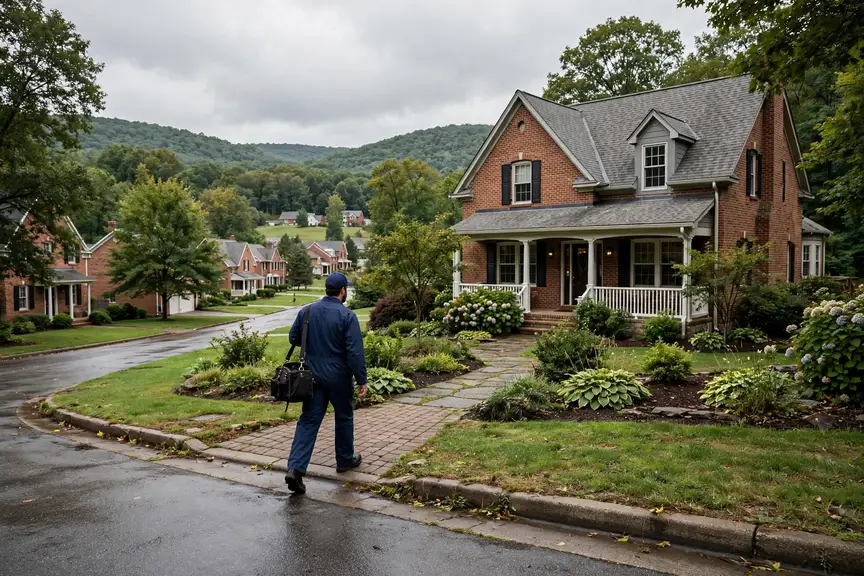
Clarksville, TN — the metro skyline and landscape
Clarksville, TN — plumbing help across the metro
A local plumber's van on a residential street
Local plumbers serving Clarksville neighbourhoods
Water heater installation in a home garage
Replacing a heater in a Clarksville home

Clarksville plumbing, in brief

The median Clarksville home was built in 1994; 31.1% of the stock predates 1980, and the pattern this metro's own data ranks first is freeze-burst pipes in cold snaps. PlumbReach USA is a referral service, not a plumbing company: one call connects you with an independent local plumber serving your ZIP code.

The Clarksville housing stock, and what it means for plumbing

Clarksville is a metro of 328,626 people and 121,182 households, and its plumbing is a portrait of its building history. The median home here was built in 1994; 31.1% of homes predate 1980 and 11.2% predate 1960, while 37.9% have arrived since 2000. Every one of those eras plumbed differently — different pipe materials, different drain designs, different fixtures — and they fail differently, which is why this page is organised around the patterns the data actually produces in Clarksville rather than plumbing in the abstract.

The pre-1980 stock is where most of the metro's plumbing character lives. Homes from those decades in Christian County and across Christian, Trigg, Montgomery, Stewart were built with galvanized supply lines, cast iron or clay drains and first-generation fixtures, and each of those materials is now at or beyond the age its makers expected of it. Owner-occupiers hold 62.1% of the metro's homes, so most of the people reading this page are reading about a system they own outright — one whose failures arrive as surprises only if nobody has looked at the pattern: pressure fading a little each year, a drain that needs attention a little more often, a heater that recovers a little more slowly.

Growth wrote this metro's newest plumbing chapter in plastic and concrete: supply and drain lines in modern materials, fixtures by the catalogue, foundations poured as slabs across the subdivisions near Hopkinsville and Fort Campbell North. The chapter is young — its systems have decades in hand — but it is not exempt from the metro's arithmetic: 1,510 cooling degree days of demand work its heaters hard, and the soil under its slabs moves with the same seasons as the soil under the oldest farmhouse in Christian County.

Over everything sits the weather, and here it is measured rather than described: NOAA's station at CLARKSVILLE OUTLAW AP, TN US averages 58.4 degrees across the year, with 43.0 days reaching 90 or more and 80.3 nights at freezing or below. A buried lateral feels that record as soil that swells and pulls away; a water heater feels it as an unbroken cycle count; an exposed line feels it on the single coldest night. The problem ranking below is what those numbers, crossed with the housing profile, produce for Clarksville specifically.

The Clarksville plumbing profile in numbers

Two public records, one metro: what was built here, and what the sky does to it.

Break the stock down by building era and the profile sharpens. Before 1960: 11.2% of homes, roughly 14,992 of them. From 1960 to 1979: 19.9%, about 26,637. From 1980 to 1999: 31.0%, about 41,495. Since 2000: 37.9%, about 50,731. Four eras, four material palettes — and the balance among them is this metro's plumbing character in a single paragraph.

New-stock metros have their own signature, and Clarksville has it in full: most homes built since 2000, most systems young, most plumbing work a matter of waves — the heater wave, the cartridge wave, the first slab questions — arriving street by street as identical subdivisions age in lockstep. The older pockets still produce the deepest single jobs, but the metro's plumbing centre of mass sits in its newest postcodes, and every year the waves get closer together.

Second in the table, the 1980-1999 band: 41,495 homes, 31.0% of the metro. Its systems are mature rather than ancient — copper in its pinhole years in places, plastic drains still sound, first-generation cartridges wearing out in waves — and its plumbing is the schedulable kind: work that rewards being booked before it becomes urgent.

The climate column of this profile is a workload statement. 3,886 heating degree days say how long the cold half of the year keeps inlet water near its chilliest and heaters firing at their hardest; 1,510 cooling degree days say how relentlessly the hot half loads every drain and tank; 80.3 freezing nights and 43.0 hot days mark the extremes where the failures concentrate. NOAA keeps these figures at CLARKSVILLE OUTLAW AP, TN US as thirty-year normals — which is to say, as the closest thing plumbing has to a settled forecast.

That is the whole method of this page in one section: era shares from the Census, loads from NOAA, and a problem list that is simply where the two overlap most in Clarksville. The services and guidance that follow are ordered by the same profile — local first, generic last.

Plumbing services in Clarksville

Sequenced by this metro's own problem ranking, not by a national catalogue order.

Pipe Repair & Repiping in Clarksville

The supply system is a single organism, so its failures correlate. Repiping exists for the point where correlation is obvious: pressure fading, water discolouring, leaks touring the house. New runs go in PEX or copper, routed to minimise opening walls, pressure-tested before anything is closed up.

Every pipe in Clarksville is in one of three conditions: new enough to forget, old enough to watch, or old enough to be living on borrowed time. The stock's distribution across those conditions is the metro's building history restated — the pre-1980 districts deep in the third condition, the growth corridors still in the first — and pipe services are how individual homes move between them. A repair returns a watched system to service; a repipe promotes a borrowed-time system back to the first condition wholesale, at a stroke, for another generation. The assessment that chooses between them is short, physical and evidenced: pressure, water colour, and the repair history in the walls. In Clarksville that holds across 22 ZIP codes, from Clarksville out to Fort Campbell North.

The repair-or-renew caseload is set by one figure above the rest: 31.1% of Clarksville homes predate 1980, plumbed in the materials now at the end of their service lives. Around Hopkinsville (31,011 residents) as in the old core, that percentage is not an abstraction — it is the street's plumbing, house by house.

More about pipe repair & repiping ➔

Water Heater Repair & Installation in Clarksville

Cold showers, rusty water, a tank that rumbles like a kettle — heater work covers repairing tired units and replacing dead ones. Diagnosis separates the simple failures (elements, thermostats, valves) from the terminal ones (a corroding tank), and a replacement gets sized to the household's actual demand.

Replacement season in Clarksville is not really a season — it is a wave, set decades ago. The heaters installed across the metro's building booms reach the end of their working lives in the same years, so whole streets of similar-aged homes swap tanks within a few seasons of each other. The 50,731 homes built since 2000 are entering the front of that wave now; the pre-1980 stock, on its second or third unit, is deep in it. Wherever a home sits in the wave, the judgement call is the same: repair the part or retire the tank, made on the tank's condition rather than its birthday alone. It is why two Clarksville homes of the same age, on different streets, so often need the same visit in the same year.

The arithmetic behind the diary: 121,182 households heating water through 1,510 cooling degree days and 3,886 heating degree days a year — every one of those households a tank ageing on the same climate's schedule, from the pre-war homes to the newest builds around Oak Grove.

More about water heater repair & installation ➔

Sewer Line Repair & Replacement in Clarksville

Across Christian, Trigg, Montgomery, Stewart, the lateral is the buried half of every home's plumbing — in Clarksville much of it dates to the the 1990s and earlier, and the local approach is inspect, show the footage, then repair or renew the run that failed.

More about sewer line repair & replacement ➔

Emergency Plumbing in Clarksville

In Clarksville the emergency call is routed, not queued: one number reaches the independent local plumber covering Christian, Trigg, Montgomery, Stewart at that hour, and the housing record on this page — median build year 1994 — is the homework they arrive already knowing.

More about emergency plumbing ➔

Drain Cleaning in Clarksville

Drain work in Clarksville splits by era: the 41,629 pre-1980 homes drain through older materials, the post-2000 subdivisions through plastic — and the local plumber reads the cable's return to tell which world your street drains through.

More about drain cleaning ➔

Leak Detection & Repair in Clarksville

The meter test starts it in Clarksville as everywhere; what follows is local — knowing which of Christian, Trigg, Montgomery, Stewart' eras hide lines in slabs, which in crawl spaces, and where the soil movement at CLARKSVILLE OUTLAW AP, TN US's record makes joints let go.

More about leak detection & repair ➔

Toilet Repair & Installation in Clarksville

Running, rocking or refusing — in Clarksville the diagnosis is the same short sequence: fill valve, flapper, supply line, flange. The plumbers routed here carry the internals for the fixtures this metro's eras installed.

More about toilet repair & installation ➔

Faucet, Fixture & Garbage Disposal Repair in Clarksville

Fixture work in Clarksville divides by era like everything else on this page: washer-era taps in the older districts, cartridge internals in the post-2000 subdivisions — the local plumber stocks for both.

More about faucet, fixture & garbage disposal repair ➔

What Clarksville books most

If this page's services were ranked by Clarksville's call patterns rather than listed in catalogue order, they would come out much as they do here — because the ranking behind them is data, not habit. Freeze-burst pipes in cold snaps leads the metro's problem table and water heaters working hard year-round follows, so the services answering them lead the list. The long tail of a metro's plumbing life — fixture failures, toilet calls, the single unexplained leak — fills in the diary around them, here as everywhere.

Plumbing problems Clarksville homes actually get

Chosen by this metro's own housing and weather data — the same two records this whole page is built from.

Freeze-burst pipes in cold snaps

Water expands as it freezes, and a pipe gives it nowhere to go. The split rarely announces itself in the cold — it waits for the thaw, when pressure returns and the crack opens into a spray inside a wall, a ceiling or a crawl space. The lines that go are predictable: runs through exterior walls, garages, crawl spaces and any stretch the heating never reaches, in homes plumbed before routing pipes through conditioned space became the habit. One hard night is enough; the damage is done by the thaw, and it is usually discovered by the sound of running water in a quiet house or a stain spreading across a ceiling that was dry at breakfast.

The burst itself usually happens quietly, inside a wall or under a floor, during the coldest hours — but the flood waits for the thaw. Ice seals the split it made, and only when temperatures rise and the ice lets go does the water start moving into the house. That delay is why freeze damage so often greets a Clarksville household in the morning or on return from a trip away. It is also why the checks after a hard freeze matter: pressure oddly low, a meter turning with nothing running, a damp patch at a wall base. Catch the split at the weep stage and the repair is a pipe; catch it after the thaw and it is a room.

The exposure is written in the climate record: CLARKSVILLE OUTLAW AP, TN US averages 80.3 nights a year at or below freezing, and it takes only one hard night to split an unprotected line. The housing side of the equation is the metro's older stock — homes from the 1990s and earlier, plumbed before freeze protection was routine, with lines in exterior walls and unheated crawl spaces that modern builds route through conditioned space instead.

Watch for

  • A tap that runs slower after a cold night than it did the evening before
  • Frost visible on an exposed section of pipe in the garage or crawl space
  • A water bill spike in the month after a hard freeze

About pipe repair & repiping ➔

Water heaters working hard year-round

Sediment is the water heater's biography, written a layer at a time. Every gallon the tank heats leaves its minerals behind a fraction more completely, and the accumulating bed insulates the water from the burner, forcing longer firings that stress the steel and cook the sediment harder. Clarksville's heaters write that biography at the pace its climate sets — hard cycling in the hot months, cold inlets in the cold ones. A yearly drain-down edits the biography while the tank is young; left unread for a decade, it ends the way most such stories end, with a replacement chosen under time pressure.

Recovery time is the number that runs a household's mornings, and it is the first thing sediment steals. A tank rated to serve a family when new delivers less hot water per heating cycle every year as the sediment layer thickens and the burner's work goes into heating rock instead of water. In Clarksville, where summer demand piles showers, laundry and dishwashing into the same hours, that slow decline shows up as a household quietly rationing hot water without ever deciding to. Flushing the tank returns some of it; a spent anode and a rumbling, scaled tank are the signs the decline has become structural, and the conversation turns to replacement.

Do the local sums: 121,182 households heating water through 1,510 cooling degree days and 3,886 heating degree days a year means the metro's heater fleet cycles relentlessly, and sediment settles further with every cycle. Heaters in Clarksville rarely die young — they die on schedule, and the schedule is written by how hard the climate makes them work and whether anyone ever drained the sediment out of the tank.

Watch for

  • Showers running lukewarm one after another on busy mornings
  • Rumbling or popping sounds from the tank as it heats
  • Rusty tint in the hot water only, while cold runs clear

About water heater repair & installation ➔

Galvanized pipes at the end of their life

Galvanized steel pipe was plumbed into millions of homes, and it ages in a particular way: the zinc coating gives out, the steel rusts, and the rust grows inward until the pipe that once carried a full stream is choked to a fraction of its width. With a median build year of 1994 and 31.1% of its homes predating 1980, Clarksville has a large stock of housing in the galvanized era, and its symptoms are the classic ones — pressure that has faded a little more each year, water that runs rusty after the house sits quiet overnight, and leaks that begin appearing at joints. No cleaning reverses this; the corrosion is the pipe itself converting to rust. The judgement call is timing. A galvanized system with one small leak and acceptable pressure can be repaired and watched. A system leaking in several places, with pressure dropping across every fixture, is telling you the material has finished its service life, and each repair buys a shorter quiet interval than the last. Repiping in PEX or copper replaces the whole question with a new system and restores the pressure the home was built with.

The geography of galvanized failure inside one house is uneven, and the unevenness misleads people. The runs nearest the water heater corrode fastest, worked by heat; long horizontal runs narrow differently from vertical risers; the line to a little-used guest bathroom may be nearly closed while the kitchen still flows. This is why a Clarksville home can seem fine at most taps while one shower has given up entirely. Repiping answers the whole geography at once, which is its real argument: not that any single run has failed, but that the system's remaining life is scattered unevenly through every wall, and spot repairs keep buying the shortest-lived section.

In raw numbers, Clarksville's exposure is 41,629 homes built before 1980 — the galvanized decades. Behind every one of those front doors is the same material on the same clock, which is why pressure complaints and pinhole leaks cluster by neighbourhood here rather than scattering evenly across the metro.

Watch for

  • Pressure fading gradually across the whole house
  • Rusty water after the taps sit unused
  • Repairs needed more often, in more places

About pipe repair & repiping ➔

Winter pipe season in Clarksville

Winter in Clarksville is pipe season. With about 80.3 nights a year at or below freezing on the long-term record, the houses that get through winter cleanly are the ones whose exposed lines were dealt with in autumn: insulation on garage and crawl-space runs, hoses off the outside taps so those lines can drain, and a household that knows where its main shutoff is before it needs it. During the hardest cold, a slow drip from the tap furthest from the main and open cabinet doors under sinks on outside walls are simple insurance. If a line does freeze, shut the water off before the thaw does its damage and have the run checked — a pipe that froze once has shown you exactly where it is vulnerable.

The numbers behind the season here: 80.3 nights a year at or below freezing at CLARKSVILLE OUTLAW AP, TN US, against a housing stock whose median build year is 1994. Every winter writes the same exam for Clarksville's older pipes, and every winter some of them — usually in the the 1990s districts first — fail it.

A closer look: freeze-burst pipes in cold snaps in Clarksville

Cold finds the same houses every year, and in Clarksville they are identifiable in advance: the ones with plumbing in the wrong places. A line crossing an unheated garage ceiling, a supply run against an outside wall, a hose bibb never drained — CLARKSVILLE OUTLAW AP, TN US's 80.3 freezing nights audit each of them annually. The older districts near Clarksville hold the densest concentration of those routings, plumbed in an era less strict about keeping water inside the heated envelope. The repair after a burst is carpentry as much as plumbing; the prevention, done in autumn, is an hour of unglamorous attention to exactly the runs the cold already knows.

The numbers underneath it, for Clarksville: 133,856 housing units, a median build year of 1994, and a climate record at CLARKSVILLE OUTLAW AP, TN US of 3,886 heating degree days against 1,510 cooling degree days. Cross the housing record with the weather record and this pattern is what falls out at the top — rarely the most dramatic problem in plumbing, but the one this metro's stock and climate manufacture most steadily.

On a first visit for this pattern, a local plumber's checks run in a practised order:

  • Every line routed through unheated space, listed before winter rather than after
  • Outside taps: hoses off, lines drained, covers on
  • Cabinet doors and insulation on outside-wall runs, the cheapest protection there is
  • The household's plan for a hard freeze: who shuts the water off, and where the key is

From problem to fixed, in Clarksville

A plumbing problem inside a Clarksville homePROBLEM
➔
The same system in Clarksville after professional repairSOLUTION

Areas covered in the Clarksville metro

Clarksville

Population 171,897

Hopkinsville

Population 31,011

Fort Campbell North

Population 11,483

Oak Grove

Population 7,945

Cadiz

Population 2,649

Dover

Population 2,080

Pembroke

Population 817

Crofton

Population 690

Cumberland City

Population 475

Cerulean

Population 409

Fairview

Population 205

LaFayette

Population 176

Also in the Clarksville metro: Big Rock (population 161), Gracey (population 53).

The communities in the grid are not suburbs of the page; they are its subject as much as Clarksville is. Hopkinsville (31,011 residents) and Fort Campbell North (11,483) carry their own building decades, their own pipe materials and their own positions in the problem ranking's logic — a lateral under a Hopkinsville street answers to the same data as one in the centre, but to a different era of it. Coverage here is defined by the ZIP list below; understanding is defined street by street, and this page's figures are the metro-wide version of a story each community tells in its own numbers.

Also on the Clarksville map: Oak Grove (7,945), Cadiz (2,649), Dover (2,080), Pembroke (817), Crofton (690) — communities spread across Christian, Trigg, Montgomery, Stewart, each with housing from its own growth years. A plumber routed through PlumbReach USA to any of them is working from this same page: the metro data does not change at the city limit, but the housing on your street — its age, its materials, its soil — is what the visit is really about.

Clarksville ZIP codes we cover

37023, 37028, 37040, 37042, 37043, 37050, 37052, 37058, 37079, 37142, 37171, 37191, 42211, 42215, 42217, 42223, 42232, 42236, 42240, 42254, 42262, 42266

The Clarksville metro in detail

Every metro has a first city and a supporting cast, and the census figures draw the billing plainly here: Clarksville first, with 171,897 residents; Hopkinsville second at 31,011; Fort Campbell North third at 11,483; then the long tail of smaller communities in the grid above. The billing matters less than the building dates — each of these places was plumbed in its own decade, by its own builders — but between them they account for nearly every housing era, material and failure pattern this page describes.

Administratively the metro is drawn from Christian, Trigg, Montgomery, Stewart — 4 in all — with Christian County at its centre. County lines do not change pipe physics, but they do shape the paperwork around the work: permits, inspections and code details are county and city business, which is one reason the professional who serves your street is a local one.

Three neighbouring coverage areas begin where this one ends: Nashville, TN, some 67 miles off; Jackson, TN, 96 miles; and Memphis, TN, 169 miles. Each keeps its own page because each keeps its own numbers — a different median build year, a different climate station, a different problem ranking. Boundary households should trust the ZIP list over the map: the code, not the compass, assigns the dataset.

Set Clarksville among its neighbours and the contrasts sharpen the profile: Nashville, TN — metro population 2,197,416, median build year 1993 — sits 67 miles away; Jackson, TN (184,569, median 1983) 96 miles; Memphis, TN (1,341,412, median 1982) 169 miles. Three different housing stocks under three nearby skies, which is why each keeps its own page and its own problem ranking rather than borrowing this one.

Ratios tell the metro's story compactly. Renters occupy 37.9% of homes; owners hold the rest. For every home built since 2000 there are 0.8 from before 1980. Spread the stock across the coverage map and each ZIP code carries about 6,084 housing units — the density at which era patterns repeat street after street instead of scattering, and at which a routed round of calls stays inside a few districts.

The Clarksville record in one line — median home age: 32 years · owner-occupied homes: 75,254 · renter-occupied homes: 45,928 · pre-1960 homes per covered ZIP code: 681 · heating-to-cooling degree-day ratio: 2.57 · average rainfall: 1,199 mm a year.

Clarksville plumbing questions

What area does PlumbReach USA cover around Clarksville?
Coverage follows the metro's own map: 22 ZIP codes across Christian, Trigg, Montgomery, Stewart, anchored on Clarksville and running out through Hopkinsville, Fort Campbell North and Oak Grove. The list printed on this page is the working boundary — inside it, one call routes you to an independent local plumber who serves your street. Put the coverage against the Census map and it tracks the population: Clarksville first (52.3% of the metro), then the rings of suburbs and smaller communities in their own building decades — all of it inside the same routing. If a street sits between Fort Campbell North and Oak Grove, it is in; the list was drawn from the Census map of the metro — 4 counties, 22 codes — rather than from a radius around a shop. The ground inside that boundary holds 133,856 housing units — 14,992 from before 1960, 26,637 from 1960-1979, 50,731 since 2000 — under the climate record kept at CLARKSVILLE OUTLAW AP, TN US. Stated as the communities it covers: the community ledger reads Clarksville (171,897 residents), Hopkinsville (31,011), Fort Campbell North (11,483), Oak Grove (7,945) and Cadiz (2,649), out of 328,626 residents metro-wide.
Which parts of a 1994-era Clarksville home's plumbing are living on borrowed time?
Walk it the way a plumber would. First the visible evidence: staining under sinks, a meter that creeps, drains that have slowed by degrees. Then the era evidence: a home of about 1994 in this metro sits amid 31.0% of housing built between 1980 and 1999 and an older core built earlier still, so mixed pipework — some original, some renewed — is the expectation, and knowing which of yours is which is most of the answer. In Clarksville that plays out across 22 ZIP codes, from Clarksville to Hopkinsville. Geography of the advice: it holds across 22 ZIP codes and 4 counties, in the 121,182 households the Census counts from Clarksville out to Oak Grove — the eras differ by district, the watch-list does not. The same applies street by street in Christian County: a median year of 1994 is an average, and the homes on either side of it — older in the core, newer past Oak Grove — read from the same materials list. Set against the climate that works on them — 3,886 heating degree days, 1,510 cooling degree days, 47.21 inches of rain at CLARKSVILLE OUTLAW AP, TN US — the era of a Clarksville home is the strongest single clue to the condition of its plumbing. Where the watching happens, in figures: the community ledger reads Clarksville (171,897 residents), Hopkinsville (31,011), Fort Campbell North (11,483), Oak Grove (7,945) and Cadiz (2,649), out of 328,626 residents metro-wide — one timetable of ageing systems across all of them.
Which plumbing fault shows up most often across Clarksville?
Count from the housing up and the answer is freeze-burst pipes in cold snaps. Water expands as it freezes, and a pipe gives it nowhere to go. The runner-up patterns on this page matter too — a metro rarely specialises in a single fault — but the leader is the leader because Clarksville's mix of eras and weather manufactures it at scale. The backdrop is the same metro-wide: 133,856 housing units working against the CLARKSVILLE OUTLAW AP, TN US climate record. For scale, the runner-up is water heaters working hard year-round, and the gap between them is the metro's own arithmetic: housing counted across Christian, Trigg, Montgomery, Stewart, weather logged at CLARKSVILLE OUTLAW AP, TN US, and an era profile with a median of 1994. Change one input and the order moves: at CLARKSVILLE OUTLAW AP, TN US the record reads 3,886 heating degree days against 1,510 cooling; in the stock, 11.2% predates 1960 and 31.1% predates 1980. The inputs behind the ranking, community by community: the community ledger reads Clarksville (171,897 residents), Hopkinsville (31,011), Fort Campbell North (11,483), Oak Grove (7,945) and Cadiz (2,649), out of 328,626 residents metro-wide.
Which parts of my plumbing does the Clarksville weather actually touch?
It decides which problems this metro gets. Clarksville's average year, per NOAA's record at CLARKSVILLE OUTLAW AP, TN US, delivers 47.21 inches of rain across 3,886 heating degree days: wet soil pressing on laterals, dry soil pulling away from them, and cold snaps hunting for the one uninsulated run in the garage wall. The seasonal section of this page translates those numbers into the months that matter. Read the record as the station logs it — CLARKSVILLE OUTLAW AP, TN US, the NOAA station nearest this metro's centre: 3,886 heating degree days against 1,510 cooling degree days in a normal year. Every pattern ranked on this page was scored against those two numbers and the housing figures beside them. It is the same story from Hopkinsville to Fort Campbell North — the stock decides, and this stock's median build year is 1994. The record behind it is measured at CLARKSVILLE OUTLAW AP, TN US and felt from Hopkinsville to Oak Grove: one climate for Christian, Trigg, Montgomery, Stewart, 133,856 housing units, and every pipe, heater and lateral inside them. The figures are worth keeping with the house papers: 58.4 degrees as the yearly average at CLARKSVILLE OUTLAW AP, TN US, 47.21 inches of precipitation, and a housing stock whose median year is 1994 — the three numbers this metro's plumbing lives by. The numbers in one line: 58.4 degrees average, 47.21 inches of precipitation, 3,886 heating degree days, 1,510 cooling degree days, 43.0 days at 90 or above, 80.3 nights at freezing or below. Whose roofs that weather works on: the community ledger reads Clarksville (171,897 residents), Hopkinsville (31,011), Fort Campbell North (11,483), Oak Grove (7,945) and Cadiz (2,649), out of 328,626 residents metro-wide.
I can hear water running inside a wall at my Clarksville home. First move?
Kill the water at the main shutoff — where the line enters the house, in the basement, garage or utility space, or out at the meter box by the street. Then crack open a ground-floor tap to bleed the pressure off, keep everyone clear of water near electrics, and make the call. Our shutoff guide, linked from this page, shows how to find the valve on a calm day instead of a wet one. Across the metro's 4 counties, Christian County included, the pattern repeats wherever the housing matches. The local detail that decides how the first minutes go: which side of Clarksville the home sits on. Houses in Hopkinsville and the older districts tend to shut off at an interior valve; slab homes out toward Fort Campbell North and Oak Grove more often at the meter — worth knowing before the water is moving, across all 22 covered ZIP codes. The calm-day homework for this metro: walk the 22 covered ZIP codes' worth of housing in your mind to your own valve — in Christian County the older stock hides it indoors, the slab tracts past Fort Campbell North at the meter — and turn it once before you ever need it in anger. The calm-day version, localised: find your valve before CLARKSVILLE OUTLAW AP, TN US's next freeze season — 80.3 freezing nights a year — whether your home sits near Clarksville, out in Hopkinsville (31,011 residents) or past Fort Campbell North (11,483). True from the centre to the edge: the community ledger reads Clarksville (171,897 residents), Hopkinsville (31,011), Fort Campbell North (11,483), Oak Grove (7,945) and Cadiz (2,649), out of 328,626 residents metro-wide — shutoff first, everywhere on the map. The ranking that frames the damage: Freeze-burst pipes in cold snaps first on this page, water heaters working hard year-round second, galvanized pipes at the end of their life third — the burst line in front of you belongs to the same local arithmetic. The calm-day version of this answer is a walk: the valve behind a 37023 address, the meter box on a 37058 street, the interior shutoff in a 42217 home — three eras, three addresses for the same valve, all inside this metro's 22 codes.
When does a Clarksville house cross the line from repairs to a full repipe?
Sometimes, and the distinction is mechanical. Repairs replace a section; repiping replaces a material — and it is the material, not the section, that is failing when leaks multiply in an older Clarksville home. Galvanized lines from the metro's pre-1980 stock (31.1% of all homes) are the usual defendant. A plumber who recommends a fourth repair on that pattern without naming the alternative is not doing you a favour. Homeowners in Hopkinsville (31,011) and Fort Campbell North (11,483) read this page for the same reason — the stock there is the same stock. The numbers are the metro's own: 121,182 households, 22 ZIP codes, one climate record at CLARKSVILLE OUTLAW AP, TN US. Ask where this conversation happens most and the answer is a map: the districts plumbed in the galvanized decades, from the centre out through Hopkinsville (31,011 residents) and Fort Campbell North (11,483), across Christian, Trigg, Montgomery, Stewart. The newer communities in the grid hear it rarely — their turn is scheduled decades from now. Streets matter to the timing: the founding districts near Clarksville reach the pattern first, the post-war ring through Hopkinsville and Fort Campbell North a decade behind, the subdivisions past Oak Grove a generation behind that. Streets carry the same ledger at household scale: from Clarksville (171,897 residents) through Hopkinsville (31,011) to Fort Campbell North (11,483), the leak sequence means the same thing wherever the material matches. Where the conversations happen: the community ledger reads Clarksville (171,897 residents), Hopkinsville (31,011), Fort Campbell North (11,483), Oak Grove (7,945) and Cadiz (2,649), out of 328,626 residents metro-wide, earliest and oftenest in the founding names on that list.
Is PlumbReach USA the company that will do the work at my Clarksville home?
No. PlumbReach USA is a connection service: your call is routed to an independent local plumbing professional who serves Clarksville, and that professional assesses and carries out the work in your home. Our part is the routing — and these city pages, assembled from Census and climate data so you can understand your metro's plumbing before you ever need the call. The local figures behind it: 41,629 homes from before 1980 and 50,731 built since 2000, sharing one system of streets and soil. The arrangement is the same across the whole footprint: 22 ZIP codes, 4 counties, communities from Clarksville through Oak Grove — in each of them the professional is local, independent, and working their own patch of the metro's housing. It is worth being precise about the local end of the arrangement: the professional serving Hopkinsville or Oak Grove sets their own terms with you, carries their own responsibility for the work, and answers for it — our routing is the only part this page undertakes. Callers from Hopkinsville (31,011 residents), Fort Campbell North (11,483) and Oak Grove get the same plain arrangement: our routing, their plumber, their terms — stated here because the metro's 328,626 residents deserve it stated. The arrangement holds in every community: the community ledger reads Clarksville (171,897 residents), Hopkinsville (31,011), Fort Campbell North (11,483), Oak Grove (7,945) and Cadiz (2,649), out of 328,626 residents metro-wide.
What plumbing checks are worth doing each year in Clarksville?
Five habits, matched to the record at CLARKSVILLE OUTLAW AP, TN US. Test the main shutoff until it turns without argument. Give the water heater its yearly drain-down against the sediment Clarksville's demand settles into it. Read the meter on a still evening. Run the ground-floor drains so their traps stay full. And walk the exposed lines before the 80.3 freezing nights arrive. Ordinary work, done in the order this metro's climate and housing age make valuable. None of it is abstract at this scale: 121,182 households across Christian, Trigg, Montgomery, Stewart share one climate and one ageing stock, so a yearly rhythm kept by even a fraction of them is the difference between this metro's plumbing failing in private, one house at a time, and failing on a schedule somebody saw coming. Scale the routine to the map and it stays the same half hour: the checks are written for a stock of 133,856 homes spread over Christian, Trigg, Montgomery, Stewart, from the founding streets near Clarksville to the subdivisions past Hopkinsville (31,011 residents) — one climate, one ageing pattern, one calendar. The calendar's local proof is in the stock figures: 41,629 pre-1980 homes to keep valves alive in, 50,731 post-2000 homes reaching first-fixture age together, and 47.21 inches of rain a year testing every cleanout in Christian, Trigg, Montgomery, Stewart. The checks are sized to the stock's actual eras — a median build year of 1994, 11.2% of it pre-1960 — not to a generic house that exists nowhere in Clarksville. The routine's territory, in codes: the codes run 37023, 37058, 42217, 42266 and 42232 among the 22 on the list, spread over Christian, Trigg, Montgomery, Stewart.
Why does this page lead with the problems it leads with in Clarksville?
By a scoring pass over public data, rebuilt for every metro. Each candidate pattern earns its place from Clarksville's own figures: how much of the stock predates 1980 (31.1%), how much predates 1960 (11.2%), and what the weather at CLARKSVILLE OUTLAW AP, TN US does to systems of those vintages across 43.0 hot days and 80.3 freezing nights a year. Patterns both records support rise; the rest wait further down the list. Run the same scoring on any single district and the order bends: Hopkinsville's streets would rank their own list, Oak Grove's another. This page ranks the metro as a whole — 121,182 households across Christian, Trigg, Montgomery, Stewart — which is why the evidence paragraphs keep returning to where each pattern actually concentrates. A useful check on the method: run it on Hopkinsville alone and the order bends toward that district's eras; run it on the whole metro — 121,182 households — and you get the list printed here. The evidence trail is on this page: the problem sections scored pattern by pattern, the housing profile drawn from Christian, Trigg, Montgomery, Stewart, the climate read from CLARKSVILLE OUTLAW AP, TN US — the ranking is the two records read together, nothing else. The scoring's raw material, code by code: the codes run 37023, 37058, 42217, 42266 and 42232 among the 22 on the list, spread over Christian, Trigg, Montgomery, Stewart. The dataset's own label for the unit being scored: the Clarksville metro — 328,626 residents, 62.1% of them owner-occupiers — scored whole, because its housing and its weather arrive whole. Subset the inputs and the order bends: score Hopkinsville's streets alone and their eras lead; score the Oak Grove subdivisions alone and theirs do. The printed order belongs to the full 22-code metro, no smaller unit.
Where are Clarksville's oldest homes, and why does it matter for plumbing?
Ask a plumber who has worked this metro for years and the answer comes as a drive, not a list: start at the old centre of Clarksville, where the houses went up before modern materials existed, and every street outward is a decade younger in its pipework. The pattern is reliable enough to stock a van by — iron and clay near the middle, steel in the post-war ring, copper and plastic beyond — and it is why the oldest homes are not scattered through Clarksville but layered, in the order the metro grew. It is also a numbers story: of Clarksville's 133,856 housing units, the pre-1960 share is 11.2% — the largest single concentration of original-era pipework in the metro, sitting in the districts where Christian County's streets were laid out first. The drive that proves it runs from the centre of Clarksville outward: through Hopkinsville (31,011 residents), then Fort Campbell North (11,483), then the younger rings toward Oak Grove — a single trip across Christian, Trigg, Montgomery, Stewart that travels forward through the metro's plumbing history decade by decade. It is why two homes a mile apart in Clarksville can need different conversations: one on the 1990s materials near the centre, one on modern lines past Fort Campbell North — the map of eras is the first diagnostic. ZIP by ZIP the same gradient: the oldest systems cluster in the codes nearest the centre — the 37023 side of the list — and the youngest toward 42266 at the edge, across Christian, Trigg, Montgomery, Stewart. The map's communities in growth order: the community ledger reads Clarksville (171,897 residents), Hopkinsville (31,011), Fort Campbell North (11,483), Oak Grove (7,945) and Cadiz (2,649), out of 328,626 residents metro-wide. Counted under its Census name — the Clarksville metro, 328,626 residents, 62.1% owner-occupied — the oldest layer is a defined population of homes, not a figure of speech.
If a plumber assessed my Clarksville home tomorrow, what would they look at first?
Expect the flags this metro's figures predict. In Clarksville the recurring findings are shutoffs seized from disuse, heaters past their anode's protection, supply lines in original the 1990s material, and a meter that creeps when the house is quiet. The check hunts those four in that order, then reads whatever the house adds of its own — in a stock of 133,856 homes, no two inspections are identical, but the shortlist rhymes from street to street. The metro's figures say why the order matters here: 41,629 pre-1980 homes means shutoffs and heaters of a certain age are the statistical norm rather than the exception, and a climate of 3,886 heating degree days works every heater in Christian County hard enough to justify its place near the front of the walk. District by district, the same half hour: in Christian County's oldest homes the flags are materials; in the middle ring, around Hopkinsville (31,011 residents), they are valves and heaters; at the growth edge they are cartridges and first questions about lines under slabs. Keep the findings with the house records: in a metro of 121,182 households, the homes whose owners can date their last check are the ones whose failures arrive as appointments — the entire point of the half hour. District accents, with figures: Hopkinsville (31,011 residents) leans to valves and materials, Fort Campbell North (11,483) to heaters and drains, Oak Grove to first-generation fixtures — one walk, three readings. The walk's districts, named: the community ledger reads Clarksville (171,897 residents), Hopkinsville (31,011), Fort Campbell North (11,483), Oak Grove (7,945) and Cadiz (2,649), out of 328,626 residents metro-wide.

Before an emergency, read the guide: How to shut off your home's water main

Nearby metro areas

Talk to a Clarksville plumber

PlumbReach USA routes your call to an independent local plumbing professional serving Clarksville — the assessment and the work are theirs.

Call center hours: Mon-Fri 7:00 AM-10:00 PM ET | Sat 8:00 AM-10:00 PM ET | Sun 7:00 AM-9:00 PM ET

Call Now
