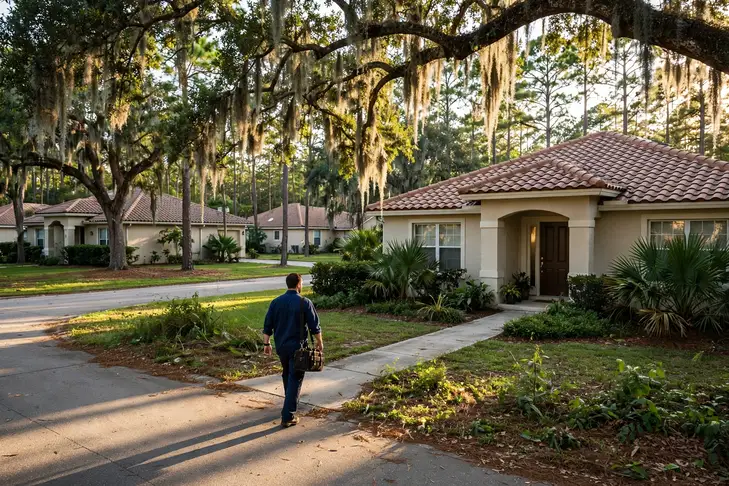


Everything on this page was computed for Gainesville and nowhere else: the problem ranking from its Census housing profile, the seasonal risks from its NOAA station record, the coverage from its own ZIP codes. PlumbReach USA connects you to an independent local plumber; the page itself is the homework, done in public, so the call you make is an informed one.
Call center hours: Mon-Fri 7:00 AM-10:00 PM ET | Sat 8:00 AM-10:00 PM ET | Sun 7:00 AM-9:00 PM ET
The median Gainesville home was built in 1988; 34.1% of the stock predates 1980, and the pattern this metro's own data ranks first is slab leaks under concrete foundations. PlumbReach USA is a referral service, not a plumbing company: one call connects you with an independent local plumber serving your ZIP code.
Every metro is really several, stacked by decade. Gainesville's stack, per the Census, reads: 9.1% of homes from before 1960, a thick middle from the growth decades, and 29.3% from 2000 onward — 154,596 housing units in all, wrapped around a median build year of 1988. Plumbing follows the stack faithfully. Each layer went in with its era's materials and workmanship, and each layer is now failing in its era's characteristic order. This page keeps the layering in view throughout, because in a stacked metro the first diagnostic question is never what broke — it is which layer the home belongs to.
The pre-1980 stock is where most of the metro's plumbing character lives. Homes from those decades in Alachua County and across Alachua, Gilchrist, Levy were built with galvanized supply lines, cast iron or clay drains and first-generation fixtures, and each of those materials is now at or beyond the age its makers expected of it. Owner-occupiers hold 58.9% of the metro's homes, so most of the people reading this page are reading about a system they own outright — one whose failures arrive as surprises only if nobody has looked at the pattern: pressure fading a little each year, a drain that needs attention a little more often, a heater that recovers a little more slowly.
The newer homes also house much of the metro's renting population, and rented plumbing lives a harder life: more occupants per system in many cases, faults reported later, and maintenance decided by someone who does not live with the drip. Across Gainesville, 137,665 households depend on systems most of them did not choose, and the post-2000 stock — 45,297 homes — is where the tenancy share runs highest. The failures are the modern ones: cartridges, heater elements, slab-line questions. They arrive on the subdivisions' shared schedule regardless of who holds the lease.
Over everything sits the weather, and here it is measured rather than described: NOAA's station at GAINESVILLE RGNL AP, FL US averages 69.3 degrees across the year, with 90.4 days reaching 90 or more and 14.8 nights at freezing or below. A buried lateral feels that record as soil that swells and pulls away; a water heater feels it as an unbroken cycle count; an exposed line feels it on the single coldest night. The problem ranking below is what those numbers, crossed with the housing profile, produce for Gainesville specifically.
Two public records, one metro: what was built here, and what the sky does to it.
The distribution, in one breath: of every hundred Gainesville homes, 9.1 were standing before 1960, 25.0 went up in the two decades after, 36.6 in the two after that, and 29.3 have arrived since 2000. Percentages flatten the picture, so hold the counts beside them — 14,068 oldest-era homes, 45,297 newest — and the metro's plumbing stops being an abstraction: it is that many systems, of those ages, failing in that order.
This metro's stock was mostly built in plumbing's transitional decades, 1980 to 1999, and it shows a particular failure calendar: not the corrosion sagas of the old metros, but the wear-out wave of everything installed in those years arriving together — cartridges, heater tanks, fixture finishes, the first of the plastic systems ageing into brittleness. Gainesville's plumbing story for the next decade is largely written: it is the story of that installed base reaching its limits neighbourhood by neighbourhood.
Behind the leading era, the growth band: 29.3% of homes arrived since 2000. Their plumbing is uniform by construction — one generation of fixtures, one approach to lines under slabs — which writes a shared calendar the whole street keeps. Reading that calendar early is most of what separates a planned replacement from a weekend emergency in Gainesville's newest districts.
Gainesville's weather, reduced to what a pipe experiences: 90.4 hot days a year loading the drains and heaters, 14.8 freezing nights testing every exposed run, and 48.31 inches of rain moving through the soil that holds the laterals. NOAA's normals at GAINESVILLE RGNL AP, FL US — 1,139 heating degree days, 2,741 cooling degree days — are the long average of that experience, and they are why this metro's problem list is not interchangeable with a milder or harsher metro's.
That is the whole method of this page in one section: era shares from the Census, loads from NOAA, and a problem list that is simply where the two overlap most in Gainesville. The services and guidance that follow are ordered by the same profile — local first, generic last.
Sequenced by this metro's own problem ranking, not by a national catalogue order.
The expensive leaks are the quiet ones: a pinhole misting inside a wall, a slab line weeping into the ground for months. Finding them is a measurement exercise — meter behaviour, acoustic listening, pressure isolation — that narrows a whole house down to a square foot before a single board is lifted.
The economics of a hidden leak are set by its hiding place, and Gainesville contains multitudes: slab tracts where water escapes into soil engineered to drink it, pier-and-beam pockets where it drips into darkness, two-storey builds where it rides a joist into a ceiling two rooms away. The effort a hunt takes follows the hiding place — an afternoon of listening in one construction, a morning of pressure isolation in another — which is why the first questions on a leak call here are architectural. Name the construction and the hunt is half planned before anyone leaves the yard. The GAINESVILLE RGNL AP, FL US record — 1,139 heating degree days, 2,741 cooling — is the backdrop Alachua County plumbers plan around.
Scale the problem by the Census count and it stays concrete: 154,596 housing units, each a small network of pressurised lines, each capable of losing water silently. The meters across Gainesville register those losses in aggregate; the detection visit exists to assign one of them to one address — in Alachua this month, somewhere else next.
Pipes fail in two tenses: suddenly, at a joint or a split, and gradually, as a material narrows, thins or pits across a whole system. The first tense asks for a repair; the second eventually asks the larger question. Pipe services cover both — the sectional fix that restores a sound system, and the planned renewal that replaces a failing material through the whole house, routed to spare the building and staged to keep the household in water.
Not every old pipe in Gainesville needs replacing, and the assessment matters: a sound copper system from the 1980s with one failed joint is a repair; a galvanized system with rust at every exposed fitting is a repipe waiting for its date. The metro's newer subdivisions (29.3% built since 2000) sit this conversation out for now — their turn comes decades from now. For the older stock, the job is planned around the household: routes through accessible spaces, water restored in stages, and openings kept to where lines actually have to pass. Count it in homes if you prefer: 52,717 built before 1980, 45,297 since 2000, one shared system of soil and seasons.
The repair-or-renew caseload is set by one figure above the rest: 34.1% of Gainesville homes predate 1980, plumbed in the materials now at the end of their service lives. Around High Springs (6,396 residents) as in the old core, that percentage is not an abstraction — it is the street's plumbing, house by house.
The sewer line is the one pipe every fixture in the house shares, and the only one whose failure backs up into the home instead of draining away from it. Its enemies are time, roots and soil movement, working at the pace of decades. Service on the line begins with evidence — camera footage of its actual condition — because the difference between a cleaning, a sectional repair and a replacement is written inside the pipe, not in the symptom at the drain.
A sewer call in Gainesville begins further from the house than most people expect: at the map. The line's age follows the street's age, its material follows the decade, its enemies — roots in the old canopy blocks, soil movement in the newer ones — follow the ground it crosses. That is why the camera survey is not a formality here: the footage converts a metro-level pattern into a property-level decision, and the decision scales honestly, from a single joint renewed through a cleanout to a full run replaced where the old one has given up along its length. With a median build year of 1988, most of the metro's 154,596 housing units are working through the same ageing curve.
Under Gainesville lie 154,596 laterals, one per housing unit, and the oldest of them — beneath the 14,068 pre-1960 homes — have been underground since the metro was a fraction of its present size. The camera diary in Williston and the old core is written by that buried generation.
Heater work in Gainesville is workload work: 90.4 hot days and 1,139 heating degree days a year cycle the metro's tanks hard, and the local professionals routed here size, flush and replace against that record.
In Gainesville the emergency call is routed, not queued: one number reaches the independent local plumber covering Alachua, Gilchrist, Levy at that hour, and the housing record on this page — median build year 1988 — is the homework they arrive already knowing.
Drain work in Gainesville splits by era: the 52,717 pre-1980 homes drain through older materials, the post-2000 subdivisions through plastic — and the local plumber reads the cable's return to tell which world your street drains through.
Running, rocking or refusing — in Gainesville the diagnosis is the same short sequence: fill valve, flapper, supply line, flange. The plumbers routed here carry the internals for the fixtures this metro's eras installed.
Fixture work in Gainesville divides by era like everything else on this page: washer-era taps in the older districts, cartridge internals in the post-2000 subdivisions — the local plumber stocks for both.
Two patterns generate most of the bookings behind the services above: Slab leaks under concrete foundations and galvanized pipes at the end of their life. That is why the order of this page's service list is what it is — the services answering those patterns come early, and the rest follow in the order the metro's data supports. A homeowner whose home matches the local profile — built in the metro's big decades, in one of its older districts — is, statistically, reading their own shortlist.
Chosen by this metro's own housing and weather data — the same two records this whole page is built from.
The slab leak's cruellest feature is its patience. A pinhole in a pressurised line under concrete does not rest: it runs at night, on holidays, while the house stands empty, moving water into soil that carries it away unseen. Weeks of that patience show up in the aggregates — a bill trending up across three statements, a meter reading that will not reconcile with the household's habits. In Gainesville's slab-built districts the pattern repeats in house after house of the same subdivisions, because the lines were poured in the same seasons and age in convoy. Detection ends the patience at a marked point on the floor.
Once a slab leak is located, the repair decision turns on geometry. Opening the floor at the marked point reaches the failed section directly and restores the original run — a good answer when the line is otherwise sound and the spot sits under replaceable flooring. Rerouting abandons the buried run entirely and carries the water through walls and ceiling instead — a better answer when the line has form, when several runs share the slab, or when the floor above is worth more than the pipe below. Plumbers in Gainesville argue both sides of that choice daily; the honest version depends on the leak's position, the line's history, and what the floor is made of.
The arithmetic of concealment: 45,297 homes built since 2000, most on slabs, joining the post-war slab tracts — a buried-line population in the tens of thousands of runs, each invisible from inside the house. Even a small annual failure rate across that population produces this metro's steady background count of slab calls.
Run two taps at once in a galvanized house and the second one apologises. That is the material's signature in old age: rust accreting inside the bore until the pipe delivers a fraction of its designed flow, weakest at the far end of the run. Gainesville carries 52,717 pre-1980 homes, and the ones still on original galvanized announce themselves the same way — pressure that fades year by year, water that runs tea-coloured after a quiet weekend. Repiping is simply the moment the household stops negotiating with the symptom and replaces the cause.
Galvanized pipe fails politely, which is exactly the problem — it gives a household years of small warnings that are easy to live with. The zinc coating that once protected the steel wears through, rust takes its place, and the rust grows inward like a narrowing artery. Flow to the farthest fixtures drops first. A shower that shares a line with a running tap loses its pressure. By the time the water itself runs discoloured after the house has sat quiet overnight, the narrowing is well advanced. None of this is a single emergency; it is a system reaching the end of its design life on schedule, and in Gainesville's pre-1980 neighbourhoods that schedule is arriving for whole streets at once, because the pipes went in together.
The scale of it in Gainesville: about 52,717 homes predate 1980, the decades when galvanized steel was plumbed into houses as a matter of course. Those lines have been corroding inward ever since, quietly and at different speeds — two houses on the same street in Gainesville can be years apart in symptoms, but they are reading from the same page of the same story.
A lateral ages in the dark, and its ageing has a geography. The run beneath the house is sheltered; the run beneath the yard takes the soil's full behaviour — swelling after Gainesville's 48.31 inches of yearly rain, shrinking in the dry months, shifting at every joint. Add the trees, whose roots read those joints as invitations, and the lateral's condition at any address is a sum of its material, its soil and its canopy. The camera reads the sum directly, which is why sewer advice here starts with footage: the remedy for a rooted joint and the remedy for a settled belly share no resemblance.
Slope is the lateral's invisible specification. A sewer line does not need much fall — a quarter inch per foot is the classic figure — but it needs it consistently, and ageing takes consistency away: a section settles, a joint steps down, and the line develops a reach where flow slows and solids settle out. That belly then collects a little more each week, narrowing the line from the bottom up. Many a Gainesville lateral diagnosed as 'blocked' is really 'bellyed' — clearable today, certain to collect again. The camera distinguishes the two, and the distinction decides whether the household is booking a cleaning or planning a repair.
Every one of the metro's 154,596 housing units drains through exactly one lateral, and in the older districts those laterals are as old as the streets above them. The pre-1960 share alone — 14,068 homes — represents that many buried lines in their seventh decade of service, under soil that shifts with Gainesville's wet and dry seasons. Most will never draw attention; the ones that fail announce themselves through the ground-floor fixtures first.
The season's plumbing story is told in water levels: soil saturated to the surface, groundwater standing high against every lateral joint, drains asked to carry away in hours what they usually carry in weeks. Backups follow the ground-floor fixtures, and the post-storm weeks bring the secondary wave — lines found to have shifted in softened ground, cleanouts buried under debris. Homes prepare the way they can: drains known, shutoffs known, the number for help already saved before the sky makes the decision for them.
The season's measure at GAINESVILLE RGNL AP, FL US is 48.31 inches of rain in an average year, with the storm months capable of delivering a season's worth in days. Gainesville's laterals — the generations-old runs under Gainesville and the old core most of all — carry the surge, and the backups of storm season are written in that arithmetic.
What makes the slab leak the defining pattern of the growth-era metro is the combination of concealment and consequence. Concealment, because the line is entombed: no crawl space to inspect, no basement ceiling to stain. Consequence, because the escaping water undermines the very ground the slab rests on and feeds the heater a second, phantom household to supply. Gainesville's slab stock spans both the post-war tracts and the 45,297 homes built since 2000 — the pattern crosses eras wherever the concrete does — and its detection has become a small science of meters, microphones and thermal cameras precisely because eyes are useless here.
Read the ranking backwards and it reads as a data summary: 344,521 residents in 154,596 housing units, 9.1% of the housing from before 1960, 48.31 inches of rain in an average year. The pattern leads because the exposure is broad — counted not in individual unlucky houses but in whole eras of the metro's building, stacked one on another.
On a first visit for this pattern, a local plumber's checks run in a practised order:
 PROBLEM
 SOLUTION
Population 143,611
Population 10,638
Population 7,608
Population 6,396
Population 3,213
Population 3,055
Population 2,303
Population 2,252
Population 2,085
Population 2,078
Population 1,693
Population 1,603
Also in the Gainesville metro: Bronson (population 1,455), Fanning Springs (population 1,154).
A metro is a federation of building decades wearing one name, and the grid above is Gainesville's federation: Gainesville at the centre, Alachua (10,638 residents) and Newberry (7,608) in the next ring, and the smaller communities beyond, down to places a few thousand households deep. What unites them is one climate record and one routing; what divides them is the year their streets were plumbed. The ZIP list that follows is the practical definition of that federation — if your code is on it, your home's era is part of the data this page was built from.
Also on the Gainesville map: High Springs (6,396), Williston Highlands (3,213), Williston (3,055), East Bronson (2,303), Manatee Road (2,252) — communities spread across Alachua, Gilchrist, Levy, each with housing from its own growth years. A plumber routed through PlumbReach USA to any of them is working from this same page: the metro data does not change at the city limit, but the housing on your street — its age, its materials, its soil — is what the visit is really about.
Every metro has a first city and a supporting cast, and the census figures draw the billing plainly here: Gainesville first, with 143,611 residents; Alachua second at 10,638; Newberry third at 7,608; then the long tail of smaller communities in the grid above. The billing matters less than the building dates — each of these places was plumbed in its own decade, by its own builders — but between them they account for nearly every housing era, material and failure pattern this page describes.
One metro, 3 county lines drawn through it: Alachua, Gilchrist, Levy. The lines are invisible to the water and the weather, but they structure everything administrative around a plumbing job — which office permits it, which inspector signs it, which code edition applies. Alachua County, at the centre, carries the oldest housing and the heaviest share of the work this page describes; its neighbours carry the growth. A routed local plumber navigates the patchwork so the homeowner does not have to.
Three neighbouring coverage areas begin where this one ends: Ocala, FL, some 45 miles off; Homosassa Springs, FL, 49 miles; and The Villages, FL, 68 miles. Each keeps its own page because each keeps its own numbers — a different median build year, a different climate station, a different problem ranking. Boundary households should trust the ZIP list over the map: the code, not the compass, assigns the dataset.
Set Gainesville among its neighbours and the contrasts sharpen the profile: Ocala, FL — metro population 442,660, median build year 1992 — sits 45 miles away; Homosassa Springs, FL (171,666, median 1989) 49 miles; The Villages, FL (157,772, median 2005) 68 miles. Three different housing stocks under three nearby skies, which is why each keeps its own page and its own problem ranking rather than borrowing this one.
Count the metro per unit of itself: 4,831 housing units per covered ZIP code; 45,888 households per county; 14 communities sharing 3 county governments. Then weigh the generations against each other — 1.2 older homes for each newer one — and the service pattern on this page stops being a list and becomes a proportion: that much of the diary written by ageing systems, the rest by young ones wearing in.
The Gainesville record in one line — median home age: 38 years · owner-occupied homes: 81,085 · renter-occupied homes: 56,580 · pre-1960 homes per covered ZIP code: 440 · heating-to-cooling degree-day ratio: 0.42 · average rainfall: 1,227 mm a year.
Before an emergency, read the guide: How to shut off your home's water main
PlumbReach USA routes your call to an independent local plumbing professional serving Gainesville — the assessment and the work are theirs.
Call center hours: Mon-Fri 7:00 AM-10:00 PM ET | Sat 8:00 AM-10:00 PM ET | Sun 7:00 AM-9:00 PM ET