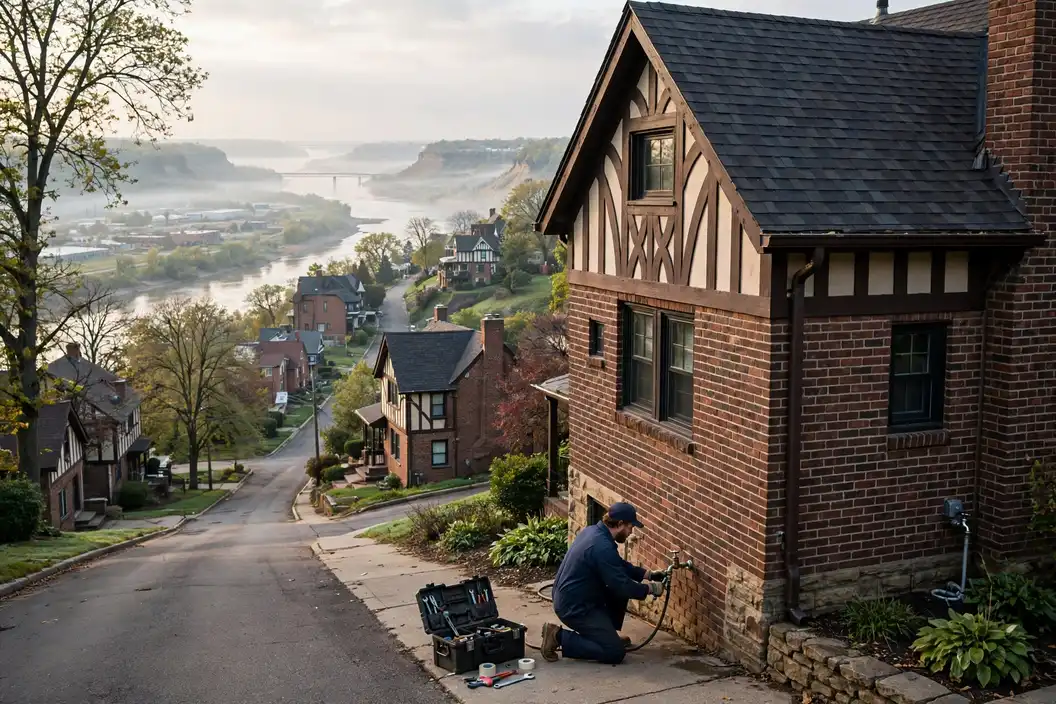


Everything on this page was computed for Davenport and nowhere else: the problem ranking from its Census housing profile, the seasonal risks from its NOAA station record, the coverage from its own ZIP codes. PlumbReach USA connects you to an independent local plumber; the page itself is the homework, done in public, so the call you make is an informed one.
Call center hours: Mon-Fri 7:00 AM-10:00 PM ET | Sat 8:00 AM-10:00 PM ET | Sun 7:00 AM-9:00 PM ET
The median Davenport home was built in 1966; 70.9% of the stock predates 1980, and the pattern this metro's own data ranks first is ageing cast iron sewer lines. PlumbReach USA is a referral service, not a plumbing company: one call connects you with an independent local plumber serving your ZIP code.
Every metro is really several, stacked by decade. Davenport's stack, per the Census, reads: 41.1% of homes from before 1960, a thick middle from the growth decades, and 14.2% from 2000 onward — 174,359 housing units in all, wrapped around a median build year of 1966. Plumbing follows the stack faithfully. Each layer went in with its era's materials and workmanship, and each layer is now failing in its era's characteristic order. This page keeps the layering in view throughout, because in a stacked metro the first diagnostic question is never what broke — it is which layer the home belongs to.
Stand in one of Davenport's older neighbourhoods and you are standing in its plumbing's back catalogue. The homes there — part of the 123,621 built before 1980 across this metro — went up when galvanized steel was a supply line, cast iron or clay was a drain, and a fixture was expected to serve for half a century. That half-century has now elapsed. What it leaves behind is not universal failure but universal exposure: every joint, valve and lateral in those districts is operating past the horizon its makers planned for, in Henry County and beyond, and the failures arrive in the order the materials tire.
The growth side of the metro tells the opposite story in the same language. Moline, Bettendorf and the subdivisions still filling in account for much of the 24,759 homes built since 2000 — plastic supply lines, plastic drains, cartridge fixtures, slab foundations. Their plumbing is not old; it is uniform, which creates its own calendar: everything installed in the same boom reaches each wear point in the same years, from the first water-heater replacements to the first slab-leak scares, while 1,040 cooling degree days of annual heat keep demand on the system high.
The climate written over all of it comes from the NOAA station at MOLINE QUAD CITY INTL AP, IL US: an average year brings 6,024 heating degree days, 1,040 cooling degree days and 38.27 inches of precipitation. Those are not abstractions to a buried pipe or an exposed line — they set how often soil around a sewer lateral swells and shrinks, how hard a water heater cycles in January and July alike, and whether an uninsulated garage line is a worry or a certainty. The problem sections that follow are selected by exactly these numbers, combined with the housing-age profile above.
The metro's building eras on one side, its weather record on the other — and its plumbing where the two meet.
Break the stock down by building era and the profile sharpens. Before 1960: 41.1% of homes, roughly 71,662 of them. From 1960 to 1979: 29.8%, about 51,959. From 1980 to 1999: 14.9%, about 25,979. Since 2000: 14.2%, about 24,759. Four eras, four material palettes — and the balance among them is this metro's plumbing character in a single paragraph.
The centre of gravity here is the deep stock: with pre-1960 homes the largest single band, Davenport's typical plumbing conversation starts with materials that have been underground or in walls for sixty years and more — cast iron drains at the end of their design lives, galvanized runs narrowed by corrosion, and laterals that predate the neighbourhoods around them. Newer work exists, out at the growth edge, but the metro's character — and most of its serious plumbing — sits in the old core and the streets that grew from it.
The second band in the table is the 1960-1979 stock: 51,959 homes, 29.8% of the metro. It is the transition generation — copper arriving, galvanized lingering, drains mixed street by street — and it supplies Davenport with its most diagnostic plumbing: two homes of the same year needing opposite answers, decided by what the builder happened to specify.
Translate the climate record into plumbing terms and it comes out as three working conditions. Condition one, the freeze count — 128.7 nights a year when exposed water can solidify and split its container. Condition two, the heat count — 22.2 days that load drains, heaters and tempers simultaneously. Condition three, the water itself: 38.27 inches of it arriving from the sky to move the soil around every lateral in the metro. Davenport's systems are engineered, installed and aged inside those three conditions, and their failures carry the conditions' fingerprints.
A profile is only useful if it predicts something, and this one predicts the shape of a plumbing diary in Davenport: which streets will call about drains, which about pressure, which about heaters, and in which months. Everything after this section is that prediction written out as services, problems and answers — the numbers first, the narrative second, the way the evidence actually runs.
Ordered by what this metro's data says its homes need most.
The sewer line is the one pipe every other pipe depends on. When it bellies, cracks or fills with roots, the whole house feels it through its ground-floor fixtures. Repair ranges from sectional fixes through a cleanout to full replacement, chosen from camera footage rather than guesswork.
Sewer trouble in Davenport rarely starts with the sewer. It starts with the ground-floor drain in the house misbehaving, and by the time sewage backs into a tub, the line outside has been compromised for a while — roots thickening at a joint, a belly deepening, cast iron scaling shut. The metro's older districts, where the housing predates 1960 by the thousands of homes, produce most of these calls; the established trees over those streets are both the neighbourhood's charm and its sewer lines' oldest enemy. The repair conversation here begins with a camera, not a shovel. Count it in homes if you prefer: 123,621 built before 1980, 24,759 since 2000, one shared system of soil and seasons.
Sewer demand follows the founding map: the districts built first, around the old centre and out through Moline, hold the jointed clay and iron; the growth rings hold plastic with decades in hand. 41.1% of the metro's homes stand on the founding side of that line, which is why the footage here so often shows a pipe at the end of its story.
Supply pipe is a house's circulatory system, and its diseases are degenerative: rust narrowing the arteries, corrosion pitting the walls, joints weeping at the seams. Repair treats the acute event. Repiping treats the disease — a planned replacement of the failing material throughout the home, staged so the household keeps water while its circulation is renewed, and verified under pressure before the walls close.
Homes in Davenport ask the repair-or-repipe question in a particular order. First one leak, repaired. Then another, in the same material, a year later. Pressure meanwhile declines across every fixture, and the water runs discoloured after the house sits quiet. That sequence — which plays out across the metro's pre-1980 housing especially — is the material delivering its verdict, and repiping in PEX or copper is the answer that ends the sequence rather than extending it by one more interval. In Davenport that holds across 66 ZIP codes, from Davenport out to Bettendorf.
The repair-or-renew caseload is set by one figure above the rest: 70.9% of Davenport homes predate 1980, plumbed in the materials now at the end of their service lives. Around Rock Island (36,758 residents) as in the old core, that percentage is not an abstraction — it is the street's plumbing, house by house.
One call from anywhere in the Davenport metro — from Davenport out to Rock Island — routes to the local professional on cover; the failure patterns they expect first are the ones this page's data ranks.
Across Henry, Mercer, Rock Island, Scott, drain calls follow the building map: iron and clay near the old core around Davenport, plastic at the growth edge — one service, two different crafts, both covered by the routing on this page.
Heater work in Davenport is workload work: 22.2 hot days and 6,024 heating degree days a year cycle the metro's tanks hard, and the local professionals routed here size, flush and replace against that record.
Leak detection in Davenport is instrument work over local knowledge: acoustic and thermal tools, aimed first at the districts this page's data flags — the pre-1980 stock and the slab tracts out toward Bettendorf.
Toilet calls in Davenport are the small end of the diary and the most democratic: every era of the 174,359-home stock produces them, and the local fix starts with the mechanism in the tank, not the porcelain.
Drips and disposals across Henry, Mercer, Rock Island, Scott are small jobs with a standard: repair the mechanism where the fixture deserves it, renew it where it does not, and check the shutoffs and supply lines while the cabinet is open.
If this page's services were ranked by Davenport's call patterns rather than listed in catalogue order, they would come out much as they do here — because the ranking behind them is data, not habit. Ageing cast iron sewer lines leads the metro's problem table and galvanized pipes at the end of their life follows, so the services answering them lead the list. The long tail of a metro's plumbing life — fixture failures, toilet calls, the single unexplained leak — fills in the diary around them, here as everywhere.
Ranked for this metro alone, from its Census housing profile and NOAA climate record.
Cast iron's failure is chemical before it is mechanical. Decades of waste water and vent gases work the pipe's crown and bore, converting sound iron to a roughened, thinning shell whose inner surface snags everything the household sends down. In Davenport, where 71,662 homes predate 1960, that chemistry has had sixty years and more to run. The symptoms arrive from the bottom of the system upward — the ground-floor fixtures complain first — and the diagnosis is a camera run that reads the bore the way a doctor reads a scan: where scale can be scoured back, and where the pipe itself has become the obstruction.
The pipe itself explains the timeline. Cast iron drains by gravity, slowly, and everything a household sends down it — grease films, mineral-heavy water, the occasional corrosive cleaner — works on the iron for decades. The metal does not fail evenly: it thins first at the bottom of horizontal runs, where water and grit sit longest, and at the joints where sections meet. That is why two Davenport homes of the same age can be in different places with the same pipe: usage, water chemistry and soil conditions around the line all vote on how fast it goes. What a camera inspection adds is certainty — the difference between a line that needs cleaning, a line that needs a section replaced, and a line living on borrowed time.
Another way to size the exposure: Davenport's pre-1960 homes — roughly 71,662 of them — were plumbed in an era when cast iron was not a choice but the standard. Their drains have now spent sixty-plus winters and summers expanding, contracting and carrying loads their installers never pictured, which is why this pattern outranks problems that belong to younger housing.
Galvanized pipe does not fail loudly; it fails by narrowing. Zinc coating gone, the steel rusts from the wet side, and every year the passage water travels through is a little smaller than the year before. The household reads it as personality — the shower that weakens when a tap opens, the washing machine that fills slowly, the rust tinge after a holiday — until the day a pinhole opens in a wall and the personality becomes a flood. In housing built when galvanized was simply how houses were plumbed, the whole system is one age and one material, which is why the faults stop being isolated: the pipe is not breaking in one place, it is finishing in all of them at the same pace, and the repair conversation has to reckon with that arithmetic.
Galvanized pipe fails politely, which is precisely the problem. No flood, no drama — just a shower that weakens across years, a washing machine that fills slowly, water that blushes rust after holidays. Households adapt without noticing, the way you adapt to a dimming bulb. The 51,959 homes built in this metro between 1960 and 1979 stand in the front of that queue now, their original steel bores narrowed to drinking-straw width in the worst runs. The fix, when it comes, tends to astonish people — not with its scale, but with the pressure they had forgotten they were owed.
Count the exposure from the Census side: the metro's 123,621 pre-1980 homes were plumbed in galvanized's long reign, and the material's failure mode — internal rust, narrowing bore — is a matter of chemistry, not workmanship. The variable is speed; the direction, for every one of those systems still original, is settled.
Ice does its damage in silence and announces it in flood. The split forms under pressure while the line is frozen, holds while the ice plug seals it, and opens the moment the thaw restores flow — which is why burst pipes are so often discovered by sound: water running somewhere it should not be, in a house that was intact at breakfast. Davenport's exposure sits where its housing does — in the older districts' unprotected runs and every era's additions and garages — and the repair visit's second job, after the pipe itself, is the insulation and routing that keep the same night from repeating.
A burst pipe is rarely about the coldest night of the year; it is about the one unprotected run of pipe the cold can reach. Water expands as it freezes, and the pressure that splits a line is not the ice itself but the water trapped between the ice blockage and a closed tap. Lines in exterior walls, unheated crawl spaces, garages and hose bibbs are the usual victims — the places where a home's heating never quite arrives. Davenport's older housing carries more of these runs than its newer builds, which route water through conditioned space by design. The thaw is when the damage shows: the split may weep for hours before anyone is home to hear it, which is why the shutoff advice on this page matters more than any repair.
Look at the shape of the risk in Davenport: 128.7 sub-freezing nights a year at MOLINE QUAD CITY INTL AP, IL US means the exposure is a season, not an event. Stack that against the housing side — 123,621 homes built before modern freeze protection was routine — and the pattern explains itself: many lines, many cold nights, and a failure that needs only one bad intersection of the two.
Between the house and the street connection sits the lateral — the home's own stretch of sewer line — and it is the homeowner's responsibility, which surprises many people the first time it fails. In Davenport, where 41.1% of homes were built before 1960 and the median home dates to 1966, laterals have been in the ground through decades of soil movement, root growth and material ageing. Clay joints shift and open, older pipe bellies where bedding has washed out, and a line can lose its clean fall to the street, so waste slows, settles and eventually blocks. The signs are house-wide rather than fixture-specific: several drains slow together, the ground-floor fixtures act up first, and cleanings help for shorter and shorter stretches. A camera run down the lateral settles the argument about what is happening — it measures the damage by distance, shows whether it is one bad joint or the whole story of the line, and lets the repair be sized to the actual problem instead of the whole run by default.
The lateral is the hardest-working pipe a household owns and the only one nobody ever sees. It carries everything, it was buried once and forgotten, and its condition depends on decisions made the year the house was built: the material chosen, the slope it was laid at, the soil it was bedded in. Ageing laterals fail in characteristic ways — joints offset as soil settles, bellies where the bedding washed or sagged, walls thinned by decades of flow. The house above reports these failures indirectly, through its ground-floor fixtures, which is why a sewer problem so often gets mistaken for a simple clog at first. In Davenport, where whole districts were built in the same few decades, laterals are ageing on a shared timetable — the line under one house is a fair guide to the line under its neighbour's.
The depth of the bench matters locally: this is not a pattern confined to a few old streets. Every district built before modern plastic — the core, the post-war rings, the middle suburbs — holds laterals of the same generations, and the metro's own growth means their combined length runs to thousands of miles of buried, jointed, ageing pipe. The ranking reflects that inventory, nothing more exotic.
Living with a real winter, as Davenport does, means the season has a rhythm: the first hard freeze finds the unprepared lines, mid-winter tests the insulation, and the late thaws reveal whatever split quietly weeks before. Households that drain exterior lines in autumn and keep a trickle running on the coldest nights get through most winters with nothing to report.
Put the season in figures: 128.7 freezing nights a year at MOLINE QUAD CITY INTL AP, IL US, against a median build year of 1966. Half of Davenport's homes are that old or older, and their exposed lines sit the winter's examination every year — the failures the season produces are simply the papers it fails.
In Davenport the pattern has an address pattern. The cast iron went under the homes built before 1960 — the streets of the old core and the first suburbs around Davenport — and it is failing in the order those streets were built. A camera call in the historic districts is a different appointment from one in Moline or the newer subdivisions: there, the same symptoms usually trace to something younger and simpler. Knowing which side of that line a home sits on is most of the diagnosis before the camera ever leaves the van, and it is why this page ranks the problem by the metro's pre-1960 count rather than by anecdote.
Read the ranking backwards and it reads as a data summary: 381,864 residents in 174,359 housing units, 41.1% of the housing from before 1960, 38.27 inches of rain in an average year. The pattern leads because the exposure is broad — counted not in individual unlucky houses but in whole eras of the metro's building, stacked one on another.
Experienced local practice starts with the simple certainties — the observations that take minutes and decide the most:
 PROBLEM
 SOLUTION
Population 101,083
Population 42,235
Population 39,297
Population 36,758
Population 20,837
Population 12,280
Population 7,939
Population 6,743
Population 6,577
Population 5,189
Population 5,037
Population 4,718
Also in the Davenport metro: Coal Valley (population 4,142), Aledo (population 3,753).
The communities in the grid are not suburbs of the page; they are its subject as much as Davenport is. Moline (42,235 residents) and Bettendorf (39,297) carry their own building decades, their own pipe materials and their own positions in the problem ranking's logic — a lateral under a Moline street answers to the same data as one in the centre, but to a different era of it. Coverage here is defined by the ZIP list below; understanding is defined street by street, and this page's figures are the metro-wide version of a story each community tells in its own numbers.
Beyond the largest communities sit Rock Island (36,758), East Moline (20,837), Kewanee (12,280), Silvis (7,939), Eldridge (6,743) — smaller places across Henry, Mercer, Rock Island, Scott, covered on the same terms. Their housing tends to be older on average than the big suburbs', and their calls follow the older patterns on this page. One routing covers them all: find your ZIP code below and the rest is a phone call.
The metro's weight is not evenly spread. Davenport holds 101,083 of the 381,864 residents; Moline and Bettendorf add 42,235 and 39,297; and the remainder scatters across the smaller places above, some no bigger than a few thousand people. Plumbing follows the weight — most calls come from where most homes are — but era matters more than size: a small community of 1960s housing generates older-system work than a large new subdivision does.
Administratively the metro is drawn from Henry, Mercer, Rock Island, Scott — 4 in all — with Henry County at its centre. County lines do not change pipe physics, but they do shape the paperwork around the work: permits, inspections and code details are county and city business, which is one reason the professional who serves your street is a local one.
This page ends at the metro boundary, but the region does not: Iowa City, IA, Cedar Rapids, IA and Waterloo, IA continue the coverage in their own directions, each with a profile built from its own Census and NOAA figures. If your home sits near the line between metros, go by your ZIP code — it places you in the dataset that describes your housing.
Set Davenport among its neighbours and the contrasts sharpen the profile: Iowa City, IA — metro population 182,711, median build year 1988 — sits 59 miles away; Cedar Rapids, IA (279,285, median 1976) 73 miles; Waterloo, IA (169,189, median 1966) 128 miles. Three different housing stocks under three nearby skies, which is why each keeps its own page and its own problem ranking rather than borrowing this one.
Ratios tell the metro's story compactly. Renters occupy 28.9% of homes; owners hold the rest. For every home built since 2000 there are 5.0 from before 1980. Spread the stock across the coverage map and each ZIP code carries about 2,642 housing units — the density at which era patterns repeat street after street instead of scattering, and at which a routed round of calls stays inside a few districts.
Davenport by the derived numbers — median home age 60 years · owners in 114,145 homes, renters in 46,396 · each covered ZIP code carrying about 1,086 pre-1960 homes · a heating-to-cooling degree-day ratio of 5.79 · 972 mm average annual rainfall.
Before an emergency, read the guide: How to shut off your home's water main
Describe the problem and the call center routes you to an independent local plumber who works in the Davenport metro.
Call center hours: Mon-Fri 7:00 AM-10:00 PM ET | Sat 8:00 AM-10:00 PM ET | Sun 7:00 AM-9:00 PM ET