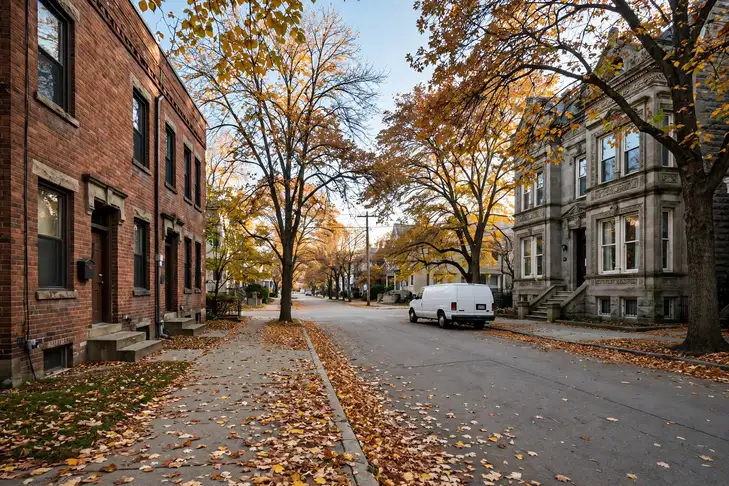


A metro's plumbing is a portrait of its building history under its weather, and Chicago's portrait is painted below from its own records: Census housing figures, NOAA climate normals, the metro's ZIP codes and communities. PlumbReach USA's role is the connection to a local professional; the portrait is here so that connection starts from understanding rather than urgency.
Call center hours: Mon-Fri 7:00 AM-10:00 PM ET | Sat 8:00 AM-10:00 PM ET | Sun 7:00 AM-9:00 PM ET
The median Chicago home was built in 1970; 63.6% of the stock predates 1980, and the pattern this metro's own data ranks first is ageing cast iron sewer lines. PlumbReach USA is a referral service, not a plumbing company: one call connects you with an independent local plumber serving your ZIP code.
Chicago is a metro of 9,359,555 people and 3,615,628 households, and its plumbing is a portrait of its building history. The median home here was built in 1970; 63.6% of homes predate 1980 and 38.0% predate 1960, while 16.6% have arrived since 2000. Every one of those eras plumbed differently — different pipe materials, different drain designs, different fixtures — and they fail differently, which is why this page is organised around the patterns the data actually produces in Chicago rather than plumbing in the abstract.
Count the older stock by its materials and the metro's maintenance burden comes into focus: iron and clay drains by the tens of thousands of homes, galvanized and early copper supplies in the same walls, fixtures from the first age of mass production still serving in bathrooms across Cook County. None of it failed yesterday; all of it is ageing on schedule together. A homeowner in that stock is not unlucky — they are on time, in a district where the systems were always going to need their generation of attention at once.
There is a second way to read the growth figures: as a maintenance wave still approaching. The 645,165 homes built since 2000 were handed over with everything new at once — heaters, cartridges, supply lines, seals — and new things age in convoy. The first replacements in those subdivisions have begun; the wave behind them is arithmetic. Households in Aurora and the other growth districts who learn their systems now, while the systems are still young, are the ones who will meet that wave as a schedule rather than a surprise.
The climate written over all of it comes from the NOAA station at CHICAGO MIDWAY AP, IL US: an average year brings 5,753 heating degree days, 1,111 cooling degree days and 34.42 inches of precipitation. Those are not abstractions to a buried pipe or an exposed line — they set how often soil around a sewer lateral swells and shrinks, how hard a water heater cycles in January and July alike, and whether an uninsulated garage line is a worry or a certainty. The problem sections that follow are selected by exactly these numbers, combined with the housing-age profile above.
Two public records, one metro: what was built here, and what the sky does to it.
Lay the eras side by side instead: 38.0% pre-1960 (1,476,883 homes), 25.6% from 1960-1979 (994,953), 19.9% from 1980-1999 (773,420), and 16.6% since 2000 (645,165). No single era tells the story — the proportions among them do, and those proportions are different in every metro this site covers.
Vintage is destiny in this metro. With the pre-1960 band the largest of the four, the centre of gravity of Chicago's plumbing sits in systems that have already outlived their design lives — iron drains gone rough inside, steel supplies thinned by their own rust, clay joints shifted by seven decades of soil. The later bands matter, and the post-2000 subdivisions will write their own chapter in time, but the calls that define plumbing here come disproportionately from the oldest streets, and they will keep coming until that stock is renewed pipe by pipe.
The second band in the table is the 1960-1979 stock: 994,953 homes, 25.6% of the metro. It is the transition generation — copper arriving, galvanized lingering, drains mixed street by street — and it supplies Chicago with its most diagnostic plumbing: two homes of the same year needing opposite answers, decided by what the builder happened to specify.
No profile of this metro is complete without its extremes, because plumbing meets the extremes, not the averages. The average year at CHICAGO MIDWAY AP, IL US — 52.1 degrees, 34.42 inches of precipitation — is a statistical resident of a metro nobody lives in. The lived version is the coldest night of January against an uninsulated run, the storm week that saturates the soil over every lateral, the August stretch that works heaters and drains without a pause. The numbers in this section are the averages; the problems ranked below are the extremes, translated.
That is the whole method of this page in one section: era shares from the Census, loads from NOAA, and a problem list that is simply where the two overlap most in Chicago. The services and guidance that follow are ordered by the same profile — local first, generic last.
Chosen by this metro's own housing and weather data — the same two records this whole page is built from.
Read a cast iron drain's age in its symptoms and the progression is orderly. First the line slows — not blocked, just reluctant, as scale roughens the bore and catches what passes. Then the complaints localise: one branch backing up, then another, as sections of the run reach their own stages of narrowing. In Chicago's oldest districts that progression plays out across whole streets of the 1970s housing at once, because the lines were laid in the same years from the same material. The camera distinguishes the stages house by house: a bore narrowed by scale that cleaning can restore, against a wall thinned and cracked past any cleaning's help.
There is a temptation to judge an old drain by its kindest day. On its kindest day it still clears, still serves, still seems to argue for another year. Judge it instead by its trend: clearings that come closer together, a tub that drains slower each season, a smell that returns after rain. In the 1,476,883 pre-1960 homes across this metro, that trend is the pipe's biography being read aloud — corrosion does not pause between visits, and the homes that fare well are the ones whose owners believed the early chapters.
Put a number on it locally: roughly 1,476,883 homes in the Chicago metro were built before 1960, when cast iron was the default drain material — and cast iron installed then has now been underground for six decades or more. Not every one of those lines has failed, and plenty test sound on a camera, but the population of pipes at risk here is counted in the tens of thousands of homes, which is why this pattern sits where it does on this page.
Galvanized pipe does not fail loudly; it fails by narrowing. Zinc coating gone, the steel rusts from the wet side, and every year the passage water travels through is a little smaller than the year before. The household reads it as personality — the shower that weakens when a tap opens, the washing machine that fills slowly, the rust tinge after a holiday — until the day a pinhole opens in a wall and the personality becomes a flood. In housing built when galvanized was simply how houses were plumbed, the whole system is one age and one material, which is why the faults stop being isolated: the pipe is not breaking in one place, it is finishing in all of them at the same pace, and the repair conversation has to reckon with that arithmetic.
Galvanized pipe fails politely, which is exactly the problem — it gives a household years of small warnings that are easy to live with. The zinc coating that once protected the steel wears through, rust takes its place, and the rust grows inward like a narrowing artery. Flow to the farthest fixtures drops first. A shower that shares a line with a running tap loses its pressure. By the time the water itself runs discoloured after the house has sat quiet overnight, the narrowing is well advanced. None of this is a single emergency; it is a system reaching the end of its design life on schedule, and in Chicago's pre-1980 neighbourhoods that schedule is arriving for whole streets at once, because the pipes went in together.
Count it by era rather than by street: the metro's homes built between the war years and 1980 — the heart of the galvanized period — number in the tens of thousands here, and the 2,471,836 pre-1980 homes overall are the pool this problem draws from. Plumbers working Chicago and the older districts can often date a home's pipework from the kerb, because the building booms that raised those neighbourhoods plumbed them all the same way.
The freeze finds the same houses every year, and the reason is architectural rather than meteorological. Somewhere in each of those homes a water line leaves the heated envelope: across a crawl space ventilated to the winter, along an exterior wall whose insulation stops at a corner, up through a garage ceiling. Chicago's record at CHICAGO MIDWAY AP, IL US — 106.3 nights at or below freezing in an average year — guarantees the audit happens; the architecture decides who fails it. Repairing the burst without correcting the exposure simply re-enrols the house for next winter's sitting.
Prevention, for this pattern, is a geography lesson: the burst never happens in the middle of the heated house. It happens at the perimeter — the wall cavity on the windward side, the run beneath the addition, the pipe the builder routed through the garage to spare six feet of copper. In Chicago, where 19.8 summer days tempt everyone to forget what 106.3 freezing nights intend, the autumn ritual is short and specific: find every line that leaves the warmth, and do something about it. The households that keep that ritual read about burst pipes the way other people do — as news.
Chicago's freeze maths is unforgiving: 106.3 sub-freezing nights in an average year at CHICAGO MIDWAY AP, IL US, multiplied by every uninsulated run in every older home, gives the season hundreds of chances to find one weak line. The splits favour the same addresses winter after winter — the the 1970s stock with pipes in the cold zones of the house.
A lateral ages in the dark, and its ageing has a geography. The run beneath the house is sheltered; the run beneath the yard takes the soil's full behaviour — swelling after Chicago's 34.42 inches of yearly rain, shrinking in the dry months, shifting at every joint. Add the trees, whose roots read those joints as invitations, and the lateral's condition at any address is a sum of its material, its soil and its canopy. The camera reads the sum directly, which is why sewer advice here starts with footage: the remedy for a rooted joint and the remedy for a settled belly share no resemblance.
A lateral gives decades of silence and then a short conversation. The conversation usually starts with the ground-floor drain in the house and escalates through the cleanout to the camera — and the camera's footage settles every argument about whether the line is blocked or broken. Across Chicago, the laterals entering that conversation now are the ones buried when the metro's median home went up, in 1970. They were built to outlast their mortgages, and they have; the question the footage answers is how much further the same pipe can honestly be asked to go.
Every one of the metro's 3,886,535 housing units drains through exactly one lateral, and in the older districts those laterals are as old as the streets above them. The pre-1960 share alone — 1,476,883 homes — represents that many buried lines in their seventh decade of service, under soil that shifts with Chicago's wet and dry seasons. Most will never draw attention; the ones that fail announce themselves through the ground-floor fixtures first.
Sewer joints were never sealed against biology; they were sealed against water, and only just. A clay or iron joint weeps a breath of moisture into the surrounding soil, and roots — which exist to find exactly that breath — arrive over seasons as fine hairs, then threads, then a woven mass that fills the bore. In Chicago the oldest lines run under the oldest trees, around Chicago and the established districts, so the pattern's geography is the geography of the mature canopy. The line does not need to be broken to be invaded; it needs only to be jointed, buried and old, in the company of trees.
Roots do not break into pipes; they are invited in. A joint in a clay or cast iron line breathes out a trace of moisture vapour, and a nearby tree's root hairs — which exist to find exactly that signal — grow toward it and through any gap the joint presents. Inside the pipe the roots find water and nutrients year-round, so they thicken, branch, and begin to trap everything the household sends down: paper, grease, solids. The first symptom is usually a slow main line that clears and returns on a cycle, because a cable can shred the root mass but cannot remove the joint it entered through. The pattern is seasonal in its own way — roots grow hardest in spring — and it belongs to streets where trees and jointed pipes have shared the same ground for decades, as they have across much of Chicago.
The metro's own canopy is the co-defendant: established neighbourhoods pair mature street trees with jointed clay and iron laterals of the same vintage. Root calls concentrate exactly where those two maps overlap — a correspondence visible in any local plumber's records and predictable from the Census-era map of the older districts.
This is the season the metro's housing stock is examined by the weather, and the examination is practical: every exposed run, every unheated void, every shutoff nobody has tested. The failures arrive in batches behind the hardest nights and announce themselves at the thaw. The rest of the season grades the slower systems too — heaters working against the coldest incoming water of the year, laterals under frozen ground — but the headline the season writes, year after year, is the sound of water in a wall that should be dry.
Winter's load on this metro can be counted two ways: in the 106.3 freezing nights CHICAGO MIDWAY AP, IL US records, and in the age of the housing that must withstand them — half of it built by 1970 or earlier. Neither number alone predicts a burst; multiplied together, they predict a season. Local plumbers plan their winter around that product, and households in the older districts do well to plan their autumn the same way.
In Chicago the pattern has an address pattern. The cast iron went under the homes built before 1960 — the streets of the old core and the first suburbs around Chicago — and it is failing in the order those streets were built. A camera call in the historic districts is a different appointment from one in Aurora or the newer subdivisions: there, the same symptoms usually trace to something younger and simpler. Knowing which side of that line a home sits on is most of the diagnosis before the camera ever leaves the van, and it is why this page ranks the problem by the metro's pre-1960 count rather than by anecdote.
Strip the pattern down to its inputs and the ranking stops being mysterious: 3,615,628 households drawing on systems installed across a median build year of 1970, in a climate that swings between 19.8 days of serious heat and 106.3 freezing nights. Whatever pattern a metro with those inputs manufactures most, it manufactures here — the lead position is less a title than a consequence, recalculated from the same public records any sceptic can check.
On a first visit for this pattern, a local plumber's checks run in a practised order:
Sequenced by this metro's own problem ranking, not by a national catalogue order.
Between the house and the street lies the lateral — privately owned, commonly forgotten, and the source of the worst backups a home can have. Sewer work begins with a camera survey of that run: its material, its fall, its invaders. Spot repairs suit local damage; a line failing along its length gets replaced, not patched into a subscription.
Put the metro's laterals end to end and they would run for thousands of miles — one private road per home, most of them laid generations ago and none of them inspected since. Chicago's share of that buried network follows its building history: clay and iron under the founding districts, transitional materials in the post-war ring, plastic in the growth corridors around Aurora. Sewer service here is the slow audit of that network, one camera run at a time, and its findings sort themselves by era so reliably that the footage often confirms the street's building date before it confirms anything else. That is the daily reality for the 3,615,628 households spread across Cook, DeKalb, DuPage, Grundy, Kane, Kendall, Lake, McHenry, Will, Jasper, Lake, Newton, Porter.
Under Chicago lie 3,886,535 laterals, one per housing unit, and the oldest of them — beneath the 1,476,883 pre-1960 homes — have been underground since the metro was a fraction of its present size. The camera diary in Aurora and the old core is written by that buried generation.
In Chicago this service is booked most often through the problem patterns at the top of this page — the metro's housing data, not habit, sets the order. If your home is in the 63.6% built before 1980, mention its age on the call: it changes the parts the plumber loads before heading to Chicago and the rest of the metro.
Pipes fail in two tenses: suddenly, at a joint or a split, and gradually, as a material narrows, thins or pits across a whole system. The first tense asks for a repair; the second eventually asks the larger question. Pipe services cover both — the sectional fix that restores a sound system, and the planned renewal that replaces a failing material through the whole house, routed to spare the building and staged to keep the household in water.
Every pipe in Chicago is in one of three conditions: new enough to forget, old enough to watch, or old enough to be living on borrowed time. The stock's distribution across those conditions is the metro's building history restated — the pre-1980 districts deep in the third condition, the growth corridors still in the first — and pipe services are how individual homes move between them. A repair returns a watched system to service; a repipe promotes a borrowed-time system back to the first condition wholesale, at a stroke, for another generation. The assessment that chooses between them is short, physical and evidenced: pressure, water colour, and the repair history in the walls. The 34.42 inches of rain in an average year here is part of the story too — buried lines feel every wet season.
Pipe work divides by era in this metro with unusual neatness: renewal conversations in the 2,471,836 pre-1980 homes, sectional repairs in the middle ring, and near-silence from the 645,165 post-2000 homes whose lines are still young. A call from Naperville can sit in any of the three bands; the home's build year says which before the door opens.
One local habit worth copying: Chicago homeowners who mention their street's building era when they book get a better-matched visit, because a plumber heading to a the 1970s home in Cook County loads different parts than one heading to a slab-built subdivision in Aurora. The service is the same; the preparation is local.
In Chicago the emergency call is routed, not queued: one number reaches the independent local plumber covering Cook, DeKalb, DuPage, Grundy, Kane, Kendall, Lake, McHenry, Will, Jasper, Lake, Newton, Porter at that hour, and the housing record on this page — median build year 1970 — is the homework they arrive already knowing.
Drain work in Chicago splits by era: the 2,471,836 pre-1980 homes drain through older materials, the post-2000 subdivisions through plastic — and the local plumber reads the cable's return to tell which world your street drains through.
In a metro of 3,886,535 homes with a median build year of 1970, water heaters fail in waves as whole streets age together — the plumbers serving Cook, DeKalb, DuPage, Grundy, Kane, Kendall, Lake, McHenry, Will, Jasper, Lake, Newton, Porter stock and schedule for exactly that pattern.
A creeping meter in a Chicago home is located, not guessed at: the professionals routed here trace the line with instruments and confirm the spot before any floor or wall is opened.
Running, rocking or refusing — in Chicago the diagnosis is the same short sequence: fill valve, flapper, supply line, flange. The plumbers routed here carry the internals for the fixtures this metro's eras installed.
Fixture work in Chicago divides by era like everything else on this page: washer-era taps in the older districts, cartridge internals in the post-2000 subdivisions — the local plumber stocks for both.
There is a plainer way to say what this page's ranking means in practice: most calls in Chicago are two calls. The first answers Ageing cast iron sewer lines; the second answers galvanized pipes at the end of their life. Between them they account for the shape of a local plumber's week here — the districts visited, the parts stocked, the diagnoses made fastest because they are made most often. The remaining services divide the rest of the diary among them, essential but episodic, the supporting work around two leading patterns.
 PROBLEM
 SOLUTION
Population 2,707,648
Population 179,867
Population 149,785
Population 149,424
Population 114,106
Population 88,919
Population 83,223
Population 77,098
Population 76,780
Population 76,552
Population 76,220
Population 73,813
Also in the Chicago metro: Gary (population 68,604), Palatine (population 66,548).
A metro is a federation of building decades wearing one name, and the grid above is Chicago's federation: Chicago at the centre, Aurora (179,867 residents) and Joliet (149,785) in the next ring, and the smaller communities beyond, down to places a few thousand households deep. What unites them is one climate record and one routing; what divides them is the year their streets were plumbed. The ZIP list that follows is the practical definition of that federation — if your code is on it, your home's era is part of the data this page was built from.
Also on the Chicago map: Naperville (149,424), Elgin (114,106), Waukegan (88,919), Cicero (83,223), Hammond (77,098) — communities spread across Cook, DeKalb, DuPage, Grundy, Kane, Kendall, Lake, McHenry, Will, Jasper, Lake, Newton, Porter, each with housing from its own growth years. A plumber routed through PlumbReach USA to any of them is working from this same page: the metro data does not change at the city limit, but the housing on your street — its age, its materials, its soil — is what the visit is really about.
Start with Chicago itself: 2,707,648 residents, 28.9% of the metro — the centre the rest of the map orbits. Aurora (179,867) and Joliet (149,785) form the next ring out, housing with its own building decades and its own plumbing generations. Beyond them the metro thins into the smaller communities in the grid above, each a few thousand households deep — small in population, identical in one respect: their pipes answer to the same eras and the same weather as the big city's.
One metro, 13 county lines drawn through it: Cook, DeKalb, DuPage, Grundy, Kane, Kendall, Lake, McHenry, Will, Jasper, Lake, Newton, Porter. The lines are invisible to the water and the weather, but they structure everything administrative around a plumbing job — which office permits it, which inspector signs it, which code edition applies. Cook County, at the centre, carries the oldest housing and the heaviest share of the work this page describes; its neighbours carry the growth. A routed local plumber navigates the patchwork so the homeowner does not have to.
Three neighbouring coverage areas begin where this one ends: Rockford, IL, some 73 miles off; Bloomington, IL, 93 miles; and Champaign, IL, 99 miles. Each keeps its own page because each keeps its own numbers — a different median build year, a different climate station, a different problem ranking. Boundary households should trust the ZIP list over the map: the code, not the compass, assigns the dataset.
Set Chicago among its neighbours and the contrasts sharpen the profile: Rockford, IL — metro population 337,242, median build year 1972 — sits 73 miles away; Bloomington, IL (171,419, median 1981) 93 miles; Champaign, IL (239,979, median 1979) 99 miles. Three different housing stocks under three nearby skies, which is why each keeps its own page and its own problem ranking rather than borrowing this one.
Divide the stock by the map and the densities appear: roughly 10,228 housing units for every covered ZIP code, 278,125 households to a county, 14 named communities in the grid. The balance between the generations reads 3.8 pre-1980 homes for every home built since 2000 — a single ratio that quietly predicts whether a metro's plumbing week leans toward renewal work in the old districts or first-generation upkeep in the new ones.
The Chicago record in one line — median home age: 56 years · owner-occupied homes: 2,361,005 · renter-occupied homes: 1,254,623 · pre-1960 homes per covered ZIP code: 3,887 · heating-to-cooling degree-day ratio: 5.18 · average rainfall: 874 mm a year.
Before an emergency, read the guide: How to shut off your home's water main
PlumbReach USA routes your call to an independent local plumbing professional serving Chicago — the assessment and the work are theirs.
Call center hours: Mon-Fri 7:00 AM-10:00 PM ET | Sat 8:00 AM-10:00 PM ET | Sun 7:00 AM-9:00 PM ET