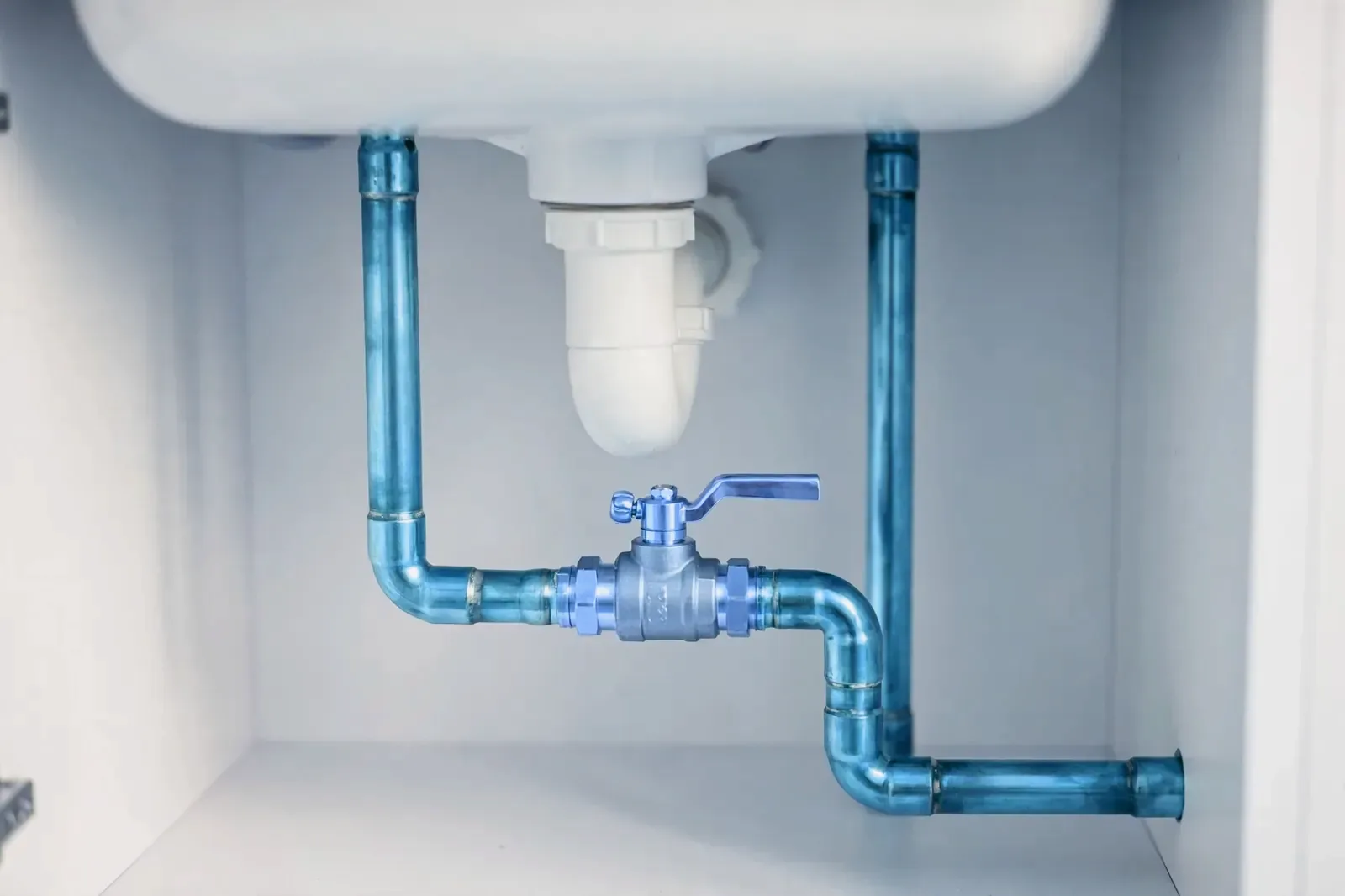


Everything on this page was computed for Bloomington and nowhere else: the problem ranking from its Census housing profile, the seasonal risks from its NOAA station record, the coverage from its own ZIP codes. PlumbReach USA connects you to an independent local plumber; the page itself is the homework, done in public, so the call you make is an informed one.
Call center hours: Mon-Fri 7:00 AM-10:00 PM ET | Sat 8:00 AM-10:00 PM ET | Sun 7:00 AM-9:00 PM ET
The median Bloomington home was built in 1985; 43.9% of the stock predates 1980, and the pattern this metro's own data ranks first is freeze-burst pipes in cold snaps. PlumbReach USA is a referral service, not a plumbing company: one call connects you with an independent local plumber serving your ZIP code.
Every metro is really several, stacked by decade. Bloomington's stack, per the Census, reads: 18.7% of homes from before 1960, a thick middle from the growth decades, and 24.9% from 2000 onward — 74,718 housing units in all, wrapped around a median build year of 1985. Plumbing follows the stack faithfully. Each layer went in with its era's materials and workmanship, and each layer is now failing in its era's characteristic order. This page keeps the layering in view throughout, because in a stacked metro the first diagnostic question is never what broke — it is which layer the home belongs to.
Stand in one of Bloomington's older neighbourhoods and you are standing in its plumbing's back catalogue. The homes there — part of the 32,801 built before 1980 across this metro — went up when galvanized steel was a supply line, cast iron or clay was a drain, and a fixture was expected to serve for half a century. That half-century has now elapsed. What it leaves behind is not universal failure but universal exposure: every joint, valve and lateral in those districts is operating past the horizon its makers planned for, in Monroe County and beyond, and the failures arrive in the order the materials tire.
The post-2000 homes have a plumbing trait the older districts never had: uniformity at scale. A subdivision's lines went in within a few seasons of each other, so its first heater failures, its first cartridge failures and its first slab questions arrive within a few seasons of each other too. With 18,605 such homes in the metro, those arrivals are not anecdotes but waves, and the households who read them early — who learn their system's age and keep its number handy — meet them as maintenance rather than emergency.
The climate written over all of it comes from the NOAA station at BLOOMINGTON MONROE CO AP, IN US: an average year brings 5,083 heating degree days, 1,026 cooling degree days and 46.92 inches of precipitation. Those are not abstractions to a buried pipe or an exposed line — they set how often soil around a sewer lateral swells and shrinks, how hard a water heater cycles in January and July alike, and whether an uninsulated garage line is a worry or a certainty. The problem sections that follow are selected by exactly these numbers, combined with the housing-age profile above.
Housing eras and climate, joined — the two datasets every section of this page is built from.
Lay the eras side by side instead: 18.7% pre-1960 (13,972 homes), 25.2% from 1960-1979 (18,829), 31.2% from 1980-1999 (23,312), and 24.9% since 2000 (18,605). No single era tells the story — the proportions among them do, and those proportions are different in every metro this site covers.
The 1980-1999 band runs this metro, and its plumbing has a particular flavour: mature but not ancient. Copper systems old enough to have histories, plastic drains still in their prime, fixtures from the first cartridge generation reaching their wear points in waves, heaters cycling through replacements on a schedule set by whole subdivisions. Bloomington's is a maintenance-era stock — the decades where attention compounds and neglect starts to invoice.
The second band in the table is the 1960-1979 stock: 18,829 homes, 25.2% of the metro. It is the transition generation — copper arriving, galvanized lingering, drains mixed street by street — and it supplies Bloomington with its most diagnostic plumbing: two homes of the same year needing opposite answers, decided by what the builder happened to specify.
The climate half of the profile, from BLOOMINGTON MONROE CO AP, IN US: 5,083 heating degree days against 1,026 cooling degree days, 46.92 inches of precipitation, an average temperature of 53.8 degrees. Read together, those figures describe the loads: how hard heaters cycle, how often the soil around buried lines swells and shrinks, and how much of the year exposed pipework spends anywhere near freezing — 108.3 nights at or below it, against 20.2 days at 90 or above.
Hold the two halves together and the rest of this page explains itself: the problems ranked highest here are the ones where Bloomington's dominant housing era and its climate record overlap. Change either dataset and the ranking changes — which is precisely why this profile is rebuilt from the records for every metro instead of carried over from the last one.
Selected and ranked from this metro's housing-age profile and climate record — not copied from another city's page.
When water freezes inside a pipe it expands, and the pressure it creates has nowhere to go: the pipe splits, often at a joint or an elbow, and the damage is done before anything thaws. Bloomington winters make this a standing risk rather than a freak event — the long-term climate record at BLOOMINGTON MONROE CO AP, IN US shows about 108.3 nights a year at or below freezing and a heating load of 5,083 degree days, which is why pipes in unheated garages, crawl spaces and exterior walls here live dangerously every cold snap. The split itself usually announces at the thaw, when water returns to the line and finds the opening. Homes in Monroe, Owen that have frozen once tend to freeze in the same place again, because the exposure that caused it — a vent blowing cold air on a line, insulation that stops short of a corner — is still there. A plumber who repairs a burst pipe here will trace why that run froze and what changes: insulation, rerouting a short section, or sealing the air leak that bathes the pipe in cold air through the coldest nights.
A burst pipe is rarely about the coldest night of the year; it is about the one unprotected run of pipe the cold can reach. Water expands as it freezes, and the pressure that splits a line is not the ice itself but the water trapped between the ice blockage and a closed tap. Lines in exterior walls, unheated crawl spaces, garages and hose bibbs are the usual victims — the places where a home's heating never quite arrives. Bloomington's older housing carries more of these runs than its newer builds, which route water through conditioned space by design. The thaw is when the damage shows: the split may weep for hours before anyone is home to hear it, which is why the shutoff advice on this page matters more than any repair.
The exposure is written in the climate record: BLOOMINGTON MONROE CO AP, IN US averages 108.3 nights a year at or below freezing, and it takes only one hard night to split an unprotected line. The housing side of the equation is the metro's older stock — homes from the 1980s and earlier, plumbed before freeze protection was routine, with lines in exterior walls and unheated crawl spaces that modern builds route through conditioned space instead.
Galvanized steel pipe was plumbed into millions of homes, and it ages in a particular way: the zinc coating gives out, the steel rusts, and the rust grows inward until the pipe that once carried a full stream is choked to a fraction of its width. With a median build year of 1985 and 43.9% of its homes predating 1980, Bloomington has a large stock of housing in the galvanized era, and its symptoms are the classic ones — pressure that has faded a little more each year, water that runs rusty after the house sits quiet overnight, and leaks that begin appearing at joints. No cleaning reverses this; the corrosion is the pipe itself converting to rust. The judgement call is timing. A galvanized system with one small leak and acceptable pressure can be repaired and watched. A system leaking in several places, with pressure dropping across every fixture, is telling you the material has finished its service life, and each repair buys a shorter quiet interval than the last. Repiping in PEX or copper replaces the whole question with a new system and restores the pressure the home was built with.
Galvanized pipe fails politely, which is exactly the problem — it gives a household years of small warnings that are easy to live with. The zinc coating that once protected the steel wears through, rust takes its place, and the rust grows inward like a narrowing artery. Flow to the farthest fixtures drops first. A shower that shares a line with a running tap loses its pressure. By the time the water itself runs discoloured after the house has sat quiet overnight, the narrowing is well advanced. None of this is a single emergency; it is a system reaching the end of its design life on schedule, and in Bloomington's pre-1980 neighbourhoods that schedule is arriving for whole streets at once, because the pipes went in together.
Count it by era rather than by street: the metro's homes built between the war years and 1980 — the heart of the galvanized period — number in the tens of thousands here, and the 32,801 pre-1980 homes overall are the pool this problem draws from. Plumbers working Bloomington and the older districts can often date a home's pipework from the kerb, because the building booms that raised those neighbourhoods plumbed them all the same way.
Ownership is the first surprise with a lateral: the buried stretch between the house and the street main typically belongs to the homeowner, however public it feels. The second surprise is its age. In Bloomington, laterals under the older streets were laid for the homes counted in the 32,801 pre-1980 properties — jointed clay or iron, bedded in soil that has swelled and shrunk through 46.92 inches of rain a year ever since. A pipe can be nobody's thought for fifty years and then become the only thought in the house, usually on the evidence of the ground-floor drain in it.
Slope is the lateral's invisible specification. A sewer line does not need much fall — a quarter inch per foot is the classic figure — but it needs it consistently, and ageing takes consistency away: a section settles, a joint steps down, and the line develops a reach where flow slows and solids settle out. That belly then collects a little more each week, narrowing the line from the bottom up. Many a Bloomington lateral diagnosed as 'blocked' is really 'bellyed' — clearable today, certain to collect again. The camera distinguishes the two, and the distinction decides whether the household is booking a cleaning or planning a repair.
The depth of the bench matters locally: this is not a pattern confined to a few old streets. Every district built before modern plastic — the core, the post-war rings, the middle suburbs — holds laterals of the same generations, and the metro's own growth means their combined length runs to thousands of miles of buried, jointed, ageing pipe. The ranking reflects that inventory, nothing more exotic.
Living with a real winter, as Bloomington does, means the season has a rhythm: the first hard freeze finds the unprepared lines, mid-winter tests the insulation, and the late thaws reveal whatever split quietly weeks before. Households that drain exterior lines in autumn and keep a trickle running on the coldest nights get through most winters with nothing to report.
Winter's load on this metro can be counted two ways: in the 108.3 freezing nights BLOOMINGTON MONROE CO AP, IN US records, and in the age of the housing that must withstand them — half of it built by 1985 or earlier. Neither number alone predicts a burst; multiplied together, they predict a season. Local plumbers plan their winter around that product, and households in the older districts do well to plan their autumn the same way.
Freeze damage in Bloomington is not evenly distributed, and the climate record explains the map. The splits happen where cold air and water lines meet: exterior walls, crawl spaces, garages, additions — features of the older housing in the districts around Bloomington and the pre-war pockets, plumbed before routing lines through heated space was standard. The record at BLOOMINGTON MONROE CO AP, IN US — 108.3 freezing nights in an average year — says the examination is annual. A home passes it by where its lines run, not by how new they are, which is why a 1950s house with interior lines can outscore a newer build with a garage run.
The numbers underneath it, for Bloomington: 74,718 housing units, a median build year of 1985, and a climate record at BLOOMINGTON MONROE CO AP, IN US of 5,083 heating degree days against 1,026 cooling degree days. Cross the housing record with the weather record and this pattern is what falls out at the top — rarely the most dramatic problem in plumbing, but the one this metro's stock and climate manufacture most steadily.
The first visit follows a short, diagnostic list — each item ruling a branch of the problem in or out:
Listed in the order this metro's housing and climate data supports.
One leak is an event; three in a year is a verdict. Pipe work weighs that pattern — the metal's age, the water's behaviour, the repair history — and either fixes the section in front of it or proposes the honest larger job: a whole-house repipe that ends the rhythm for good.
Not every old pipe in Bloomington needs replacing, and the assessment matters: a sound copper system from the 1980s with one failed joint is a repair; a galvanized system with rust at every exposed fitting is a repipe waiting for its date. The metro's newer subdivisions (24.9% built since 2000) sit this conversation out for now — their turn comes decades from now. For the older stock, the job is planned around the household: routes through accessible spaces, water restored in stages, and openings kept to where lines actually have to pass. Ask in Spencer and the answer rhymes with Bloomington: same eras, same materials, same calendar of failures.
Pipe work divides by era in this metro with unusual neatness: renewal conversations in the 32,801 pre-1980 homes, sectional repairs in the middle ring, and near-silence from the 18,605 post-2000 homes whose lines are still young. A call from Ellettsville can sit in any of the three bands; the home's build year says which before the door opens.
Of all a home's pipes, the sewer lateral works under the worst conditions: buried, jointed, rooted at, and loaded by every fixture in the building. Its care begins with seeing it — a camera run that records material, slope and damage — and proceeds by the footage's logic: clear what clearing cures, mend what is locally broken, renew what has failed along its length. No stage of that is guesswork, and the homeowner sees the same footage the plumber does.
Put the metro's laterals end to end and they would run for thousands of miles — one private road per home, most of them laid generations ago and none of them inspected since. Bloomington's share of that buried network follows its building history: clay and iron under the founding districts, transitional materials in the post-war ring, plastic in the growth corridors around Ellettsville. Sewer service here is the slow audit of that network, one camera run at a time, and its findings sort themselves by era so reliably that the footage often confirms the street's building date before it confirms anything else. In Bloomington that holds across 18 ZIP codes, from Bloomington out to Smithville-Sanders.
Under Bloomington lie 74,718 laterals, one per housing unit, and the oldest of them — beneath the 13,972 pre-1960 homes — have been underground since the metro was a fraction of its present size. The camera diary in Spencer and the old core is written by that buried generation.
In a metro of 74,718 homes with a median build year of 1985, water heaters fail in waves as whole streets age together — the plumbers serving Monroe, Owen stock and schedule for exactly that pattern.
Emergencies in Bloomington are answered by local independents, not a dispatch centre: PlumbReach USA routes the call, and the stock it serves — 74,718 homes across 18 ZIP codes — is the stock this page profiles.
Bloomington's drains are cleared by local independents who work this stock weekly: a median build year of 1985 means most lines they open have decades of history in them, and the clearing approach is chosen for the era, not the postcode.
The meter test starts it in Bloomington as everywhere; what follows is local — knowing which of Monroe, Owen' eras hide lines in slabs, which in crawl spaces, and where the soil movement at BLOOMINGTON MONROE CO AP, IN US's record makes joints let go.
In Bloomington, a toilet that runs all night is a water bill with a sound; the local service replaces the tired internals and checks the flange and supply while the tank is open.
In Bloomington the faucet call is often the first plumbing visit a newer home ever gets — the professionals routed here treat it as an introduction: the fixture fixed, and the home's shutoffs and heater age noted for the record.
There is a plainer way to say what this page's ranking means in practice: most calls in Bloomington are two calls. The first answers Freeze-burst pipes in cold snaps; the second answers galvanized pipes at the end of their life. Between them they account for the shape of a local plumber's week here — the districts visited, the parts stocked, the diagnoses made fastest because they are made most often. The remaining services divide the rest of the diary among them, essential but episodic, the supporting work around two leading patterns.
 PROBLEM
 SOLUTION
Population 78,791
Population 6,653
Population 3,228
Population 2,308
Population 1,113
Population 463
Population 316
Population 315
Population 290
Population 138
Population 92
Beyond Bloomington itself, the metro takes in Ellettsville (6,653 residents), Smithville-Sanders (3,228) and the rest of the communities in the grid above — each plumbed in its own building era, which is why two streets in the same metro can need entirely different plumbing conversations. The ZIP list below is the full coverage footprint: if your code is on it, this page was written about your housing stock.
The map continues: Spencer (2,308), Gosport (1,113), Stanford (463), Stinesville (316), Harrodsburg (315). Different names, different decades — each community in Monroe, Owen was plumbed in its own growth years, which is why two streets in the same metro can need entirely different plumbing conversations. The ZIP list below is the working definition of coverage; the housing behind each code is the working definition of the job.
Every metro has a first city and a supporting cast, and the census figures draw the billing plainly here: Bloomington first, with 78,791 residents; Ellettsville second at 6,653; Smithville-Sanders third at 3,228; then the long tail of smaller communities in the grid above. The billing matters less than the building dates — each of these places was plumbed in its own decade, by its own builders — but between them they account for nearly every housing era, material and failure pattern this page describes.
The metro answers to 2 county governments (Monroe, Owen), a patchwork that matters at permit time rather than at the pipe. Monroe County carries the centre; the others carry the growth rings and the older outlying towns. A plumber routed through this page works inside that patchwork daily — the water does not care about the boundaries, but the job's paperwork does.
Beyond the metro line, the nearest covered metros are Terre Haute, IN (38 miles away), Indianapolis, IN (48 miles) and Lafayette, IN (88 miles) — separate pages, separate profiles, because their housing and weather records are their own. Homeowners near the boundary sit between two datasets; the ZIP list above, not the map's edge, decides which page was written about your stock.
The region around Bloomington is a set of variations on its theme: Terre Haute, IN, 38 miles off, runs a median build year of 1969 on a metro population of 169,241; Indianapolis, IN (48 miles) medians 1982 on 2,205,695; Lafayette, IN (88 miles) medians 1981 on 228,468. Nearness is not sameness — a few decades of median build year separate their plumbing as surely as the miles separate their maps.
Divide the stock by the map and the densities appear: roughly 4,151 housing units for every covered ZIP code, 33,431 households to a county, 11 named communities in the grid. The balance between the generations reads 1.8 pre-1980 homes for every home built since 2000 — a single ratio that quietly predicts whether a metro's plumbing week leans toward renewal work in the old districts or first-generation upkeep in the new ones.
One line of Bloomington arithmetic — a median home 41 years old · 38,914 owner-occupied homes against 27,948 renter-occupied · 776 pre-1960 homes for every covered ZIP code · a heating-to-cooling degree-day ratio of 4.95 · 1,192 mm of rain in an average year.
Before an emergency, read the guide: How to shut off your home's water main
One call connects you with an independent local plumbing professional serving Bloomington and the surrounding metro.
Call center hours: Mon-Fri 7:00 AM-10:00 PM ET | Sat 8:00 AM-10:00 PM ET | Sun 7:00 AM-9:00 PM ET