

A metro's plumbing is a portrait of its building history under its weather, and Blacksburg's portrait is painted below from its own records: Census housing figures, NOAA climate normals, the metro's ZIP codes and communities. PlumbReach USA's role is the connection to a local professional; the portrait is here so that connection starts from understanding rather than urgency.
Call center hours: Mon-Fri 7:00 AM-10:00 PM ET | Sat 8:00 AM-10:00 PM ET | Sun 7:00 AM-9:00 PM ET
The median Blacksburg home was built in 1981; 47.9% of the stock predates 1980, and the pattern this metro's own data ranks first is freeze-burst pipes in cold snaps. PlumbReach USA is a referral service, not a plumbing company: one call connects you with an independent local plumber serving your ZIP code.
The stock, in one pass: 181,605 residents, 81,987 housing units, 70,035 households — and a build history that splits the metro into plumbers' generations. 22.1% of homes stand from before 1960; 47.9% from before 1980; the rest divide between the late-century suburbs and the 22.3% built since 2000. Every era is a materials decision still in force: the pipes in a Blacksburg wall are the ones its decade specified, ageing on that decade's schedule, whatever the current owner's plans for them.
There is a materials timeline buried in Blacksburg's housing figures, and it reads like a plumber's diary. The 18,119 homes from before 1960 were drained in cast iron or clay and supplied, in many cases, in galvanized steel. The 21,153 that followed between 1960 and 1979 mixed those materials with early copper. Then came the 24,350 homes of 1980-1999, plumbed increasingly in copper and early plastics. Each band of that timeline is now a band of characteristic failures, arriving in the order the materials tire — which is why a home's build year, in this metro, is the single most predictive fact about its plumbing.
The growth side of the metro tells the opposite story in the same language. Christiansburg, Radford and the subdivisions still filling in account for much of the 18,283 homes built since 2000 — plastic supply lines, plastic drains, cartridge fixtures, slab foundations. Their plumbing is not old; it is uniform, which creates its own calendar: everything installed in the same boom reaches each wear point in the same years, from the first water-heater replacements to the first slab-leak scares, while 1,368 cooling degree days of annual heat keep demand on the system high.
Over the housing sits one more dataset, the sky's: 3,868 heating degree days and 1,368 cooling degree days in the average year at ROANOKE RGNL AP, VA US, an average temperature of 58.1 degrees, extremes at both ends faithfully recorded. A metro's plumbing is designed — to the extent it is designed at all — for the middle of that record, and it fails at the record's edges. What follows is a page about the edges: the cold snaps, the storm weeks, the long hot stretches, and the systems they find first.
Two public records, one metro: what was built here, and what the sky does to it.
The distribution, in one breath: of every hundred Blacksburg homes, 22.1 were standing before 1960, 25.8 went up in the two decades after, 29.7 in the two after that, and 22.3 have arrived since 2000. Percentages flatten the picture, so hold the counts beside them — 18,119 oldest-era homes, 18,283 newest — and the metro's plumbing stops being an abstraction: it is that many systems, of those ages, failing in that order.
Homes from 1980 to 1999 form Blacksburg's largest band, and they set its plumbing agenda: copper supply lines entering their pinhole years in places, plastic drains still sound, first-generation cartridge fixtures wearing out in waves, water heaters on their second or third cycle. It is a stock past its carefree decades and into its maintenance decades — the era where watched systems keep lasting and unwatched ones start presenting their accounts in the form of leaks.
Close behind the leader come the 1960-1979 homes, 25.8% of the stock. Their plumbing is mid-change by construction — the decades when materials swapped over mid-stream — so this band is where a Blacksburg plumber earns the diagnostic fee: pressure tests and camera runs that say which side of the transition a given house was built on.
A profile needs its climate column, and Blacksburg's comes from ROANOKE RGNL AP, VA US: an average year of 58.1 degrees, built from extremes at both ends. The heating load (3,868 degree days) and the cooling load (1,368) together set the water heater's working life; the precipitation total (42.82 inches) sets the soil's behaviour around every buried line; the freeze count (76.6 nights) sets the exposure of every uninsulated run. Four numbers — and most of the metro's plumbing behaviour follows from them.
That is the whole method of this page in one section: era shares from the Census, loads from NOAA, and a problem list that is simply where the two overlap most in Blacksburg. The services and guidance that follow are ordered by the same profile — local first, generic last.
Chosen by this metro's own housing and weather data — the same two records this whole page is built from.
The freeze finds the same houses every year, and the reason is architectural rather than meteorological. Somewhere in each of those homes a water line leaves the heated envelope: across a crawl space ventilated to the winter, along an exterior wall whose insulation stops at a corner, up through a garage ceiling. Blacksburg's record at ROANOKE RGNL AP, VA US — 76.6 nights at or below freezing in an average year — guarantees the audit happens; the architecture decides who fails it. Repairing the burst without correcting the exposure simply re-enrols the house for next winter's sitting.
Prevention, for this pattern, is a geography lesson: the burst never happens in the middle of the heated house. It happens at the perimeter — the wall cavity on the windward side, the run beneath the addition, the pipe the builder routed through the garage to spare six feet of copper. In Blacksburg, where 30.4 summer days tempt everyone to forget what 76.6 freezing nights intend, the autumn ritual is short and specific: find every line that leaves the warmth, and do something about it. The households that keep that ritual read about burst pipes the way other people do — as news.
Blacksburg's freeze maths is unforgiving: 76.6 sub-freezing nights in an average year at ROANOKE RGNL AP, VA US, multiplied by every uninsulated run in every older home, gives the season hundreds of chances to find one weak line. The splits favour the same addresses winter after winter — the the 1980s stock with pipes in the cold zones of the house.
Cast iron's failure is chemical before it is mechanical. Decades of waste water and vent gases work the pipe's crown and bore, converting sound iron to a roughened, thinning shell whose inner surface snags everything the household sends down. In Blacksburg, where 18,119 homes predate 1960, that chemistry has had sixty years and more to run. The symptoms arrive from the bottom of the system upward — the ground-floor fixtures complain first — and the diagnosis is a camera run that reads the bore the way a doctor reads a scan: where scale can be scoured back, and where the pipe itself has become the obstruction.
There is a temptation to judge an old drain by its kindest day. On its kindest day it still clears, still serves, still seems to argue for another year. Judge it instead by its trend: clearings that come closer together, a tub that drains slower each season, a smell that returns after rain. In the 18,119 pre-1960 homes across this metro, that trend is the pipe's biography being read aloud — corrosion does not pause between visits, and the homes that fare well are the ones whose owners believed the early chapters.
Put a number on it locally: roughly 18,119 homes in the Blacksburg metro were built before 1960, when cast iron was the default drain material — and cast iron installed then has now been underground for six decades or more. Not every one of those lines has failed, and plenty test sound on a camera, but the population of pipes at risk here is counted in the tens of thousands of homes, which is why this pattern sits where it does on this page.
Between the house and the street connection sits the lateral — the home's own stretch of sewer line — and it is the homeowner's responsibility, which surprises many people the first time it fails. In Blacksburg, where 22.1% of homes were built before 1960 and the median home dates to 1981, laterals have been in the ground through decades of soil movement, root growth and material ageing. Clay joints shift and open, older pipe bellies where bedding has washed out, and a line can lose its clean fall to the street, so waste slows, settles and eventually blocks. The signs are house-wide rather than fixture-specific: several drains slow together, the ground-floor fixtures act up first, and cleanings help for shorter and shorter stretches. A camera run down the lateral settles the argument about what is happening — it measures the damage by distance, shows whether it is one bad joint or the whole story of the line, and lets the repair be sized to the actual problem instead of the whole run by default.
A lateral gives decades of silence and then a short conversation. The conversation usually starts with the ground-floor drain in the house and escalates through the cleanout to the camera — and the camera's footage settles every argument about whether the line is blocked or broken. Across Blacksburg, the laterals entering that conversation now are the ones buried when the metro's median home went up, in 1981. They were built to outlast their mortgages, and they have; the question the footage answers is how much further the same pipe can honestly be asked to go.
Universality is the point: every housing unit in the metro — 81,987 of them — drains through one lateral apiece, and the older half of that stock is served by lines as old as the homes above them. A component that universal, ageing on that schedule, does not need bad luck to top a problem list; it needs only time.
This is the season the metro's housing stock is examined by the weather, and the examination is practical: every exposed run, every unheated void, every shutoff nobody has tested. The failures arrive in batches behind the hardest nights and announce themselves at the thaw. The rest of the season grades the slower systems too — heaters working against the coldest incoming water of the year, laterals under frozen ground — but the headline the season writes, year after year, is the sound of water in a wall that should be dry.
Put the season in figures: 76.6 freezing nights a year at ROANOKE RGNL AP, VA US, against a median build year of 1981. Half of Blacksburg's homes are that old or older, and their exposed lines sit the winter's examination every year — the failures the season produces are simply the papers it fails.
Cold finds the same houses every year, and in Blacksburg they are identifiable in advance: the ones with plumbing in the wrong places. A line crossing an unheated garage ceiling, a supply run against an outside wall, a hose bibb never drained — ROANOKE RGNL AP, VA US's 76.6 freezing nights audit each of them annually. The older districts near Blacksburg hold the densest concentration of those routings, plumbed in an era less strict about keeping water inside the heated envelope. The repair after a burst is carpentry as much as plumbing; the prevention, done in autumn, is an hour of unglamorous attention to exactly the runs the cold already knows.
Why here and not everywhere: Blacksburg pairs 39,272 pre-1980 homes with 30.4 days a year at 90 degrees or more and 76.6 nights below freezing. Every metro pairs its housing with its weather somehow; this particular pairing is what puts the pattern where it sits on this page's list, ahead of problems that dominate metros built in other decades, under other skies.
On a first visit for this pattern, a local plumber's checks run in a practised order:
Sequenced by this metro's own problem ranking, not by a national catalogue order.
Pipes fail in two tenses: suddenly, at a joint or a split, and gradually, as a material narrows, thins or pits across a whole system. The first tense asks for a repair; the second eventually asks the larger question. Pipe services cover both — the sectional fix that restores a sound system, and the planned renewal that replaces a failing material through the whole house, routed to spare the building and staged to keep the household in water.
Pressure is the pipe system's public voice, and in Blacksburg it speaks with a district accent. In the pre-1980 districts — 39,272 homes — it fades year by year as galvanized bores narrow, a decline so gradual that households adapt to it fixture by fixture and only notice when a visitor's shower puts theirs to shame. In the newer subdivisions it stays loud and even. The repair-or-renew decision is usually just a translation of that voice: a system whose pressure is leaving has delivered its diagnosis already, and the assessment visit exists to confirm it in person. From Christiansburg to Radford, the pattern repeats wherever the housing era matches.
Pipe work divides by era in this metro with unusual neatness: renewal conversations in the 39,272 pre-1980 homes, sectional repairs in the middle ring, and near-silence from the 18,283 post-2000 homes whose lines are still young. A call from Christiansburg can sit in any of the three bands; the home's build year says which before the door opens.
The sewer line is the one pipe every fixture in the house shares, and the only one whose failure backs up into the home instead of draining away from it. Its enemies are time, roots and soil movement, working at the pace of decades. Service on the line begins with evidence — camera footage of its actual condition — because the difference between a cleaning, a sectional repair and a replacement is written inside the pipe, not in the symptom at the drain.
Sewer trouble in Blacksburg rarely starts with the sewer. It starts with the ground-floor drain in the house misbehaving, and by the time sewage backs into a tub, the line outside has been compromised for a while — roots thickening at a joint, a belly deepening, cast iron scaling shut. The metro's older districts, where the housing predates 1960 by the thousands of homes, produce most of these calls; the established trees over those streets are both the neighbourhood's charm and its sewer lines' oldest enemy. The repair conversation here begins with a camera, not a shovel. That is the daily reality for the 70,035 households spread across Floyd, Giles, Montgomery, Pulaski, Radford city.
Under Blacksburg lie 81,987 laterals, one per housing unit, and the oldest of them — beneath the 18,119 pre-1960 homes — have been underground since the metro was a fraction of its present size. The camera diary in Pulaski and the old core is written by that buried generation.
In Blacksburg the emergency call is routed, not queued: one number reaches the independent local plumber covering Floyd, Giles, Montgomery, Pulaski, Radford city at that hour, and the housing record on this page — median build year 1981 — is the homework they arrive already knowing.
Drain work in Blacksburg splits by era: the 39,272 pre-1980 homes drain through older materials, the post-2000 subdivisions through plastic — and the local plumber reads the cable's return to tell which world your street drains through.
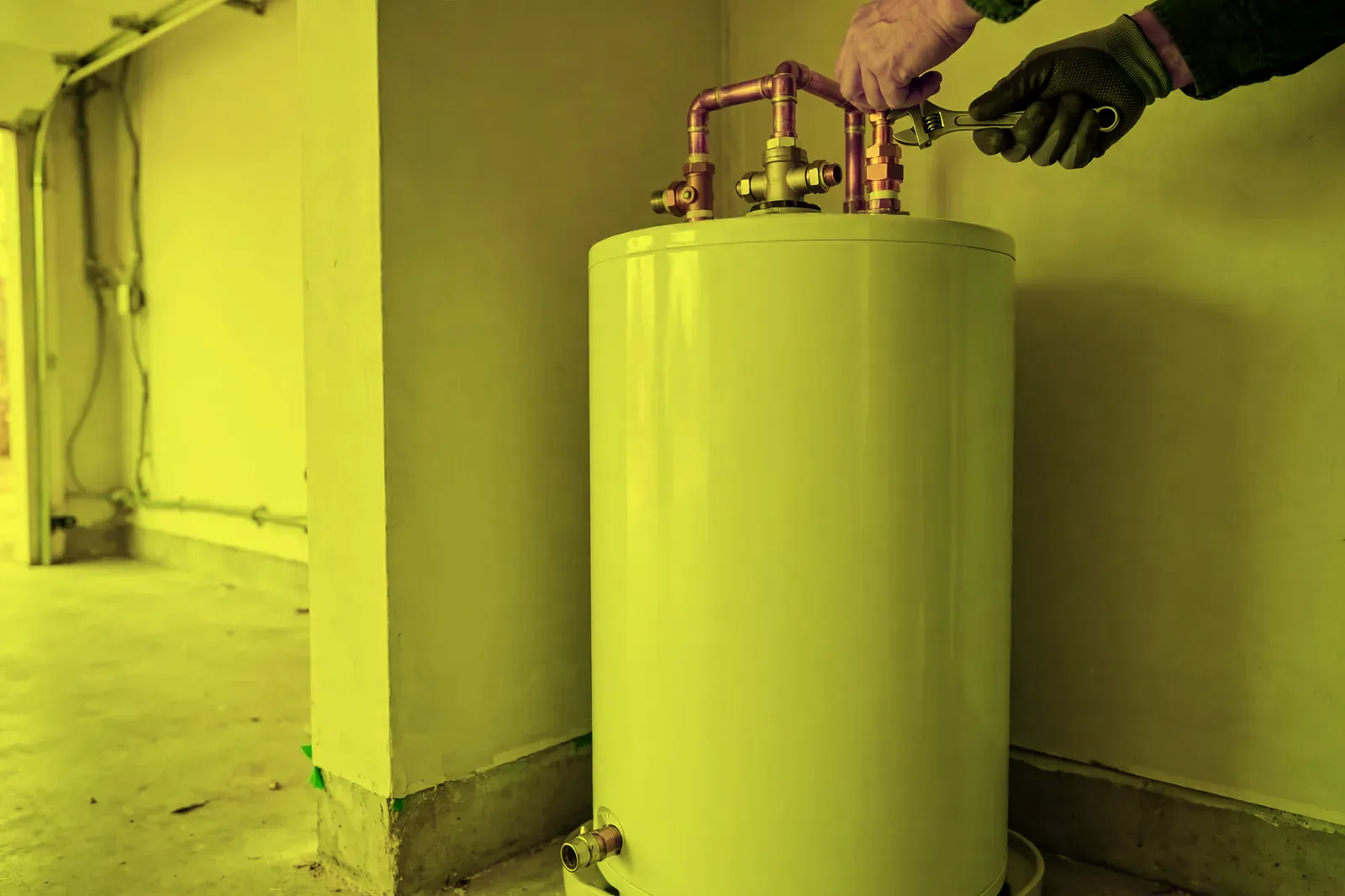
In a metro of 81,987 homes with a median build year of 1981, water heaters fail in waves as whole streets age together — the plumbers serving Floyd, Giles, Montgomery, Pulaski, Radford city stock and schedule for exactly that pattern.
Leak detection in Blacksburg is instrument work over local knowledge: acoustic and thermal tools, aimed first at the districts this page's data flags — the pre-1980 stock and the slab tracts out toward Radford.
Running, rocking or refusing — in Blacksburg the diagnosis is the same short sequence: fill valve, flapper, supply line, flange. The plumbers routed here carry the internals for the fixtures this metro's eras installed.
Fixture work in Blacksburg divides by era like everything else on this page: washer-era taps in the older districts, cartridge internals in the post-2000 subdivisions — the local plumber stocks for both.
Two patterns generate most of the bookings behind the services above: Freeze-burst pipes in cold snaps and ageing cast iron sewer lines. That is why the order of this page's service list is what it is — the services answering those patterns come early, and the rest follow in the order the metro's data supports. A homeowner whose home matches the local profile — built in the metro's big decades, in one of its older districts — is, statistically, reading their own shortlist.
 PROBLEM
 SOLUTION
Population 45,288
Population 22,820
Population 16,505
Population 8,937
Population 2,955
Population 2,864
Population 2,671
Population 2,555
Population 2,064
Population 1,725
Population 1,130
Population 1,067
Also in the Blacksburg metro: Elliston (population 1,041), Riner (population 1,037).
Beyond Blacksburg itself, the metro takes in Christiansburg (22,820 residents), Radford (16,505) and the rest of the communities in the grid above — each plumbed in its own building era, which is why two streets in the same metro can need entirely different plumbing conversations. The ZIP list below is the full coverage footprint: if your code is on it, this page was written about your housing stock.
Also on the Blacksburg map: Pulaski (8,937), Merrimac (2,955), Pearisburg (2,864), Dublin (2,671), Fairlawn (2,555) — communities spread across Floyd, Giles, Montgomery, Pulaski, Radford city, each with housing from its own growth years. A plumber routed through PlumbReach USA to any of them is working from this same page: the metro data does not change at the city limit, but the housing on your street — its age, its materials, its soil — is what the visit is really about.
Start with Blacksburg itself: 45,288 residents, 24.9% of the metro — the centre the rest of the map orbits. Christiansburg (22,820) and Radford (16,505) form the next ring out, housing with its own building decades and its own plumbing generations. Beyond them the metro thins into the smaller communities in the grid above, each a few thousand households deep — small in population, identical in one respect: their pipes answer to the same eras and the same weather as the big city's.
The metro answers to 5 county governments (Floyd, Giles, Montgomery, Pulaski, Radford city), a patchwork that matters at permit time rather than at the pipe. Floyd County carries the centre; the others carry the growth rings and the older outlying towns. A plumber routed through this page works inside that patchwork daily — the water does not care about the boundaries, but the job's paperwork does.
Three neighbouring coverage areas begin where this one ends: Roanoke, VA, some 32 miles off; Lynchburg, VA, 78 miles; and Charlottesville, VA, 125 miles. Each keeps its own page because each keeps its own numbers — a different median build year, a different climate station, a different problem ranking. Boundary households should trust the ZIP list over the map: the code, not the compass, assigns the dataset.
The region around Blacksburg is a set of variations on its theme: Roanoke, VA, 32 miles off, runs a median build year of 1975 on a metro population of 316,547; Lynchburg, VA (78 miles) medians 1980 on 269,169; Charlottesville, VA (125 miles) medians 1988 on 228,597. Nearness is not sameness — a few decades of median build year separate their plumbing as surely as the miles separate their maps.
Ratios tell the metro's story compactly. Renters occupy 37.5% of homes; owners hold the rest. For every home built since 2000 there are 2.1 from before 1980. Spread the stock across the coverage map and each ZIP code carries about 2,733 housing units — the density at which era patterns repeat street after street instead of scattering, and at which a routed round of calls stays inside a few districts.
The Blacksburg record in one line — median home age: 45 years · owner-occupied homes: 43,772 · renter-occupied homes: 26,263 · pre-1960 homes per covered ZIP code: 604 · heating-to-cooling degree-day ratio: 2.83 · average rainfall: 1,088 mm a year.
Before an emergency, read the guide: How to shut off your home's water main
PlumbReach USA routes your call to an independent local plumbing professional serving Blacksburg — the assessment and the work are theirs.
Call center hours: Mon-Fri 7:00 AM-10:00 PM ET | Sat 8:00 AM-10:00 PM ET | Sun 7:00 AM-9:00 PM ET