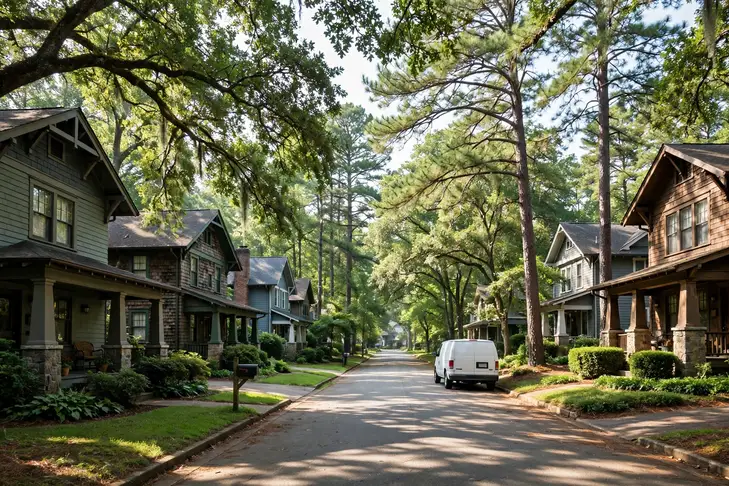


Everything on this page was computed for Atlanta and nowhere else: the problem ranking from its Census housing profile, the seasonal risks from its NOAA station record, the coverage from its own ZIP codes. PlumbReach USA connects you to an independent local plumber; the page itself is the homework, done in public, so the call you make is an informed one.
Call center hours: Mon-Fri 7:00 AM-10:00 PM ET | Sat 8:00 AM-10:00 PM ET | Sun 7:00 AM-9:00 PM ET
The median Atlanta home was built in 1993; 26.9% of the stock predates 1980, and the pattern this metro's own data ranks first is slab leaks under concrete foundations. PlumbReach USA is a referral service, not a plumbing company: one call connects you with an independent local plumber serving your ZIP code.
Atlanta is a metro of 6,176,937 people and 2,280,747 households, and its plumbing is a portrait of its building history. The median home here was built in 1993; 26.9% of homes predate 1980 and 8.6% predate 1960, while 37.0% have arrived since 2000. Every one of those eras plumbed differently — different pipe materials, different drain designs, different fixtures — and they fail differently, which is why this page is organised around the patterns the data actually produces in Atlanta rather than plumbing in the abstract.
Count the older stock by its materials and the metro's maintenance burden comes into focus: iron and clay drains by the tens of thousands of homes, galvanized and early copper supplies in the same walls, fixtures from the first age of mass production still serving in bathrooms across Barrow County. None of it failed yesterday; all of it is ageing on schedule together. A homeowner in that stock is not unlucky — they are on time, in a district where the systems were always going to need their generation of attention at once.
Growth wrote this metro's newest plumbing chapter in plastic and concrete: supply and drain lines in modern materials, fixtures by the catalogue, foundations poured as slabs across the subdivisions near South Fulton and Sandy Springs. The chapter is young — its systems have decades in hand — but it is not exempt from the metro's arithmetic: 2,051 cooling degree days of demand work its heaters hard, and the soil under its slabs moves with the same seasons as the soil under the oldest farmhouse in Barrow County.
Over everything sits the weather, and here it is measured rather than described: NOAA's station at ATLANTA HARTSFIELD INTL AP, GA US averages 63.6 degrees across the year, with 47.1 days reaching 90 or more and 35.7 nights at freezing or below. A buried lateral feels that record as soil that swells and pulls away; a water heater feels it as an unbroken cycle count; an exposed line feels it on the single coldest night. The problem ranking below is what those numbers, crossed with the housing profile, produce for Atlanta specifically.
The metro's building eras on one side, its weather record on the other — and its plumbing where the two meet.
Break the stock down by building era and the profile sharpens. Before 1960: 8.6% of homes, roughly 211,743 of them. From 1960 to 1979: 18.3%, about 450,569. From 1980 to 1999: 36.1%, about 888,827. Since 2000: 37.0%, about 910,986. Four eras, four material palettes — and the balance among them is this metro's plumbing character in a single paragraph.
Read this metro's profile as a before-and-after photograph with the after still developing: the post-2000 band leads, the older bands trail, and every year the balance tips further toward young systems with young problems. Atlanta's plumbing volume already lives in the new stock — its heater waves, its cartridge waves, its slab questions — while its deepest single jobs still come from the old core. Both facts are in the numbers above; a local plumber's week is simply where they meet.
Second in the table, the 1980-1999 band: 888,827 homes, 36.1% of the metro. Its systems are mature rather than ancient — copper in its pinhole years in places, plastic drains still sound, first-generation cartridges wearing out in waves — and its plumbing is the schedulable kind: work that rewards being booked before it becomes urgent.
A profile needs its climate column, and Atlanta's comes from ATLANTA HARTSFIELD INTL AP, GA US: an average year of 63.6 degrees, built from extremes at both ends. The heating load (2,531 degree days) and the cooling load (2,051) together set the water heater's working life; the precipitation total (50.43 inches) sets the soil's behaviour around every buried line; the freeze count (35.7 nights) sets the exposure of every uninsulated run. Four numbers — and most of the metro's plumbing behaviour follows from them.
A profile is only useful if it predicts something, and this one predicts the shape of a plumbing diary in Atlanta: which streets will call about drains, which about pressure, which about heaters, and in which months. Everything after this section is that prediction written out as services, problems and answers — the numbers first, the narrative second, the way the evidence actually runs.
Ordered by what this metro's data says its homes need most.
Every leak has two addresses: where the water appears, and where it escapes. The two are often rooms apart. Detection work exists to close that distance with instruments rather than demolition — acoustic sensors, pressure gauges, tracer methods — until the escape point is known within inches. Only then does the repair begin, sized to the actual failure instead of the size of the search.
The water bill is usually Atlanta's first leak alarm. With 2,280,747 households on the meter across the metro, a quiet leak inside one home's walls still registers — a climb with no change in habits, a meter that moves at 3 a.m. Detection here is methodical because the housing varies: a slab home near Atlanta, a pier-and-beam older house near the centre and a two-storey newer build each hide water differently, and the plumber chooses listening, isolation or moisture tools to match the construction in front of them. With a median build year of 1993, most of the metro's 2,462,125 housing units are working through the same ageing curve.
Scale the problem by the Census count and it stays concrete: 2,462,125 housing units, each a small network of pressurised lines, each capable of losing water silently. The meters across Atlanta register those losses in aggregate; the detection visit exists to assign one of them to one address — in South Fulton this month, somewhere else next.
In Atlanta this service is booked most often through the problem patterns at the top of this page — the metro's housing data, not habit, sets the order. If your home is in the 26.9% built before 1980, mention its age on the call: it changes the parts the plumber loads before heading to Atlanta and the rest of the metro.
Hot water is a daily expectation so total that its absence reorganises a household within hours. Heater servicing protects that expectation: burners and elements tested, sediment drained, the safety valve exercised, the anode's remaining life judged. When the tank itself is finished, installation replaces it with a unit matched to the home's demand and venting, set up to serve the same expectation for another decade.
Replacement season in Atlanta is not really a season — it is a wave, set decades ago. The heaters installed across the metro's building booms reach the end of their working lives in the same years, so whole streets of similar-aged homes swap tanks within a few seasons of each other. The 910,986 homes built since 2000 are entering the front of that wave now; the pre-1980 stock, on its second or third unit, is deep in it. Wherever a home sits in the wave, the judgement call is the same: repair the part or retire the tank, made on the tank's condition rather than its birthday alone. The ATLANTA HARTSFIELD INTL AP, GA US record — 2,531 heating degree days, 2,051 cooling — is the backdrop Barrow County plumbers plan around.
Heater work in this metro is a fleet problem: the tanks were installed in waves with the subdivisions, and they reach their verdicts in waves too. Roswell (92,577 residents) sits inside one of those waves; the older districts run their own, one tank at a time, inside plumbing a generation older.
One local habit worth copying: Atlanta homeowners who mention their street's building era when they book get a better-matched visit, because a plumber heading to a the 1990s home in Barrow County loads different parts than one heading to a slab-built subdivision in South Fulton. The service is the same; the preparation is local.
The supply system is a single organism, so its failures correlate. Repiping exists for the point where correlation is obvious: pressure fading, water discolouring, leaks touring the house. New runs go in PEX or copper, routed to minimise opening walls, pressure-tested before anything is closed up.
Pressure is the pipe system's public voice, and in Atlanta it speaks with a district accent. In the pre-1980 districts — 662,312 homes — it fades year by year as galvanized bores narrow, a decline so gradual that households adapt to it fixture by fixture and only notice when a visitor's shower puts theirs to shame. In the newer subdivisions it stays loud and even. The repair-or-renew decision is usually just a translation of that voice: a system whose pressure is leaving has delivered its diagnosis already, and the assessment visit exists to confirm it in person. Count it in homes if you prefer: 662,312 built before 1980, 910,986 since 2000, one shared system of soil and seasons.
The repair-or-renew caseload is set by one figure above the rest: 26.9% of Atlanta homes predate 1980, plumbed in the materials now at the end of their service lives. Around Alpharetta (66,355 residents) as in the old core, that percentage is not an abstraction — it is the street's plumbing, house by house.
Where this service gets booked in Atlanta follows the map on this page: the older districts generate the deep-end work, the post-2000 subdivisions the wear-and-tear work, and the 888,827 homes in between split the difference. Telling the call center your home's build decade — most Atlanta owners know it within a few years — puts the right kit on the van the first time.
The sewer line is the one pipe every fixture in the house shares, and the only one whose failure backs up into the home instead of draining away from it. Its enemies are time, roots and soil movement, working at the pace of decades. Service on the line begins with evidence — camera footage of its actual condition — because the difference between a cleaning, a sectional repair and a replacement is written inside the pipe, not in the symptom at the drain.
Sewer trouble in Atlanta rarely starts with the sewer. It starts with the ground-floor drain in the house misbehaving, and by the time sewage backs into a tub, the line outside has been compromised for a while — roots thickening at a joint, a belly deepening, cast iron scaling shut. The metro's older districts, where the housing predates 1960 by the thousands of homes, produce most of these calls; the established trees over those streets are both the neighbourhood's charm and its sewer lines' oldest enemy. The repair conversation here begins with a camera, not a shovel. The 50.43 inches of rain in an average year here is part of the story too — buried lines feel every wet season.
Under Atlanta lie 2,462,125 laterals, one per housing unit, and the oldest of them — beneath the 211,743 pre-1960 homes — have been underground since the metro was a fraction of its present size. The camera diary in Stonecrest and the old core is written by that buried generation.
Where this service gets booked in Atlanta follows the map on this page: the older districts generate the deep-end work, the post-2000 subdivisions the wear-and-tear work, and the 888,827 homes in between split the difference. Telling the call center your home's build decade — most Atlanta owners know it within a few years — puts the right kit on the van the first time.
One call from anywhere in the Atlanta metro — from Atlanta out to Roswell — routes to the local professional on cover; the failure patterns they expect first are the ones this page's data ranks.
Across Barrow, Bartow, Butts, Carroll, Cherokee, Clayton, Cobb, Coweta, Dawson, DeKalb, Douglas, Fayette, Forsyth, Fulton, Gwinnett, Haralson, Heard, Henry, Jasper, Lumpkin, Meriwether, Morgan, Newton, Paulding, Pickens, Pike, Rockdale, Spalding, Walton, drain calls follow the building map: iron and clay near the old core around Atlanta, plastic at the growth edge — one service, two different crafts, both covered by the routing on this page.
Toilet calls in Atlanta are the small end of the diary and the most democratic: every era of the 2,462,125-home stock produces them, and the local fix starts with the mechanism in the tank, not the porcelain.
Drips and disposals across Barrow, Bartow, Butts, Carroll, Cherokee, Clayton, Cobb, Coweta, Dawson, DeKalb, Douglas, Fayette, Forsyth, Fulton, Gwinnett, Haralson, Heard, Henry, Jasper, Lumpkin, Meriwether, Morgan, Newton, Paulding, Pickens, Pike, Rockdale, Spalding, Walton are small jobs with a standard: repair the mechanism where the fixture deserves it, renew it where it does not, and check the shutoffs and supply lines while the cabinet is open.
There is a plainer way to say what this page's ranking means in practice: most calls in Atlanta are two calls. The first answers Slab leaks under concrete foundations; the second answers water heaters working hard year-round. Between them they account for the shape of a local plumber's week here — the districts visited, the parts stocked, the diagnoses made fastest because they are made most often. The remaining services divide the rest of the diary among them, essential but episodic, the supporting work around two leading patterns.
Ranked for this metro alone, from its Census housing profile and NOAA climate record.
Homes built on concrete slabs carry their water lines beneath or within that slab, and in Atlanta that describes a large share of the housing stock: 37.0% of homes were built after 2000 and much of the building boom before it used slab foundations too. When a pressurized line under a slab develops a leak, the water has no visible place to go. It warms a patch of floor from below, works into the soil under the foundation, raises the water bill steadily, and in time can undermine the slab's support. The clues are quiet ones — a warm spot on tile, a bill climbing with no change in habits, the faint sound of running water in a silent house. Detection equipment listens through the slab and pinpoints the line and the leak, which turns the repair into a choice with real options: open the floor at the marked point, or abandon that run and reroute the line through the walls and ceiling above, leaving the slab untouched. Which route suits depends on where the leak sits and how many lines share the run — a plumber who has heard the leak through the concrete can lay both out plainly.
Once a slab leak is located, the repair decision turns on geometry. Opening the floor at the marked point reaches the failed section directly and restores the original run — a good answer when the line is otherwise sound and the spot sits under replaceable flooring. Rerouting abandons the buried run entirely and carries the water through walls and ceiling instead — a better answer when the line has form, when several runs share the slab, or when the floor above is worth more than the pipe below. Plumbers in Atlanta argue both sides of that choice daily; the honest version depends on the leak's position, the line's history, and what the floor is made of.
The local denominator matters: 910,986 of the metro's homes went up since 2000, most on slabs, most with lines beneath them. Even a small failure rate across that many buried runs produces a steady stream of leaks — and the stream is young, because those lines are only now reaching the age where soil movement and hot-water cycling start their work.
A water heater keeps its accounts in two currencies: temperature and time. Every shower is a withdrawal; every degree the incoming water must be raised is a tax on the recovery. Atlanta taxes its tanks from both ends — summer demand volume against winter inlet cold — and the fleet pays out accordingly, the oldest units in the oldest homes first. The strain is rarely visible from outside the closet: it is a shower ending cooler than it began, a tank that fires at hours when nobody has drawn water, a household quietly reorganising its mornings around an appliance's fatigue. Those are the entries in the ledger that precede the failure itself.
A water heater's enemies compound quietly. Sediment settling on the tank floor insulates the water from the burner or elements, so the unit fires longer to do the same work; the longer firing expands and contracts the tank steel, working the lining; the anode rod, designed to corrode in the steel's place, spends itself a little faster with every cycle. None of this announces itself until recovery slows — showers running lukewarm in sequence, a rumble from the tank as steam pockets form in the sediment — and by then the arithmetic of age has usually been running for years. Homes in Atlanta put real hours on these appliances: hot water is not a seasonal luxury here but a year-round daily load, and the fleet of heaters across the metro ages in step with the housing that holds it.
The demand side, from the Census: 2,280,747 households, most heating water daily, in a metro where the hot season runs long and the cold snaps are sharp. Appliance populations that large, worked that hard, fail on a distribution — and the distribution's peak is what a ranking like this one is measuring.
The freeze finds the same houses every year, and the reason is architectural rather than meteorological. Somewhere in each of those homes a water line leaves the heated envelope: across a crawl space ventilated to the winter, along an exterior wall whose insulation stops at a corner, up through a garage ceiling. Atlanta's record at ATLANTA HARTSFIELD INTL AP, GA US — 35.7 nights at or below freezing in an average year — guarantees the audit happens; the architecture decides who fails it. Repairing the burst without correcting the exposure simply re-enrols the house for next winter's sitting.
A burst pipe is rarely about the coldest night of the year; it is about the one unprotected run of pipe the cold can reach. Water expands as it freezes, and the pressure that splits a line is not the ice itself but the water trapped between the ice blockage and a closed tap. Lines in exterior walls, unheated crawl spaces, garages and hose bibbs are the usual victims — the places where a home's heating never quite arrives. Atlanta's older housing carries more of these runs than its newer builds, which route water through conditioned space by design. The thaw is when the damage shows: the split may weep for hours before anyone is home to hear it, which is why the shutoff advice on this page matters more than any repair.
Two local numbers frame the risk: 35.7 nights a year at or below freezing at ATLANTA HARTSFIELD INTL AP, GA US, against a housing stock whose median home dates to 1993 — plumbed, much of it, before routing lines away from cold air was standard practice. Exposure is the product of those two numbers, and in this metro the product is large.
There is a diagnostic shortcut for galvanized systems, and it is a white bucket. Fill it at a tap after the house has sat quiet overnight: the first draw runs tea-coloured with the rust the lines have shed, clearing as fresh water arrives. It is a small experiment with a large meaning — the pipe's interior is dissolving into the water it carries. Across Atlanta, homes plumbed in the galvanized decades run that experiment daily whether they look at the bucket or not. One home's result is a curiosity; the same result with falling pressure and returning leaks is the material's resignation letter.
Galvanized pipe fails politely, which is exactly the problem — it gives a household years of small warnings that are easy to live with. The zinc coating that once protected the steel wears through, rust takes its place, and the rust grows inward like a narrowing artery. Flow to the farthest fixtures drops first. A shower that shares a line with a running tap loses its pressure. By the time the water itself runs discoloured after the house has sat quiet overnight, the narrowing is well advanced. None of this is a single emergency; it is a system reaching the end of its design life on schedule, and in Atlanta's pre-1980 neighbourhoods that schedule is arriving for whole streets at once, because the pipes went in together.
Count the exposure from the Census side: the metro's 662,312 pre-1980 homes were plumbed in galvanized's long reign, and the material's failure mode — internal rust, narrowing bore — is a matter of chemistry, not workmanship. The variable is speed; the direction, for every one of those systems still original, is settled.
Every lateral in Atlanta is a private road with a public destination, and like a road it wears where the traffic and the ground conspire: at the joints. Sections laid generations ago were joined to the standards of their day, and the decades since have worked each joint individually — a fraction of movement here, a root hair there. The ground-floor fixtures report the cumulative result. Sewer service is the survey of that road, cleanout to street, and its recommendations scale with the survey: a joint renewed, a section replaced, or — where the whole run has given up — a new road laid on the old one's line.
A lateral gives decades of silence and then a short conversation. The conversation usually starts with the ground-floor drain in the house and escalates through the cleanout to the camera — and the camera's footage settles every argument about whether the line is blocked or broken. Across Atlanta, the laterals entering that conversation now are the ones buried when the metro's median home went up, in 1993. They were built to outlast their mortgages, and they have; the question the footage answers is how much further the same pipe can honestly be asked to go.
The depth of the bench matters locally: this is not a pattern confined to a few old streets. Every district built before modern plastic — the core, the post-war rings, the middle suburbs — holds laterals of the same generations, and the metro's own growth means their combined length runs to thousands of miles of buried, jointed, ageing pipe. The ranking reflects that inventory, nothing more exotic.
When a storm system pushes through Atlanta, the plumbing load arrives as water: saturated ground pressing on laterals, storm runoff testing every joint, and households running everything at once once the weather clears. The homes that ride the season out well are the ones whose drains were clear before it started — a line at half capacity in June is a backup in September.
The season's measure at ATLANTA HARTSFIELD INTL AP, GA US is 50.43 inches of rain in an average year, with the storm months capable of delivering a season's worth in days. Atlanta's laterals — the generations-old runs under Atlanta and the old core most of all — carry the surge, and the backups of storm season are written in that arithmetic.
What makes the slab leak the defining pattern of the growth-era metro is the combination of concealment and consequence. Concealment, because the line is entombed: no crawl space to inspect, no basement ceiling to stain. Consequence, because the escaping water undermines the very ground the slab rests on and feeds the heater a second, phantom household to supply. Atlanta's slab stock spans both the post-war tracts and the 910,986 homes built since 2000 — the pattern crosses eras wherever the concrete does — and its detection has become a small science of meters, microphones and thermal cameras precisely because eyes are useless here.
The numbers underneath it, for Atlanta: 2,462,125 housing units, a median build year of 1993, and a climate record at ATLANTA HARTSFIELD INTL AP, GA US of 2,531 heating degree days against 2,051 cooling degree days. Cross the housing record with the weather record and this pattern is what falls out at the top — rarely the most dramatic problem in plumbing, but the one this metro's stock and climate manufacture most steadily.
Experienced local practice starts with the simple certainties — the observations that take minutes and decide the most:
 PROBLEM
 SOLUTION
Population 499,287
Population 109,157
Population 107,198
Population 92,577
Population 82,115
Population 66,355
Population 61,773
Population 59,917
Population 57,224
Population 56,285
Population 51,563
Population 43,510
Also in the Atlanta metro: Mableton (population 42,403), Peachtree Corners (population 42,184).
Read the grid as a building programme spread over a century. The oldest communities sit where the metro began; the youngest are still adding streets at its edge; and South Fulton and Sandy Springs, with 109,157 and 107,198 residents, stand for the rings in between. Each ring plumbed in its era's materials, and each is now failing, wearing or holding in its era's characteristic order. The ZIP codes below draw the coverage boundary; the eras inside it draw everything else on this page — the problems ranked, the services ordered, the checks advised.
Also on the Atlanta map: Roswell (92,577), Johns Creek (82,115), Alpharetta (66,355), Marietta (61,773), Stonecrest (59,917) — communities spread across Barrow, Bartow, Butts, Carroll, Cherokee, Clayton, Cobb, Coweta, Dawson, DeKalb, Douglas, Fayette, Forsyth, Fulton, Gwinnett, Haralson, Heard, Henry, Jasper, Lumpkin, Meriwether, Morgan, Newton, Paulding, Pickens, Pike, Rockdale, Spalding, Walton, each with housing from its own growth years. A plumber routed through PlumbReach USA to any of them is working from this same page: the metro data does not change at the city limit, but the housing on your street — its age, its materials, its soil — is what the visit is really about.
Every metro has a first city and a supporting cast, and the census figures draw the billing plainly here: Atlanta first, with 499,287 residents; South Fulton second at 109,157; Sandy Springs third at 107,198; then the long tail of smaller communities in the grid above. The billing matters less than the building dates — each of these places was plumbed in its own decade, by its own builders — but between them they account for nearly every housing era, material and failure pattern this page describes.
Draw the metro by its paperwork and it resolves into Barrow, Bartow, Butts, Carroll, Cherokee, Clayton, Cobb, Coweta, Dawson, DeKalb, Douglas, Fayette, Forsyth, Fulton, Gwinnett, Haralson, Heard, Henry, Jasper, Lumpkin, Meriwether, Morgan, Newton, Paulding, Pickens, Pike, Rockdale, Spalding, Walton — 29 jurisdictions sharing one housing stock and one weather system. Barrow County holds the historic centre and the densest share of the older homes; the surrounding counties hold the rings of growth around it. Permits and inspections follow those boundaries even though water never does, which is part of why the plumber this page connects you to works these streets specifically.
This page ends at the metro boundary, but the region does not: Gainesville, GA, Athens, GA and Macon, GA continue the coverage in their own directions, each with a profile built from its own Census and NOAA figures. If your home sits near the line between metros, go by your ZIP code — it places you in the dataset that describes your housing.
Set Atlanta among its neighbours and the contrasts sharpen the profile: Gainesville, GA — metro population 226,568, median build year 1995 — sits 51 miles away; Athens, GA (224,148, median 1990) 63 miles; Macon, GA (238,553, median 1982) 71 miles. Three different housing stocks under three nearby skies, which is why each keeps its own page and its own problem ranking rather than borrowing this one.
The stock has a shape as well as a size. Owners hold 65.8% of it and renters 34.2%, a split that decides who notices a drip first and who arranges the repair. The generations split 0.7-to-one in favour of the pre-1980 homes. And the map divides into 14 named communities across Barrow, Bartow, Butts, Carroll, Cherokee, Clayton, Cobb, Coweta, Dawson, DeKalb, Douglas, Fayette, Forsyth, Fulton, Gwinnett, Haralson, Heard, Henry, Jasper, Lumpkin, Meriwether, Morgan, Newton, Paulding, Pickens, Pike, Rockdale, Spalding, Walton, each carrying its era's share of the 2,462,125 housing units the Census counts here.
Atlanta by the derived numbers — median home age 33 years · owners in 1,500,732 homes, renters in 780,015 · each covered ZIP code carrying about 980 pre-1960 homes · a heating-to-cooling degree-day ratio of 1.23 · 1,281 mm average annual rainfall.
Before an emergency, read the guide: How to shut off your home's water main
Describe the problem and the call center routes you to an independent local plumber who works in the Atlanta metro.
Call center hours: Mon-Fri 7:00 AM-10:00 PM ET | Sat 8:00 AM-10:00 PM ET | Sun 7:00 AM-9:00 PM ET