

Home / Cities / New Jersey / Vineland

Plumbing Services in Vineland, NJ

Everything on this page was computed for Vineland and nowhere else: the problem ranking from its Census housing profile, the seasonal risks from its NOAA station record, the coverage from its own ZIP codes. PlumbReach USA connects you to an independent local plumber; the page itself is the homework, done in public, so the call you make is an informed one.

Call center hours: Mon-Fri 7:00 AM-10:00 PM ET | Sat 8:00 AM-10:00 PM ET | Sun 7:00 AM-9:00 PM ET

19
ZIP codes covered
1
County in the metro
53,341
Households (Census ACS)
1968
Median year home built
Vineland, NJ — the metro skyline and landscape
Vineland, NJ — plumbing help across the metro
A local plumber's van on a residential street
A service van between calls in Vineland
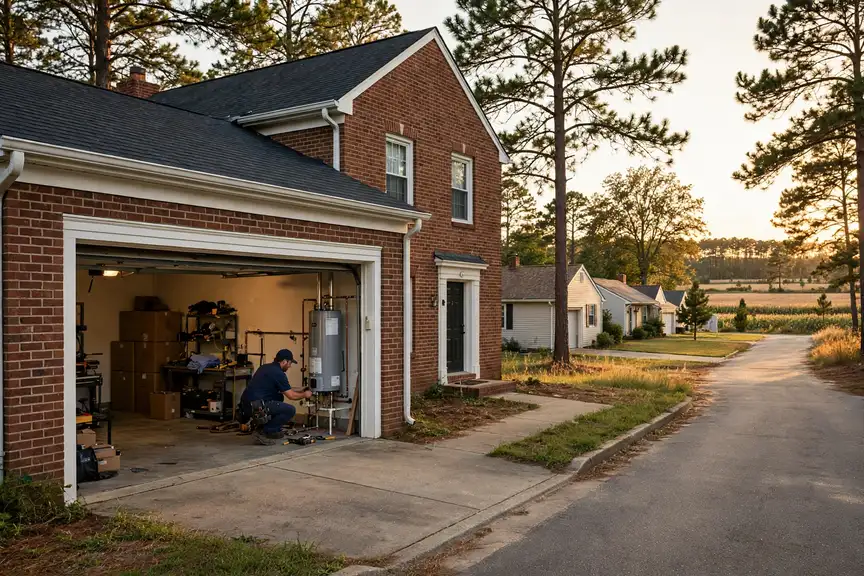
Water heater installation in a home garage
Replacing a heater in a Vineland home

Vineland plumbing, in brief

The median Vineland home was built in 1968; 67.9% of the stock predates 1980, and the pattern this metro's own data ranks first is ageing cast iron sewer lines. PlumbReach USA is a referral service, not a plumbing company: one call connects you with an independent local plumber serving your ZIP code.

The Vineland housing stock, and what it means for plumbing

Start with the raw material: 152,915 people, 57,203 housing units, and a housing stock whose middle home was built in 1968. That single date organises everything on this page. On one side of it stand the older districts — 39.2% of homes predate 1960, 67.9% predate 1980 — plumbed in galvanized steel, cast iron and clay, in homes across Cumberland that have been repaired piecemeal for decades. On the other side, the 14.1% built since 2000 run plastic lines under slabs, and fail in the newer ways. A Vineland plumber reads a home's build year the way a doctor reads a chart: it predicts, before a single wall is opened, which systems deserve suspicion first.

Ask how Vineland's older homes have been kept and the honest answer is: in pieces. A water heater here, a repipe there, one bathroom renewed while the rest of the system carries on — across 38,841 pre-1980 homes, the patchwork is the norm rather than the exception. That history is written in the walls of Cumberland County and everywhere else the early stock stands: systems that are part original, part renewed, and entirely individual. It is also why the guidance on this page keeps returning to patterns rather than single faults — in a patchwork system, the pattern is the diagnosis.

The newer side of Vineland — the 14.1% of homes built since 2000, concentrated around growing communities like Vineland — runs on plastic supply and drain lines that age more gracefully but fail in their own ways: slab leaks where lines run under concrete, water heaters worked hard by 1,050 cooling degree days of hot-season demand, and fixture cartridges wearing out in houses that all reach the same age at the same time. One metro, two plumbing generations, and the sections below take them in the order this metro's data ranks them.

Over everything sits the weather, and here it is measured rather than described: NOAA's station at MILLVILLE MUNI AP, NJ US averages 54.3 degrees across the year, with 22.2 days reaching 90 or more and 108.1 nights at freezing or below. A buried lateral feels that record as soil that swells and pulls away; a water heater feels it as an unbroken cycle count; an exposed line feels it on the single coldest night. The problem ranking below is what those numbers, crossed with the housing profile, produce for Vineland specifically.

The Vineland plumbing profile in numbers

Two public records, one metro: what was built here, and what the sky does to it.

The distribution, in one breath: of every hundred Vineland homes, 39.2 were standing before 1960, 28.7 went up in the two decades after, 18.0 in the two after that, and 14.1 have arrived since 2000. Percentages flatten the picture, so hold the counts beside them — 22,424 oldest-era homes, 8,066 newest — and the metro's plumbing stops being an abstraction: it is that many systems, of those ages, failing in that order.

Some metros are defined by their growth; this one is defined by its inheritance. The largest share of Vineland's homes was built before 1960, and inheritance in plumbing means materials at the end of their design lives serving households who did not choose them. The work that follows from that fact is the metro's staple: drains renewed, supplies renewed, laterals renewed — the patient, house-by-house replacement of a founding stock. Newer districts exist and matter, but they are not where this metro's plumbing character was decided.

Close behind the leader come the 1960-1979 homes, 28.7% of the stock. Their plumbing is mid-change by construction — the decades when materials swapped over mid-stream — so this band is where a Vineland plumber earns the diagnostic fee: pressure tests and camera runs that say which side of the transition a given house was built on.

The climate column of this profile is a workload statement. 4,934 heating degree days say how long the cold half of the year keeps inlet water near its chilliest and heaters firing at their hardest; 1,050 cooling degree days say how relentlessly the hot half loads every drain and tank; 108.1 freezing nights and 22.2 hot days mark the extremes where the failures concentrate. NOAA keeps these figures at MILLVILLE MUNI AP, NJ US as thirty-year normals — which is to say, as the closest thing plumbing has to a settled forecast.

That is the whole method of this page in one section: era shares from the Census, loads from NOAA, and a problem list that is simply where the two overlap most in Vineland. The services and guidance that follow are ordered by the same profile — local first, generic last.

Plumbing services in Vineland

Sequenced by this metro's own problem ranking, not by a national catalogue order.

Sewer Line Repair & Replacement in Vineland

Between the house and the street lies the lateral — privately owned, commonly forgotten, and the source of the worst backups a home can have. Sewer work begins with a camera survey of that run: its material, its fall, its invaders. Spot repairs suit local damage; a line failing along its length gets replaced, not patched into a subscription.

Put the metro's laterals end to end and they would run for thousands of miles — one private road per home, most of them laid generations ago and none of them inspected since. Vineland's share of that buried network follows its building history: clay and iron under the founding districts, transitional materials in the post-war ring, plastic in the growth corridors around Millville. Sewer service here is the slow audit of that network, one camera run at a time, and its findings sort themselves by era so reliably that the footage often confirms the street's building date before it confirms anything else. The 43.37 inches of rain in an average year here is part of the story too — buried lines feel every wet season.

Sewer demand follows the founding map: the districts built first, around the old centre and out through Millville, hold the jointed clay and iron; the growth rings hold plastic with decades in hand. 39.2% of the metro's homes stand on the founding side of that line, which is why the footage here so often shows a pipe at the end of its story.

More about sewer line repair & replacement ➔

Pipe Repair & Repiping in Vineland

The supply system is a single organism, so its failures correlate. Repiping exists for the point where correlation is obvious: pressure fading, water discolouring, leaks touring the house. New runs go in PEX or copper, routed to minimise opening walls, pressure-tested before anything is closed up.

Walk the older streets of Vineland with a plumber and you will hear the housing stock dated by its pipework: galvanized behind this wall, copper of a certain vintage there, a repipe already done on the corner house. The metro's median build year of 1968 means that dating game works on half the homes in the metro. What decides any individual home's path is not the street's average but the evidence inside its own walls — pressure at the fixtures, the water's colour after a quiet weekend, the count of repairs already made. The assessment is short; the conclusion follows from it. Locally the workload concentrates where the stock is oldest — the districts built around the 1960s first.

The repair-or-renew caseload is set by one figure above the rest: 67.9% of Vineland homes predate 1980, plumbed in the materials now at the end of their service lives. Around Laurel Lake (2,514 residents) as in the old core, that percentage is not an abstraction — it is the street's plumbing, house by house.

More about pipe repair & repiping ➔

Emergency Plumbing in Vineland

In Vineland the emergency call is routed, not queued: one number reaches the independent local plumber covering Cumberland at that hour, and the housing record on this page — median build year 1968 — is the homework they arrive already knowing.

More about emergency plumbing ➔

Drain Cleaning in Vineland

Drain work in Vineland splits by era: the 38,841 pre-1980 homes drain through older materials, the post-2000 subdivisions through plastic — and the local plumber reads the cable's return to tell which world your street drains through.

More about drain cleaning ➔

Water Heater Repair & Installation in Vineland

Heater work in Vineland is workload work: 22.2 hot days and 4,934 heating degree days a year cycle the metro's tanks hard, and the local professionals routed here size, flush and replace against that record.

More about water heater repair & installation ➔

Leak Detection & Repair in Vineland

A creeping meter in a Vineland home is located, not guessed at: the professionals routed here trace the line with instruments and confirm the spot before any floor or wall is opened.

More about leak detection & repair ➔

Toilet Repair & Installation in Vineland

Running, rocking or refusing — in Vineland the diagnosis is the same short sequence: fill valve, flapper, supply line, flange. The plumbers routed here carry the internals for the fixtures this metro's eras installed.

More about toilet repair & installation ➔

Faucet, Fixture & Garbage Disposal Repair in Vineland

In Vineland the faucet call is often the first plumbing visit a newer home ever gets — the professionals routed here treat it as an introduction: the fixture fixed, and the home's shutoffs and heater age noted for the record.

More about faucet, fixture & garbage disposal repair ➔

What Vineland books most

Ask where this metro's plumbing diary fills up and the answer is a short story: Ageing cast iron sewer lines first, galvanized pipes at the end of their life close behind, and the services that answer them doing the bulk of the booked work. Everything else on the list above is the supporting cast — necessary, frequent enough, but not what Vineland's housing stock, at its age and in its climate, principally demands. Read the service list as a weather report for the metro's pipes and it stops looking like a catalogue.

Plumbing problems Vineland homes actually get

Chosen by this metro's own housing and weather data — the same two records this whole page is built from.

Ageing cast iron sewer lines

Read a cast iron drain's age in its symptoms and the progression is orderly. First the line slows — not blocked, just reluctant, as scale roughens the bore and catches what passes. Then the complaints localise: one branch backing up, then another, as sections of the run reach their own stages of narrowing. In Vineland's oldest districts that progression plays out across whole streets of the 1960s housing at once, because the lines were laid in the same years from the same material. The camera distinguishes the stages house by house: a bore narrowed by scale that cleaning can restore, against a wall thinned and cracked past any cleaning's help.

The pipe itself explains the timeline. Cast iron drains by gravity, slowly, and everything a household sends down it — grease films, mineral-heavy water, the occasional corrosive cleaner — works on the iron for decades. The metal does not fail evenly: it thins first at the bottom of horizontal runs, where water and grit sit longest, and at the joints where sections meet. That is why two Vineland homes of the same age can be in different places with the same pipe: usage, water chemistry and soil conditions around the line all vote on how fast it goes. What a camera inspection adds is certainty — the difference between a line that needs cleaning, a line that needs a section replaced, and a line living on borrowed time.

Count it from the Census side: 22,424 homes in this metro predate 1960, and the drain lines beneath them were cast in an era that assumed a working life now fully spent. They will not all fail at once — they will fail one street at a time, in the order the corrosion reaches, which is what makes the pattern a ranking on this page rather than a footnote.

Watch for

  • A floor drain that smells of the sewer after dry weather
  • Toilet bowls that bubble when the washing machine drains
  • Patches of unusually green grass along the line's path to the street

About sewer line repair & replacement ➔

Galvanized pipes at the end of their life

Galvanized pipe does not fail loudly; it fails by narrowing. Zinc coating gone, the steel rusts from the wet side, and every year the passage water travels through is a little smaller than the year before. The household reads it as personality — the shower that weakens when a tap opens, the washing machine that fills slowly, the rust tinge after a holiday — until the day a pinhole opens in a wall and the personality becomes a flood. In housing built when galvanized was simply how houses were plumbed, the whole system is one age and one material, which is why the faults stop being isolated: the pipe is not breaking in one place, it is finishing in all of them at the same pace, and the repair conversation has to reckon with that arithmetic.

Galvanized pipe fails politely, which is precisely the problem. No flood, no drama — just a shower that weakens across years, a washing machine that fills slowly, water that blushes rust after holidays. Households adapt without noticing, the way you adapt to a dimming bulb. The 16,417 homes built in this metro between 1960 and 1979 stand in the front of that queue now, their original steel bores narrowed to drinking-straw width in the worst runs. The fix, when it comes, tends to astonish people — not with its scale, but with the pressure they had forgotten they were owed.

In raw numbers, Vineland's exposure is 38,841 homes built before 1980 — the galvanized decades. Behind every one of those front doors is the same material on the same clock, which is why pressure complaints and pinhole leaks cluster by neighbourhood here rather than scattering evenly across the metro.

Watch for

  • Fixtures farthest from the meter noticeably weaker than near ones
  • Rust-coloured first water of the day that clears within seconds
  • Shower pressure that drops hard when a second tap opens

About pipe repair & repiping ➔

Freeze-burst pipes in cold snaps

Water expands when it freezes, and a closed pipe gives that expansion nowhere honourable to go. The split usually forms where the ice plug's pressure peaks — often not where the freeze itself sits — which is why a burst can hide in a warm stretch of wall downstream of the frozen one. Vineland's exposure concentrates where lines leave the heated envelope: the pre-1980 districts around Vineland, garages, crawl spaces, additions. On the coldest nights of the year, the metro's plumbing is only as strong as its least-protected run, and the thaw reads out the verdict house by house.

Prevention, for this pattern, is a geography lesson: the burst never happens in the middle of the heated house. It happens at the perimeter — the wall cavity on the windward side, the run beneath the addition, the pipe the builder routed through the garage to spare six feet of copper. In Vineland, where 22.2 summer days tempt everyone to forget what 108.1 freezing nights intend, the autumn ritual is short and specific: find every line that leaves the warmth, and do something about it. The households that keep that ritual read about burst pipes the way other people do — as news.

Vineland's freeze maths is unforgiving: 108.1 sub-freezing nights in an average year at MILLVILLE MUNI AP, NJ US, multiplied by every uninsulated run in every older home, gives the season hundreds of chances to find one weak line. The splits favour the same addresses winter after winter — the the 1960s stock with pipes in the cold zones of the house.

Watch for

  • A tap that runs slower after a cold night than it did the evening before
  • Frost visible on an exposed section of pipe in the garage or crawl space
  • A water bill spike in the month after a hard freeze

About pipe repair & repiping ➔

Winter pipe season in Vineland

Winter in Vineland is pipe season. With about 108.1 nights a year at or below freezing on the long-term record, the houses that get through winter cleanly are the ones whose exposed lines were dealt with in autumn: insulation on garage and crawl-space runs, hoses off the outside taps so those lines can drain, and a household that knows where its main shutoff is before it needs it. During the hardest cold, a slow drip from the tap furthest from the main and open cabinet doors under sinks on outside walls are simple insurance. If a line does freeze, shut the water off before the thaw does its damage and have the run checked — a pipe that froze once has shown you exactly where it is vulnerable.

The numbers behind the season here: 108.1 nights a year at or below freezing at MILLVILLE MUNI AP, NJ US, against a housing stock whose median build year is 1968. Every winter writes the same exam for Vineland's older pipes, and every winter some of them — usually in the the 1960s districts first — fail it.

A closer look: ageing cast iron sewer lines in Vineland

In Vineland the pattern has an address pattern. The cast iron went under the homes built before 1960 — the streets of the old core and the first suburbs around Vineland — and it is failing in the order those streets were built. A camera call in the historic districts is a different appointment from one in Millville or the newer subdivisions: there, the same symptoms usually trace to something younger and simpler. Knowing which side of that line a home sits on is most of the diagnosis before the camera ever leaves the van, and it is why this page ranks the problem by the metro's pre-1960 count rather than by anecdote.

Why here and not everywhere: Vineland pairs 38,841 pre-1980 homes with 22.2 days a year at 90 degrees or more and 108.1 nights below freezing. Every metro pairs its housing with its weather somehow; this particular pairing is what puts the pattern where it sits on this page's list, ahead of problems that dominate metros built in other decades, under other skies.

On a first visit for this pattern, a local plumber's checks run in a practised order:

  • Whether the line has ever been camera-inspected, and what the last footage showed
  • The cleanout's condition — standing water there tells its own story
  • Which fixtures misbehave first, since the ground-floor ones report a main-line problem earliest
  • The age of the street's housing, because neighbouring lines of the same era fail in sequence

From problem to fixed, in Vineland

A plumbing problem inside a Vineland homePROBLEM
➔
The same system in Vineland after professional repairSOLUTION

Areas covered in the Vineland metro

Vineland

Population 60,692

Millville

Population 27,432

Bridgeton

Population 26,836

Laurel Lake

Population 2,514

Port Norris

Population 1,702

Gouldtown

Population 1,555

West Park

Population 1,521

Silver Lake

Population 1,447

Centre Grove

Population 1,371

Sunset Lake

Population 1,341

Rosenhayn

Population 1,066

Fairton

Population 918

Also in the Vineland metro: Carlls Corner (population 845), Cedarville (population 636).

Read the grid as a building programme spread over a century. The oldest communities sit where the metro began; the youngest are still adding streets at its edge; and Millville and Bridgeton, with 27,432 and 26,836 residents, stand for the rings in between. Each ring plumbed in its era's materials, and each is now failing, wearing or holding in its era's characteristic order. The ZIP codes below draw the coverage boundary; the eras inside it draw everything else on this page — the problems ranked, the services ordered, the checks advised.

Beyond the largest communities sit Laurel Lake (2,514), Port Norris (1,702), Gouldtown (1,555), West Park (1,521), Silver Lake (1,447) — smaller places across Cumberland, covered on the same terms. Their housing tends to be older on average than the big suburbs', and their calls follow the older patterns on this page. One routing covers them all: find your ZIP code below and the rest is a phone call.

Vineland ZIP codes we cover

08302, 08311, 08314, 08316, 08320, 08321, 08323, 08324, 08327, 08329, 08332, 08340, 08345, 08348, 08349, 08352, 08353, 08360, 08361

The Vineland metro in detail

The metro's weight is not evenly spread. Vineland holds 60,692 of the 152,915 residents; Millville and Bridgeton add 27,432 and 26,836; and the remainder scatters across the smaller places above, some no bigger than a few thousand people. Plumbing follows the weight — most calls come from where most homes are — but era matters more than size: a small community of 1960s housing generates older-system work than a large new subdivision does.

The metro answers to 1 county governments (Cumberland), a patchwork that matters at permit time rather than at the pipe. Cumberland County carries the centre; the others carry the growth rings and the older outlying towns. A plumber routed through this page works inside that patchwork daily — the water does not care about the boundaries, but the job's paperwork does.

Three neighbouring coverage areas begin where this one ends: Atlantic City, NJ, some 21 miles off; Trenton, NJ, 70 miles; and Dover, DE, 26 miles. Each keeps its own page because each keeps its own numbers — a different median build year, a different climate station, a different problem ranking. Boundary households should trust the ZIP list over the map: the code, not the compass, assigns the dataset.

Set Vineland among its neighbours and the contrasts sharpen the profile: Atlantic City, NJ — metro population 372,047, median build year 1978 — sits 21 miles away; Trenton, NJ (399,289, median 1967) 70 miles; Dover, DE (194,786, median 1993) 26 miles. Three different housing stocks under three nearby skies, which is why each keeps its own page and its own problem ranking rather than borrowing this one.

The stock has a shape as well as a size. Owners hold 65.6% of it and renters 34.4%, a split that decides who notices a drip first and who arranges the repair. The generations split 4.8-to-one in favour of the pre-1980 homes. And the map divides into 14 named communities across Cumberland, each carrying its era's share of the 57,203 housing units the Census counts here.

The Vineland record in one line — median home age: 58 years · owner-occupied homes: 34,992 · renter-occupied homes: 18,349 · pre-1960 homes per covered ZIP code: 1,180 · heating-to-cooling degree-day ratio: 4.7 · average rainfall: 1,102 mm a year.

Vineland plumbing questions

What area does PlumbReach USA cover around Vineland?
Every covered community in the metro — 19 ZIP codes in total, spread over Cumberland. The largest share sits in Vineland, with Millville and Bridgeton behind it, and the full list is printed on this page. Find your code there and the routing takes a single call. Put the coverage against the Census map and it tracks the population: Vineland first (39.7% of the metro), then the rings of suburbs and smaller communities in their own building decades — all of it inside the same routing. If a street sits between Bridgeton and Laurel Lake, it is in; the list was drawn from the Census map of the metro — 1 counties, 19 codes — rather than from a radius around a shop. Read the boundary in its own numbers: the list opens at 08302 by Vineland (60,692 residents), crosses 08323 near Millville (27,432) and 08345 near Bridgeton (26,836), and closes at 08361 — 19 codes over Cumberland in all. Stated as the communities it covers: the community ledger reads Vineland (60,692 residents), Millville (27,432), Bridgeton (26,836), Laurel Lake (2,514) and Port Norris (1,702), out of 152,915 residents metro-wide.
A Vineland house from about 1968 — which parts of its plumbing deserve a closer look?
Walk it the way a plumber would. First the visible evidence: staining under sinks, a meter that creeps, drains that have slowed by degrees. Then the era evidence: a home of about 1968 in this metro sits amid 18.0% of housing built between 1980 and 1999 and an older core built earlier still, so mixed pipework — some original, some renewed — is the expectation, and knowing which of yours is which is most of the answer. In Vineland that plays out across 19 ZIP codes, from Vineland to Millville. Geography of the advice: it holds across 19 ZIP codes and 1 counties, in the 53,341 households the Census counts from Vineland out to Laurel Lake — the eras differ by district, the watch-list does not. The same applies street by street in Cumberland County: a median year of 1968 is an average, and the homes on either side of it — older in the core, newer past Laurel Lake — read from the same materials list. The counts behind the watch-list: 22,424 homes before 1960, 16,417 between 1960 and 1979, 10,297 between 1980 and 1999, 8,066 since 2000 — 57,203 units in all. And the climate pressing on every era alike: 54.3 degrees on average at MILLVILLE MUNI AP, NJ US, 22.2 hot days, 108.1 freezing nights, 43.37 inches of rain.
What is the most common plumbing problem in Vineland?
Stand back from the ranking and the pattern explains itself: ageing cast iron sewer lines is what this metro's building history has been manufacturing for decades. Read a cast iron drain's age in its symptoms and the progression is orderly. The districts around Vineland report it most, the newer subdivisions least — a map of the problem that is also, not coincidentally, a map of the metro's growth. The backdrop is the same metro-wide: 57,203 housing units working against the MILLVILLE MUNI AP, NJ US climate record. For scale, the runner-up is galvanized pipes at the end of their life, and the gap between them is the metro's own arithmetic: housing counted across Cumberland, weather logged at MILLVILLE MUNI AP, NJ US, and an era profile with a median of 1968. Change one input and the order moves: at MILLVILLE MUNI AP, NJ US the record reads 4,934 heating degree days against 1,050 cooling; in the stock, 39.2% predates 1960 and 67.9% predates 1980. The inputs behind the ranking, community by community: the community ledger reads Vineland (60,692 residents), Millville (27,432), Bridgeton (26,836), Laurel Lake (2,514) and Port Norris (1,702), out of 152,915 residents metro-wide.
Does Vineland's weather affect my plumbing?
It decides which problems this metro gets. Vineland's average year, per NOAA's record at MILLVILLE MUNI AP, NJ US, delivers 43.37 inches of rain across 4,934 heating degree days: wet soil pressing on laterals, dry soil pulling away from them, and cold snaps hunting for the one uninsulated run in the garage wall. The seasonal section of this page translates those numbers into the months that matter. Read the record as the station logs it — MILLVILLE MUNI AP, NJ US, the NOAA station nearest this metro's centre: 4,934 heating degree days against 1,050 cooling degree days in a normal year. Every pattern ranked on this page was scored against those two numbers and the housing figures beside them. It is the same story from Millville to Bridgeton — the stock decides, and this stock's median build year is 1968. The record behind it is measured at MILLVILLE MUNI AP, NJ US and felt from Millville to Laurel Lake: one climate for Cumberland, 57,203 housing units, and every pipe, heater and lateral inside them. That is why the seasonal advice on this page is dated by MILLVILLE MUNI AP, NJ US's record rather than by a national calendar: 22.2 hot days and 108.1 freezing nights draw the two working seasons here. The numbers in one line: 54.3 degrees average, 43.37 inches of precipitation, 4,934 heating degree days, 1,050 cooling degree days, 22.2 days at 90 or above, 108.1 nights at freezing or below. Whose roofs that weather works on: the community ledger reads Vineland (60,692 residents), Millville (27,432), Bridgeton (26,836), Laurel Lake (2,514) and Port Norris (1,702), out of 152,915 residents metro-wide.
A pipe just burst at my Vineland house — what are the first three things to do?
The first five minutes belong to one valve. Find the main shutoff (meter box at the street for many Vineland homes, an interior valve for others), close it, then open a low faucet so the broken line empties into a drain instead of a wall. Photograph the damage for your records once the water stops, keep clear of any electrics the water has reached, and then call — in that order. Across the metro's 1 counties, Cumberland County included, the pattern repeats wherever the housing matches. The local detail that decides how the first minutes go: which side of Vineland the home sits on. Houses in Millville and the older districts tend to shut off at an interior valve; slab homes out toward Bridgeton and Laurel Lake more often at the meter — worth knowing before the water is moving, across all 19 covered ZIP codes. The calm-day homework for this metro: walk the 19 covered ZIP codes' worth of housing in your mind to your own valve — in Cumberland County the older stock hides it indoors, the slab tracts past Bridgeton at the meter — and turn it once before you ever need it in anger. The calm-day version, localised: find your valve before MILLVILLE MUNI AP, NJ US's next freeze season — 108.1 freezing nights a year — whether your home sits near Vineland, out in Millville (27,432 residents) or past Bridgeton (26,836). True from the centre to the edge: the community ledger reads Vineland (60,692 residents), Millville (27,432), Bridgeton (26,836), Laurel Lake (2,514) and Port Norris (1,702), out of 152,915 residents metro-wide — shutoff first, everywhere on the map. The ranking that frames the damage: Ageing cast iron sewer lines first on this page, galvanized pipes at the end of their life second, freeze-burst pipes in cold snaps third — the burst line in front of you belongs to the same local arithmetic. The calm-day version of this answer is a walk: the valve behind a 08302 address, the meter box on a 08323 street, the interior shutoff in a 08345 home — three eras, three addresses for the same valve, all inside this metro's 19 codes.
How many leaks in a Vineland house mean the pipes themselves are done?
The odds rise with the housing data: 67.9% of Vineland homes predate 1980, when galvanized steel was a standard supply material, and galvanized corrodes from the inside out. Its signature is a pattern — fading pressure, discoloured water after the house sits quiet, leaks arriving in sequence. One leak in sound pipe earns a repair; the pattern is what earns the repiping conversation. Homeowners in Millville (27,432) and Bridgeton (26,836) read this page for the same reason — the stock there is the same stock. It holds in the 10,297 homes built between 1980 and 1999 just as it holds in the older core. Ask where this conversation happens most and the answer is a map: the districts plumbed in the galvanized decades, from the centre out through Millville (27,432 residents) and Bridgeton (26,836), across Cumberland. The newer communities in the grid hear it rarely — their turn is scheduled decades from now. Streets matter to the timing: the founding districts near Vineland reach the pattern first, the post-war ring through Millville and Bridgeton a decade behind, the subdivisions past Laurel Lake a generation behind that. Streets carry the same ledger at household scale: from Vineland (60,692 residents) through Millville (27,432) to Bridgeton (26,836), the leak sequence means the same thing wherever the material matches. Where the pattern concentrates, in codes: the codes run 08302, 08323, 08345, 08361 and 08349 among the 19 on the list, spread over Cumberland, thickest in the earliest-built of them.
Does PlumbReach USA employ the plumbers it sends out in Vineland?
Two things, and only two. We publish the homework — city pages like this one, built from Vineland's Census and climate records — and we route calls to independent local plumbing professionals. We do not employ those professionals, set their schedules, or carry out the work in your home. If that distinction ever seems blurred on a page of ours, the plainer reading is the right one. The local figures behind it: 38,841 homes from before 1980 and 8,066 built since 2000, sharing one system of streets and soil. From Millville to Laurel Lake, the model does not change: PlumbReach USA publishes the homework — this page, built from Vineland's Census and NOAA records — and routes the call; the independent professional who serves that part of Cumberland does everything at the home. It is worth being precise about the local end of the arrangement: the professional serving Millville or Laurel Lake sets their own terms with you, carries their own responsibility for the work, and answers for it — our routing is the only part this page undertakes. Callers from Millville (27,432 residents), Bridgeton (26,836) and Laurel Lake get the same plain arrangement: our routing, their plumber, their terms — stated here because the metro's 152,915 residents deserve it stated. The arrangement holds across the whole stock: the era ledger reads 22,424 homes before 1960, 16,417 from 1960-1979, 10,297 from 1980-1999 and 8,066 since 2000 — 57,203 units, 53,341 households, 65.6% of them owner-occupied — in each era, the professional is local and independent.
Which small plumbing jobs prevent big ones in a Vineland house?
Work from the street inward, once a year. Start at the meter and confirm it rests when the house does. Then the cleanout in the yard — a dry, clear view down it is the cheapest camera inspection there is. Then the heater's drain valve and relief lever, then every shutoff under every sink, turned twice so they remember how. Vineland's housing, median vintage 1968, rewards exactly this kind of unglamorous attention: systems here rarely fail without having whispered about it first. Scale it to this metro: Vineland's stock runs to 57,203 housing units, 38,841 of them built before 1980 — the checks above are written for exactly that population, in a climate that deals the metro 22.2 days of serious heat and 108.1 freezing nights a year. Scale the routine to the map and it stays the same half hour: the checks are written for a stock of 57,203 homes spread over Cumberland, from the founding streets near Vineland to the subdivisions past Millville (27,432 residents) — one climate, one ageing pattern, one calendar. What the routine is really insuring against is written at the top of this page: the patterns this metro's 4,934 heating degree days and 22.2 hot days manufacture out of its housing eras, caught while they are still whispers. Kept yearly, the routine compounds across the metro: 53,341 households in Cumberland, from Vineland to Laurel Lake, each holding one page of notes against the same two seasons. The routine's territory, in codes: the codes run 08302, 08323, 08345, 08361 and 08349 among the 19 on the list, spread over Cumberland.
Why does this page lead with the problems it leads with in Vineland?
The ranking is computed, not copied. Each pattern is scored against this metro's own figures — the housing-age profile from the Census Bureau's American Community Survey (a median build year of 1968 here, 39.2% of homes before 1960) and the climate normals NOAA keeps at MILLVILLE MUNI AP, NJ US. A pattern rises when the local stock and the local weather both manufacture it. Another metro's page is ranked by that metro's numbers, which is why the lists differ from city to city. Run the same scoring on any single district and the order bends: Millville's streets would rank their own list, Laurel Lake's another. This page ranks the metro as a whole — 53,341 households across Cumberland — which is why the evidence paragraphs keep returning to where each pattern actually concentrates. A useful check on the method: run it on Millville alone and the order bends toward that district's eras; run it on the whole metro — 53,341 households — and you get the list printed here. Re-run the sort on any other metro's inputs and a different order falls out; on Vineland's — 39.2% pre-1960 stock, 67.9% pre-1980, 22.2 hot days, 108.1 freezing nights — this order is the one the arithmetic returns. The scoring's raw material, code by code: the codes run 08302, 08323, 08345, 08361 and 08349 among the 19 on the list, spread over Cumberland. The dataset's own label for the unit being scored: the Vineland metro — 152,915 residents, 65.6% of them owner-occupiers — scored whole, because its housing and its weather arrive whole. Subset the inputs and the order bends: score Millville's streets alone and their eras lead; score the Laurel Lake subdivisions alone and theirs do. The printed order belongs to the full 19-code metro, no smaller unit.
Where are Vineland's oldest homes, and why does it matter for plumbing?
Follow the building dates. Vineland's pre-1960 stock — 22,424 homes, 39.2% of the metro — concentrates in the old core and the inner suburbs, and its plumbing is the metro's oldest by the same margin. The growth rings repeat the pattern at intervals: each era's building district carries that era's pipe materials, so a plumber can often guess a home's system from its street before the door opens. Put the eras on the same map and the pattern sharpens: the 22,424 oldest homes cluster centrally, the 16,417 homes of 1960-1979 ring them, and the stock thins into new subdivisions past Bridgeton. A plumber driving outward from Vineland is driving forward through plumbing history, decade by decade. The drive that proves it runs from the centre of Vineland outward: through Millville (27,432 residents), then Bridgeton (26,836), then the younger rings toward Laurel Lake — a single trip across Cumberland that travels forward through the metro's plumbing history decade by decade. It is why two homes a mile apart in Vineland can need different conversations: one on the 1960s materials near the centre, one on modern lines past Bridgeton — the map of eras is the first diagnostic. ZIP by ZIP the same gradient: the oldest systems cluster in the codes nearest the centre — the 08302 side of the list — and the youngest toward 08361 at the edge, across Cumberland. The map's communities in growth order: the community ledger reads Vineland (60,692 residents), Millville (27,432), Bridgeton (26,836), Laurel Lake (2,514) and Port Norris (1,702), out of 152,915 residents metro-wide. The patterns the oldest stock feeds, in this page's order: Ageing cast iron sewer lines, galvanized pipes at the end of their life, freeze-burst pipes in cold snaps — a ranking the founding districts of Vineland dominate precisely because their pipework is the metro's earliest.
If a plumber assessed my Vineland home tomorrow, what would they look at first?
The order is by consequence, not convenience: first the main shutoff, because everything else depends on being able to stop the water; then the heater, the hardest-working appliance in a Vineland home; then the drains and the meter, which together report on the buried half of the system. In Vineland, with 38,841 homes built before 1980, that sequence catches the era's usual suspects in the order they matter. The metro's figures say why the order matters here: 38,841 pre-1980 homes means shutoffs and heaters of a certain age are the statistical norm rather than the exception, and a climate of 4,934 heating degree days works every heater in Cumberland County hard enough to justify its place near the front of the walk. District by district, the same half hour: in Cumberland County's oldest homes the flags are materials; in the middle ring, around Millville (27,432 residents), they are valves and heaters; at the growth edge they are cartridges and first questions about lines under slabs. The shortlist is drawn from this metro's evidence: 38,841 pre-1980 homes for the valves and materials, 22.2 hot days for the heater sediment, 43.37 inches of rain for the buried lines the meter reports on. District accents, with figures: Millville (27,432 residents) leans to valves and materials, Bridgeton (26,836) to heaters and drains, Laurel Lake to first-generation fixtures — one walk, three readings. The walk's districts, named: the community ledger reads Vineland (60,692 residents), Millville (27,432), Bridgeton (26,836), Laurel Lake (2,514) and Port Norris (1,702), out of 152,915 residents metro-wide.

Before an emergency, read the guide: How to shut off your home's water main

Nearby metro areas

One call to a Vineland plumber

One call connects you with an independent local plumbing professional serving Vineland and the surrounding metro.

Call center hours: Mon-Fri 7:00 AM-10:00 PM ET | Sat 8:00 AM-10:00 PM ET | Sun 7:00 AM-9:00 PM ET

Call Now
