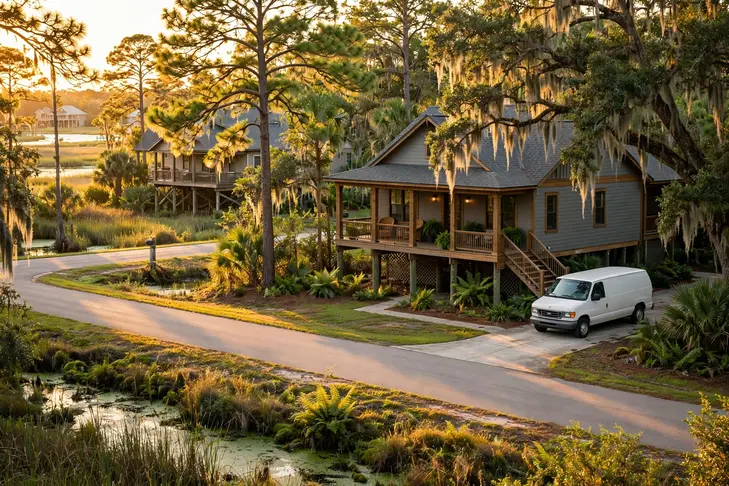


Everything on this page was computed for Slidell and nowhere else: the problem ranking from its Census housing profile, the seasonal risks from its NOAA station record, the coverage from its own ZIP codes. PlumbReach USA connects you to an independent local plumber; the page itself is the homework, done in public, so the call you make is an informed one.
Call center hours: Mon-Fri 7:00 AM-10:00 PM ET | Sat 8:00 AM-10:00 PM ET | Sun 7:00 AM-9:00 PM ET
The median Slidell home was built in 1995; 22.9% of the stock predates 1980, and the pattern this metro's own data ranks first is water heaters working hard year-round. PlumbReach USA is a referral service, not a plumbing company: one call connects you with an independent local plumber serving your ZIP code.
The stock, in one pass: 269,331 residents, 112,414 housing units, 103,286 households — and a build history that splits the metro into plumbers' generations. 4.5% of homes stand from before 1960; 22.9% from before 1980; the rest divide between the late-century suburbs and the 39.7% built since 2000. Every era is a materials decision still in force: the pipes in a Slidell wall are the ones its decade specified, ageing on that decade's schedule, whatever the current owner's plans for them.
By now, most of Slidell's pre-1980 homes are on their second plumbing lives in part: a heater replaced, a bathroom renewed, a section of drain renewed after a failure — while the remainder of the original system carries on into its sixth and seventh decades. The 25,743 homes in that stock are therefore not uniformly old; they are individually old, each with its own archaeology of repairs. That is why the pre-1980 districts reward inspection over inference: the street's average says little about the house in front of you, whose real history is written under its floors.
Uniformity is the newer stock's defining trait. A subdivision in Mandeville or Covington went up in a handful of years, fitted with one generation of fixtures, one heater model class, one approach to running lines under slabs. That uniformity writes a calendar the whole street shares: the first heater wave, the first cartridge wave, the first questions about lines under concrete arrive together, years before the same streets need anything structural. With 39.7% of the metro built since 2000, that calendar governs a large and growing share of Slidell's plumbing work — predictable work, if a household reads the calendar early.
The weather's part in this is written at SLIDELL AP, LA US, where an average year carries 61.88 inches of precipitation, 79.9 days at ninety degrees or more and 23.5 nights at freezing or below. Pipes experience that year as workload and as hazard in roughly equal measure — the workload in the heater's cycle count and the drains' burden, the hazard in the exposed runs and the swelling soil. The problem ranking further down is simply the housing profile above, read under this sky.
Two public records, one metro: what was built here, and what the sky does to it.
Lay the eras side by side instead: 4.5% pre-1960 (5,059 homes), 18.4% from 1960-1979 (20,684), 37.4% from 1980-1999 (42,043), and 39.7% since 2000 (44,628). No single era tells the story — the proportions among them do, and those proportions are different in every metro this site covers.
A metro that mostly built itself after 2000 has plumbing with a distinctive trait: uniformity. The same subdivisions, the same materials, the same installation years — and therefore the same maintenance waves, arriving at the same streets in the same seasons. Slidell's older pockets still produce the deepest individual jobs, but the volume lives in the new stock: heater fleets cycling together, cartridges wearing together, slab questions surfacing together. Reading those waves early is most of what local knowledge means here.
The runner-up era is 1980-1999, with 37.4% of homes. That stock has left its carefree decades and entered its maintenance decades, and it shows in the call pattern around Mandeville and the other districts of those years: heaters on their second or third cycle, fixtures reaching their wear points together, drains still young enough to reward attention over replacement.
A profile needs its climate column, and Slidell's comes from SLIDELL AP, LA US: an average year of 67.7 degrees, built from extremes at both ends. The heating load (1,612 degree days) and the cooling load (2,634) together set the water heater's working life; the precipitation total (61.88 inches) sets the soil's behaviour around every buried line; the freeze count (23.5 nights) sets the exposure of every uninsulated run. Four numbers — and most of the metro's plumbing behaviour follows from them.
That is the whole method of this page in one section: era shares from the Census, loads from NOAA, and a problem list that is simply where the two overlap most in Slidell. The services and guidance that follow are ordered by the same profile — local first, generic last.
Chosen by this metro's own housing and weather data — the same two records this whole page is built from.
Strain is what a decade of mornings does to a tank. Each cycle heats, expands, cools and settles; sediment from every gallon the household has ever drawn settles a fraction at a time into the bottom, where it insulates the burner, lengthens the cycles and bakes the steel. In Slidell, where demand runs high through the long hot season, that accumulation is the difference between a heater that fades quietly at year twelve and one that lets go at year seven. The appliance looks identical from the closet door. Its account of itself, told in rumblings and recovery times, is not.
Two heaters of the same age can live very different lives in this metro, and the difference is usually maintenance rather than luck. The attended tank — sediment drained yearly, anode checked before it is spent, temperature kept sane — routinely outlasts its neglected twin by years. The neglected one's decline announces itself in the water first: a rust blush at the hot tap, a sulphur note after holidays, hot water that arrives carrying the tank's interior with it. By the time the symptoms are that descriptive, the conversation has usually moved from servicing to succession planning.
Scale the problem by the metro: 112,414 housing units, each with a tank cycling through 2,634 cooling degree days of demand a year. The fleet ages in formation — suburbs built in one boom replace their heaters in one wave — so strain is not randomly distributed across Slidell; it arrives neighbourhood by neighbourhood, on the building calendar.
The galvanized story can be told at a single tap. Open the fixture farthest from the meter in a Slidell home still on its original steel and watch the stream: respectable for a moment, then thinning as the narrowed runs upstream ration the flow. That rationing is the material's old age made visible — decades of internal rust taxing every gallon. The metro holds 25,743 pre-1980 homes, and in the ones never repiped, the tax rises yearly. Unlike most plumbing failures, this one is perfectly forecastable: the tap has been reporting it, patiently, for years.
The geography of galvanized failure inside one house is uneven, and the unevenness misleads people. The runs nearest the water heater corrode fastest, worked by heat; long horizontal runs narrow differently from vertical risers; the line to a little-used guest bathroom may be nearly closed while the kitchen still flows. This is why a Slidell home can seem fine at most taps while one shower has given up entirely. Repiping answers the whole geography at once, which is its real argument: not that any single run has failed, but that the system's remaining life is scattered unevenly through every wall, and spot repairs keep buying the shortest-lived section.
Count it by era rather than by street: the metro's homes built between the war years and 1980 — the heart of the galvanized period — number in the tens of thousands here, and the 25,743 pre-1980 homes overall are the pool this problem draws from. Plumbers working Slidell and the older districts can often date a home's pipework from the kerb, because the building booms that raised those neighbourhoods plumbed them all the same way.
Ice does its damage in silence and announces it in flood. The split forms under pressure while the line is frozen, holds while the ice plug seals it, and opens the moment the thaw restores flow — which is why burst pipes are so often discovered by sound: water running somewhere it should not be, in a house that was intact at breakfast. Slidell's exposure sits where its housing does — in the older districts' unprotected runs and every era's additions and garages — and the repair visit's second job, after the pipe itself, is the insulation and routing that keep the same night from repeating.
The burst itself usually happens quietly, inside a wall or under a floor, during the coldest hours — but the flood waits for the thaw. Ice seals the split it made, and only when temperatures rise and the ice lets go does the water start moving into the house. That delay is why freeze damage so often greets a Slidell household in the morning or on return from a trip away. It is also why the checks after a hard freeze matter: pressure oddly low, a meter turning with nothing running, a damp patch at a wall base. Catch the split at the weep stage and the repair is a pipe; catch it after the thaw and it is a room.
The exposure is written in the climate record: SLIDELL AP, LA US averages 23.5 nights a year at or below freezing, and it takes only one hard night to split an unprotected line. The housing side of the equation is the metro's older stock — homes from the 1990s and earlier, plumbed before freeze protection was routine, with lines in exterior walls and unheated crawl spaces that modern builds route through conditioned space instead.
Storm season changes the plumbing risks in Slidell. Heavy rain pushes groundwater up around buried lines and can flood low-lying drainage, and homes here learn which of their drains sit at the bottom of the system the hard way — a floor drain or a basement fixture is where a surcharged line shows first. Before the season, it is worth knowing how your home behaves: whether the yard drains toward or away from the house, whether the sewer cleanout cap is sound, and where the main water shutoff is if a line is damaged. After a major storm, running every drain and watching the ground-floor ones tells you within minutes whether the line is moving water normally again.
The season's measure at SLIDELL AP, LA US is 61.88 inches of rain in an average year, with the storm months capable of delivering a season's worth in days. Slidell's laterals — the generations-old runs under Slidell and the old core most of all — carry the surge, and the backups of storm season are written in that arithmetic.
Strain, in a tank, is arithmetic: gallons demanded times degrees raised, repeated for years. Slidell's side of the multiplication is set by its climate — long hot stretches where the incoming water arrives warm yet the showers multiply, and cold snaps that send the tank's workload the other way. Layered over the arithmetic is time: the heater fleet under Slidell and the suburbs was installed in construction waves, and it fails in waves too, street by street. A single tank's story is usually smaller — sediment insulating the burner, an anode spent, a valve weeping — but the pattern of calls across the metro is the climate's signature written in appliance failures.
The numbers underneath it, for Slidell: 112,414 housing units, a median build year of 1995, and a climate record at SLIDELL AP, LA US of 1,612 heating degree days against 2,634 cooling degree days. Cross the housing record with the weather record and this pattern is what falls out at the top — rarely the most dramatic problem in plumbing, but the one this metro's stock and climate manufacture most steadily.
On a first visit for this pattern, a local plumber's checks run in a practised order:
Sequenced by this metro's own problem ranking, not by a national catalogue order.
The water heater is the hardest-working appliance in most homes, cycling daily for a decade or more. When output fades or water discolours, the visit tests the components in order — power, elements, thermostat, anode, sediment — because each tells a different story about whether the tank is worth saving.
Replacement season in Slidell is not really a season — it is a wave, set decades ago. The heaters installed across the metro's building booms reach the end of their working lives in the same years, so whole streets of similar-aged homes swap tanks within a few seasons of each other. The 44,628 homes built since 2000 are entering the front of that wave now; the pre-1980 stock, on its second or third unit, is deep in it. Wherever a home sits in the wave, the judgement call is the same: repair the part or retire the tank, made on the tank's condition rather than its birthday alone. The 61.88 inches of rain in an average year here is part of the story too — buried lines feel every wet season.
The arithmetic behind the diary: 103,286 households heating water through 2,634 cooling degree days and 1,612 heating degree days a year — every one of those households a tank ageing on the same climate's schedule, from the pre-war homes to the newest builds around Mandeville.
One leak is an event; three in a year is a verdict. Pipe work weighs that pattern — the metal's age, the water's behaviour, the repair history — and either fixes the section in front of it or proposes the honest larger job: a whole-house repipe that ends the rhythm for good.
Not every old pipe in Slidell needs replacing, and the assessment matters: a sound copper system from the 1990s with one failed joint is a repair; a galvanized system with rust at every exposed fitting is a repipe waiting for its date. The metro's newer subdivisions (39.7% built since 2000) sit this conversation out for now — their turn comes decades from now. For the older stock, the job is planned around the household: routes through accessible spaces, water restored in stages, and openings kept to where lines actually have to pass. Ask in Eden Isle and the answer rhymes with Slidell: same eras, same materials, same calendar of failures.
Pipe work divides by era in this metro with unusual neatness: renewal conversations in the 25,743 pre-1980 homes, sectional repairs in the middle ring, and near-silence from the 44,628 post-2000 homes whose lines are still young. A call from Eden Isle can sit in any of the three bands; the home's build year says which before the door opens.
A creeping meter in a Slidell home is located, not guessed at: the professionals routed here trace the line with instruments and confirm the spot before any floor or wall is opened.
Across St. Tammany Parish, the lateral is the buried half of every home's plumbing — in Slidell much of it dates to the the 1990s and earlier, and the local approach is inspect, show the footage, then repair or renew the run that failed.
Emergencies in Slidell are answered by local independents, not a dispatch centre: PlumbReach USA routes the call, and the stock it serves — 112,414 homes across 16 ZIP codes — is the stock this page profiles.
Drain work in Slidell splits by era: the 25,743 pre-1980 homes drain through older materials, the post-2000 subdivisions through plastic — and the local plumber reads the cable's return to tell which world your street drains through.
Running, rocking or refusing — in Slidell the diagnosis is the same short sequence: fill valve, flapper, supply line, flange. The plumbers routed here carry the internals for the fixtures this metro's eras installed.
Fixture work in Slidell divides by era like everything else on this page: washer-era taps in the older districts, cartridge internals in the post-2000 subdivisions — the local plumber stocks for both.
If this page's services were ranked by Slidell's call patterns rather than listed in catalogue order, they would come out much as they do here — because the ranking behind them is data, not habit. Water heaters working hard year-round leads the metro's problem table and galvanized pipes at the end of their life follows, so the services answering them lead the list. The long tail of a metro's plumbing life — fixture failures, toilet calls, the single unexplained leak — fills in the diary around them, here as everywhere.
 PROBLEM
 SOLUTION
Population 28,664
Population 12,931
Population 11,568
Population 7,753
Population 6,883
Population 2,669
Population 2,614
Population 971
Population 722
Population 491
Population 242
Population 217
Beyond Slidell itself, the metro takes in Mandeville (12,931 residents), Covington (11,568) and the rest of the communities in the grid above — each plumbed in its own building era, which is why two streets in the same metro can need entirely different plumbing conversations. The ZIP list below is the full coverage footprint: if your code is on it, this page was written about your housing stock.
The map continues: Eden Isle (7,753), Lacombe (6,883), Abita Springs (2,669), Pearl River (2,614), Madisonville (971). Different names, different decades — each community in St. Tammany Parish was plumbed in its own growth years, which is why two streets in the same metro can need entirely different plumbing conversations. The ZIP list below is the working definition of coverage; the housing behind each code is the working definition of the job.
The metro's weight is not evenly spread. Slidell holds 28,664 of the 269,331 residents; Mandeville and Covington add 12,931 and 11,568; and the remainder scatters across the smaller places above, some no bigger than a few thousand people. Plumbing follows the weight — most calls come from where most homes are — but era matters more than size: a small community of 1960s housing generates older-system work than a large new subdivision does.
Administratively the metro is drawn from St. Tammany Parish — 1 in all — with St. Tammany Parish County at its centre. County lines do not change pipe physics, but they do shape the paperwork around the work: permits, inspections and code details are county and city business, which is one reason the professional who serves your street is a local one.
Three neighbouring coverage areas begin where this one ends: New Orleans, LA, some 40 miles off; Baton Rouge, LA, 70 miles; and Houma, LA, 80 miles. Each keeps its own page because each keeps its own numbers — a different median build year, a different climate station, a different problem ranking. Boundary households should trust the ZIP list over the map: the code, not the compass, assigns the dataset.
The region around Slidell is a set of variations on its theme: New Orleans, LA, 40 miles off, runs a median build year of 1973 on a metro population of 970,849; Baton Rouge, LA (70 miles) medians 1989 on 888,699; Houma, LA (80 miles) medians 1982 on 199,668. Nearness is not sameness — a few decades of median build year separate their plumbing as surely as the miles separate their maps.
The stock has a shape as well as a size. Owners hold 78.8% of it and renters 21.2%, a split that decides who notices a drip first and who arranges the repair. The generations split 0.6-to-one in favour of the pre-1980 homes. And the map divides into 12 named communities across St. Tammany Parish, each carrying its era's share of the 112,414 housing units the Census counts here.
The Slidell record in one line — median home age: 31 years · owner-occupied homes: 81,389 · renter-occupied homes: 21,897 · pre-1960 homes per covered ZIP code: 316 · heating-to-cooling degree-day ratio: 0.61 · average rainfall: 1,572 mm a year.
Before an emergency, read the guide: How to shut off your home's water main
One call connects you with an independent local plumbing professional serving Slidell and the surrounding metro.
Call center hours: Mon-Fri 7:00 AM-10:00 PM ET | Sat 8:00 AM-10:00 PM ET | Sun 7:00 AM-9:00 PM ET