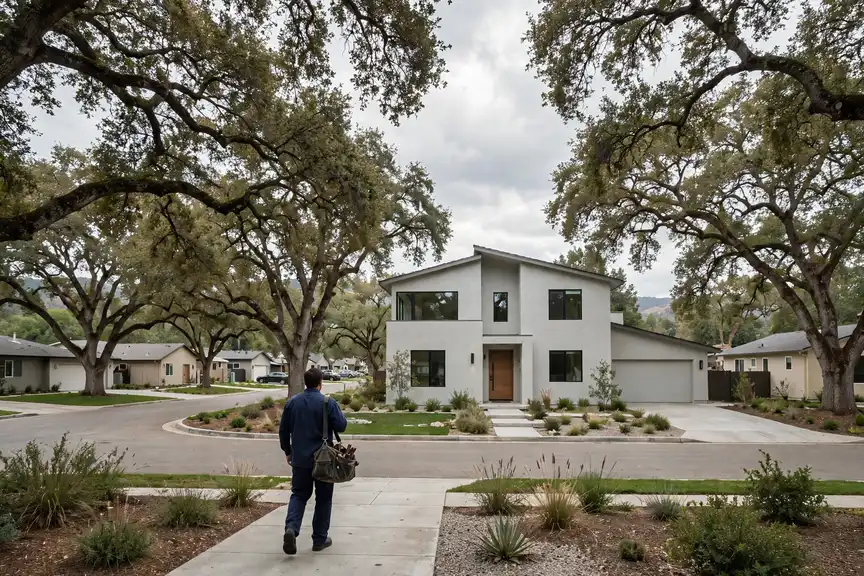


This is Sacramento's plumbing page, built from Sacramento's own numbers: Census housing figures, the metro's ZIP codes and its NOAA climate record. PlumbReach USA routes your call to an independent local plumber; the homework below is here so you know your home's likely problems before you ever make it.
Call center hours: Mon-Fri 7:00 AM-10:00 PM ET | Sat 8:00 AM-10:00 PM ET | Sun 7:00 AM-9:00 PM ET
The median Sacramento home was built in 1983; 44.6% of the stock predates 1980, and the pattern this metro's own data ranks first is galvanized pipes at the end of their life. PlumbReach USA is a referral service, not a plumbing company: one call connects you with an independent local plumber serving your ZIP code.
Two numbers frame everything that follows: 62.5% of Sacramento homes are owner-occupied, and the median one was built in 1983. Ownership matters to plumbing because owners inherit their systems whole — every material decision a builder made in the 1980s or earlier is still in the walls, ageing on its original schedule. With 44.6% of homes predating 1980 and 25.1% arriving since 2000, the metro is really two housing stocks sharing one map, and they are taken separately below before the problems are ranked.
There is a materials timeline buried in Sacramento's housing figures, and it reads like a plumber's diary. The 159,815 homes from before 1960 were drained in cast iron or clay and supplied, in many cases, in galvanized steel. The 261,945 that followed between 1960 and 1979 mixed those materials with early copper. Then came the 286,532 homes of 1980-1999, plumbed increasingly in copper and early plastics. Each band of that timeline is now a band of characteristic failures, arriving in the order the materials tire — which is why a home's build year, in this metro, is the single most predictive fact about its plumbing.
The growth side of the metro tells the opposite story in the same language. Elk Grove, Roseville and the subdivisions still filling in account for much of the 237,358 homes built since 2000 — plastic supply lines, plastic drains, cartridge fixtures, slab foundations. Their plumbing is not old; it is uniform, which creates its own calendar: everything installed in the same boom reaches each wear point in the same years, from the first water-heater replacements to the first slab-leak scares, while 1,576 cooling degree days of annual heat keep demand on the system high.
The weather's part in this is written at SACRAMENTO 5 ESE, CA US, where an average year carries 19.2 inches of precipitation, 89.9 days at ninety degrees or more and 4.0 nights at freezing or below. Pipes experience that year as workload and as hazard in roughly equal measure — the workload in the heater's cycle count and the drains' burden, the hazard in the exposed runs and the swelling soil. The problem ranking further down is simply the housing profile above, read under this sky.
Housing eras and climate, joined — the two datasets every section of this page is built from.
Break the stock down by building era and the profile sharpens. Before 1960: 16.9% of homes, roughly 159,815 of them. From 1960 to 1979: 27.7%, about 261,945. From 1980 to 1999: 30.3%, about 286,532. Since 2000: 25.1%, about 237,358. Four eras, four material palettes — and the balance among them is this metro's plumbing character in a single paragraph.
The 1980-1999 band runs this metro, and its plumbing has a particular flavour: mature but not ancient. Copper systems old enough to have histories, plastic drains still in their prime, fixtures from the first cartridge generation reaching their wear points in waves, heaters cycling through replacements on a schedule set by whole subdivisions. Sacramento's is a maintenance-era stock — the decades where attention compounds and neglect starts to invoice.
Close behind the leader come the 1960-1979 homes, 27.7% of the stock. Their plumbing is mid-change by construction — the decades when materials swapped over mid-stream — so this band is where a Sacramento plumber earns the diagnostic fee: pressure tests and camera runs that say which side of the transition a given house was built on.
The climate half of the profile, from SACRAMENTO 5 ESE, CA US: 2,138 heating degree days against 1,576 cooling degree days, 19.2 inches of precipitation, an average temperature of 63.4 degrees. Read together, those figures describe the loads: how hard heaters cycle, how often the soil around buried lines swells and shrinks, and how much of the year exposed pipework spends anywhere near freezing — 4.0 nights at or below it, against 89.9 days at 90 or above.
That is the whole method of this page in one section: era shares from the Census, loads from NOAA, and a problem list that is simply where the two overlap most in Sacramento. The services and guidance that follow are ordered by the same profile — local first, generic last.
Selected and ranked from this metro's housing-age profile and climate record — not copied from another city's page.
Galvanized steel pipe was plumbed into millions of homes, and it ages in a particular way: the zinc coating gives out, the steel rusts, and the rust grows inward until the pipe that once carried a full stream is choked to a fraction of its width. With a median build year of 1983 and 44.6% of its homes predating 1980, Sacramento has a large stock of housing in the galvanized era, and its symptoms are the classic ones — pressure that has faded a little more each year, water that runs rusty after the house sits quiet overnight, and leaks that begin appearing at joints. No cleaning reverses this; the corrosion is the pipe itself converting to rust. The judgement call is timing. A galvanized system with one small leak and acceptable pressure can be repaired and watched. A system leaking in several places, with pressure dropping across every fixture, is telling you the material has finished its service life, and each repair buys a shorter quiet interval than the last. Repiping in PEX or copper replaces the whole question with a new system and restores the pressure the home was built with.
Galvanized pipe fails politely, which is precisely the problem. No flood, no drama — just a shower that weakens across years, a washing machine that fills slowly, water that blushes rust after holidays. Households adapt without noticing, the way you adapt to a dimming bulb. The 261,945 homes built in this metro between 1960 and 1979 stand in the front of that queue now, their original steel bores narrowed to drinking-straw width in the worst runs. The fix, when it comes, tends to astonish people — not with its scale, but with the pressure they had forgotten they were owed.
The replacement side of the ledger is equally local: when a Sacramento home of the galvanized era is sold, inspected or renovated, the supply lines are among the first systems examined — because everyone in the local trade knows the material's age here. A pattern the whole market has learned to look for is not an anecdote; it is the metro's housing data wearing a tape measure.
Between the house and the street connection sits the lateral — the home's own stretch of sewer line — and it is the homeowner's responsibility, which surprises many people the first time it fails. In Sacramento, where 16.9% of homes were built before 1960 and the median home dates to 1983, laterals have been in the ground through decades of soil movement, root growth and material ageing. Clay joints shift and open, older pipe bellies where bedding has washed out, and a line can lose its clean fall to the street, so waste slows, settles and eventually blocks. The signs are house-wide rather than fixture-specific: several drains slow together, the ground-floor fixtures act up first, and cleanings help for shorter and shorter stretches. A camera run down the lateral settles the argument about what is happening — it measures the damage by distance, shows whether it is one bad joint or the whole story of the line, and lets the repair be sized to the actual problem instead of the whole run by default.
A lateral gives decades of silence and then a short conversation. The conversation usually starts with the ground-floor drain in the house and escalates through the cleanout to the camera — and the camera's footage settles every argument about whether the line is blocked or broken. Across Sacramento, the laterals entering that conversation now are the ones buried when the metro's median home went up, in 1983. They were built to outlast their mortgages, and they have; the question the footage answers is how much further the same pipe can honestly be asked to go.
Think of the laterals as a hidden census: 945,650 lines, one per home, the oldest of them — serving the 159,815 pre-1960 homes — now in their seventh decade underground. They age in soil that moves with Sacramento's seasons, and their condition surfaces only as symptoms inside the house, which is why so many are discovered late.
Time is unkind to cast iron below ground. The pipe that carried this metro's post-war growth was laid with a working life in mind, and the calendar has now passed it: the inner wall sheds its lining in flakes, rust blooms narrow the bore, and the rough surface that remains catches everything the household sends down. Flow fades first — a tub that empties slower each year — then the failures arrive: a section that gives way under the yard, a joint that weeps into the soil. Where the metro's housing is oldest, this is not an edge case; it is the standard condition of the stock, arriving street by street as each neighbourhood's pipes reach the same age together. The camera distinguishes rust from roots from collapse, and that distinction sets the job.
There is a temptation to judge an old drain by its kindest day. On its kindest day it still clears, still serves, still seems to argue for another year. Judge it instead by its trend: clearings that come closer together, a tub that drains slower each season, a smell that returns after rain. In the 159,815 pre-1960 homes across this metro, that trend is the pipe's biography being read aloud — corrosion does not pause between visits, and the homes that fare well are the ones whose owners believed the early chapters.
The historical record is the evidence: iron was the default drain material for the whole era that built this metro's core, and the Census counts that era's survivors home by home — 159,815 of them. Camera surveys in those districts confirm the arithmetic often enough that the pattern's ranking here is the least speculative thing on this page.
A root system is patient and it is thirsty. It finds the joints in a buried drain line — the small gaps where sections meet, exhaling moisture vapour — and sends in hair-fine roots that thicken on the water and the nutrients the line carries past them. Year by year the mass grows until it is a net across the pipe, catching paper and grease, slowing the flow, gurgling its warning through the ground-floor fixtures. Mature streets grow mature trees, and the drains beneath them were jointed by hand; the two facts together write this metro's share of the problem. Cutting the roots restores the line for a season or several; a joint the roots have forced open is a repair, and the camera tells one from the other.
Roots do not break into pipes; they are invited in. A joint in a clay or cast iron line breathes out a trace of moisture vapour, and a nearby tree's root hairs — which exist to find exactly that signal — grow toward it and through any gap the joint presents. Inside the pipe the roots find water and nutrients year-round, so they thicken, branch, and begin to trap everything the household sends down: paper, grease, solids. The first symptom is usually a slow main line that clears and returns on a cycle, because a cable can shred the root mass but cannot remove the joint it entered through. The pattern is seasonal in its own way — roots grow hardest in spring — and it belongs to streets where trees and jointed pipes have shared the same ground for decades, as they have across much of Sacramento.
The metro's own canopy is the co-defendant: established neighbourhoods pair mature street trees with jointed clay and iron laterals of the same vintage. Root calls concentrate exactly where those two maps overlap — a correspondence visible in any local plumber's records and predictable from the Census-era map of the older districts.
A tank heater is a vessel that cooks its own lining. Every heating cycle precipitates minerals out of the water, and they settle on the tank floor as sediment — an insulating blanket that makes the burner or element work longer, rumbling as steam pockets form and collapse beneath it. Meanwhile the anode rod, installed to be corroded in the steel's place, quietly spends itself. When it is gone, the tank itself is next. The pattern is universal, but the pace belongs to the local water and the local climate: the harder a metro heats and the more hot water its households draw, the sooner the rumble, the rust-tinged water and the puddle at the base arrive to announce the end of a heater's service.
Recovery time is the number that runs a household's mornings, and it is the first thing sediment steals. A tank rated to serve a family when new delivers less hot water per heating cycle every year as the sediment layer thickens and the burner's work goes into heating rock instead of water. In Sacramento, where summer demand piles showers, laundry and dishwashing into the same hours, that slow decline shows up as a household quietly rationing hot water without ever deciding to. Flushing the tank returns some of it; a spent anode and a rumbling, scaled tank are the signs the decline has become structural, and the conversation turns to replacement.
The demand side, from the Census: 876,004 households, most heating water daily, in a metro where the hot season runs long and the cold snaps are sharp. Appliance populations that large, worked that hard, fail on a distribution — and the distribution's peak is what a ranking like this one is measuring.
In the wet months the ground itself becomes a plumbing component: saturated soil pressing on every buried joint, groundwater finding every imperfect seal, sump and drain alike working at capacity. The pattern of calls shifts underground — laterals, cleanouts, the ground-floor fixtures in the house reporting what the soil is doing. Homes on the older streets feel it first, because their lines have the most joints per mile for the water to argue with.
An average year brings Sacramento 19.2 inches of precipitation, and the wet months deliver most of it. Saturated soil is the season's plumbing fact: it presses on every lateral joint in the metro's older ground, and the ground-floor fixtures in Sacramento and the low districts report the result first.
Where this problem lives in Sacramento, it lives street by street. The galvanized went in by the subdivision, not by the house — one builder, one material, one decade — so the streets around Sacramento that filled in during the post-war decades are ageing out of their supply pipe in formation. That formation is visible in the call pattern: a street produces its first repipe, then its third, then a run of them, as neighbours compare notes over fences. The homes on the newer side of the metro will meet different materials at different ages; for the galvanized districts, the decade of decision is the present one.
Strip the pattern down to its inputs and the ranking stops being mysterious: 876,004 households drawing on systems installed across a median build year of 1983, in a climate that swings between 89.9 days of serious heat and 4.0 freezing nights. Whatever pattern a metro with those inputs manufactures most, it manufactures here — the lead position is less a title than a consequence, recalculated from the same public records any sceptic can check.
On a first visit for this pattern, a local plumber's checks run in a practised order:
Sequenced by this metro's own problem ranking, not by a national catalogue order.
One leak is an event; three in a year is a verdict. Pipe work weighs that pattern — the metal's age, the water's behaviour, the repair history — and either fixes the section in front of it or proposes the honest larger job: a whole-house repipe that ends the rhythm for good.
Walk the older streets of Sacramento with a plumber and you will hear the housing stock dated by its pipework: galvanized behind this wall, copper of a certain vintage there, a repipe already done on the corner house. The metro's median build year of 1983 means that dating game works on half the homes in the metro. What decides any individual home's path is not the street's average but the evidence inside its own walls — pressure at the fixtures, the water's colour after a quiet weekend, the count of repairs already made. The assessment is short; the conclusion follows from it. Ask in Arden-Arcade and the answer rhymes with Sacramento: same eras, same materials, same calendar of failures.
Pipe work divides by era in this metro with unusual neatness: renewal conversations in the 421,760 pre-1980 homes, sectional repairs in the middle ring, and near-silence from the 237,358 post-2000 homes whose lines are still young. A call from Elk Grove can sit in any of the three bands; the home's build year says which before the door opens.
One local habit worth copying: Sacramento homeowners who mention their street's building era when they book get a better-matched visit, because a plumber heading to a the 1980s home in El Dorado County loads different parts than one heading to a slab-built subdivision in Elk Grove. The service is the same; the preparation is local.
The sewer line is the one pipe every other pipe depends on. When it bellies, cracks or fills with roots, the whole house feels it through its ground-floor fixtures. Repair ranges from sectional fixes through a cleanout to full replacement, chosen from camera footage rather than guesswork.
Consider the lateral as the home's only road out: every drain, every flush, every appliance discharge travels it. In Sacramento's older districts that road was built generations ago, in sections, and it has been subsiding, rooting and corroding on its own schedule ever since. The sewer visit surveys the road before recommending anything — its material, its slope, where it is broken versus merely blocked — because the remedies differ by an order of magnitude and the footage, not the symptom, is what separates them. A cleared symptom on a broken road is a postponement, and local plumbers here give their advice accordingly: honestly, from the camera's evidence. The SACRAMENTO 5 ESE, CA US record — 2,138 heating degree days, 1,576 cooling — is the backdrop El Dorado County plumbers plan around.
Under Sacramento lie 945,650 laterals, one per housing unit, and the oldest of them — beneath the 159,815 pre-1960 homes — have been underground since the metro was a fraction of its present size. The camera diary in Arden-Arcade and the old core is written by that buried generation.
Where this service gets booked in Sacramento follows the map on this page: the older districts generate the deep-end work, the post-2000 subdivisions the wear-and-tear work, and the 286,532 homes in between split the difference. Telling the call center your home's build decade — most Sacramento owners know it within a few years — puts the right kit on the van the first time.
The water heater is the hardest-working appliance in the house and the least observed. It cycles through every shower, wash and rinse, accumulating sediment with each firing, until its decline announces itself in the household's most intimate routines: the shower that fades, the rumble from the closet, the rust at the tap. Service reads the tank's age, its sediment and its anode, and separates the heaters with years left from the ones living on borrowed time.
The heater fleet in Sacramento was not installed one household at a time; it arrived with the subdivisions, street after street of identical tanks set in the same season. That is why replacement calls arrive in neighbourhood waves, and why an experienced local plumber can guess a tank's age from the street it stands on. The servicing side respects the same pattern: sediment from 1,576 cooling degree days of hard cycling, anodes spent on the metro's water, thermostats drifting — each fixable alone, but together the biography of a unit deciding, this year or next, whether it is a repair or a replacement. It is why two Sacramento homes of the same age, on different streets, so often need the same visit in the same year.
The arithmetic behind the diary: 876,004 households heating water through 1,576 cooling degree days and 2,138 heating degree days a year — every one of those households a tank ageing on the same climate's schedule, from the pre-war homes to the newest builds around Folsom.
In Sacramento this service is booked most often through the problem patterns at the top of this page — the metro's housing data, not habit, sets the order. If your home is in the 44.6% built before 1980, mention its age on the call: it changes the parts the plumber loads before heading to Sacramento and the rest of the metro.
Emergencies in Sacramento are answered by local independents, not a dispatch centre: PlumbReach USA routes the call, and the stock it serves — 945,650 homes across 126 ZIP codes — is the stock this page profiles.
Drain work in Sacramento splits by era: the 421,760 pre-1980 homes drain through older materials, the post-2000 subdivisions through plastic — and the local plumber reads the cable's return to tell which world your street drains through.
The meter test starts it in Sacramento as everywhere; what follows is local — knowing which of El Dorado, Placer, Sacramento, Yolo' eras hide lines in slabs, which in crawl spaces, and where the soil movement at SACRAMENTO 5 ESE, CA US's record makes joints let go.
In Sacramento, a toilet that runs all night is a water bill with a sound; the local service replaces the tired internals and checks the flange and supply while the tank is open.
In Sacramento the faucet call is often the first plumbing visit a newer home ever gets — the professionals routed here treat it as an introduction: the fixture fixed, and the home's shutoffs and heater age noted for the record.
There is a plainer way to say what this page's ranking means in practice: most calls in Sacramento are two calls. The first answers Galvanized pipes at the end of their life; the second answers ageing sewer laterals. Between them they account for the shape of a local plumber's week here — the districts visited, the parts stocked, the diagnoses made fastest because they are made most often. The remaining services divide the rest of the diary among them, essential but episodic, the supporting work around two leading patterns.
 PROBLEM
 SOLUTION
Population 524,802
Population 177,221
Population 152,438
Population 96,319
Population 87,036
Population 82,140
Population 80,656
Population 78,070
Population 72,340
Population 66,801
Population 61,256
Population 54,496
Also in the Sacramento metro: Lincoln (population 51,629), El Dorado Hills (population 50,553).
Beyond Sacramento itself, the metro takes in Elk Grove (177,221 residents), Roseville (152,438) and the rest of the communities in the grid above — each plumbed in its own building era, which is why two streets in the same metro can need entirely different plumbing conversations. The ZIP list below is the full coverage footprint: if your code is on it, this page was written about your housing stock.
Also on the Sacramento map: Arden-Arcade (96,319), Citrus Heights (87,036), Folsom (82,140), Rancho Cordova (80,656), Carmichael (78,070) — communities spread across El Dorado, Placer, Sacramento, Yolo, each with housing from its own growth years. A plumber routed through PlumbReach USA to any of them is working from this same page: the metro data does not change at the city limit, but the housing on your street — its age, its materials, its soil — is what the visit is really about.
Every metro has a first city and a supporting cast, and the census figures draw the billing plainly here: Sacramento first, with 524,802 residents; Elk Grove second at 177,221; Roseville third at 152,438; then the long tail of smaller communities in the grid above. The billing matters less than the building dates — each of these places was plumbed in its own decade, by its own builders — but between them they account for nearly every housing era, material and failure pattern this page describes.
Administratively the metro is drawn from El Dorado, Placer, Sacramento, Yolo — 4 in all — with El Dorado County at its centre. County lines do not change pipe physics, but they do shape the paperwork around the work: permits, inspections and code details are county and city business, which is one reason the professional who serves your street is a local one.
Three neighbouring coverage areas begin where this one ends: Yuba City, CA, some 35 miles off; Vallejo, CA, 55 miles; and Stockton, CA, 56 miles. Each keeps its own page because each keeps its own numbers — a different median build year, a different climate station, a different problem ranking. Boundary households should trust the ZIP list over the map: the code, not the compass, assigns the dataset.
Set Sacramento among its neighbours and the contrasts sharpen the profile: Yuba City, CA — metro population 187,478, median build year 1983 — sits 35 miles away; Vallejo, CA (455,376, median 1982) 55 miles; Stockton, CA (823,815, median 1983) 56 miles. Three different housing stocks under three nearby skies, which is why each keeps its own page and its own problem ranking rather than borrowing this one.
Divide the stock by the map and the densities appear: roughly 7,505 housing units for every covered ZIP code, 219,001 households to a county, 14 named communities in the grid. The balance between the generations reads 1.8 pre-1980 homes for every home built since 2000 — a single ratio that quietly predicts whether a metro's plumbing week leans toward renewal work in the old districts or first-generation upkeep in the new ones.
The Sacramento record in one line — median home age: 43 years · owner-occupied homes: 547,502 · renter-occupied homes: 328,502 · pre-1960 homes per covered ZIP code: 1,268 · heating-to-cooling degree-day ratio: 1.36 · average rainfall: 488 mm a year.
Before an emergency, read the guide: How to shut off your home's water main
One call connects you with an independent local plumbing professional serving Sacramento and the surrounding metro.
Call center hours: Mon-Fri 7:00 AM-10:00 PM ET | Sat 8:00 AM-10:00 PM ET | Sun 7:00 AM-9:00 PM ET