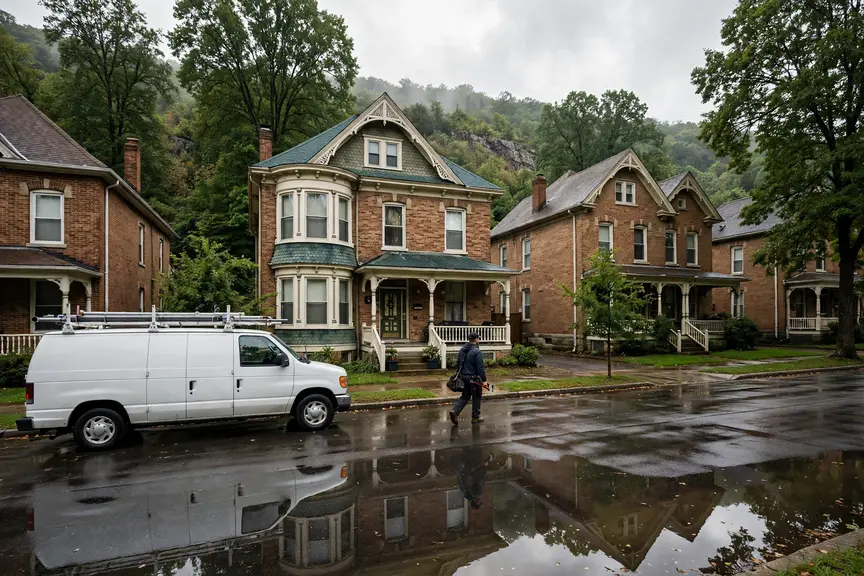


PlumbReach USA connects Reading homeowners with independent local plumbers. This page is built from the metro's own Census housing data, ZIP codes and climate record — the plumbing problems described here are the ones Reading homes actually have.
Call center hours: Mon-Fri 7:00 AM-10:00 PM ET | Sat 8:00 AM-10:00 PM ET | Sun 7:00 AM-9:00 PM ET
The median Reading home was built in 1968; 63.6% of the stock predates 1980, and the pattern this metro's own data ranks first is ageing cast iron sewer lines. PlumbReach USA is a referral service, not a plumbing company: one call connects you with an independent local plumber serving your ZIP code.
Start with the raw material: 429,989 people, 171,147 housing units, and a housing stock whose middle home was built in 1968. That single date organises everything on this page. On one side of it stand the older districts — 43.0% of homes predate 1960, 63.6% predate 1980 — plumbed in galvanized steel, cast iron and clay, in homes across Berks that have been repaired piecemeal for decades. On the other side, the 14.3% built since 2000 run plastic lines under slabs, and fail in the newer ways. A Reading plumber reads a home's build year the way a doctor reads a chart: it predicts, before a single wall is opened, which systems deserve suspicion first.
There is a materials timeline buried in Reading's housing figures, and it reads like a plumber's diary. The 73,593 homes from before 1960 were drained in cast iron or clay and supplied, in many cases, in galvanized steel. The 35,256 that followed between 1960 and 1979 mixed those materials with early copper. Then came the 37,823 homes of 1980-1999, plumbed increasingly in copper and early plastics. Each band of that timeline is now a band of characteristic failures, arriving in the order the materials tire — which is why a home's build year, in this metro, is the single most predictive fact about its plumbing.
The growth side of the metro tells the opposite story in the same language. Wyomissing, Blandon and the subdivisions still filling in account for much of the 24,474 homes built since 2000 — plastic supply lines, plastic drains, cartridge fixtures, slab foundations. Their plumbing is not old; it is uniform, which creates its own calendar: everything installed in the same boom reaches each wear point in the same years, from the first water-heater replacements to the first slab-leak scares, while 1,056 cooling degree days of annual heat keep demand on the system high.
The weather's part in this is written at READING SPAATZ FLD, PA US, where an average year carries 45.21 inches of precipitation, 23.8 days at ninety degrees or more and 107.1 nights at freezing or below. Pipes experience that year as workload and as hazard in roughly equal measure — the workload in the heater's cycle count and the drains' burden, the hazard in the exposed runs and the swelling soil. The problem ranking further down is simply the housing profile above, read under this sky.
Two public records, one metro: what was built here, and what the sky does to it.
Lay the eras side by side instead: 43.0% pre-1960 (73,593 homes), 20.6% from 1960-1979 (35,256), 22.1% from 1980-1999 (37,823), and 14.3% since 2000 (24,474). No single era tells the story — the proportions among them do, and those proportions are different in every metro this site covers.
This is, by the numbers, an old-system metro. The largest slice of its housing predates 1960, which means the typical serious job here involves materials in their seventh decade or beyond: drains of cast iron or clay, supply runs in galvanized steel, laterals laid when the streets themselves were young. The newer bands exist — the growth since 2000 is real — but they are the supporting cast. Reading's plumbing identity was fixed by its earliest builders, and its problem list is written in their materials.
Second in the table, the 1980-1999 band: 37,823 homes, 22.1% of the metro. Its systems are mature rather than ancient — copper in its pinhole years in places, plastic drains still sound, first-generation cartridges wearing out in waves — and its plumbing is the schedulable kind: work that rewards being booked before it becomes urgent.
Translate the climate record into plumbing terms and it comes out as three working conditions. Condition one, the freeze count — 107.1 nights a year when exposed water can solidify and split its container. Condition two, the heat count — 23.8 days that load drains, heaters and tempers simultaneously. Condition three, the water itself: 45.21 inches of it arriving from the sky to move the soil around every lateral in the metro. Reading's systems are engineered, installed and aged inside those three conditions, and their failures carry the conditions' fingerprints.
A profile is only useful if it predicts something, and this one predicts the shape of a plumbing diary in Reading: which streets will call about drains, which about pressure, which about heaters, and in which months. Everything after this section is that prediction written out as services, problems and answers — the numbers first, the narrative second, the way the evidence actually runs.
Ordered by what this metro's data says its homes need most.
A house can survive a lot of plumbing faults, but not a failed path to the street. Sewer services confront the lateral directly — inspected by camera, cleared where clearing suffices, excavated and renewed where the pipe has structurally given up. The footage, shown to the homeowner, is the basis of every recommendation.
The sewer lines under Reading are as old as its oldest streets. 43.0% of homes here were built before 1960, when clay and cast iron were the standard materials, and those lines have now carried sixty-plus years of service under soil, roots and traffic. The failures cluster where the trees are mature and the pipe is jointed — the established neighbourhoods around Reading and the historic core — because roots have had the most years to find the joints. A camera run tells the truth about any given line: how much is scale and roots that cleaning can handle, and how much is a pipe at the end of its story. In Reading that holds across 51 ZIP codes, from Reading out to Blandon.
Sewer demand follows the founding map: the districts built first, around the old centre and out through Wyomissing, hold the jointed clay and iron; the growth rings hold plastic with decades in hand. 43.0% of the metro's homes stand on the founding side of that line, which is why the footage here so often shows a pipe at the end of its story.
Pipes age by material: galvanized chokes with rust, copper pits into pinholes, early plastic turns brittle. Repair answers the isolated failure; repiping replaces a system whose failures have become a rhythm, rerunning supply lines in modern material while the house stays liveable around the work.
The repiping conversation in Reading starts with its housing data: median build year 1968, 63.6% of homes from before 1980, and whole districts plumbed in materials that are now at or past their expected service lives. Galvanized lines in the older neighbourhoods have been narrowing from the inside for decades; the symptom homeowners notice — pressure fading year by year — is the pipe's inner diameter closing. One pinhole in that stock is an event; the third is a pattern, and the plumbers who work Reading and the older core will say so plainly rather than sell a fourth repair. That is the daily reality for the 161,701 households spread across Berks.
The repair-or-renew caseload is set by one figure above the rest: 63.6% of Reading homes predate 1980, plumbed in the materials now at the end of their service lives. Around Shillington (5,462 residents) as in the old core, that percentage is not an abstraction — it is the street's plumbing, house by house.
One call from anywhere in the Reading metro — from Reading out to Shillington — routes to the local professional on cover; the failure patterns they expect first are the ones this page's data ranks.
Across Berks, drain calls follow the building map: iron and clay near the old core around Reading, plastic at the growth edge — one service, two different crafts, both covered by the routing on this page.
In a metro of 171,147 homes with a median build year of 1968, water heaters fail in waves as whole streets age together — the plumbers serving Berks stock and schedule for exactly that pattern.
Leak detection in Reading is instrument work over local knowledge: acoustic and thermal tools, aimed first at the districts this page's data flags — the pre-1980 stock and the slab tracts out toward Blandon.
Running, rocking or refusing — in Reading the diagnosis is the same short sequence: fill valve, flapper, supply line, flange. The plumbers routed here carry the internals for the fixtures this metro's eras installed.
Fixture work in Reading divides by era like everything else on this page: washer-era taps in the older districts, cartridge internals in the post-2000 subdivisions — the local plumber stocks for both.
If this page's services were ranked by Reading's call patterns rather than listed in catalogue order, they would come out much as they do here — because the ranking behind them is data, not habit. Ageing cast iron sewer lines leads the metro's problem table and galvanized pipes at the end of their life follows, so the services answering them lead the list. The long tail of a metro's plumbing life — fixture failures, toilet calls, the single unexplained leak — fills in the diary around them, here as everywhere.
Chosen by this metro's own housing and weather data — the same two records this whole page is built from.
Ask a cast iron drain how it is doing and it answers at the ground-floor fixture in the house. That is where a failing main shows itself first — the ground-floor bath that gurgles, the basement drain that sighs up odours — because everything above drains through the same tired run. In Reading, the homes reporting those signals share a profile: built when cast iron was the default, in the streets around Reading that went up first. The pipe underground is rough now with scale, its bore narrowed, its joints weeping into the soil — and the fixtures upstairs are merely its messengers.
There is a temptation to judge an old drain by its kindest day. On its kindest day it still clears, still serves, still seems to argue for another year. Judge it instead by its trend: clearings that come closer together, a tub that drains slower each season, a smell that returns after rain. In the 73,593 pre-1960 homes across this metro, that trend is the pipe's biography being read aloud — corrosion does not pause between visits, and the homes that fare well are the ones whose owners believed the early chapters.
Put a number on it locally: roughly 73,593 homes in the Reading metro were built before 1960, when cast iron was the default drain material — and cast iron installed then has now been underground for six decades or more. Not every one of those lines has failed, and plenty test sound on a camera, but the population of pipes at risk here is counted in the tens of thousands of homes, which is why this pattern sits where it does on this page.
The galvanized story can be told at a single tap. Open the fixture farthest from the meter in a Reading home still on its original steel and watch the stream: respectable for a moment, then thinning as the narrowed runs upstream ration the flow. That rationing is the material's old age made visible — decades of internal rust taxing every gallon. The metro holds 108,849 pre-1980 homes, and in the ones never repiped, the tax rises yearly. Unlike most plumbing failures, this one is perfectly forecastable: the tap has been reporting it, patiently, for years.
Galvanized pipe fails politely, which is exactly the problem — it gives a household years of small warnings that are easy to live with. The zinc coating that once protected the steel wears through, rust takes its place, and the rust grows inward like a narrowing artery. Flow to the farthest fixtures drops first. A shower that shares a line with a running tap loses its pressure. By the time the water itself runs discoloured after the house has sat quiet overnight, the narrowing is well advanced. None of this is a single emergency; it is a system reaching the end of its design life on schedule, and in Reading's pre-1980 neighbourhoods that schedule is arriving for whole streets at once, because the pipes went in together.
Count the exposure from the Census side: the metro's 108,849 pre-1980 homes were plumbed in galvanized's long reign, and the material's failure mode — internal rust, narrowing bore — is a matter of chemistry, not workmanship. The variable is speed; the direction, for every one of those systems still original, is settled.
Ice does its damage in silence and announces it in flood. The split forms under pressure while the line is frozen, holds while the ice plug seals it, and opens the moment the thaw restores flow — which is why burst pipes are so often discovered by sound: water running somewhere it should not be, in a house that was intact at breakfast. Reading's exposure sits where its housing does — in the older districts' unprotected runs and every era's additions and garages — and the repair visit's second job, after the pipe itself, is the insulation and routing that keep the same night from repeating.
The burst itself usually happens quietly, inside a wall or under a floor, during the coldest hours — but the flood waits for the thaw. Ice seals the split it made, and only when temperatures rise and the ice lets go does the water start moving into the house. That delay is why freeze damage so often greets a Reading household in the morning or on return from a trip away. It is also why the checks after a hard freeze matter: pressure oddly low, a meter turning with nothing running, a damp patch at a wall base. Catch the split at the weep stage and the repair is a pipe; catch it after the thaw and it is a room.
Two local numbers frame the risk: 107.1 nights a year at or below freezing at READING SPAATZ FLD, PA US, against a housing stock whose median home dates to 1968 — plumbed, much of it, before routing lines away from cold air was standard practice. Exposure is the product of those two numbers, and in this metro the product is large.
One pipe carries everything a house produces, and in the older half of this metro that pipe has been buried since the street was young. Clay sections shift as soil settles; cast iron scales inward; joints open by degrees. The lateral rarely fails all at once — it degrades into symptoms the household learns to live with: the slow drain blamed on the fixture, the gurgle blamed on venting, the cleanings that help for shorter and shorter stretches. Each of those is the lateral reporting its condition. When sewage finally backs up into the ground-floor tub, the line has usually been compromised for a long while, and the question the camera answers is how much of it: a section, or the whole run from house to main.
A lateral gives decades of silence and then a short conversation. The conversation usually starts with the ground-floor drain in the house and escalates through the cleanout to the camera — and the camera's footage settles every argument about whether the line is blocked or broken. Across Reading, the laterals entering that conversation now are the ones buried when the metro's median home went up, in 1968. They were built to outlast their mortgages, and they have; the question the footage answers is how much further the same pipe can honestly be asked to go.
Every one of the metro's 171,147 housing units drains through exactly one lateral, and in the older districts those laterals are as old as the streets above them. The pre-1960 share alone — 73,593 homes — represents that many buried lines in their seventh decade of service, under soil that shifts with Reading's wet and dry seasons. Most will never draw attention; the ones that fail announce themselves through the ground-floor fixtures first.
This is the season the metro's housing stock is examined by the weather, and the examination is practical: every exposed run, every unheated void, every shutoff nobody has tested. The failures arrive in batches behind the hardest nights and announce themselves at the thaw. The rest of the season grades the slower systems too — heaters working against the coldest incoming water of the year, laterals under frozen ground — but the headline the season writes, year after year, is the sound of water in a wall that should be dry.
Winter's load on this metro can be counted two ways: in the 107.1 freezing nights READING SPAATZ FLD, PA US records, and in the age of the housing that must withstand them — half of it built by 1968 or earlier. Neither number alone predicts a burst; multiplied together, they predict a season. Local plumbers plan their winter around that product, and households in the older districts do well to plan their autumn the same way.
There is a reason this pattern tops so many old-metro lists, and Reading holds the reason in bulk: iron was simply what drains were, for the whole first age of indoor plumbing. Every pre-1960 home still on its original line — and the Census counts 73,593 pre-1960 homes here — is running an experiment in how long buried iron can serve. The results arrive unevenly: one street's lines camera clean and sound, the next street's flaked to lace. That unevenness is why the deep-dive ends in a camera rather than a conclusion, and why two neighbours with identical houses can honestly need different work.
Strip the pattern down to its inputs and the ranking stops being mysterious: 161,701 households drawing on systems installed across a median build year of 1968, in a climate that swings between 23.8 days of serious heat and 107.1 freezing nights. Whatever pattern a metro with those inputs manufactures most, it manufactures here — the lead position is less a title than a consequence, recalculated from the same public records any sceptic can check.
Experienced local practice starts with the simple certainties — the observations that take minutes and decide the most:
 PROBLEM
 SOLUTION
Population 94,836
Population 11,100
Population 7,546
Population 5,462
Population 5,406
Population 5,346
Population 5,090
Population 4,633
Population 4,537
Population 4,377
Population 4,288
Population 4,264
Also in the Reading metro: Laureldale (population 4,259), Kutztown University (population 4,225).
Read the grid as a building programme spread over a century. The oldest communities sit where the metro began; the youngest are still adding streets at its edge; and Wyomissing and Blandon, with 11,100 and 7,546 residents, stand for the rings in between. Each ring plumbed in its era's materials, and each is now failing, wearing or holding in its era's characteristic order. The ZIP codes below draw the coverage boundary; the eras inside it draw everything else on this page — the problems ranked, the services ordered, the checks advised.
Beyond the largest communities sit Shillington (5,462), Pennside (5,406), Whitfield (5,346), Birdsboro (5,090), Lorane (4,633) — smaller places across Berks, covered on the same terms. Their housing tends to be older on average than the big suburbs', and their calls follow the older patterns on this page. One routing covers them all: find your ZIP code below and the rest is a phone call.
The metro's weight is not evenly spread. Reading holds 94,836 of the 429,989 residents; Wyomissing and Blandon add 11,100 and 7,546; and the remainder scatters across the smaller places above, some no bigger than a few thousand people. Plumbing follows the weight — most calls come from where most homes are — but era matters more than size: a small community of 1960s housing generates older-system work than a large new subdivision does.
Administratively the metro is drawn from Berks — 1 in all — with Berks County at its centre. County lines do not change pipe physics, but they do shape the paperwork around the work: permits, inspections and code details are county and city business, which is one reason the professional who serves your street is a local one.
This page ends at the metro boundary, but the region does not: Lebanon, PA, Lancaster, PA and Allentown, PA continue the coverage in their own directions, each with a profile built from its own Census and NOAA figures. If your home sits near the line between metros, go by your ZIP code — it places you in the dataset that describes your housing.
The region around Reading is a set of variations on its theme: Lebanon, PA, 28 miles off, runs a median build year of 1971 on a metro population of 146,380; Lancaster, PA (31 miles) medians 1977 on 563,159; Allentown, PA (38 miles) medians 1970 on 887,615. Nearness is not sameness — a few decades of median build year separate their plumbing as surely as the miles separate their maps.
Divide the stock by the map and the densities appear: roughly 3,356 housing units for every covered ZIP code, 161,701 households to a county, 14 named communities in the grid. The balance between the generations reads 4.4 pre-1980 homes for every home built since 2000 — a single ratio that quietly predicts whether a metro's plumbing week leans toward renewal work in the old districts or first-generation upkeep in the new ones.
Reading by the derived numbers — median home age 58 years · owners in 114,808 homes, renters in 46,893 · each covered ZIP code carrying about 1,443 pre-1960 homes · a heating-to-cooling degree-day ratio of 4.86 · 1,148 mm average annual rainfall.
Before an emergency, read the guide: How to shut off your home's water main
Describe the problem and the call center routes you to an independent local plumber who works in the Reading metro.
Call center hours: Mon-Fri 7:00 AM-10:00 PM ET | Sat 8:00 AM-10:00 PM ET | Sun 7:00 AM-9:00 PM ET