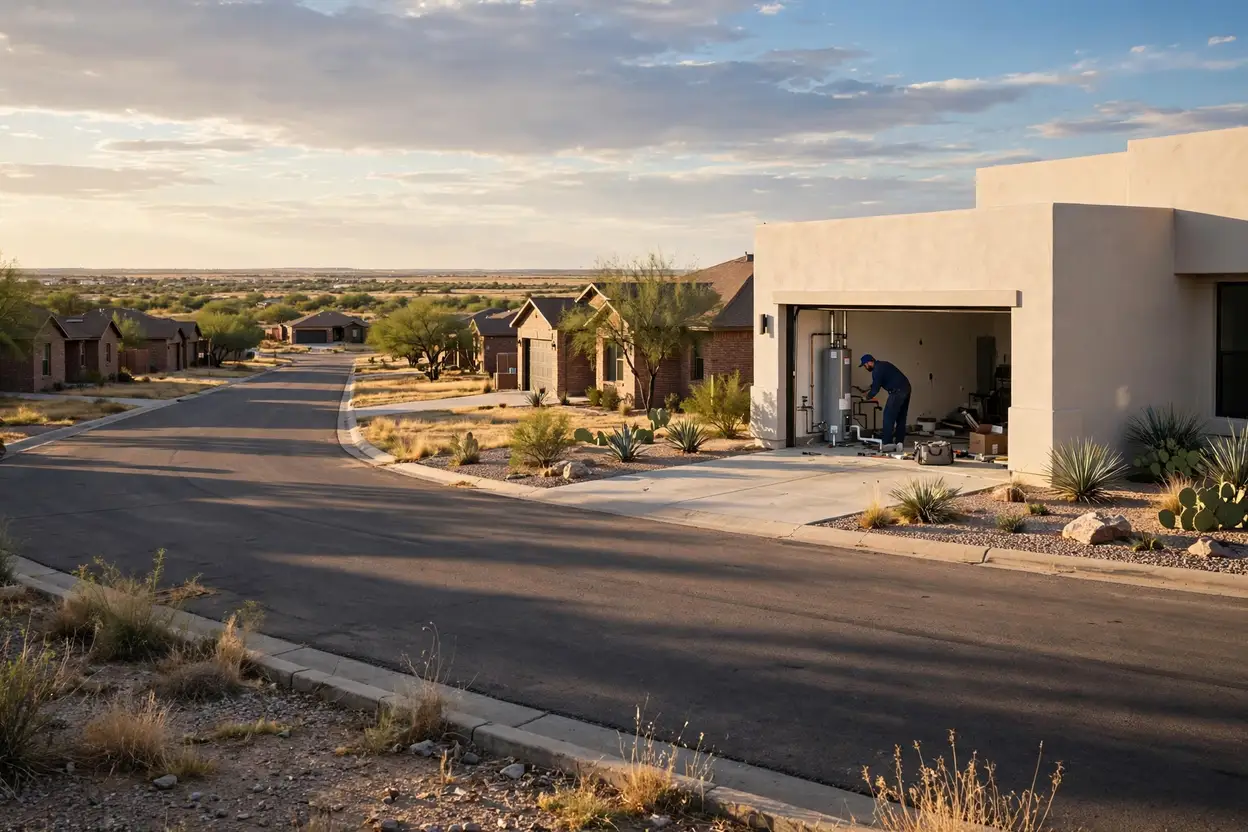


Everything on this page was computed for Odessa and nowhere else: the problem ranking from its Census housing profile, the seasonal risks from its NOAA station record, the coverage from its own ZIP codes. PlumbReach USA connects you to an independent local plumber; the page itself is the homework, done in public, so the call you make is an informed one.
Call center hours: Mon-Fri 7:00 AM-10:00 PM ET | Sat 8:00 AM-10:00 PM ET | Sun 7:00 AM-9:00 PM ET
The median Odessa home was built in 1981; 48.4% of the stock predates 1980, and the pattern this metro's own data ranks first is ageing cast iron sewer lines. PlumbReach USA is a referral service, not a plumbing company: one call connects you with an independent local plumber serving your ZIP code.
Two numbers frame everything that follows: 64.4% of Odessa homes are owner-occupied, and the median one was built in 1981. Ownership matters to plumbing because owners inherit their systems whole — every material decision a builder made in the 1980s or earlier is still in the walls, ageing on its original schedule. With 48.4% of homes predating 1980 and 26.3% arriving since 2000, the metro is really two housing stocks sharing one map, and they are taken separately below before the problems are ranked.
Stand in one of Odessa's older neighbourhoods and you are standing in its plumbing's back catalogue. The homes there — part of the 32,690 built before 1980 across this metro — went up when galvanized steel was a supply line, cast iron or clay was a drain, and a fixture was expected to serve for half a century. That half-century has now elapsed. What it leaves behind is not universal failure but universal exposure: every joint, valve and lateral in those districts is operating past the horizon its makers planned for, in Ector County and beyond, and the failures arrive in the order the materials tire.
The growth side of the metro tells the opposite story in the same language. Odessa, West Odessa and the subdivisions still filling in account for much of the 17,764 homes built since 2000 — plastic supply lines, plastic drains, cartridge fixtures, slab foundations. Their plumbing is not old; it is uniform, which creates its own calendar: everything installed in the same boom reaches each wear point in the same years, from the first water-heater replacements to the first slab-leak scares, while 2,478 cooling degree days of annual heat keep demand on the system high.
Over everything sits the weather, and here it is measured rather than described: NOAA's station at ODESSA SCHLEMEYER FLD, TX US averages 64.8 degrees across the year, with 114.9 days reaching 90 or more and 49.4 nights at freezing or below. A buried lateral feels that record as soil that swells and pulls away; a water heater feels it as an unbroken cycle count; an exposed line feels it on the single coldest night. The problem ranking below is what those numbers, crossed with the housing profile, produce for Odessa specifically.
Housing eras and climate, joined — the two datasets every section of this page is built from.
The distribution, in one breath: of every hundred Odessa homes, 22.5 were standing before 1960, 25.9 went up in the two decades after, 25.4 in the two after that, and 26.3 have arrived since 2000. Percentages flatten the picture, so hold the counts beside them — 15,197 oldest-era homes, 17,764 newest — and the metro's plumbing stops being an abstraction: it is that many systems, of those ages, failing in that order.
New-stock metros have their own signature, and Odessa has it in full: most homes built since 2000, most systems young, most plumbing work a matter of waves — the heater wave, the cartridge wave, the first slab questions — arriving street by street as identical subdivisions age in lockstep. The older pockets still produce the deepest single jobs, but the metro's plumbing centre of mass sits in its newest postcodes, and every year the waves get closer together.
Close behind the leader come the 1960-1979 homes, 25.9% of the stock. Their plumbing is mid-change by construction — the decades when materials swapped over mid-stream — so this band is where a Odessa plumber earns the diagnostic fee: pressure tests and camera runs that say which side of the transition a given house was built on.
A profile needs its climate column, and Odessa's comes from ODESSA SCHLEMEYER FLD, TX US: an average year of 64.8 degrees, built from extremes at both ends. The heating load (2,512 degree days) and the cooling load (2,478) together set the water heater's working life; the precipitation total (12.93 inches) sets the soil's behaviour around every buried line; the freeze count (49.4 nights) sets the exposure of every uninsulated run. Four numbers — and most of the metro's plumbing behaviour follows from them.
Hold the two halves together and the rest of this page explains itself: the problems ranked highest here are the ones where Odessa's dominant housing era and its climate record overlap. Change either dataset and the ranking changes — which is precisely why this profile is rebuilt from the records for every metro instead of carried over from the last one.
Selected and ranked from this metro's housing-age profile and climate record — not copied from another city's page.
Read a cast iron drain's age in its symptoms and the progression is orderly. First the line slows — not blocked, just reluctant, as scale roughens the bore and catches what passes. Then the complaints localise: one branch backing up, then another, as sections of the run reach their own stages of narrowing. In Odessa's oldest districts that progression plays out across whole streets of the 1980s housing at once, because the lines were laid in the same years from the same material. The camera distinguishes the stages house by house: a bore narrowed by scale that cleaning can restore, against a wall thinned and cracked past any cleaning's help.
Look inside an old cast iron line with a camera and the failure stops being abstract. The inner wall grows rough with tuberculation — rust nodules that narrow the bore and catch everything passing. The bottom of the run, where water and grit travel, thins fastest; the top can look sound while the channel below it is nearly through. Roots enter at joints and add their own blockage. A Odessa line of this vintage is therefore not one problem but a profile of problems along its length, and the repair that makes sense — cleaning, a section, a full replacement — is the one matched to the worst ten feet the camera finds, not the average of the whole run.
The historical record is the evidence: iron was the default drain material for the whole era that built this metro's core, and the Census counts that era's survivors home by home — 15,197 of them. Camera surveys in those districts confirm the arithmetic often enough that the pattern's ranking here is the least speculative thing on this page.
A lateral ages in the dark, at the pace of the ground around it. Soil creeps; bedding washes grain by grain toward the street; joints laid generations ago in Odessa's older districts step a fraction out of true and stay there, catching what the household sends down. Nothing about this is dramatic from inside the house — until the day the accumulated fractions add up to a line that no longer falls cleanly to the main. That day announces itself downstairs, at the ground-floor fixture, the way it always has: the private sewer reporting, at last, in public.
A lateral gives decades of silence and then a short conversation. The conversation usually starts with the ground-floor drain in the house and escalates through the cleanout to the camera — and the camera's footage settles every argument about whether the line is blocked or broken. Across Odessa, the laterals entering that conversation now are the ones buried when the metro's median home went up, in 1981. They were built to outlast their mortgages, and they have; the question the footage answers is how much further the same pipe can honestly be asked to go.
Think of the laterals as a hidden census: 67,542 lines, one per home, the oldest of them — serving the 15,197 pre-1960 homes — now in their seventh decade underground. They age in soil that moves with Odessa's seasons, and their condition surfaces only as symptoms inside the house, which is why so many are discovered late.
There is a diagnostic shortcut for galvanized systems, and it is a white bucket. Fill it at a tap after the house has sat quiet overnight: the first draw runs tea-coloured with the rust the lines have shed, clearing as fresh water arrives. It is a small experiment with a large meaning — the pipe's interior is dissolving into the water it carries. Across Odessa, homes plumbed in the galvanized decades run that experiment daily whether they look at the bucket or not. One home's result is a curiosity; the same result with falling pressure and returning leaks is the material's resignation letter.
Galvanized pipe fails politely, which is precisely the problem. No flood, no drama — just a shower that weakens across years, a washing machine that fills slowly, water that blushes rust after holidays. Households adapt without noticing, the way you adapt to a dimming bulb. The 17,493 homes built in this metro between 1960 and 1979 stand in the front of that queue now, their original steel bores narrowed to drinking-straw width in the worst runs. The fix, when it comes, tends to astonish people — not with its scale, but with the pressure they had forgotten they were owed.
The scale of it in Odessa: about 32,690 homes predate 1980, the decades when galvanized steel was plumbed into houses as a matter of course. Those lines have been corroding inward ever since, quietly and at different speeds — two houses on the same street in Midland can be years apart in symptoms, but they are reading from the same page of the same story.
The snap does not need to be long; it needs to be sharp. A fast fall through freezing catches the metro's exposed runs before households react — the bibb still connected, the crawl-space vent still open, the addition's lines still full. What follows is the familiar sequence: silence during the cold, water at the thaw, and a cluster of calls that maps precisely onto the oldest, least-protected plumbing in the metro. Between snaps, the season's other work continues — heaters straining against cold incoming water, drains carrying holiday loads — but the snap weeks are what this season is remembered for.
The older housing carries the exposure here: 32,690 pre-1980 homes across the metro, plumbed before freeze protection was routine, with runs in exterior walls and crawl spaces that modern construction routes through warm space. ODESSA SCHLEMEYER FLD, TX US's cold, when it comes to Odessa, hunts those runs down one by one.
The telltale geography here is generational. Cast iron under a Odessa street means the street predates the metro's plastic era — the blocks around Midland first, the early suburbs second, almost nothing built after the material left standard practice. A homeowner in those blocks owns a drain in its eighth or ninth decade, and the diagnostic question is never whether the iron has corroded — it has — but how far the corrosion has travelled: a section, a run, or the whole line to the street. Cameras answer it street by street, house by house, and the answers in the oldest blocks rhyme closely enough that experienced local plumbers can often predict the footage before they see it.
The numbers underneath it, for Odessa: 67,542 housing units, a median build year of 1981, and a climate record at ODESSA SCHLEMEYER FLD, TX US of 2,512 heating degree days against 2,478 cooling degree days. Cross the housing record with the weather record and this pattern is what falls out at the top — rarely the most dramatic problem in plumbing, but the one this metro's stock and climate manufacture most steadily.
The first visit follows a short, diagnostic list — each item ruling a branch of the problem in or out:
Listed in the order this metro's housing and climate data supports.
Between the house and the street lies the lateral — privately owned, commonly forgotten, and the source of the worst backups a home can have. Sewer work begins with a camera survey of that run: its material, its fall, its invaders. Spot repairs suit local damage; a line failing along its length gets replaced, not patched into a subscription.
Consider the lateral as the home's only road out: every drain, every flush, every appliance discharge travels it. In Odessa's older districts that road was built generations ago, in sections, and it has been subsiding, rooting and corroding on its own schedule ever since. The sewer visit surveys the road before recommending anything — its material, its slope, where it is broken versus merely blocked — because the remedies differ by an order of magnitude and the footage, not the symptom, is what separates them. A cleared symptom on a broken road is a postponement, and local plumbers here give their advice accordingly: honestly, from the camera's evidence. The ODESSA SCHLEMEYER FLD, TX US record — 2,512 heating degree days, 2,478 cooling — is the backdrop Ector County plumbers plan around.
Under Odessa lie 67,542 laterals, one per housing unit, and the oldest of them — beneath the 15,197 pre-1960 homes — have been underground since the metro was a fraction of its present size. The camera diary in Odessa and the old core is written by that buried generation.
Pipes age by material: galvanized chokes with rust, copper pits into pinholes, early plastic turns brittle. Repair answers the isolated failure; repiping replaces a system whose failures have become a rhythm, rerunning supply lines in modern material while the house stays liveable around the work.
Stand in a Odessa street built in the metro's big decades and you are standing over a synchronised experiment: hundreds of homes plumbed in the same material, by the same crews, in the same years, now ageing in unison. Pipe work here is consequently part diagnosis, part census — the plumber reads one home's failure against the street's pattern and can often say what the neighbouring houses will need next. Sectional repair serves the home whose system is sound elsewhere; repiping serves the street-timer home, where the failures have begun arriving in rhythm and the rhythm itself is the diagnosis. It is why two Odessa homes of the same age, on different streets, so often need the same visit in the same year.
Pipe work divides by era in this metro with unusual neatness: renewal conversations in the 32,690 pre-1980 homes, sectional repairs in the middle ring, and near-silence from the 17,764 post-2000 homes whose lines are still young. A call from Andrews can sit in any of the three bands; the home's build year says which before the door opens.
Emergencies in Odessa are answered by local independents, not a dispatch centre: PlumbReach USA routes the call, and the stock it serves — 67,542 homes across 10 ZIP codes — is the stock this page profiles.
Odessa's drains are cleared by local independents who work this stock weekly: a median build year of 1981 means most lines they open have decades of history in them, and the clearing approach is chosen for the era, not the postcode.
In a metro of 67,542 homes with a median build year of 1981, water heaters fail in waves as whole streets age together — the plumbers serving Ector stock and schedule for exactly that pattern.
A creeping meter in a Odessa home is located, not guessed at: the professionals routed here trace the line with instruments and confirm the spot before any floor or wall is opened.
In Odessa, a toilet that runs all night is a water bill with a sound; the local service replaces the tired internals and checks the flange and supply while the tank is open.
In Odessa the faucet call is often the first plumbing visit a newer home ever gets — the professionals routed here treat it as an introduction: the fixture fixed, and the home's shutoffs and heater age noted for the record.
Ask where this metro's plumbing diary fills up and the answer is a short story: Ageing cast iron sewer lines first, ageing sewer laterals close behind, and the services that answer them doing the bulk of the booked work. Everything else on the list above is the supporting cast — necessary, frequent enough, but not what Odessa's housing stock, at its age and in its climate, principally demands. Read the service list as a weather report for the metro's pipes and it stops looking like a catalogue.
 PROBLEM
 SOLUTION
Population 133,998
Population 114,080
Population 31,985
Population 13,416
Population 7,536
Population 5,681
Population 3,304
Population 1,520
Population 1,328
Population 1,174
Population 678
Population 644
Also in the Odessa metro: McKinney Acres (population 605), Grandfalls town (population 322).
Read the grid as a building programme spread over a century. The oldest communities sit where the metro began; the youngest are still adding streets at its edge; and Odessa and West Odessa, with 114,080 and 31,985 residents, stand for the rings in between. Each ring plumbed in its era's materials, and each is now failing, wearing or holding in its era's characteristic order. The ZIP codes below draw the coverage boundary; the eras inside it draw everything else on this page — the problems ranked, the services ordered, the checks advised.
Beyond the largest communities sit Andrews (13,416), Monahans (7,536), Kermit (5,681), Crane (3,304), Gardendale (1,520) — smaller places across Ector, covered on the same terms. Their housing tends to be older on average than the big suburbs', and their calls follow the older patterns on this page. One routing covers them all: find your ZIP code below and the rest is a phone call.
Midland (133,998 residents) anchors the metro, and Odessa (114,080) is its second centre of gravity. Between them they hold the bulk of the 62,422 households — and, not coincidentally, the bulk of every housing era this page discusses, from the pre-1960 core to the newest subdivisions. West Odessa (31,985) and the communities beyond it repeat the same eras at smaller scale.
Administratively the metro is drawn from Ector — 1 in all — with Ector County at its centre. County lines do not change pipe physics, but they do shape the paperwork around the work: permits, inspections and code details are county and city business, which is one reason the professional who serves your street is a local one.
Beyond the metro line, the nearest covered metros are Midland, TX (36 miles away), Lubbock, TX (117 miles) and Abilene, TX (170 miles) — separate pages, separate profiles, because their housing and weather records are their own. Homeowners near the boundary sit between two datasets; the ZIP list above, not the map's edge, decides which page was written about your stock.
The region around Odessa is a set of variations on its theme: Midland, TX, 36 miles off, runs a median build year of 1989 on a metro population of 193,139; Lubbock, TX (117 miles) medians 1982 on 368,431; Abilene, TX (170 miles) medians 1976 on 185,429. Nearness is not sameness — a few decades of median build year separate their plumbing as surely as the miles separate their maps.
The stock has a shape as well as a size. Owners hold 64.4% of it and renters 35.6%, a split that decides who notices a drip first and who arranges the repair. The generations split 1.8-to-one in favour of the pre-1980 homes. And the map divides into 14 named communities across Ector, each carrying its era's share of the 67,542 housing units the Census counts here.
One line of Odessa arithmetic — a median home 45 years old · 40,200 owner-occupied homes against 22,222 renter-occupied · 1,520 pre-1960 homes for every covered ZIP code · a heating-to-cooling degree-day ratio of 1.01 · 328 mm of rain in an average year.
Before an emergency, read the guide: How to shut off your home's water main
One call connects you with an independent local plumbing professional serving Odessa and the surrounding metro.
Call center hours: Mon-Fri 7:00 AM-10:00 PM ET | Sat 8:00 AM-10:00 PM ET | Sun 7:00 AM-9:00 PM ET