

Home / Cities / Texas / Longview

Plumbing Services in Longview, TX

Everything on this page was computed for Longview and nowhere else: the problem ranking from its Census housing profile, the seasonal risks from its NOAA station record, the coverage from its own ZIP codes. PlumbReach USA connects you to an independent local plumber; the page itself is the homework, done in public, so the call you make is an informed one.

Call center hours: Mon-Fri 7:00 AM-10:00 PM ET | Sat 8:00 AM-10:00 PM ET | Sun 7:00 AM-9:00 PM ET

35
ZIP codes covered
4
Counties in the metro
106,264
Households (Census ACS)
1981
Median year home built
Longview, TX — the metro skyline and landscape
Longview, TX — plumbing help across the metro
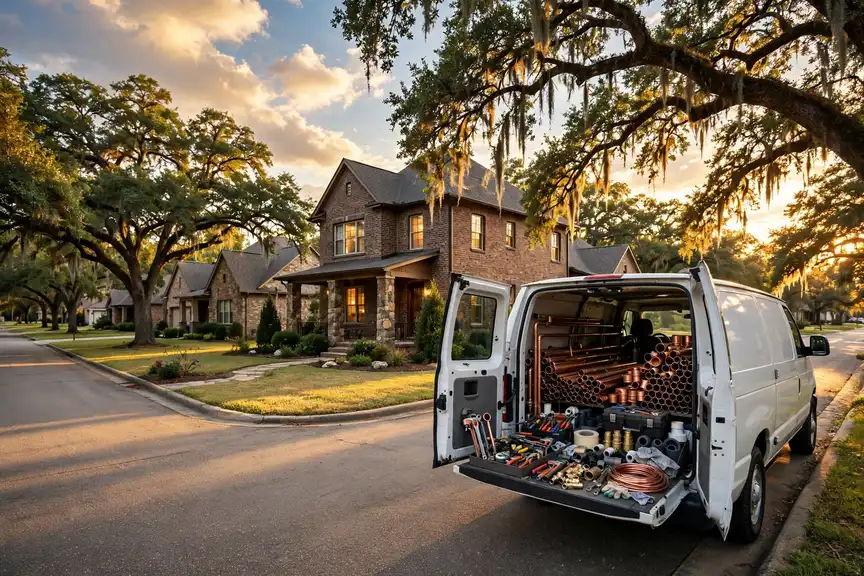
A local plumber's van on a residential street
Local plumbers serving Longview neighbourhoods
Water heater installation in a home garage
Replacing a heater in a Longview home

Longview plumbing, in brief

The median Longview home was built in 1981; 47.8% of the stock predates 1980, and the pattern this metro's own data ranks first is galvanized pipes at the end of their life. PlumbReach USA is a referral service, not a plumbing company: one call connects you with an independent local plumber serving your ZIP code.

The Longview housing stock, and what it means for plumbing

Every metro is really several, stacked by decade. Longview's stack, per the Census, reads: 18.3% of homes from before 1960, a thick middle from the growth decades, and 25.3% from 2000 onward — 121,822 housing units in all, wrapped around a median build year of 1981. Plumbing follows the stack faithfully. Each layer went in with its era's materials and workmanship, and each layer is now failing in its era's characteristic order. This page keeps the layering in view throughout, because in a stacked metro the first diagnostic question is never what broke — it is which layer the home belongs to.

Stand in one of Longview's older neighbourhoods and you are standing in its plumbing's back catalogue. The homes there — part of the 58,231 built before 1980 across this metro — went up when galvanized steel was a supply line, cast iron or clay was a drain, and a fixture was expected to serve for half a century. That half-century has now elapsed. What it leaves behind is not universal failure but universal exposure: every joint, valve and lateral in those districts is operating past the horizon its makers planned for, in Gregg County and beyond, and the failures arrive in the order the materials tire.

Growth wrote this metro's newest plumbing chapter in plastic and concrete: supply and drain lines in modern materials, fixtures by the catalogue, foundations poured as slabs across the subdivisions near Marshall and Kilgore. The chapter is young — its systems have decades in hand — but it is not exempt from the metro's arithmetic: 2,612 cooling degree days of demand work its heaters hard, and the soil under its slabs moves with the same seasons as the soil under the oldest farmhouse in Gregg County.

Over everything sits the weather, and here it is measured rather than described: NOAA's station at LONGVIEW E TX RGNL AP, TX US averages 66.2 degrees across the year, with 100.1 days reaching 90 or more and 35.1 nights at freezing or below. A buried lateral feels that record as soil that swells and pulls away; a water heater feels it as an unbroken cycle count; an exposed line feels it on the single coldest night. The problem ranking below is what those numbers, crossed with the housing profile, produce for Longview specifically.

The Longview plumbing profile in numbers

Two public records, one metro: what was built here, and what the sky does to it.

Break the stock down by building era and the profile sharpens. Before 1960: 18.3% of homes, roughly 22,293 of them. From 1960 to 1979: 29.5%, about 35,937. From 1980 to 1999: 26.9%, about 32,770. Since 2000: 25.3%, about 30,821. Four eras, four material palettes — and the balance among them is this metro's plumbing character in a single paragraph.

The largest band of Longview homes dates from 1960 to 1979, and that band defines the metro's plumbing present: copper and galvanized in transition, cast iron giving way to newer drain materials, fixtures from the first age of mass-produced internals. Those systems are now fifty years and more into service — old enough for patterns to have formed, young enough that sound sections genuinely remain. The assessment culture here is repair-versus-renew, home by home, because the mid-century stock refuses a single verdict for the whole street.

Second in the table, the 1980-1999 band: 32,770 homes, 26.9% of the metro. Its systems are mature rather than ancient — copper in its pinhole years in places, plastic drains still sound, first-generation cartridges wearing out in waves — and its plumbing is the schedulable kind: work that rewards being booked before it becomes urgent.

Longview's weather, reduced to what a pipe experiences: 100.1 hot days a year loading the drains and heaters, 35.1 freezing nights testing every exposed run, and 45.31 inches of rain moving through the soil that holds the laterals. NOAA's normals at LONGVIEW E TX RGNL AP, TX US — 2,136 heating degree days, 2,612 cooling degree days — are the long average of that experience, and they are why this metro's problem list is not interchangeable with a milder or harsher metro's.

That is the whole method of this page in one section: era shares from the Census, loads from NOAA, and a problem list that is simply where the two overlap most in Longview. The services and guidance that follow are ordered by the same profile — local first, generic last.

Plumbing services in Longview

Sequenced by this metro's own problem ranking, not by a national catalogue order.

Pipe Repair & Repiping in Longview

Pipes fail in two tenses: suddenly, at a joint or a split, and gradually, as a material narrows, thins or pits across a whole system. The first tense asks for a repair; the second eventually asks the larger question. Pipe services cover both — the sectional fix that restores a sound system, and the planned renewal that replaces a failing material through the whole house, routed to spare the building and staged to keep the household in water.

Homes in Longview ask the repair-or-repipe question in a particular order. First one leak, repaired. Then another, in the same material, a year later. Pressure meanwhile declines across every fixture, and the water runs discoloured after the house sits quiet. That sequence — which plays out across the metro's pre-1980 housing especially — is the material delivering its verdict, and repiping in PEX or copper is the answer that ends the sequence rather than extending it by one more interval. With a median build year of 1981, most of the metro's 121,822 housing units are working through the same ageing curve.

The repair-or-renew caseload is set by one figure above the rest: 47.8% of Longview homes predate 1980, plumbed in the materials now at the end of their service lives. Around Marshall (23,646 residents) as in the old core, that percentage is not an abstraction — it is the street's plumbing, house by house.

More about pipe repair & repiping ➔

Sewer Line Repair & Replacement in Longview

The sewer line is the one pipe every other pipe depends on. When it bellies, cracks or fills with roots, the whole house feels it through its ground-floor fixtures. Repair ranges from sectional fixes through a cleanout to full replacement, chosen from camera footage rather than guesswork.

The sewer lines under Longview are as old as its oldest streets. 18.3% of homes here were built before 1960, when clay and cast iron were the standard materials, and those lines have now carried sixty-plus years of service under soil, roots and traffic. The failures cluster where the trees are mature and the pipe is jointed — the established neighbourhoods around Longview and the historic core — because roots have had the most years to find the joints. A camera run tells the truth about any given line: how much is scale and roots that cleaning can handle, and how much is a pipe at the end of its story. Locally the workload concentrates where the stock is oldest — the districts built around the 1980s first.

Under Longview lie 121,822 laterals, one per housing unit, and the oldest of them — beneath the 22,293 pre-1960 homes — have been underground since the metro was a fraction of its present size. The camera diary in Henderson and the old core is written by that buried generation.

More about sewer line repair & replacement ➔

Water Heater Repair & Installation in Longview

From Longview to Henderson, the heater question is the same — repair the unit or renew it — and the honest answer starts from its age against Longview's demand record, which this page sets out.

More about water heater repair & installation ➔

Emergency Plumbing in Longview

In Longview the emergency call is routed, not queued: one number reaches the independent local plumber covering Gregg, Harrison, Rusk, Upshur at that hour, and the housing record on this page — median build year 1981 — is the homework they arrive already knowing.

More about emergency plumbing ➔

Drain Cleaning in Longview

Drain work in Longview splits by era: the 58,231 pre-1980 homes drain through older materials, the post-2000 subdivisions through plastic — and the local plumber reads the cable's return to tell which world your street drains through.

More about drain cleaning ➔

Leak Detection & Repair in Longview

A creeping meter in a Longview home is located, not guessed at: the professionals routed here trace the line with instruments and confirm the spot before any floor or wall is opened.

More about leak detection & repair ➔

Toilet Repair & Installation in Longview

Running, rocking or refusing — in Longview the diagnosis is the same short sequence: fill valve, flapper, supply line, flange. The plumbers routed here carry the internals for the fixtures this metro's eras installed.

More about toilet repair & installation ➔

Faucet, Fixture & Garbage Disposal Repair in Longview

Fixture work in Longview divides by era like everything else on this page: washer-era taps in the older districts, cartridge internals in the post-2000 subdivisions — the local plumber stocks for both.

More about faucet, fixture & garbage disposal repair ➔

What Longview books most

If this page's services were ranked by Longview's call patterns rather than listed in catalogue order, they would come out much as they do here — because the ranking behind them is data, not habit. Galvanized pipes at the end of their life leads the metro's problem table and ageing sewer laterals follows, so the services answering them lead the list. The long tail of a metro's plumbing life — fixture failures, toilet calls, the single unexplained leak — fills in the diary around them, here as everywhere.

Plumbing problems Longview homes actually get

Chosen by this metro's own housing and weather data — the same two records this whole page is built from.

Galvanized pipes at the end of their life

Galvanized steel announces its age through the water itself. The zinc coating that once protected the pipe is long spent; the steel beneath rusts inward, and the bore narrows to a passage that delivers less water every year. Households adapt without noticing — the shower accepted as weak, the washing machine's fill taken as slow — until a fixture upgrade or a guest's comparison names the decline. In Longview's pre-1980 districts that decline is the stock's shared condition, written into 58,231 homes, and the repipe conversation begins when the household stops adapting and starts measuring.

Galvanized pipe fails politely, which is exactly the problem — it gives a household years of small warnings that are easy to live with. The zinc coating that once protected the steel wears through, rust takes its place, and the rust grows inward like a narrowing artery. Flow to the farthest fixtures drops first. A shower that shares a line with a running tap loses its pressure. By the time the water itself runs discoloured after the house has sat quiet overnight, the narrowing is well advanced. None of this is a single emergency; it is a system reaching the end of its design life on schedule, and in Longview's pre-1980 neighbourhoods that schedule is arriving for whole streets at once, because the pipes went in together.

In raw numbers, Longview's exposure is 58,231 homes built before 1980 — the galvanized decades. Behind every one of those front doors is the same material on the same clock, which is why pressure complaints and pinhole leaks cluster by neighbourhood here rather than scattering evenly across the metro.

Watch for

  • Fixtures farthest from the meter noticeably weaker than near ones
  • Rust-coloured first water of the day that clears within seconds
  • Shower pressure that drops hard when a second tap opens

About pipe repair & repiping ➔

Ageing sewer laterals

Between the house and the street connection sits the lateral — the home's own stretch of sewer line — and it is the homeowner's responsibility, which surprises many people the first time it fails. In Longview, where 18.3% of homes were built before 1960 and the median home dates to 1981, laterals have been in the ground through decades of soil movement, root growth and material ageing. Clay joints shift and open, older pipe bellies where bedding has washed out, and a line can lose its clean fall to the street, so waste slows, settles and eventually blocks. The signs are house-wide rather than fixture-specific: several drains slow together, the ground-floor fixtures act up first, and cleanings help for shorter and shorter stretches. A camera run down the lateral settles the argument about what is happening — it measures the damage by distance, shows whether it is one bad joint or the whole story of the line, and lets the repair be sized to the actual problem instead of the whole run by default.

Slope is the lateral's invisible specification. A sewer line does not need much fall — a quarter inch per foot is the classic figure — but it needs it consistently, and ageing takes consistency away: a section settles, a joint steps down, and the line develops a reach where flow slows and solids settle out. That belly then collects a little more each week, narrowing the line from the bottom up. Many a Longview lateral diagnosed as 'blocked' is really 'bellyed' — clearable today, certain to collect again. The camera distinguishes the two, and the distinction decides whether the household is booking a cleaning or planning a repair.

Think of the laterals as a hidden census: 121,822 lines, one per home, the oldest of them — serving the 22,293 pre-1960 homes — now in their seventh decade underground. They age in soil that moves with Longview's seasons, and their condition surfaces only as symptoms inside the house, which is why so many are discovered late.

Watch for

  • The ground-floor bath draining slower than every fixture above it
  • A cleanout cap weeping or crusted with residue
  • Trouble that worsens during long, heavy rain

About sewer line repair & replacement ➔

Ageing cast iron sewer lines

Ask a cast iron drain how it is doing and it answers at the ground-floor fixture in the house. That is where a failing main shows itself first — the ground-floor bath that gurgles, the basement drain that sighs up odours — because everything above drains through the same tired run. In Longview, the homes reporting those signals share a profile: built when cast iron was the default, in the streets around Longview that went up first. The pipe underground is rough now with scale, its bore narrowed, its joints weeping into the soil — and the fixtures upstairs are merely its messengers.

The pipe itself explains the timeline. Cast iron drains by gravity, slowly, and everything a household sends down it — grease films, mineral-heavy water, the occasional corrosive cleaner — works on the iron for decades. The metal does not fail evenly: it thins first at the bottom of horizontal runs, where water and grit sit longest, and at the joints where sections meet. That is why two Longview homes of the same age can be in different places with the same pipe: usage, water chemistry and soil conditions around the line all vote on how fast it goes. What a camera inspection adds is certainty — the difference between a line that needs cleaning, a line that needs a section replaced, and a line living on borrowed time.

Another way to size the exposure: Longview's pre-1960 homes — roughly 22,293 of them — were plumbed in an era when cast iron was not a choice but the standard. Their drains have now spent sixty-plus winters and summers expanding, contracting and carrying loads their installers never pictured, which is why this pattern outranks problems that belong to younger housing.

Watch for

  • A floor drain that smells of the sewer after dry weather
  • Toilet bowls that bubble when the washing machine drains
  • Patches of unusually green grass along the line's path to the street

About sewer line repair & replacement ➔

Storm season readiness in Longview

Storm season changes the plumbing risks in Longview. Heavy rain pushes groundwater up around buried lines and can flood low-lying drainage, and homes here learn which of their drains sit at the bottom of the system the hard way — a floor drain or a basement fixture is where a surcharged line shows first. Before the season, it is worth knowing how your home behaves: whether the yard drains toward or away from the house, whether the sewer cleanout cap is sound, and where the main water shutoff is if a line is damaged. After a major storm, running every drain and watching the ground-floor ones tells you within minutes whether the line is moving water normally again.

When the storms come, Longview's plumbing meets them in the ground: laterals under saturated soil, cleanouts under standing water, ground floors at the level the water is looking for. The season tests the buried half of every system here, and it tests the older districts — where the lines are jointed clay and iron — hardest of all. Preparation is unglamorous and specific: know the cleanout, know the shutoff, know the ground-floor drain in the house.

A closer look: galvanized pipes at the end of their life in Longview

The geography of this problem inside Longview is a map of its pre-1980 building. The galvanized went into the post-war districts and the the 1980s growth around Longview — whole streets of it, installed by the same builders in the same years. Those streets are now reaching the material's limit together, which is why repiping conversations cluster: one home on a street is an incident, three is the street arriving at its date. The newer side of the metro, around Marshall and the post-2000 subdivisions, simply does not appear in this pattern — its turn is decades away, in different materials.

Strip the pattern down to its inputs and the ranking stops being mysterious: 106,264 households drawing on systems installed across a median build year of 1981, in a climate that swings between 100.1 days of serious heat and 35.1 freezing nights. Whatever pattern a metro with those inputs manufactures most, it manufactures here — the lead position is less a title than a consequence, recalculated from the same public records any sceptic can check.

On a first visit for this pattern, a local plumber's checks run in a practised order:

  • Which fixtures sit at the end of the longest runs — they report low pressure first
  • A glass of first-draw water after a weekend away, judged by colour
  • Any sections already replaced, since mixed materials change the picture
  • The meter-side pressure, to separate the house's problem from the street's

From problem to fixed, in Longview

A plumbing problem inside a Longview homePROBLEM
➔
The same system in Longview after professional repairSOLUTION

Areas covered in the Longview metro

Longview

Population 82,765

Marshall

Population 23,646

Kilgore

Population 13,444

Henderson

Population 13,348

Gladewater

Population 6,297

White Oak

Population 6,208

Gilmer

Population 4,955

Hallsville

Population 4,496

Lake Cherokee

Population 3,358

Liberty City

Population 2,826

Overton

Population 2,633

Waskom

Population 1,862

Also in the Longview metro: Tatum (population 1,528), Lakeport (population 1,250).

Read the grid as a building programme spread over a century. The oldest communities sit where the metro began; the youngest are still adding streets at its edge; and Marshall and Kilgore, with 23,646 and 13,444 residents, stand for the rings in between. Each ring plumbed in its era's materials, and each is now failing, wearing or holding in its era's characteristic order. The ZIP codes below draw the coverage boundary; the eras inside it draw everything else on this page — the problems ranked, the services ordered, the checks advised.

Beyond the largest communities sit Henderson (13,348), Gladewater (6,297), White Oak (6,208), Gilmer (4,955), Hallsville (4,496) — smaller places across Gregg, Harrison, Rusk, Upshur, covered on the same terms. Their housing tends to be older on average than the big suburbs', and their calls follow the older patterns on this page. One routing covers them all: find your ZIP code below and the rest is a phone call.

Longview ZIP codes we cover

75601, 75602, 75603, 75604, 75605, 75640, 75641, 75644, 75645, 75647, 75650, 75651, 75652, 75654, 75658, 75659, 75661, 75662, 75667, 75670, 75671, 75672, 75680, 75681, 75682, 75683, 75684, 75687, 75689, 75691, 75692, 75693, 75694, 75755, 75784

The Longview metro in detail

The metro's weight is not evenly spread. Longview holds 82,765 of the 288,921 residents; Marshall and Kilgore add 23,646 and 13,444; and the remainder scatters across the smaller places above, some no bigger than a few thousand people. Plumbing follows the weight — most calls come from where most homes are — but era matters more than size: a small community of 1960s housing generates older-system work than a large new subdivision does.

The metro answers to 4 county governments (Gregg, Harrison, Rusk, Upshur), a patchwork that matters at permit time rather than at the pipe. Gregg County carries the centre; the others carry the growth rings and the older outlying towns. A plumber routed through this page works inside that patchwork daily — the water does not care about the boundaries, but the job's paperwork does.

Three neighbouring coverage areas begin where this one ends: Tyler, TX, some 33 miles off; Texarkana, TX, 77 miles; and Dallas–Fort Worth, TX, 131 miles. Each keeps its own page because each keeps its own numbers — a different median build year, a different climate station, a different problem ranking. Boundary households should trust the ZIP list over the map: the code, not the compass, assigns the dataset.

The region around Longview is a set of variations on its theme: Tyler, TX, 33 miles off, runs a median build year of 1986 on a metro population of 252,549; Texarkana, TX (77 miles) medians 1984 on 146,816; Dallas–Fort Worth, TX (131 miles) medians 1992 on 8,477,157. Nearness is not sameness — a few decades of median build year separate their plumbing as surely as the miles separate their maps.

Count the metro per unit of itself: 3,481 housing units per covered ZIP code; 26,566 households per county; 14 communities sharing 4 county governments. Then weigh the generations against each other — 1.9 older homes for each newer one — and the service pattern on this page stops being a list and becomes a proportion: that much of the diary written by ageing systems, the rest by young ones wearing in.

The Longview record in one line — median home age: 45 years · owner-occupied homes: 73,853 · renter-occupied homes: 32,411 · pre-1960 homes per covered ZIP code: 637 · heating-to-cooling degree-day ratio: 0.82 · average rainfall: 1,151 mm a year.

Longview plumbing questions

What area does PlumbReach USA cover around Longview?
Start with the list on this page: 35 ZIP codes, running from the centre of Longview out through Marshall, Kilgore and the metro's edge communities, across Gregg, Harrison, Rusk, Upshur. That list is the coverage. A home inside it sits inside the dataset this page was built from — its housing era, its climate station, its problem ranking — and inside the routing area of the independent local plumbers PlumbReach USA connects callers to. Put the coverage against the Census map and it tracks the population: Longview first (28.6% of the metro), then the rings of suburbs and smaller communities in their own building decades — all of it inside the same routing. If a street sits between Kilgore and Henderson, it is in; the list was drawn from the Census map of the metro — 4 counties, 35 codes — rather than from a radius around a shop. The ground inside that boundary holds 121,822 housing units — 22,293 from before 1960, 35,937 from 1960-1979, 30,821 since 2000 — under the climate record kept at LONGVIEW E TX RGNL AP, TX US. Stated as the communities it covers: the community ledger reads Longview (82,765 residents), Marshall (23,646), Kilgore (13,444), Henderson (13,348) and Gladewater (6,297), out of 288,921 residents metro-wide.
If my Longview house dates to about 1981, where does a plumber look first?
Start with whatever is original. A the 1980s build in Gregg County has likely kept some of its first plumbing — and with 58,231 pre-1980 homes across the metro, plumbers here open walls on that stock every week. The tells are gradual: pressure a little weaker than last year, a drain cleared a little more often, a heater recovering a little more slowly. None of them is an emergency; together they are a timetable. In Longview that plays out across 35 ZIP codes, from Longview to Marshall. The same watch-list runs metro-wide: from Marshall (23,646 residents) to Kilgore (13,444) and Henderson, across Gregg, Harrison, Rusk, Upshur, the 58,231 pre-1980 homes share the materials this answer describes — which is why a neighbour's leak two streets away is worth a homeowner's attention here. The same applies street by street in Gregg County: a median year of 1981 is an average, and the homes on either side of it — older in the core, newer past Henderson — read from the same materials list. Set against the climate that works on them — 2,136 heating degree days, 2,612 cooling degree days, 45.31 inches of rain at LONGVIEW E TX RGNL AP, TX US — the era of a Longview home is the strongest single clue to the condition of its plumbing. Where the watching happens, in figures: the community ledger reads Longview (82,765 residents), Marshall (23,646), Kilgore (13,444), Henderson (13,348) and Gladewater (6,297), out of 288,921 residents metro-wide — one timetable of ageing systems across all of them.
Which plumbing fault shows up most often across Longview?
The honest answer comes from the stock, not from anecdotes: Longview's leading pattern is galvanized pipes at the end of their life. Galvanized steel announces its age through the water itself. Homes around Longview and the older districts supply most of these calls, because that is where the relevant housing concentrates. The backdrop is the same metro-wide: 121,822 housing units working against the LONGVIEW E TX RGNL AP, TX US climate record. For scale, the runner-up is ageing sewer laterals, and the gap between them is the metro's own arithmetic: housing counted across Gregg, Harrison, Rusk, Upshur, weather logged at LONGVIEW E TX RGNL AP, TX US, and an era profile with a median of 1981. Change one input and the order moves: at LONGVIEW E TX RGNL AP, TX US the record reads 2,136 heating degree days against 2,612 cooling; in the stock, 18.3% predates 1960 and 47.8% predates 1980. The inputs behind the ranking, community by community: the community ledger reads Longview (82,765 residents), Marshall (23,646), Kilgore (13,444), Henderson (13,348) and Gladewater (6,297), out of 288,921 residents metro-wide.
Which parts of my plumbing does the Longview weather actually touch?
Put a single number on it: the average year at LONGVIEW E TX RGNL AP, TX US runs to about 66.2 degrees, but a plumbing system never meets the average — it meets the extremes the average is built from. 100.1 hot days drive the heater and drain load; 35.1 freezing nights test the exposed lines. A Longview home's pipes live at both ends of that spread, every year, for as long as the house stands. The figures behind that answer, from the station record: a yearly average of 66.2 degrees, 45.31 inches of precipitation, 100.1 days at 90 or above and 35.1 nights at freezing or below — the four numbers this page's seasonal section is built from. It is the same story from Marshall to Kilgore — the stock decides, and this stock's median build year is 1981. That is the metro-wide version; the household version differs by exposure — a shaded lot in Marshall, an open slab in Kilgore (13,444 residents), a crawl space in Henderson — but the loads themselves, 2,136 heating degree days against 2,612 cooling, are the same sky over every roof in Longview. The figures are worth keeping with the house papers: 66.2 degrees as the yearly average at LONGVIEW E TX RGNL AP, TX US, 45.31 inches of precipitation, and a housing stock whose median year is 1981 — the three numbers this metro's plumbing lives by. The numbers in one line: 66.2 degrees average, 45.31 inches of precipitation, 2,136 heating degree days, 2,612 cooling degree days, 100.1 days at 90 or above, 35.1 nights at freezing or below. Whose roofs that weather works on: the community ledger reads Longview (82,765 residents), Marshall (23,646), Kilgore (13,444), Henderson (13,348) and Gladewater (6,297), out of 288,921 residents metro-wide.
I can hear water running inside a wall at my Longview home. First move?
Kill the water at the main shutoff — where the line enters the house, in the basement, garage or utility space, or out at the meter box by the street. Then crack open a ground-floor tap to bleed the pressure off, keep everyone clear of water near electrics, and make the call. Our shutoff guide, linked from this page, shows how to find the valve on a calm day instead of a wet one. Across the metro's 4 counties, Gregg County included, the pattern repeats wherever the housing matches. The geography is printed on this page: 35 ZIP codes across Gregg, Harrison, Rusk, Upshur, and in every one of them the first move is identical even though the valve's address changes — interior wall in the older districts around Longview, meter box at the street in the newer rings past Marshall (23,646 residents). The calm-day homework for this metro: walk the 35 covered ZIP codes' worth of housing in your mind to your own valve — in Gregg County the older stock hides it indoors, the slab tracts past Kilgore at the meter — and turn it once before you ever need it in anger. The calm-day version, localised: find your valve before LONGVIEW E TX RGNL AP, TX US's next freeze season — 35.1 freezing nights a year — whether your home sits near Longview, out in Marshall (23,646 residents) or past Kilgore (13,444). True from the centre to the edge: the community ledger reads Longview (82,765 residents), Marshall (23,646), Kilgore (13,444), Henderson (13,348) and Gladewater (6,297), out of 288,921 residents metro-wide — shutoff first, everywhere on the map. The ranking that frames the damage: Galvanized pipes at the end of their life first on this page, ageing sewer laterals second, ageing cast iron sewer lines third — the burst line in front of you belongs to the same local arithmetic. Learn it street by street if you must: the 75784 subdivisions shut off at the meter, the 75684 districts at the wall, the oldest homes out toward 75603 at a curb stop — the map of valves is the map of build decades.
Is a repipe inevitable for Longview's older housing, or can repairs keep up?
Think of it as a count with a trend. Leak one: repair it and note the material. Leak two, same material, different room: the system has started a pattern. Leak three, with pressure sagging at every tap: repairs are now renting time in a house that needs its lines renewed. The metro's pre-1980 share — 47.8% of homes — means Longview plumbers hold this conversation weekly, and the honest ones hold it at leak two, not leak five. Homeowners in Marshall (23,646) and Kilgore (13,444) read this page for the same reason — the stock there is the same stock. That is as true on the streets around Longview as it is at the metro's growing edge. The pattern is not evenly spread: it concentrates in the 58,231 pre-1980 homes, thickest in the founding districts and the first suburbs — the streets around Marshall and the old core — and thins toward Henderson and the growth edge, where the stock is a generation younger. Streets matter to the timing: the founding districts near Longview reach the pattern first, the post-war ring through Marshall and Kilgore a decade behind, the subdivisions past Henderson a generation behind that. Streets carry the same ledger at household scale: from Longview (82,765 residents) through Marshall (23,646) to Kilgore (13,444), the leak sequence means the same thing wherever the material matches. Where the conversations happen: the community ledger reads Longview (82,765 residents), Marshall (23,646), Kilgore (13,444), Henderson (13,348) and Gladewater (6,297), out of 288,921 residents metro-wide, earliest and oftenest in the founding names on that list.
Am I hiring PlumbReach USA, or a local Longview plumber?
No. PlumbReach USA is a connection service: your call is routed to an independent local plumbing professional who serves Longview, and that professional assesses and carries out the work in your home. Our part is the routing — and these city pages, assembled from Census and climate data so you can understand your metro's plumbing before you ever need the call. The local figures behind it: 58,231 homes from before 1980 and 30,821 built since 2000, sharing one system of streets and soil. The arrangement is the same across the whole footprint: 35 ZIP codes, 4 counties, communities from Longview through Henderson — in each of them the professional is local, independent, and working their own patch of the metro's housing. It is worth being precise about the local end of the arrangement: the professional serving Marshall or Henderson sets their own terms with you, carries their own responsibility for the work, and answers for it — our routing is the only part this page undertakes. Callers from Marshall (23,646 residents), Kilgore (13,444) and Henderson get the same plain arrangement: our routing, their plumber, their terms — stated here because the metro's 288,921 residents deserve it stated. The arrangement holds in every community: the community ledger reads Longview (82,765 residents), Marshall (23,646), Kilgore (13,444), Henderson (13,348) and Gladewater (6,297), out of 288,921 residents metro-wide.
What plumbing checks are worth doing each year in Longview?
Four, sized to this metro's record. Exercise the main shutoff so it turns when it has to. Drain a few gallons from the water heater to clear the sediment that Longview's 2,612 cooling degree days of demand settle into it. Walk the ground-floor drains and the yard cleanout after heavy rain — 45.31 inches fall here in an average year — and check the meter on a quiet evening for movement nobody can explain. None of it takes an hour; together they catch the patterns this page ranks highest while they are still small. None of it is abstract at this scale: 106,264 households across Gregg, Harrison, Rusk, Upshur share one climate and one ageing stock, so a yearly rhythm kept by even a fraction of them is the difference between this metro's plumbing failing in private, one house at a time, and failing on a schedule somebody saw coming. The checks travel well because the conditions do: LONGVIEW E TX RGNL AP, TX US's record covers Marshall, Kilgore and Henderson alike, and the housing eras repeat across all 35 ZIP codes. A neighbour in another district keeping the same calendar is not copying you; they are reading the same data. The calendar's local proof is in the stock figures: 58,231 pre-1980 homes to keep valves alive in, 30,821 post-2000 homes reaching first-fixture age together, and 45.31 inches of rain a year testing every cleanout in Gregg, Harrison, Rusk, Upshur. The checks are sized to the stock's actual eras — a median build year of 1981, 18.3% of it pre-1960 — not to a generic house that exists nowhere in Longview. The routine's territory, in codes: the codes run 75601, 75651, 75681, 75784 and 75684 among the 35 on the list, spread over Gregg, Harrison, Rusk, Upshur.
Why does this page lead with the problems it leads with in Longview?
It starts from the two datasets this page is built on: Census housing figures for the Longview metro and NOAA's 1991-2020 climate normals for LONGVIEW E TX RGNL AP, TX US. Every candidate pattern — ageing laterals, slab leaks, freeze damage and the rest — is weighed against both: how much of the local stock is exposed to it, and how hard the local climate pushes it. The order you are reading is the result, and it is recalculated metro by metro rather than inherited from a bigger city's page. The ranking's geography is visible in the coverage grid: the patterns at the top of the list concentrate where the old stock does — the core around Longview, the first suburbs toward Marshall — while the growth communities past Kilgore (13,444 residents) pull the ranking's lower half upward year by year. A useful check on the method: run it on Marshall alone and the order bends toward that district's eras; run it on the whole metro — 106,264 households — and you get the list printed here. The evidence trail is on this page: the problem sections scored pattern by pattern, the housing profile drawn from Gregg, Harrison, Rusk, Upshur, the climate read from LONGVIEW E TX RGNL AP, TX US — the ranking is the two records read together, nothing else. The scoring's raw material, code by code: the codes run 75601, 75651, 75681, 75784 and 75684 among the 35 on the list, spread over Gregg, Harrison, Rusk, Upshur. The dataset's own label for the unit being scored: the Longview metro — 288,921 residents, 69.5% of them owner-occupiers — scored whole, because its housing and its weather arrive whole. The sort ran over the whole list — from 75601 and 75651 through 75681, 75784 and 75684 to 75603 — and returned one order for all of it, because the inputs were the metro's totals, not any single district's.
Where are Longview's oldest homes, and why does it matter for plumbing?
The oldest homes cluster where the metro began: the historic core around Longview and the first suburbs out from it, where the 22,293 pre-1960 homes in this metro mostly stand. It matters because era is destiny for plumbing — those streets hold the cast iron, the galvanized steel and the clay laterals this page's problem list is built from. The newer districts around Marshall hold younger systems with younger problems: fewer material failures, more wear and installation questions. It is also a numbers story: of Longview's 121,822 housing units, the pre-1960 share is 18.3% — the largest single concentration of original-era pipework in the metro, sitting in the districts where Gregg County's streets were laid out first. The drive that proves it runs from the centre of Longview outward: through Marshall (23,646 residents), then Kilgore (13,444), then the younger rings toward Henderson — a single trip across Gregg, Harrison, Rusk, Upshur that travels forward through the metro's plumbing history decade by decade. It is why two homes a mile apart in Longview can need different conversations: one on the 1980s materials near the centre, one on modern lines past Kilgore — the map of eras is the first diagnostic. ZIP by ZIP the same gradient: the oldest systems cluster in the codes nearest the centre — the 75601 side of the list — and the youngest toward 75784 at the edge, across Gregg, Harrison, Rusk, Upshur. The map's communities in growth order: the community ledger reads Longview (82,765 residents), Marshall (23,646), Kilgore (13,444), Henderson (13,348) and Gladewater (6,297), out of 288,921 residents metro-wide. Counted under its Census name — the Longview metro, 288,921 residents, 69.5% owner-occupied — the oldest layer is a defined population of homes, not a figure of speech.
If a plumber assessed my Longview home tomorrow, what would they look at first?
The order is by consequence, not convenience: first the main shutoff, because everything else depends on being able to stop the water; then the heater, the hardest-working appliance in a Longview home; then the drains and the meter, which together report on the buried half of the system. In Longview, with 58,231 homes built before 1980, that sequence catches the era's usual suspects in the order they matter. The metro's figures say why the order matters here: 58,231 pre-1980 homes means shutoffs and heaters of a certain age are the statistical norm rather than the exception, and a climate of 2,136 heating degree days works every heater in Gregg County hard enough to justify its place near the front of the walk. The accents shift by ring: in the founding streets of Longview the flags are original materials; through Kilgore (13,444 residents) they are valves and heater age; out toward Henderson they are first-generation fixtures and lines under slabs — the walk is one, the findings follow the building map of Gregg, Harrison, Rusk, Upshur. Keep the findings with the house records: in a metro of 106,264 households, the homes whose owners can date their last check are the ones whose failures arrive as appointments — the entire point of the half hour. District accents, with figures: Marshall (23,646 residents) leans to valves and materials, Kilgore (13,444) to heaters and drains, Henderson to first-generation fixtures — one walk, three readings. The walk's districts, named: the community ledger reads Longview (82,765 residents), Marshall (23,646), Kilgore (13,444), Henderson (13,348) and Gladewater (6,297), out of 288,921 residents metro-wide.

Before an emergency, read the guide: How to shut off your home's water main

Nearby metro areas

Talk to a Longview plumber

PlumbReach USA routes your call to an independent local plumbing professional serving Longview — the assessment and the work are theirs.

Call center hours: Mon-Fri 7:00 AM-10:00 PM ET | Sat 8:00 AM-10:00 PM ET | Sun 7:00 AM-9:00 PM ET

Call Now
