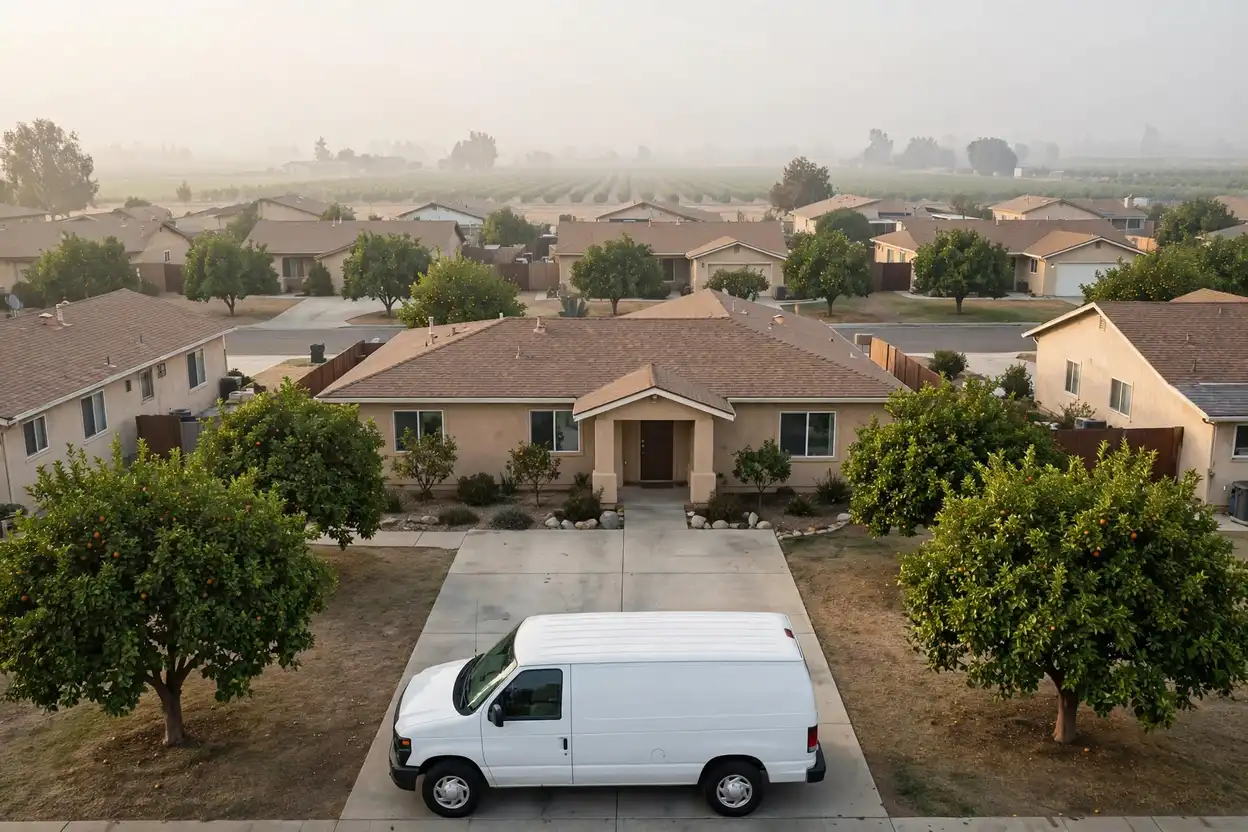


This is Fresno's plumbing page, built from Fresno's own numbers: Census housing figures, the metro's ZIP codes and its NOAA climate record. PlumbReach USA routes your call to an independent local plumber; the homework below is here so you know your home's likely problems before you ever make it.
Call center hours: Mon-Fri 7:00 AM-10:00 PM ET | Sat 8:00 AM-10:00 PM ET | Sun 7:00 AM-9:00 PM ET
The median Fresno home was built in 1982; 47.4% of the stock predates 1980, and the pattern this metro's own data ranks first is galvanized pipes at the end of their life. PlumbReach USA is a referral service, not a plumbing company: one call connects you with an independent local plumber serving your ZIP code.
Fresno is a metro of 1,170,942 people and 366,676 households, and its plumbing is a portrait of its building history. The median home here was built in 1982; 47.4% of homes predate 1980 and 19.5% predate 1960, while 25.2% have arrived since 2000. Every one of those eras plumbed differently — different pipe materials, different drain designs, different fixtures — and they fail differently, which is why this page is organised around the patterns the data actually produces in Fresno rather than plumbing in the abstract.
By now, most of Fresno's pre-1980 homes are on their second plumbing lives in part: a heater replaced, a bathroom renewed, a section of drain renewed after a failure — while the remainder of the original system carries on into its sixth and seventh decades. The 185,984 homes in that stock are therefore not uniformly old; they are individually old, each with its own archaeology of repairs. That is why the pre-1980 districts reward inspection over inference: the street's average says little about the house in front of you, whose real history is written under its floors.
The post-2000 homes have a plumbing trait the older districts never had: uniformity at scale. A subdivision's lines went in within a few seasons of each other, so its first heater failures, its first cartridge failures and its first slab questions arrive within a few seasons of each other too. With 98,877 such homes in the metro, those arrivals are not anecdotes but waves, and the households who read them early — who learn their system's age and keep its number handy — meet them as maintenance rather than emergency.
One more record sits over the whole metro, and it is the one the pipes themselves keep: the weather's. FRESNO YOSEMITE INTL AP, CA US logs 10.99 inches of precipitation in an average year and swings between 113.3 days at 90 degrees or more and 10.7 nights at or below freezing. Buried lines ride that swing in the soil; heaters ride it in their cycle counts; exposed runs ride it at the extremes. Cross the swing with the housing ages above and the selection of problems further down this page stops looking like a list and starts looking like an arithmetic result.
Housing eras and climate, joined — the two datasets every section of this page is built from.
Lay the eras side by side instead: 19.5% pre-1960 (76,512 homes), 27.9% from 1960-1979 (109,472), 27.4% from 1980-1999 (107,510), and 25.2% since 2000 (98,877). No single era tells the story — the proportions among them do, and those proportions are different in every metro this site covers.
Between the old metros and the new ones sits this one, its centre of gravity in the 1960-1979 band — the decades when the trade changed materials mid-stream. The consequence is a housing stock that must be read house by house: galvanized beside copper, iron beside plastic, original beside renewed, sometimes within one wall. Fresno's plumbing rewards the diagnostic visit more than most metros' do, because the street's average is a genuinely poor guide to the individual system.
The runner-up era is 1980-1999, with 27.4% of homes. That stock has left its carefree decades and entered its maintenance decades, and it shows in the call pattern around Clovis and the other districts of those years: heaters on their second or third cycle, fixtures reaching their wear points together, drains still young enough to reward attention over replacement.
The climate half of the profile, from FRESNO YOSEMITE INTL AP, CA US: 2,186 heating degree days against 2,209 cooling degree days, 10.99 inches of precipitation, an average temperature of 65.0 degrees. Read together, those figures describe the loads: how hard heaters cycle, how often the soil around buried lines swells and shrinks, and how much of the year exposed pipework spends anywhere near freezing — 10.7 nights at or below it, against 113.3 days at 90 or above.
Hold the two halves together and the rest of this page explains itself: the problems ranked highest here are the ones where Fresno's dominant housing era and its climate record overlap. Change either dataset and the ranking changes — which is precisely why this profile is rebuilt from the records for every metro instead of carried over from the last one.
Selected and ranked from this metro's housing-age profile and climate record — not copied from another city's page.
Galvanized steel pipe was plumbed into millions of homes, and it ages in a particular way: the zinc coating gives out, the steel rusts, and the rust grows inward until the pipe that once carried a full stream is choked to a fraction of its width. With a median build year of 1982 and 47.4% of its homes predating 1980, Fresno has a large stock of housing in the galvanized era, and its symptoms are the classic ones — pressure that has faded a little more each year, water that runs rusty after the house sits quiet overnight, and leaks that begin appearing at joints. No cleaning reverses this; the corrosion is the pipe itself converting to rust. The judgement call is timing. A galvanized system with one small leak and acceptable pressure can be repaired and watched. A system leaking in several places, with pressure dropping across every fixture, is telling you the material has finished its service life, and each repair buys a shorter quiet interval than the last. Repiping in PEX or copper replaces the whole question with a new system and restores the pressure the home was built with.
Galvanized pipe fails politely, which is exactly the problem — it gives a household years of small warnings that are easy to live with. The zinc coating that once protected the steel wears through, rust takes its place, and the rust grows inward like a narrowing artery. Flow to the farthest fixtures drops first. A shower that shares a line with a running tap loses its pressure. By the time the water itself runs discoloured after the house has sat quiet overnight, the narrowing is well advanced. None of this is a single emergency; it is a system reaching the end of its design life on schedule, and in Fresno's pre-1980 neighbourhoods that schedule is arriving for whole streets at once, because the pipes went in together.
Count the exposure from the Census side: the metro's 185,984 pre-1980 homes were plumbed in galvanized's long reign, and the material's failure mode — internal rust, narrowing bore — is a matter of chemistry, not workmanship. The variable is speed; the direction, for every one of those systems still original, is settled.
Ownership is the first surprise with a lateral: the buried stretch between the house and the street main typically belongs to the homeowner, however public it feels. The second surprise is its age. In Fresno, laterals under the older streets were laid for the homes counted in the 185,984 pre-1980 properties — jointed clay or iron, bedded in soil that has swelled and shrunk through 10.99 inches of rain a year ever since. A pipe can be nobody's thought for fifty years and then become the only thought in the house, usually on the evidence of the ground-floor drain in it.
A lateral gives decades of silence and then a short conversation. The conversation usually starts with the ground-floor drain in the house and escalates through the cleanout to the camera — and the camera's footage settles every argument about whether the line is blocked or broken. Across Fresno, the laterals entering that conversation now are the ones buried when the metro's median home went up, in 1982. They were built to outlast their mortgages, and they have; the question the footage answers is how much further the same pipe can honestly be asked to go.
Universality is the point: every housing unit in the metro — 392,371 of them — drains through one lateral apiece, and the older half of that stock is served by lines as old as the homes above them. A component that universal, ageing on that schedule, does not need bad luck to top a problem list; it needs only time.
Time is unkind to cast iron below ground. The pipe that carried this metro's post-war growth was laid with a working life in mind, and the calendar has now passed it: the inner wall sheds its lining in flakes, rust blooms narrow the bore, and the rough surface that remains catches everything the household sends down. Flow fades first — a tub that empties slower each year — then the failures arrive: a section that gives way under the yard, a joint that weeps into the soil. Where the metro's housing is oldest, this is not an edge case; it is the standard condition of the stock, arriving street by street as each neighbourhood's pipes reach the same age together. The camera distinguishes rust from roots from collapse, and that distinction sets the job.
Look inside an old cast iron line with a camera and the failure stops being abstract. The inner wall grows rough with tuberculation — rust nodules that narrow the bore and catch everything passing. The bottom of the run, where water and grit travel, thins fastest; the top can look sound while the channel below it is nearly through. Roots enter at joints and add their own blockage. A Fresno line of this vintage is therefore not one problem but a profile of problems along its length, and the repair that makes sense — cleaning, a section, a full replacement — is the one matched to the worst ten feet the camera finds, not the average of the whole run.
Another way to size the exposure: Fresno's pre-1960 homes — roughly 76,512 of them — were plumbed in an era when cast iron was not a choice but the standard. Their drains have now spent sixty-plus winters and summers expanding, contracting and carrying loads their installers never pictured, which is why this pattern outranks problems that belong to younger housing.
The contest between a street tree and a sewer lateral is rigged in the tree's favour: it has time, numbers and chemistry on its side, and it only needs one imperfect joint. Fresno's older districts run the contest at scale — mature canopy above, jointed pipe below, decades elapsed. The symptoms keep the tree's calendar: worse in the growing season, quieter in winter, returning each spring a little stronger. A root cutting resets the contest; a renewed joint ends it. The camera's footage tells the household which of those it is actually gaining, in the only currency that matters here — years of clear line.
Left alone, a rooted line does not stabilise; it escalates on the tree's schedule, not the household's. Each clearing trims the root mass back and, like pruning, can encourage denser regrowth through the same joint. The interval between clearings is therefore the number to watch in Fresno's older neighbourhoods: steady for years, then shortening, then suddenly urgent. That shortening interval is the line reporting that the opening the roots use has widened — the point where the conversation properly turns from maintenance to renewal of the section itself.
Time is the ingredient, and Fresno has supplied it: the metro's older districts pair jointed drain lines from the 1980s and earlier with street trees planted the same decades. A root system has had forty, fifty, sixty years to explore the joints under those streets. Where the housing is newer and the pipe is plastic with fused joints, the invitation never arrives — which is why this problem maps so precisely onto the old-tree, old-pipe neighbourhoods.
A water heater's workload is set by the climate around it and the water coming into it, and Fresno asks plenty of its heaters: the climate record shows 2,209 cooling degree days and 2,186 heating degree days a year, which together mean ground water arrives cold in winter, hot showers run long, and the tank cycles hard across the whole calendar. Every cycle moves sediment: minerals settle out of heated water and collect on the tank floor, where the layer insulates the water from the heat source, makes the burner or element run longer, and produces the rumbling and popping homeowners hear from older tanks. With 366,676 households in the metro drawing on heaters of every age, the failures follow the same order — recovery slows, hot water runs out earlier, then rust or a leak at the base announces the tank itself. Flushing a tank while it is still sound, and replacing the anode rod that sacrifices itself against corrosion, are the maintenance steps that decide whether a heater reaches the long end of its expected life or gives up early.
Recovery time is the number that runs a household's mornings, and it is the first thing sediment steals. A tank rated to serve a family when new delivers less hot water per heating cycle every year as the sediment layer thickens and the burner's work goes into heating rock instead of water. In Fresno, where summer demand piles showers, laundry and dishwashing into the same hours, that slow decline shows up as a household quietly rationing hot water without ever deciding to. Flushing the tank returns some of it; a spent anode and a rumbling, scaled tank are the signs the decline has become structural, and the conversation turns to replacement.
Do the local sums: 366,676 households heating water through 2,209 cooling degree days and 2,186 heating degree days a year means the metro's heater fleet cycles relentlessly, and sediment settles further with every cycle. Heaters in Fresno rarely die young — they die on schedule, and the schedule is written by how hard the climate makes them work and whether anyone ever drained the sediment out of the tank.
In the wet months the ground itself becomes a plumbing component: saturated soil pressing on every buried joint, groundwater finding every imperfect seal, sump and drain alike working at capacity. The pattern of calls shifts underground — laterals, cleanouts, the ground-floor fixtures in the house reporting what the soil is doing. Homes on the older streets feel it first, because their lines have the most joints per mile for the water to argue with.
An average year brings Fresno 10.99 inches of precipitation, and the wet months deliver most of it. Saturated soil is the season's plumbing fact: it presses on every lateral joint in the metro's older ground, and the ground-floor fixtures in Fresno and the low districts report the result first.
The physics of galvanized failure is a narrowing, and narrowings compound: a bore at half width delivers far less than half the flow, and the rust that narrows it also seeds the pinhole leaks that eventually spot the ceilings below. Fresno's exposure is the metro's whole pre-1980 belt — street after street around Fresno where the same specification went into wall after wall. What looks like one home's private decline is really a cohort effect, and cohorts fail together: the local signature of this pattern is its clustering, street by street, season by season, as near-identical systems reach the same age within months of each other.
Strip the pattern down to its inputs and the ranking stops being mysterious: 366,676 households drawing on systems installed across a median build year of 1982, in a climate that swings between 113.3 days of serious heat and 10.7 freezing nights. Whatever pattern a metro with those inputs manufactures most, it manufactures here — the lead position is less a title than a consequence, recalculated from the same public records any sceptic can check.
The first visit follows a short, diagnostic list — each item ruling a branch of the problem in or out:
Listed in the order this metro's housing and climate data supports.
Supply pipe is a house's circulatory system, and its diseases are degenerative: rust narrowing the arteries, corrosion pitting the walls, joints weeping at the seams. Repair treats the acute event. Repiping treats the disease — a planned replacement of the failing material throughout the home, staged so the household keeps water while its circulation is renewed, and verified under pressure before the walls close.
Pressure is the pipe system's public voice, and in Fresno it speaks with a district accent. In the pre-1980 districts — 185,984 homes — it fades year by year as galvanized bores narrow, a decline so gradual that households adapt to it fixture by fixture and only notice when a visitor's shower puts theirs to shame. In the newer subdivisions it stays loud and even. The repair-or-renew decision is usually just a translation of that voice: a system whose pressure is leaving has delivered its diagnosis already, and the assessment visit exists to confirm it in person. In Fresno that holds across 68 ZIP codes, from Fresno out to Madera.
Pipe work divides by era in this metro with unusual neatness: renewal conversations in the 185,984 pre-1980 homes, sectional repairs in the middle ring, and near-silence from the 98,877 post-2000 homes whose lines are still young. A call from Clovis can sit in any of the three bands; the home's build year says which before the door opens.
Where this service gets booked in Fresno follows the map on this page: the older districts generate the deep-end work, the post-2000 subdivisions the wear-and-tear work, and the 107,510 homes in between split the difference. Telling the call center your home's build decade — most Fresno owners know it within a few years — puts the right kit on the van the first time.
Roots, offsets, bellies, corrosion — the camera distinguishes them, and each has a different remedy at a different scale. That is the whole logic of sewer work: see the line first, then decide whether it needs a clearing, a section, or a new run entirely.
The camera footage is where Fresno's sewer conversations get honest. From the surface, a backup is a backup; on the screen, the metro's whole history is visible — clay joints shouldered apart by decades of soil movement, cast iron scaled to half its width, a plastic line in a newer subdivision bellied where its bedding settled. Fresno County's older laterals and the growth areas' young ones fail in their own dialects, and the repair that follows the footage — sectional, partial, or the full run to the street — is the one the pipe itself argues for. From Clovis to Madera, the pattern repeats wherever the housing era matches.
Sewer demand follows the founding map: the districts built first, around the old centre and out through Sanger, hold the jointed clay and iron; the growth rings hold plastic with decades in hand. 19.5% of the metro's homes stand on the founding side of that line, which is why the footage here so often shows a pipe at the end of its story.
One local habit worth copying: Fresno homeowners who mention their street's building era when they book get a better-matched visit, because a plumber heading to a the 1980s home in Fresno County loads different parts than one heading to a slab-built subdivision in Clovis. The service is the same; the preparation is local.
The water heater is the hardest-working appliance in the house and the least observed. It cycles through every shower, wash and rinse, accumulating sediment with each firing, until its decline announces itself in the household's most intimate routines: the shower that fades, the rumble from the closet, the rust at the tap. Service reads the tank's age, its sediment and its anode, and separates the heaters with years left from the ones living on borrowed time.
Ask a Fresno plumber what kills water heaters and the answer is time plus sediment: the tank heats, minerals settle, the anode rod spends itself slowing the corrosion, and eventually the steel loses. The metro's climate keeps the cycle count high — long hot seasons pull more hot water through showers and laundry than a mild climate would — so heaters here earn their keep. Owners in Fresno County who flush the tank yearly and keep an eye on the anode rod are the ones whose heaters reach the far side of a decade. Ask in Sanger and the answer rhymes with Fresno: same eras, same materials, same calendar of failures.
Heater work in this metro is a fleet problem: the tanks were installed in waves with the subdivisions, and they reach their verdicts in waves too. Selma (24,586 residents) sits inside one of those waves; the older districts run their own, one tank at a time, inside plumbing a generation older.
In Fresno this service is booked most often through the problem patterns at the top of this page — the metro's housing data, not habit, sets the order. If your home is in the 47.4% built before 1980, mention its age on the call: it changes the parts the plumber loads before heading to Fresno and the rest of the metro.
Emergencies in Fresno are answered by local independents, not a dispatch centre: PlumbReach USA routes the call, and the stock it serves — 392,371 homes across 68 ZIP codes — is the stock this page profiles.
Fresno's drains are cleared by local independents who work this stock weekly: a median build year of 1982 means most lines they open have decades of history in them, and the clearing approach is chosen for the era, not the postcode.
A creeping meter in a Fresno home is located, not guessed at: the professionals routed here trace the line with instruments and confirm the spot before any floor or wall is opened.
In Fresno, a toilet that runs all night is a water bill with a sound; the local service replaces the tired internals and checks the flange and supply while the tank is open.
In Fresno the faucet call is often the first plumbing visit a newer home ever gets — the professionals routed here treat it as an introduction: the fixture fixed, and the home's shutoffs and heater age noted for the record.
Two patterns generate most of the bookings behind the services above: Galvanized pipes at the end of their life and ageing sewer laterals. That is why the order of this page's service list is what it is — the services answering those patterns come early, and the rest follow in the order the metro's data supports. A homeowner whose home matches the local profile — built in the metro's big decades, in one of its older districts — is, statistically, reading their own shortlist.
 PROBLEM
 SOLUTION
Population 543,615
Population 122,719
Population 67,133
Population 26,515
Population 25,446
Population 24,586
Population 18,876
Population 17,352
Population 16,492
Population 14,545
Population 12,589
Population 12,554
Also in the Fresno metro: Madera Acres (population 9,758), Firebaugh (population 8,301).
Read the grid as a building programme spread over a century. The oldest communities sit where the metro began; the youngest are still adding streets at its edge; and Clovis and Madera, with 122,719 and 67,133 residents, stand for the rings in between. Each ring plumbed in its era's materials, and each is now failing, wearing or holding in its era's characteristic order. The ZIP codes below draw the coverage boundary; the eras inside it draw everything else on this page — the problems ranked, the services ordered, the checks advised.
Beyond the largest communities sit Sanger (26,515), Reedley (25,446), Selma (24,586), Chowchilla (18,876), Coalinga (17,352) — smaller places across Fresno, Madera, covered on the same terms. Their housing tends to be older on average than the big suburbs', and their calls follow the older patterns on this page. One routing covers them all: find your ZIP code below and the rest is a phone call.
Fresno (543,615 residents) anchors the metro, and Clovis (122,719) is its second centre of gravity. Between them they hold the bulk of the 366,676 households — and, not coincidentally, the bulk of every housing era this page discusses, from the pre-1960 core to the newest subdivisions. Madera (67,133) and the communities beyond it repeat the same eras at smaller scale.
The metro answers to 2 county governments (Fresno, Madera), a patchwork that matters at permit time rather than at the pipe. Fresno County carries the centre; the others carry the growth rings and the older outlying towns. A plumber routed through this page works inside that patchwork daily — the water does not care about the boundaries, but the job's paperwork does.
Beyond the metro line, the nearest covered metros are Merced, CA (58 miles away), Hanford, CA (63 miles) and Visalia, CA (73 miles) — separate pages, separate profiles, because their housing and weather records are their own. Homeowners near the boundary sit between two datasets; the ZIP list above, not the map's edge, decides which page was written about your stock.
The region around Fresno is a set of variations on its theme: Merced, CA, 58 miles off, runs a median build year of 1984 on a metro population of 297,260; Hanford, CA (63 miles) medians 1986 on 154,327; Visalia, CA (73 miles) medians 1983 on 485,146. Nearness is not sameness — a few decades of median build year separate their plumbing as surely as the miles separate their maps.
Divide the stock by the map and the densities appear: roughly 5,770 housing units for every covered ZIP code, 183,338 households to a county, 14 named communities in the grid. The balance between the generations reads 1.9 pre-1980 homes for every home built since 2000 — a single ratio that quietly predicts whether a metro's plumbing week leans toward renewal work in the old districts or first-generation upkeep in the new ones.
One line of Fresno arithmetic — a median home 44 years old · 207,539 owner-occupied homes against 159,137 renter-occupied · 1,125 pre-1960 homes for every covered ZIP code · a heating-to-cooling degree-day ratio of 0.99 · 279 mm of rain in an average year.
Before an emergency, read the guide: How to shut off your home's water main
One call connects you with an independent local plumbing professional serving Fresno and the surrounding metro.
Call center hours: Mon-Fri 7:00 AM-10:00 PM ET | Sat 8:00 AM-10:00 PM ET | Sun 7:00 AM-9:00 PM ET