

Home / Cities / South Carolina / Florence

Plumbing Services in Florence, SC

PlumbReach USA connects Florence homeowners with independent local plumbers. This page is built from the metro's own Census housing data, ZIP codes and climate record — the plumbing problems described here are the ones Florence homes actually have.

Call center hours: Mon-Fri 7:00 AM-10:00 PM ET | Sat 8:00 AM-10:00 PM ET | Sun 7:00 AM-9:00 PM ET

17
ZIP codes covered
2
Counties in the metro
77,596
Households (Census ACS)
1984
Median year home built
Florence, SC — the metro skyline and landscape
Florence, SC — plumbing help across the metro
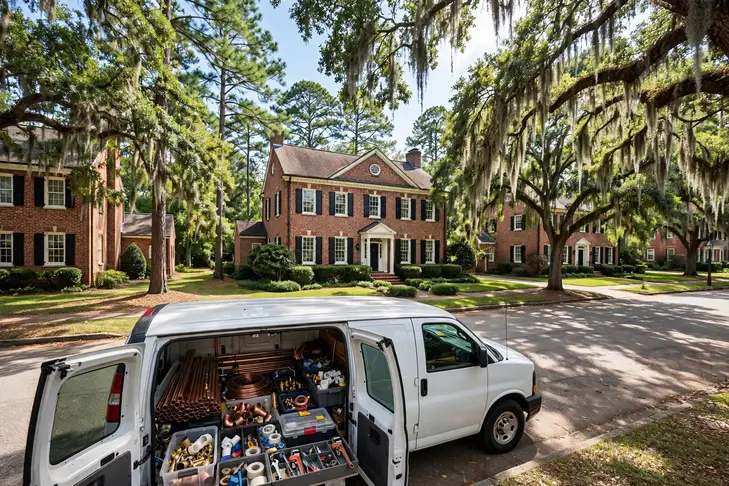
A local plumber's van on a residential street
A service van between calls in Florence
Water heater installation in a home garage
Heater calls follow the housing eras in Florence

Florence plumbing, in brief

The median Florence home was built in 1984; 42.7% of the stock predates 1980, and the pattern this metro's own data ranks first is galvanized pipes at the end of their life. PlumbReach USA is a referral service, not a plumbing company: one call connects you with an independent local plumber serving your ZIP code.

The Florence housing stock, and what it means for plumbing

Start with the raw material: 199,675 people, 91,063 housing units, and a housing stock whose middle home was built in 1984. That single date organises everything on this page. On one side of it stand the older districts — 15.7% of homes predate 1960, 42.7% predate 1980 — plumbed in galvanized steel, cast iron and clay, in homes across Darlington, Florence that have been repaired piecemeal for decades. On the other side, the 23.3% built since 2000 run plastic lines under slabs, and fail in the newer ways. A Florence plumber reads a home's build year the way a doctor reads a chart: it predicts, before a single wall is opened, which systems deserve suspicion first.

There is a materials timeline buried in Florence's housing figures, and it reads like a plumber's diary. The 14,297 homes from before 1960 were drained in cast iron or clay and supplied, in many cases, in galvanized steel. The 24,587 that followed between 1960 and 1979 mixed those materials with early copper. Then came the 30,961 homes of 1980-1999, plumbed increasingly in copper and early plastics. Each band of that timeline is now a band of characteristic failures, arriving in the order the materials tire — which is why a home's build year, in this metro, is the single most predictive fact about its plumbing.

The newer side of Florence — the 23.3% of homes built since 2000, concentrated around growing communities like Florence — runs on plastic supply and drain lines that age more gracefully but fail in their own ways: slab leaks where lines run under concrete, water heaters worked hard by 2,257 cooling degree days of hot-season demand, and fixture cartridges wearing out in houses that all reach the same age at the same time. One metro, two plumbing generations, and the sections below take them in the order this metro's data ranks them.

One more record sits over the whole metro, and it is the one the pipes themselves keep: the weather's. FLORENCE RGNL AP, SC US logs 45.3 inches of precipitation in an average year and swings between 70.2 days at 90 degrees or more and 40.0 nights at or below freezing. Buried lines ride that swing in the soil; heaters ride it in their cycle counts; exposed runs ride it at the extremes. Cross the swing with the housing ages above and the selection of problems further down this page stops looking like a list and starts looking like an arithmetic result.

The Florence plumbing profile in numbers

The metro's building eras on one side, its weather record on the other — and its plumbing where the two meet.

The distribution, in one breath: of every hundred Florence homes, 15.7 were standing before 1960, 27.0 went up in the two decades after, 34.0 in the two after that, and 23.3 have arrived since 2000. Percentages flatten the picture, so hold the counts beside them — 14,297 oldest-era homes, 21,218 newest — and the metro's plumbing stops being an abstraction: it is that many systems, of those ages, failing in that order.

The 1980-1999 band runs this metro, and its plumbing has a particular flavour: mature but not ancient. Copper systems old enough to have histories, plastic drains still in their prime, fixtures from the first cartridge generation reaching their wear points in waves, heaters cycling through replacements on a schedule set by whole subdivisions. Florence's is a maintenance-era stock — the decades where attention compounds and neglect starts to invoice.

Close behind the leader come the 1960-1979 homes, 27.0% of the stock. Their plumbing is mid-change by construction — the decades when materials swapped over mid-stream — so this band is where a Florence plumber earns the diagnostic fee: pressure tests and camera runs that say which side of the transition a given house was built on.

Translate the climate record into plumbing terms and it comes out as three working conditions. Condition one, the freeze count — 40.0 nights a year when exposed water can solidify and split its container. Condition two, the heat count — 70.2 days that load drains, heaters and tempers simultaneously. Condition three, the water itself: 45.3 inches of it arriving from the sky to move the soil around every lateral in the metro. Florence's systems are engineered, installed and aged inside those three conditions, and their failures carry the conditions' fingerprints.

A profile is only useful if it predicts something, and this one predicts the shape of a plumbing diary in Florence: which streets will call about drains, which about pressure, which about heaters, and in which months. Everything after this section is that prediction written out as services, problems and answers — the numbers first, the narrative second, the way the evidence actually runs.

Plumbing services in Florence

Ordered by what this metro's data says its homes need most.

Pipe Repair & Repiping in Florence

Pipes age by material: galvanized chokes with rust, copper pits into pinholes, early plastic turns brittle. Repair answers the isolated failure; repiping replaces a system whose failures have become a rhythm, rerunning supply lines in modern material while the house stays liveable around the work.

Every pipe in Florence is in one of three conditions: new enough to forget, old enough to watch, or old enough to be living on borrowed time. The stock's distribution across those conditions is the metro's building history restated — the pre-1980 districts deep in the third condition, the growth corridors still in the first — and pipe services are how individual homes move between them. A repair returns a watched system to service; a repipe promotes a borrowed-time system back to the first condition wholesale, at a stroke, for another generation. The assessment that chooses between them is short, physical and evidenced: pressure, water colour, and the repair history in the walls. Locally the workload concentrates where the stock is oldest — the districts built around the 1980s first.

The repair-or-renew caseload is set by one figure above the rest: 42.7% of Florence homes predate 1980, plumbed in the materials now at the end of their service lives. Around Hartsville (7,422 residents) as in the old core, that percentage is not an abstraction — it is the street's plumbing, house by house.

More about pipe repair & repiping ➔

Sewer Line Repair & Replacement in Florence

Of all a home's pipes, the sewer lateral works under the worst conditions: buried, jointed, rooted at, and loaded by every fixture in the building. Its care begins with seeing it — a camera run that records material, slope and damage — and proceeds by the footage's logic: clear what clearing cures, mend what is locally broken, renew what has failed along its length. No stage of that is guesswork, and the homeowner sees the same footage the plumber does.

A lateral's enemies in Florence are patient and they are local: roots working the joints under the canopy streets of Darlington County, soil that swells with 45.3 inches of yearly rain and shrinks back in the dry stretches, and plain elapsed time in the districts where the pipe predates the pavement above it. Against enemies that slow, the camera is less a diagnostic luxury than the only honest calendar the line will ever get — footage that says whether the pipe has years left, or has been spending them. The remedy scales to that verdict and to no other. It is why two Florence homes of the same age, on different streets, so often need the same visit in the same year.

Sewer demand follows the founding map: the districts built first, around the old centre and out through Lake City, hold the jointed clay and iron; the growth rings hold plastic with decades in hand. 15.7% of the metro's homes stand on the founding side of that line, which is why the footage here so often shows a pipe at the end of its story.

More about sewer line repair & replacement ➔

Emergency Plumbing in Florence

One call from anywhere in the Florence metro — from Florence out to Lake City — routes to the local professional on cover; the failure patterns they expect first are the ones this page's data ranks.

More about emergency plumbing ➔

Drain Cleaning in Florence

Across Darlington, Florence, drain calls follow the building map: iron and clay near the old core around Florence, plastic at the growth edge — one service, two different crafts, both covered by the routing on this page.

More about drain cleaning ➔

Water Heater Repair & Installation in Florence

From Florence to Lake City, the heater question is the same — repair the unit or renew it — and the honest answer starts from its age against Florence's demand record, which this page sets out.

More about water heater repair & installation ➔

Leak Detection & Repair in Florence

A creeping meter in a Florence home is located, not guessed at: the professionals routed here trace the line with instruments and confirm the spot before any floor or wall is opened.

More about leak detection & repair ➔

Toilet Repair & Installation in Florence

Toilet calls in Florence are the small end of the diary and the most democratic: every era of the 91,063-home stock produces them, and the local fix starts with the mechanism in the tank, not the porcelain.

More about toilet repair & installation ➔

Faucet, Fixture & Garbage Disposal Repair in Florence

Drips and disposals across Darlington, Florence are small jobs with a standard: repair the mechanism where the fixture deserves it, renew it where it does not, and check the shutoffs and supply lines while the cabinet is open.

More about faucet, fixture & garbage disposal repair ➔

What Florence books most

There is a plainer way to say what this page's ranking means in practice: most calls in Florence are two calls. The first answers Galvanized pipes at the end of their life; the second answers ageing sewer laterals. Between them they account for the shape of a local plumber's week here — the districts visited, the parts stocked, the diagnoses made fastest because they are made most often. The remaining services divide the rest of the diary among them, essential but episodic, the supporting work around two leading patterns.

Plumbing problems Florence homes actually get

Ranked for this metro alone, from its Census housing profile and NOAA climate record.

Galvanized pipes at the end of their life

Galvanized steel pipe was plumbed into millions of homes, and it ages in a particular way: the zinc coating gives out, the steel rusts, and the rust grows inward until the pipe that once carried a full stream is choked to a fraction of its width. With a median build year of 1984 and 42.7% of its homes predating 1980, Florence has a large stock of housing in the galvanized era, and its symptoms are the classic ones — pressure that has faded a little more each year, water that runs rusty after the house sits quiet overnight, and leaks that begin appearing at joints. No cleaning reverses this; the corrosion is the pipe itself converting to rust. The judgement call is timing. A galvanized system with one small leak and acceptable pressure can be repaired and watched. A system leaking in several places, with pressure dropping across every fixture, is telling you the material has finished its service life, and each repair buys a shorter quiet interval than the last. Repiping in PEX or copper replaces the whole question with a new system and restores the pressure the home was built with.

Galvanized pipe fails politely, which is exactly the problem — it gives a household years of small warnings that are easy to live with. The zinc coating that once protected the steel wears through, rust takes its place, and the rust grows inward like a narrowing artery. Flow to the farthest fixtures drops first. A shower that shares a line with a running tap loses its pressure. By the time the water itself runs discoloured after the house has sat quiet overnight, the narrowing is well advanced. None of this is a single emergency; it is a system reaching the end of its design life on schedule, and in Florence's pre-1980 neighbourhoods that schedule is arriving for whole streets at once, because the pipes went in together.

The replacement side of the ledger is equally local: when a Florence home of the galvanized era is sold, inspected or renovated, the supply lines are among the first systems examined — because everyone in the local trade knows the material's age here. A pattern the whole market has learned to look for is not an anecdote; it is the metro's housing data wearing a tape measure.

Watch for

  • Fixtures farthest from the meter noticeably weaker than near ones
  • Rust-coloured first water of the day that clears within seconds
  • Shower pressure that drops hard when a second tap opens

About pipe repair & repiping ➔

Ageing sewer laterals

Ownership is the first surprise with a lateral: the buried stretch between the house and the street main typically belongs to the homeowner, however public it feels. The second surprise is its age. In Florence, laterals under the older streets were laid for the homes counted in the 38,884 pre-1980 properties — jointed clay or iron, bedded in soil that has swelled and shrunk through 45.3 inches of rain a year ever since. A pipe can be nobody's thought for fifty years and then become the only thought in the house, usually on the evidence of the ground-floor drain in it.

Slope is the lateral's invisible specification. A sewer line does not need much fall — a quarter inch per foot is the classic figure — but it needs it consistently, and ageing takes consistency away: a section settles, a joint steps down, and the line develops a reach where flow slows and solids settle out. That belly then collects a little more each week, narrowing the line from the bottom up. Many a Florence lateral diagnosed as 'blocked' is really 'bellyed' — clearable today, certain to collect again. The camera distinguishes the two, and the distinction decides whether the household is booking a cleaning or planning a repair.

The census figures draw the map: 14,297 homes from before 1960 and a median build year of 1984 mean the typical lateral in Florence has been buried for decades, and the oldest have passed the service life their materials were expected to give. Multiply one buried line by 91,063 housing units and the pattern's rank on this page stops being surprising.

Watch for

  • The ground-floor bath draining slower than every fixture above it
  • A cleanout cap weeping or crusted with residue
  • Trouble that worsens during long, heavy rain

About sewer line repair & replacement ➔

Ageing cast iron sewer lines

Iron drains do not fail the way modern pipes fail. Plastic cracks; iron thins, roughens and narrows from within, wall by wall, until the smooth bore the installer left is a reef of corrosion products that catches everything the household sends down. In Florence, that reef is growing under the oldest streets in the metro — the homes around Florence plumbed when iron was the only serious choice. A line in this condition can serve for years in a diminished way, draining slowly, complaining occasionally, which is exactly how it escapes attention until the day it stops entirely.

There is a temptation to judge an old drain by its kindest day. On its kindest day it still clears, still serves, still seems to argue for another year. Judge it instead by its trend: clearings that come closer together, a tub that drains slower each season, a smell that returns after rain. In the 14,297 pre-1960 homes across this metro, that trend is the pipe's biography being read aloud — corrosion does not pause between visits, and the homes that fare well are the ones whose owners believed the early chapters.

The local weight of it: 14,297 homes in this metro predate 1960, and while some have renewed their drains since, every original line still serving is past the age its installers planned for. That is a population of risk no single street explains — it is the metro's founding stock, failing on a schedule set in the post-war decades.

Watch for

  • Floor drains in the basement or ground floor backing up during heavy use
  • A sewer smell near drains that cleaning does not shift
  • Patches of lawn staying green or soggy over the line's path

About sewer line repair & replacement ➔

Storm season readiness in Florence

When a storm system pushes through Florence, the plumbing load arrives as water: saturated ground pressing on laterals, storm runoff testing every joint, and households running everything at once once the weather clears. The homes that ride the season out well are the ones whose drains were clear before it started — a line at half capacity in June is a backup in September.

The season's measure at FLORENCE RGNL AP, SC US is 45.3 inches of rain in an average year, with the storm months capable of delivering a season's worth in days. Florence's laterals — the generations-old runs under Florence and the old core most of all — carry the surge, and the backups of storm season are written in that arithmetic.

A closer look: galvanized pipes at the end of their life in Florence

Where this problem lives in Florence, it lives street by street. The galvanized went in by the subdivision, not by the house — one builder, one material, one decade — so the streets around Florence that filled in during the post-war decades are ageing out of their supply pipe in formation. That formation is visible in the call pattern: a street produces its first repipe, then its third, then a run of them, as neighbours compare notes over fences. The homes on the newer side of the metro will meet different materials at different ages; for the galvanized districts, the decade of decision is the present one.

Strip the pattern down to its inputs and the ranking stops being mysterious: 77,596 households drawing on systems installed across a median build year of 1984, in a climate that swings between 70.2 days of serious heat and 40.0 freezing nights. Whatever pattern a metro with those inputs manufactures most, it manufactures here — the lead position is less a title than a consequence, recalculated from the same public records any sceptic can check.

Experienced local practice starts with the simple certainties — the observations that take minutes and decide the most:

  • Pressure at the farthest fixture compared with the tap nearest the meter
  • The water's colour after the house has stood quiet overnight
  • How many repairs the system has already had, and in which materials
  • Whether the shutoff valves still turn — in this stock, they are often as tired as the pipe

From problem to fixed, in Florence

A plumbing problem inside a Florence homePROBLEM
➔
The same system in Florence after professional repairSOLUTION

Areas covered in the Florence metro

Florence

Population 40,205

Hartsville

Population 7,422

Darlington

Population 6,128

Lake City

Population 6,032

North Hartsville

Population 3,217

Timmonsville

Population 2,153

Lamar

Population 1,446

Johnsonville

Population 1,037

Dovesville

Population 1,014

Pamplico

Population 952

Quinby

Population 865

Scranton

Population 820

Also in the Florence metro: Olanta (population 703), Coward (population 668).

Beyond Florence itself, the metro takes in Hartsville (7,422 residents), Darlington (6,128) and the rest of the communities in the grid above — each plumbed in its own building era, which is why two streets in the same metro can need entirely different plumbing conversations. The ZIP list below is the full coverage footprint: if your code is on it, this page was written about your housing stock.

Beyond the largest communities sit Lake City (6,032), North Hartsville (3,217), Timmonsville (2,153), Lamar (1,446), Johnsonville (1,037) — smaller places across Darlington, Florence, covered on the same terms. Their housing tends to be older on average than the big suburbs', and their calls follow the older patterns on this page. One routing covers them all: find your ZIP code below and the rest is a phone call.

Florence ZIP codes we cover

29069, 29079, 29114, 29161, 29501, 29505, 29506, 29530, 29532, 29540, 29541, 29550, 29555, 29560, 29583, 29591, 29593

The Florence metro in detail

Every metro has a first city and a supporting cast, and the census figures draw the billing plainly here: Florence first, with 40,205 residents; Hartsville second at 7,422; Darlington third at 6,128; then the long tail of smaller communities in the grid above. The billing matters less than the building dates — each of these places was plumbed in its own decade, by its own builders — but between them they account for nearly every housing era, material and failure pattern this page describes.

The metro answers to 2 county governments (Darlington, Florence), a patchwork that matters at permit time rather than at the pipe. Darlington County carries the centre; the others carry the growth rings and the older outlying towns. A plumber routed through this page works inside that patchwork daily — the water does not care about the boundaries, but the job's paperwork does.

This page ends at the metro boundary, but the region does not: Myrtle Beach, SC, Columbia, SC and Charleston, SC continue the coverage in their own directions, each with a profile built from its own Census and NOAA figures. If your home sits near the line between metros, go by your ZIP code — it places you in the dataset that describes your housing.

The region around Florence is a set of variations on its theme: Myrtle Beach, SC, 53 miles off, runs a median build year of 1998 on a metro population of 427,551; Columbia, SC (71 miles) medians 1990 on 879,918; Charleston, SC (81 miles) medians 1995 on 889,263. Nearness is not sameness — a few decades of median build year separate their plumbing as surely as the miles separate their maps.

Count the metro per unit of itself: 5,357 housing units per covered ZIP code; 38,798 households per county; 14 communities sharing 2 county governments. Then weigh the generations against each other — 1.8 older homes for each newer one — and the service pattern on this page stops being a list and becomes a proportion: that much of the diary written by ageing systems, the rest by young ones wearing in.

Florence by the derived numbers — median home age 42 years · owners in 51,601 homes, renters in 25,995 · each covered ZIP code carrying about 841 pre-1960 homes · a heating-to-cooling degree-day ratio of 1.03 · 1,151 mm average annual rainfall.

Florence plumbing questions

Is my Florence neighbourhood inside PlumbReach USA's coverage?
Coverage follows the metro's own map: 17 ZIP codes across Darlington, Florence, anchored on Florence and running out through Hartsville, Darlington and Lake City. The list printed on this page is the working boundary — inside it, one call routes you to an independent local plumber who serves your street. One measure of the footprint: Florence accounts for 20.1% of the metro's people, and the remaining share spreads across the communities in the grid — every one of them plumbed in its own decade, every one of them a single call from a local professional. The boundary is worth stating in numbers: 77,596 households, a median build year of 1984, and a climate record kept at FLORENCE RGNL AP, SC US — the coverage and the data describe the same ground. Read the boundary in its own numbers: the list opens at 29069 by Florence (40,205 residents), crosses 29505 near Hartsville (7,422) and 29550 near Darlington (6,128), and closes at 29593 — 17 codes over Darlington, Florence in all. Stated as the stock it covers: the era ledger reads 14,297 homes before 1960, 24,587 from 1960-1979, 30,961 from 1980-1999 and 21,218 since 2000 — 91,063 units, 77,596 households, 66.5% of them owner-occupied.
My Florence home was built around 1984. What plumbing should I be watching?
Houses of that vintage in Florence usually run a mixture of original pipework and piecemeal replacements. Metro-wide, 42.7% of homes predate 1980 and 15.7% predate 1960, so tired supply lines, first-generation fixtures and older drain materials are the local norm rather than the exception. Watch for repetition: one leak is an incident, but the same fault returning is the system filing a report on itself. In Florence that plays out across 17 ZIP codes, from Florence to Hartsville. The same watch-list runs metro-wide: from Hartsville (7,422 residents) to Darlington (6,128) and Lake City, across Darlington, Florence, the 38,884 pre-1980 homes share the materials this answer describes — which is why a neighbour's leak two streets away is worth a homeowner's attention here. Scale explains the pattern: 91,063 housing units share this stock profile, and the 24,587 homes of 1960-1979 alone outnumber the entire housing stock of most smaller metros. The counts behind the watch-list: 14,297 homes before 1960, 24,587 between 1960 and 1979, 30,961 between 1980 and 1999, 21,218 since 2000 — 91,063 units in all. And the climate pressing on every era alike: 64.7 degrees on average at FLORENCE RGNL AP, SC US, 70.2 hot days, 40.0 freezing nights, 45.3 inches of rain.
Which plumbing fault shows up most often across Florence?
Stand back from the ranking and the pattern explains itself: galvanized pipes at the end of their life is what this metro's building history has been manufacturing for decades. Galvanized steel pipe was plumbed into millions of homes, and it ages in a particular way: the zinc coating gives out, the steel rusts, and the rust grows inward until the pipe that once carried a full stream is choked to a fraction of its width. The districts around Florence report it most, the newer subdivisions least — a map of the problem that is also, not coincidentally, a map of the metro's growth. The backdrop is the same metro-wide: 91,063 housing units working against the FLORENCE RGNL AP, SC US climate record. The ranking's local weight: Galvanized pipes at the end of their life sits on top because the stock manufactures it — 38,884 pre-1980 homes, 70.2 hot days and 40.0 freezing nights a year at FLORENCE RGNL AP, SC US, all pressing the same systems. The full scoring line for Florence: Galvanized pipes at the end of their life first, ageing sewer laterals second, then the rest — computed over 91,063 housing units, 70.2 hot days, 40.0 freezing nights and 45.3 inches of rain. The inputs behind the ranking, code by code: the codes run 29069, 29505, 29550, 29593 and 29555 among the 17 on the list, spread over Darlington, Florence.
How does the Florence climate change what my plumbing needs?
Mostly through the ground. Buried lines do not experience weather as temperature; they experience it as soil — soil that swells with Florence's 45.3 inches of average rainfall, shrinks back in the dry stretches, and shifts the joints of every lateral in the metro a fraction at a time. Above ground, the same record works on exposed pipework and heaters. The climate is not a detail on this page; it is half the evidence. The figures behind that answer, from the station record: a yearly average of 64.7 degrees, 45.3 inches of precipitation, 70.2 days at 90 or above and 40.0 nights at freezing or below — the four numbers this page's seasonal section is built from. It is the same story from Hartsville to Darlington — the stock decides, and this stock's median build year is 1984. That is the metro-wide version; the household version differs by exposure — a shaded lot in Hartsville, an open slab in Darlington (6,128 residents), a crawl space in Lake City — but the loads themselves, 2,334 heating degree days against 2,257 cooling, are the same sky over every roof in Florence. Compare the load across the footprint and it does not change: the same 2,334 heating degree days fall on Hartsville (7,422 residents) as on the core, the same 2,257 cooling degree days on Lake City — one sky, every roof. Filed with the record: FLORENCE RGNL AP, SC US also logs the extremes the averages hide — and the stock it falls on runs to 38,884 pre-1980 homes out of 91,063 units, spread from Florence to Lake City. The ground it falls on, in codes: the codes run 29069, 29505, 29550, 29593 and 29555 among the 17 on the list, spread over Darlington, Florence.
A line has let go somewhere in my Florence house and water is spreading. What happens first?
The first five minutes belong to one valve. Find the main shutoff (meter box at the street for many Florence homes, an interior valve for others), close it, then open a low faucet so the broken line empties into a drain instead of a wall. Photograph the damage for your records once the water stops, keep clear of any electrics the water has reached, and then call — in that order. Across the metro's 2 counties, Darlington County included, the pattern repeats wherever the housing matches. One metro, two shutoff geographies: the pre-1980 districts around the centre and out in Hartsville run interior valves, while the slab subdivisions through Darlington run meter boxes at the street. The 77,596 households in Darlington, Florence divide between them, and the calm-day version of this emergency is learning which one your home has. After the water is off, the metro's pattern helps the call: telling the professional your district — near Hartsville, out toward Lake City — tells them which housing era's shutoff and stock they are walking into. One fact steadies the first minutes: your home is one of 91,063 in a metro whose median build year is 1984 — the valve arrangement follows that era, indoors in the older stock, out at the meter in the slab rings. True across the whole stock: the era ledger reads 14,297 homes before 1960, 24,587 from 1960-1979, 30,961 from 1980-1999 and 21,218 since 2000 — 91,063 units, 77,596 households, 66.5% of them owner-occupied — the valve's address changes with the era, the first move does not. And if the call goes out, the geography that frames it: Florence sits 53 miles from Myrtle Beach, SC, 71 miles from Columbia, SC and 81 miles from Charleston, SC — three neighbouring metros, three different housing stocks, none of them the stock inside your walls. Learn it street by street if you must: the 29593 subdivisions shut off at the meter, the 29555 districts at the wall, the oldest homes out toward 29114 at a curb stop — the map of valves is the map of build decades.
Are older Florence homes more likely to need repiping?
It is less about age than about evidence. A sound copper system from the 1980s with a single failed joint is a repair, full stop. The repipe case builds when the same material fails in different places — and with 38,884 pre-1980 homes in this metro, local plumbers see that sequence weekly. Pressure declining across every fixture at once is the other half of the verdict. Homeowners in Hartsville (7,422) and Darlington (6,128) read this page for the same reason — the stock there is the same stock. That is as true on the streets around Florence as it is at the metro's growing edge. The pattern is not evenly spread: it concentrates in the 38,884 pre-1980 homes, thickest in the founding districts and the first suburbs — the streets around Hartsville and the old core — and thins toward Lake City and the growth edge, where the stock is a generation younger. Put the metro's numbers to it: 42.7% of homes predate 1980, so the repipe conversation is a standing item here in a way it is not in younger metros — Florence simply has more of the defendant material in the ground and in the walls. Against the whole stock — 91,063 housing units, 77,596 households, 42.7% of them pre-1980 — the sequence test is how Florence plumbers separate a repair from a renewal without guessing. The defendant material's full extent: the era ledger reads 14,297 homes before 1960, 24,587 from 1960-1979, 30,961 from 1980-1999 and 21,218 since 2000 — 91,063 units, 77,596 households, 66.5% of them owner-occupied.
Who actually turns up at my door if I call PlumbReach USA from Florence?
Nobody from PlumbReach USA will knock on your door, because that is not the service. We connect Florence homeowners with independent local plumbing professionals; the person who arrives is one of those professionals, working for their own business. What we publish — pages like this one, built from the metro's real housing and climate figures — is the homework we do so the connection is an informed one. The local figures behind it: 38,884 homes from before 1980 and 21,218 built since 2000, sharing one system of streets and soil. The arrangement is the same across the whole footprint: 17 ZIP codes, 2 counties, communities from Florence through Lake City — in each of them the professional is local, independent, and working their own patch of the metro's housing. The model's footprint on this page is exact: 17 ZIP codes across Darlington, Florence, 77,596 households — in every part of it, the professional who arrives is a local business, and PlumbReach USA's part ends at the connection. Nothing about the arrangement changes with the data on this page: FLORENCE RGNL AP, SC US's record, a median build year of 1984, 38,884 pre-1980 homes — the homework is ours, the work is the local professional's, in every district alike. The arrangement holds across the whole stock: the era ledger reads 14,297 homes before 1960, 24,587 from 1960-1979, 30,961 from 1980-1999 and 21,218 since 2000 — 91,063 units, 77,596 households, 66.5% of them owner-occupied — in each era, the professional is local and independent.
Which small plumbing jobs prevent big ones in a Florence house?
The highest-value checks here are the ones aimed at this page's top patterns. Know and test your shutoff. Keep the meter honest — a reading taken when the house is asleep should not move. Give the water heater its yearly drain-down, and the ground-floor drains a run of water so their traps stay wet and sealed. In a metro where the median home was built in 1984, those four habits intercept most of what eventually becomes an emergency call. The local version of the list is set by FLORENCE RGNL AP, SC US's record and the Census profile together: a median home built in 1984, 45.3 inches of rain in an average year, and the patterns ranked at the top of this page. Another metro's calendar would order the same checks differently; Florence's numbers order them this way. The checks travel well because the conditions do: FLORENCE RGNL AP, SC US's record covers Hartsville, Darlington and Lake City alike, and the housing eras repeat across all 17 ZIP codes. A neighbour in another district keeping the same calendar is not copying you; they are reading the same data. What the routine is really insuring against is written at the top of this page: the patterns this metro's 2,334 heating degree days and 70.2 hot days manufacture out of its housing eras, caught while they are still whispers. The calendar's arithmetic: 70.2 hot days and 40.0 freezing nights at FLORENCE RGNL AP, SC US, 45.3 inches of rain, over a stock of 91,063 homes — 38,884 of them pre-1980, 21,218 since 2000. The routine's households, community by community: the community ledger reads Florence (40,205 residents), Hartsville (7,422), Darlington (6,128), Lake City (6,032) and North Hartsville (3,217), out of 199,675 residents metro-wide.
Who decided that these are Florence's main plumbing problems?
It starts from the two datasets this page is built on: Census housing figures for the Florence metro and NOAA's 1991-2020 climate normals for FLORENCE RGNL AP, SC US. Every candidate pattern — ageing laterals, slab leaks, freeze damage and the rest — is weighed against both: how much of the local stock is exposed to it, and how hard the local climate pushes it. The order you are reading is the result, and it is recalculated metro by metro rather than inherited from a bigger city's page. Run the same scoring on any single district and the order bends: Hartsville's streets would rank their own list, Lake City's another. This page ranks the metro as a whole — 77,596 households across Darlington, Florence — which is why the evidence paragraphs keep returning to where each pattern actually concentrates. The inputs are on the record: the Census profile of Darlington, Florence — 91,063 housing units, median build year 1984 — and the normals at FLORENCE RGNL AP, SC US. Change either input and the order changes; both are this metro's own. Re-run the sort on any other metro's inputs and a different order falls out; on Florence's — 15.7% pre-1960 stock, 42.7% pre-1980, 70.2 hot days, 40.0 freezing nights — this order is the one the arithmetic returns. The scoring's raw material, era by era: the era ledger reads 14,297 homes before 1960, 24,587 from 1960-1979, 30,961 from 1980-1999 and 21,218 since 2000 — 91,063 units, 77,596 households, 66.5% of them owner-occupied. The full local podium the scoring returns: Galvanized pipes at the end of their life, ageing sewer laterals, ageing cast iron sewer lines — then the rest of the patterns weighed for Florence, each scored on this metro's stock and sky alone. The sort ran over the whole list — from 29069 and 29505 through 29550, 29593 and 29555 to 29114 — and returned one order for all of it, because the inputs were the metro's totals, not any single district's.
Which parts of Florence have the oldest plumbing?
Work outward from the middle. The centre of Florence and the neighbourhoods that grew first around it hold Florence's oldest plumbing — iron and clay drains, steel supplies, laterals laid when the metro was young. Each ring beyond them is a decade younger in its pipework, out to the subdivisions past Darlington. The plumbing map and the building map are the same map; age is the legend that reads both. The counts behind the geography: 14,297 pre-1960 homes (15.7% of the metro), concentrated where the map says — the core around Florence and the first suburbs in Darlington County — against 21,218 homes built since 2000 at the metro's edge. The drive that proves it runs from the centre of Florence outward: through Hartsville (7,422 residents), then Darlington (6,128), then the younger rings toward Lake City — a single trip across Darlington, Florence that travels forward through the metro's plumbing history decade by decade. County lines annotate the same map: the old core sits in Darlington County, and the rings cross into the rest of Darlington, Florence as they widen — the pipework's age follows the building, not the boundary. The rings, counted: 14,297 homes in the oldest, 24,587 in the 1960-1979 ring, 30,961 in the 1980-1999 ring, 21,218 since 2000 — 91,063 in all, centred on Florence (40,205 residents). The oldest systems' addresses, in codes: the codes run 29069, 29505, 29550, 29593 and 29555 among the 17 on the list, spread over Darlington, Florence, with the oldest plumbing toward the first codes on the list. The patterns the oldest stock feeds, in this page's order: Galvanized pipes at the end of their life, ageing sewer laterals, ageing cast iron sewer lines — a ranking the founding districts of Florence dominate precisely because their pipework is the metro's earliest.
What does a plumbing check flag most often in Florence homes?
In a metro with a median build year of 1984, the flags repeat: shutoff valves that no longer turn, a water heater living past its anode's protection, drains whose behaviour nobody has tested under full use, and supply lines in the era's original material. The check itself is undramatic — valves exercised, the meter watched, the heater's age read off its plate — but in housing of this age it finds the small failures while they are still small. In Florence the walk has local emphases: with 42.7% of homes predating 1980, original-material supply lines earn an extra look, and with FLORENCE RGNL AP, SC US recording 40.0 freezing nights a year, the exposed runs earn one too. The order stays the same; the attention follows the data. District by district, the same half hour: in Darlington County's oldest homes the flags are materials; in the middle ring, around Hartsville (7,422 residents), they are valves and heaters; at the growth edge they are cartridges and first questions about lines under slabs. Across Darlington, Florence the walk reads the same because the stock rhymes: a median of 1984 in the core districts around Florence, younger past Hartsville — the findings age with the streets. Kept with the house papers, a Florence check reads: shutoff turned, heater age noted, meter still at rest, drains clear — dated against a stock where 42.7% of homes predate 1980 and 40.0 nights a year freeze. The walk's stock, counted before the door opens: the era ledger reads 14,297 homes before 1960, 24,587 from 1960-1979, 30,961 from 1980-1999 and 21,218 since 2000 — 91,063 units, 77,596 households, 66.5% of them owner-occupied.

Before an emergency, read the guide: How to shut off your home's water main

Nearby metro areas

Need a plumber in Florence?

Describe the problem and the call center routes you to an independent local plumber who works in the Florence metro.

Call center hours: Mon-Fri 7:00 AM-10:00 PM ET | Sat 8:00 AM-10:00 PM ET | Sun 7:00 AM-9:00 PM ET

Call Now
