Signs of a Sewer Line Problem
A sewer line almost never fails without sending warnings first. It cannot speak, so it reports through the fixtures: the slow drain that is suddenly every drain, the gurgle in the ground-floor bath when the upstairs shower empties, the smell that appears after rain. Read early, those reports are a maintenance conversation. Read late, they are a backup — sewage in the house, the one plumbing event nobody describes as minor. This guide walks through the signs in the order they usually arrive, explains what each one is actually saying about the line underground, and marks the point where watching should turn into a camera inspection.
Call center hours: Mon-Fri 7:00 AM-10:00 PM ET | Sat 8:00 AM-10:00 PM ET | Sun 7:00 AM-9:00 PM ET
The first sign: one drain, then every drain
A single slow drain is a local story — hair in the bath trap, grease in the kitchen branch. The sewer line's first unmistakable sign is synchrony: several drains, in different rooms, slowing in the same week. Fixtures that share nothing except the main line cannot conspire; when they misbehave together, the common chapter is the suspect. The ground floor reports first and worst, because it sits nearest the line's level. A household that notices the pattern early — all drains, same week — is reading the line's opening statement, and it is the cheapest moment in the whole story to act.
Gurgling: the sound of displaced air
Drains are supposed to move water and air together, the air escaping up through vents as water flows down. A line narrowing or filling changes that choreography: water pushed through a restricted section shoves air ahead of it, and the air escapes through the nearest trap — the toilet bowl that bubbles when the washing machine discharges, the bath drain that sighs and glugs as the kitchen empties. Gurgling from a fixture you are not using is therefore never that fixture's fault. It is the sound of a system whose main passage is compromised, reporting at the nearest available microphone.
The ground-floor fixture rule
Sewage obeys levels, and the rule of the ground-floor fixture organises most sewer symptoms. When a main line blocks or fills, the backup surfaces at the first opening it can reach, downstairs — typically a ground-floor tub, a basement shower or a floor drain — because that is where the rising column of water reaches an exit soonest. The corollary is diagnostic gold: if the ground-floor fixture misbehaves while everything above it drains normally, the problem is very likely downstream of the whole house, in the lateral itself. If only an upper fixture is slow, the problem is almost certainly local to that fixture's branch. One observation, honestly made, halves the search space.
Smells: what the nose knows and when
A healthy drainage system is sealed by design — every trap holds a plug of water whose only job is to keep sewer air inside the pipes. Persistent sewer smell therefore means a seal has failed somewhere: a trap dried out in a little-used floor drain or guest bath, a cracked vent, or — the case this guide is about — a line whose behaviour is pushing air and odour back into the house. Smell that strengthens after heavy rain, or that arrives with gurgling, belongs to the third category. Smell from one fixture that has sat unused for weeks usually belongs to the first, and is cured with a jug of water and a spoonful of mineral oil to slow the trap's evaporation.
The yard's testimony: lush patches, soft ground, the cleanout
The line's route across the yard keeps its own records. A strip of grass conspicuously lusher than its surroundings, along the path from house to street, is being watered and fed from below — a joint leaking sewage into the soil. Ground that stays soft or spongy over the line after the rest of the yard has dried tells the same story. The cleanout — the capped access point, usually in the yard or basement — gives the direct testimony: opened carefully (stand aside; a charged line can push back), standing water inside it means the line beyond is holding what it should be carrying away. A dry, clear cleanout with symptoms indoors moves the search back inside the house; a full one settles the argument.
Patterns that point at roots, bellies and breaks
Some sewer stories have signatures. Backups that return seasonally, worst in the growing months, and clearings that bring back stringy material, spell roots in a joint — a living problem on a living schedule. Trouble that worsens after long rain spells, in a line that tests clear of blockage, suggests infiltration or a bellied section filling with groundwater's help. A sudden, total failure after years of quiet — especially with a depression or sinkhole forming over the line's route — suggests structural failure: a collapsed section. Each signature has its own remedy, which is why the camera comes before the quote: the sign narrows the possibilities, but only the footage closes the case.
When a sign becomes an emergency
Most signs in this guide tolerate a booked appointment. Three do not. Sewage physically backing up into the house — at a floor drain, a ground-floor tub, a toilet that will not clear — is the emergency itself, not a sign of one: stop using water anywhere in the home, since every flush upstairs arrives downstairs, and call. A strong sewage smell accompanied by anyone in the house feeling unwell deserves the same urgency. And a cleanout or yard area where the ground is actively sinking over the line marks a collapse in progress. Everything upstream of those three is warning, and warning is a gift — the whole purpose of reading signs early is to keep the story in the chapters where a camera and a conversation are still the right tools.
What a camera inspection will actually show
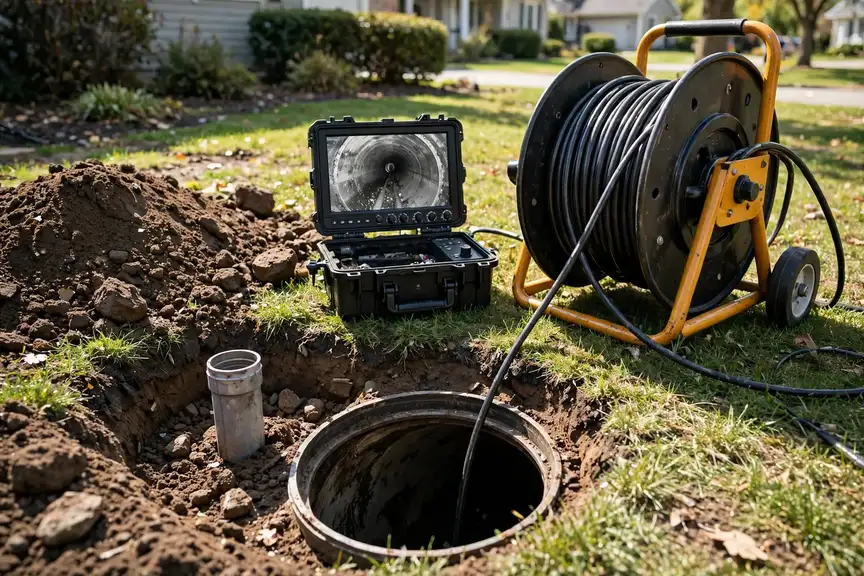
The inspection this guide keeps recommending is a short, undramatic procedure with an outsized evidentiary value. A waterproof camera travels the line from the cleanout, its footage timestamped by distance, while the plumber narrates what passes: the material, the joints, any roots, bellies standing full of water, offsets, cracks, the condition at the street connection. The household should receive or view that footage — it is the document from which every later decision properly flows. A line pronounced healthy on camera closes the case honestly. A line condemned without one has not been tried at all, and the distinction is the difference between sewer work as diagnosis and sewer work as salesmanship.
Keeping a record: the household sewer diary
Sewer problems reward households that keep notes, because the pattern across months is the diagnosis. A simple record — the date a drain slowed, what the weather had been doing, which fixtures were involved, what a clearing recovered — converts isolated annoyances into evidence with a trend line. A line cleared twice in a year at shortening intervals is telling a different story from one cleared twice in a decade, and the diary is what proves it, to the plumber and, if it comes to it, to a seller or an insurer. The entries take a minute each. Their cumulative value is that the third conversation about the line starts from facts instead of recollections, and sewer decisions made from facts are consistently the cheaper ones.
 PROBLEM
 SOLUTION
Related service: Sewer Line Repair & Replacement
One drain in my house is slow. Is it the sewer line?
Can I just use a chemical opener or rent a snake for a sewer problem?
How long can I watch a sewer sign before acting on it?
The problem only happens when it rains heavily. Is that still my line?
My neighbour's sewer failed. Should I worry about mine?
Can tree roots really break a sewer pipe, or just block it?
Need a plumber now?
One call connects you with an independent local plumbing professional in your metro.
Call center hours: Mon-Fri 7:00 AM-10:00 PM ET | Sat 8:00 AM-10:00 PM ET | Sun 7:00 AM-9:00 PM ET